
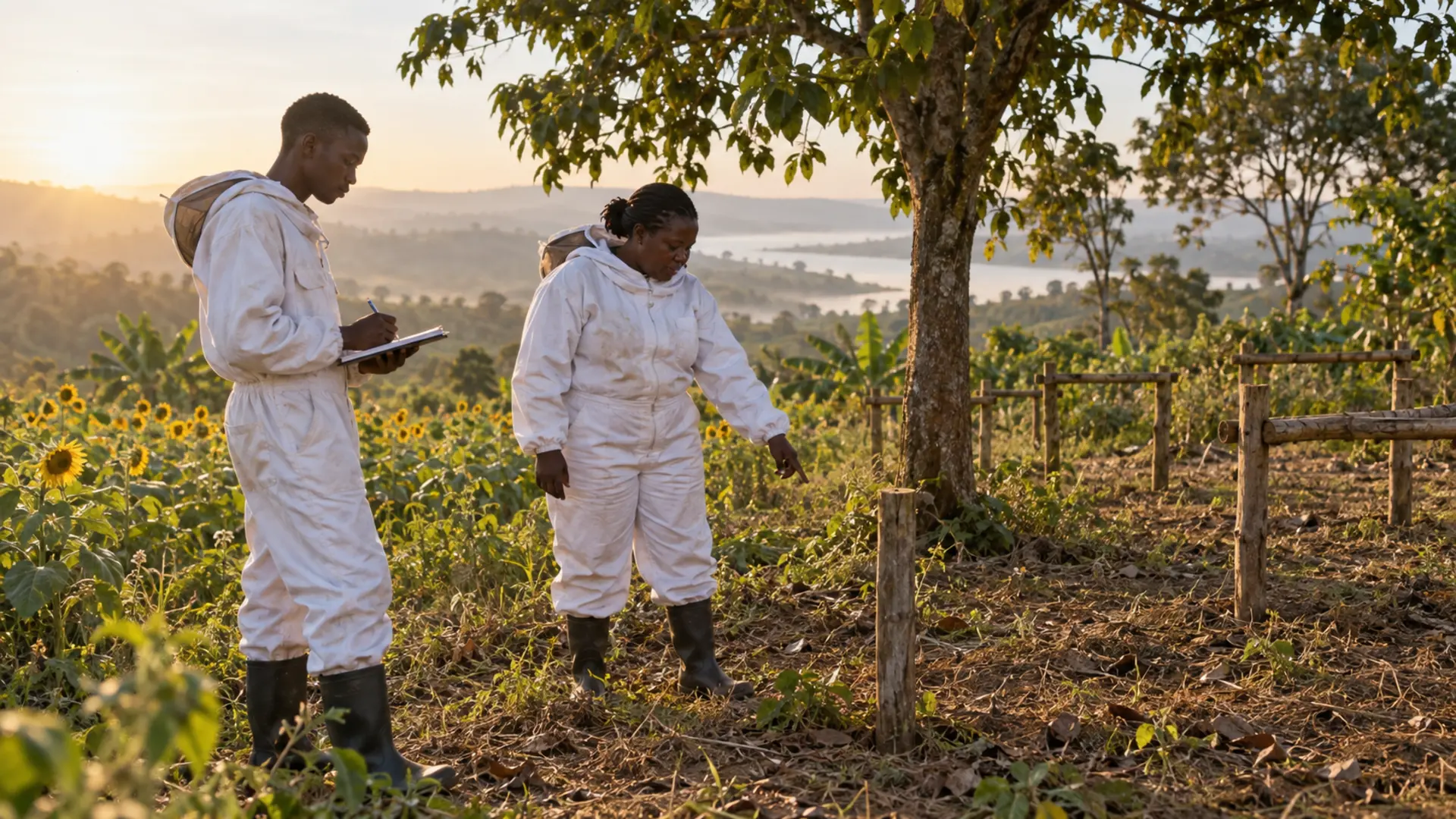
The hives arrive. They are beautiful, they smell of fresh timber, and they are put out at the edge of the shamba where there is room. Then nothing happens. Six months later they are still empty, still smelling of fresh timber, and the money is gone.
This is the most common way beekeeping fails in Uganda, and it fails for two reasons that have nothing to do with the bees. The hives were put in the wrong place, and nothing was done to attract anything into them.
What this guide helps you decide
By the end you should be able to score a site against the criteria that matter, arrange and orient the hives once you have chosen it, and choose between the three ways of getting bees: baiting and waiting, capturing a swarm, or buying an established colony.
It does not cover which hive type to buy, which is a separate decision made before this one, and it does not cover the inspection routine or forage planning.
The short answer
Put the apiary where there is forage, water and shade, away from paths, houses and livestock, on ground that does not flood, and fence it. Uganda’s code of practice for apiary management sets a minimum of 100 metres from public places.
Then bait the hives. Melt beeswax and paint the inside and the entrance, add propolis if you have it, and hang the hive high rather than at working height during the swarming season. Ugandan field trials found both of those choices make a large difference to whether a hive gets occupied at all.
Baiting is the cheapest route to your first colony. Buying is the fastest. Capture is the one that requires help.
What the Ugandan code of practice actually says
Uganda has a national standard on this, and most new beekeepers have never seen it. It is US 641:2006, the Code of Practice for Apiary Management, Handling and Processing of Bee-Products, first edition, dated 14 November 2006.
Its site requirements, quoted as it states them:
- Distance. A hive shall be sited away from the next beekeeper and an appropriate distance from people, livestock and public places, in any case a minimum of 100 metres from public places.
- Preparation. Before installation of hives, the site shall be slashed, fenced off and protected from the intrusion of animals and humans.
- Mounting. Hives shall be installed on strong poles, for example metallic poles or poles with the capability to germinate. To enable ease of inspection and harvesting, hives shall be sited at waist level from the ground.
- Arrangement. Four patterns are permitted: straight line, T pattern, zigzag pattern or cross pattern.
- Water. A source of water is required as part of site selection.
- Records. Records shall be retained for at least one year after the expiration of the durable life date, or at least two years after the food has been released to the consumer.
One honest caution. We opened and read the standard’s own text, which is strong evidence of its number, title and content. But a mirrored copy of the 2020 Uganda Standards Catalogue that we also opened did not show an entry for US 641 in the content returned to us, while it did list the honey specification US 18:2004 as compulsory. That could mean the catalogue extract we saw was incomplete, or it could mean the standard has since been withdrawn, superseded or renumbered. Before you treat the 100 metre figure as a current legal obligation rather than good practice, check with the Uganda National Bureau of Standards directly.
Note also the tension between two of the requirements above and the trial evidence below. The standard requires waist height for ease of inspection. Ugandan colonisation trials found high placement works far better for getting hives occupied. Those are not contradictory so much as answering different questions, and the section on baiting explains how beekeepers resolve it.
Choosing the site
Score any candidate site against these, which are drawn from the Ugandan code of practice, the national beekeeping training and extension manual, FAO’s guidance for Africa, and the Tanzanian national manual.
Forage. This is the first criterion in every source. The national extension manual limits an apiary to around 20 hives depending on available forage. FAO’s guidance for Africa suggests around 10 hives per square kilometre.
Water. Required by the Ugandan standard. FAO recommends siting near a natural source, a river, lake, pond or even a dripping tap. If there is none, provide one, and make sure the bees can land without drowning.
Distance from people and paths. The Ugandan standard’s 100 metre minimum from public places. The extension manual adds dwellings, roads, noise and children’s play areas. FAO recommends keeping hives 100 to 200 metres away from crops and from people specifically because of the defensiveness of African honey bees, and away from playgrounds and noisy industrial areas.
Distance from livestock. Required in general terms by the Ugandan standard and by the Tanzanian manual, which lists livestock disturbance among the things a site must be free of.
Flooding, fire and pesticides. The Tanzanian manual is the clearest on these: sites must be free of floods, disease, pests, areas of pesticide use and wildfire risk.
Shade and wind. The Ugandan standard requires shade and air circulation without excessive wind. FAO recommends the leeward side of a hill.
Screening. The extension manual recommends a high hedge or fence around the apiary to separate the bees from people and animals. This is worth more than distance alone, because a barrier forces the bees to fly up and over, and they then stay high across the ground beyond it.
Access. You will carry hives, honey and equipment in and out, sometimes at dusk in a bee suit.
Arranging and orienting the hives
Do not put them in a long straight row. The national extension manual is explicit: avoid long straight rows of hives to reduce drifting and disease transmission. Drifting is bees returning to the wrong hive, which spreads pests and disease and unbalances colony strength. The Ugandan standard permits the zigzag and cross patterns for the same reason.
Vary what each hive looks like from the air. Different spacing, different angles, a landmark such as a bush or a rock beside some and not others. Bees navigate by landmark.
Face entrances away from paths. So the flight line does not cross where people walk.
Mounting. The Ugandan standard specifies strong poles, giving metallic poles or living poles that will take root as examples. The extension manual describes hanging on greased wire or standing on oil can stands at waist height. Both approaches are about the same thing: keeping ants, termites and honey badgers out.
No source we could open specified a distance in metres between hives. The guidance is consistently about pattern and forage rather than a fixed spacing figure, and we will not supply a number nobody published.
The three routes to a colony
Route one: bait and wait
This is how most Ugandan beekeepers get their first bees, and there is real Ugandan trial evidence on how to do it well.
A trial across six sites in Moyo, Koboko and Yumbe used 216 hives, half log hives and half Kenya top bar hives, and measured what got colonised. Read the figures carefully, because they are easy to misquote.
- Of the hives that were colonised, 60.2 per cent had been placed high, above five metres, and 39.8 per cent at waist height.
- Of the hives that were colonised, 65.7 per cent had been baited with propolis, 28 per cent with wax, and only 5.3 per cent were unbaited.
- Colonisation rate at twelve months was 83.4 per cent at managed sites against 47.0 per cent at unmanaged sites.
A separate trial in the Lake Albert Crescent zone used 48 hives across three hive types with beeswax, cow dung and ripe banana as baits against an unbaited control. Beeswax accounted for 62.5 per cent of colonised hives. Of the unbaited control hives, 91.7 per cent were never colonised at all. Kenya top bar hives colonised best at 53.1 per cent, and colonisation in July and August, at 43.8 per cent, was well above January and February at 27.1 per cent.
Two conclusions follow. First, baiting is not optional. An unbaited hive in these trials was overwhelmingly likely to stay empty. Second, height matters, and it conflicts with the waist-height mounting the standard recommends for ease of working. The usual resolution is to bait high and work low: hang bait hives high in trees during the swarming period, and once a colony has moved in, transfer it down to a hive on a stand in the apiary at night.
How to bait. Guidance from a Kenyan apiculture platform describes the method: melt beeswax, optionally mixed with propolis, and paint it on the interior and the entrance. Uganda’s extension manual lists beeswax, propolis and lemongrass as baits and recommends placing hives along swarming flight routes.
On lemongrass and plant baits, there is now regional experimental evidence. A 2024 Kenyan study tested volatiles from three plants against a beeswax-only control and found that Ocimum kilimandscharicum combined with beeswax attracted two and a half times more swarms than the control, attributed to geraniol and citral mimicking the bees’ own Nasonov pheromone. A third plant tested showed no improvement over the control. That is Kenyan, not Ugandan, and it is one study, but it is the strongest evidence we found on plant baits.
Timing. The Kenyan guidance is that hives should be baited just before the high fly time and placed directly in the forest at the very beginning of it. The Ugandan Lake Albert trial found a strong seasonal difference. Neither gives a national calendar, because swarming follows local flowering and rainfall. Ask beekeepers within a few kilometres of you when swarms move. They will know.
Route two: capture a swarm
A swarm that has settled on a branch can be shaken or brushed into a container and transferred into a hive. This is a skill, it involves a large number of defensive bees at close range, and it is not a first solo task.
Go with someone who has done it. Wear full protective clothing. Do the transfer at dusk when flight has stopped. The safety guidance in Uganda’s responsible business guide for the honey sector is specific about the related risk of tree work: climbing to check, install or remove hives placed in trees should be undertaken by experienced beekeepers and not by children.
Route three: buy a colony
The fastest route, and the one where we have the least to tell you. We searched for Ugandan or East African institutional guidance on what to check when buying an established colony, what disease risks to screen for, how likely a bought colony is to abscond, and what colonies cost. We found none we could verify.
That is a real gap and we will not fill it with generic advice dressed as local guidance. What we can say is that the general principles of the published guide to whole-farm biosecurity apply: anything brought onto your land can bring something with it. Ask the seller to open the colony in front of you, ask where it came from, and ask your district production office or a local beekeeping group what they advise before you pay.
We similarly could not verify any Ugandan or African guidance on transporting a hive: whether to move at night, whether to seal the entrance, or how far a hive can be moved without disorienting the bees. Generic rules circulate widely. None of them is sourced to work on African honey bees, and we are not going to repeat them as though they were.
Absconding, which is the next problem after occupation
Getting bees in is one thing. Keeping them is another, and African honey bees leave far more readily than European ones.
A study of African honey bees in the Okavango documented migration tied to declining foraging conditions rather than directly to weather, occurring as floral abundance declined, and concluded that migration is unique to tropical honey bee races. African races have no winter dormancy and forage year round, but they face unpredictable rain-driven forage, and moving is a normal response to it rather than a failure.
A review of Ugandan beekeeping lists the local drivers: inadequate forage, deforestation, pests and disease, predators, leaking hives and human disturbance. Four of those six are things you control at the siting stage. A hive that leaks, sits in the sun, is opened too often or has nothing to forage on within range is a hive that will be empty again.
What it costs
No prices. We could not verify a Ugandan colony price or hive price from any institutional source, and we will not estimate one. The cost categories are:
- Site clearing, fencing or hedging, required by the national code of practice
- Hive stands, poles or hanging wire, plus grease or oil cans for ant control
- Beeswax and propolis for baiting, which you may be able to obtain from another beekeeper
- Protective clothing, which is not optional with African bees
- A smoker and hive tool
- Water point construction if there is no natural source
- Labour for the transfer of colonies from bait sites down to the apiary
- Transport, if the bait sites are away from the homestead
- Purchase cost, for the buying route only
Common mistakes
Putting out unbaited hives and waiting. In the Lake Albert trial, 91.7 per cent of unbaited control hives were never colonised.
Hanging bait hives at working height. Convenient for you, and the Ugandan trial evidence says it costs you occupancy.
Baiting out of season. A baited hive in the wrong month is an unbaited hive.
Long straight rows. Causes drifting, which spreads disease and unbalances colonies.
Siting near a footpath or a school. The 100 metre rule exists because African bees defend vigorously, and a bee incident near people is a serious matter for you as well as for them.
No water. The bees will find water, and where they find it may be a neighbour’s washing or a livestock trough, which creates conflict.
Opening the hive to check whether bees have arrived. You can see whether bees are flying at the entrance from ten metres away. Opening a new colony disturbs it, and disturbance is a documented absconding trigger.
Treating occupancy as success. Occupation is the start. Retention is the achievement.
Warning signs and escalation points
- A colony that arrives and leaves within weeks, which usually points to forage, heat, a leaking hive or disturbance
- Ants, wax moth or beetles visible at the entrance or on the stand
- A colony that becomes noticeably more defensive than others in the same apiary
- Any sting incident involving a person outside your household, which is a matter to report to your local authority as well as to fix
- Evidence of honey badger or other predator interference with stands
- Repeated failure to colonise across a whole season despite correct baiting, which usually means the site is wrong rather than the method
Contact your district production office or a local beekeeping group early rather than late. Uganda’s national apiculture body works under the supervision of the Ministry of Agriculture, Animal Industry and Fisheries on technology dissemination and product quality, and local groups usually know the swarming calendar and the sources of colonies in your area better than any document.
Where this works, and where it does not
It works where there is genuine forage within a few kilometres, where you have land you control at the required distance from people and paths, and where you can visit the apiary regularly without disturbing it.
It does not work close to a homestead on a small plot with a public path running past, where the 100 metre requirement cannot be met. It does not work in an area under heavy pesticide use, which the Tanzanian manual lists as a disqualifying site condition and which will cost you colonies regardless of your siting. And it does not work as a passive investment: the Ugandan trial’s difference between managed and unmanaged sites, 83.4 per cent against 47.0 per cent colonisation, is the difference between beekeeping and hive ownership.
One evidence caution worth stating. The best-known research on what cavity size and entrance size bees prefer was done on European honey bee subspecies in North America, which found a preference for cavities around 40 litres and small entrances of about 12.5 square centimetres over larger ones, and for entrances high rather than low. Those findings are consistent with the Ugandan height results, but they are not African honey bee findings. We could not locate accessible peer-reviewed work quantifying cavity volume or entrance size preference for the African honey bee specifically, and that is a genuine gap in the published literature rather than a gap in our searching.
A low-risk first step
Bait two hives, not ten, and hang them high in trees at the edge of good forage, timed to the local swarming period.
Melt beeswax, paint the inside and the entrance, add propolis if you can get it from another beekeeper, close them up and walk away. Check from a distance once a week and note the date on the day you first see bees flying in and out.
Two hives will tell you whether your area produces swarms, whether your timing was right, and whether the site works, for the price of a little wax and two trips up a tree. Ten hives will tell you exactly the same thing and cost five times as much.
What to do next
- Ask two established beekeepers within a few kilometres when swarming happens where you are, and write the months down.
- Walk your candidate sites and score them for forage, water, shade, flooding, pesticide use and distance from people, paths and livestock.
- Confirm with the Uganda National Bureau of Standards whether US 641:2006 is current, before relying on the 100 metre figure as an obligation.
- Clear, fence or hedge the chosen site before any hive goes on it, as the code of practice requires.
- Provide a shallow water point with landing stones if there is no natural source.
- Bait two hives with beeswax and propolis and hang them high, timed to the swarming period.
- Arrange the apiary in a zigzag or cross pattern rather than a row, with entrances facing away from paths.
- Plan the transfer down to stands at night, and arrange for an experienced beekeeper to be there the first time.
Related reading: choosing a hive system covers the decision that comes before this one, and the hive inspection routine and planning bee forage through the year cover what comes after. The published guide to agroforestry for soil and water conservation is relevant to anyone thinking about forage on their own land.
About the author
This guide was researched and written by the Falcon Foundation Ltd Editorial Team. Falcon Foundation Ltd is a privately owned Ugandan agricultural company producing greenhouse crops, livestock and honey. Our Knowledge Hub is written for Ugandan farmers making practical decisions with incomplete information. Where guidance circulates widely but is not sourced to work on African honey bees, we say so rather than repeating it.
