The hive you choose is not a container. It decides what kind of beekeeper you can be for the next ten years: whether you can open a colony and look at it, what happens to the comb when you harvest, who can repair the hive when it breaks, and how much of your money is tied up before a single bee arrives.
Most Ugandan beekeepers do not choose. They receive whatever a project distributed, or they buy the cheapest thing available. Both routes produce beekeepers who own hives they cannot work.
What this guide helps you decide
This guide helps you answer one question: which hive system should I build or buy?
It compares the three systems on the things that actually differ between them, using Ugandan field trial evidence, Uganda's own code of practice for apiary management, and African beekeeping guidance from FAO and Bees for Development.
It does not cover where to put the apiary or how to get bees into the hive, which is the next guide, and it does not cover inspection technique or harvesting method.
The three systems, and what really separates them
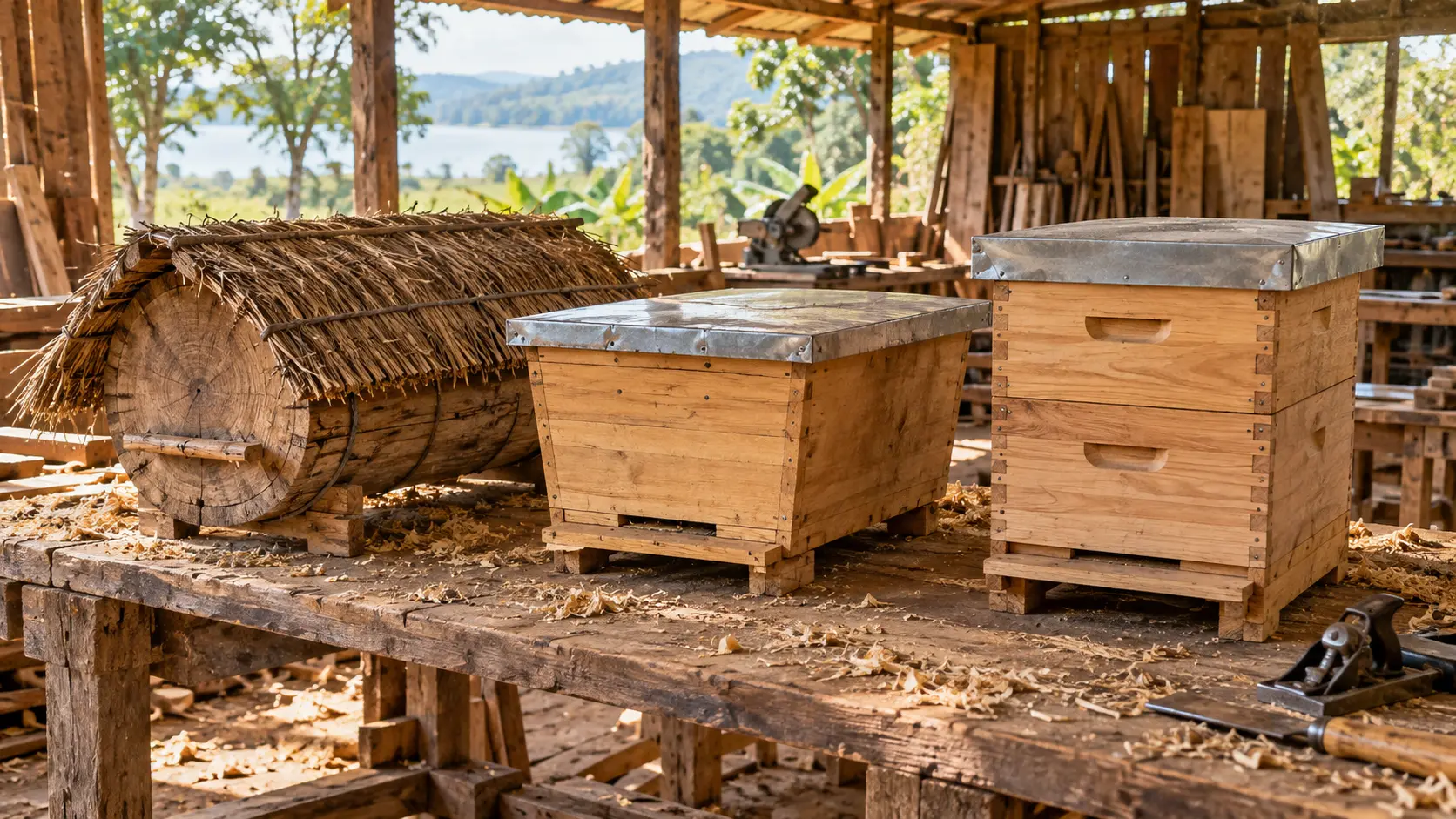
Uganda's code of practice for apiary management recognises three hive categories: traditional fixed-comb hives such as logs and woven hives, top-bar movable-comb hives such as the Kenya top bar, and frame movable-comb hives such as the Langstroth and Dadant [1].
The real difference between them is what the bees attach the comb to.
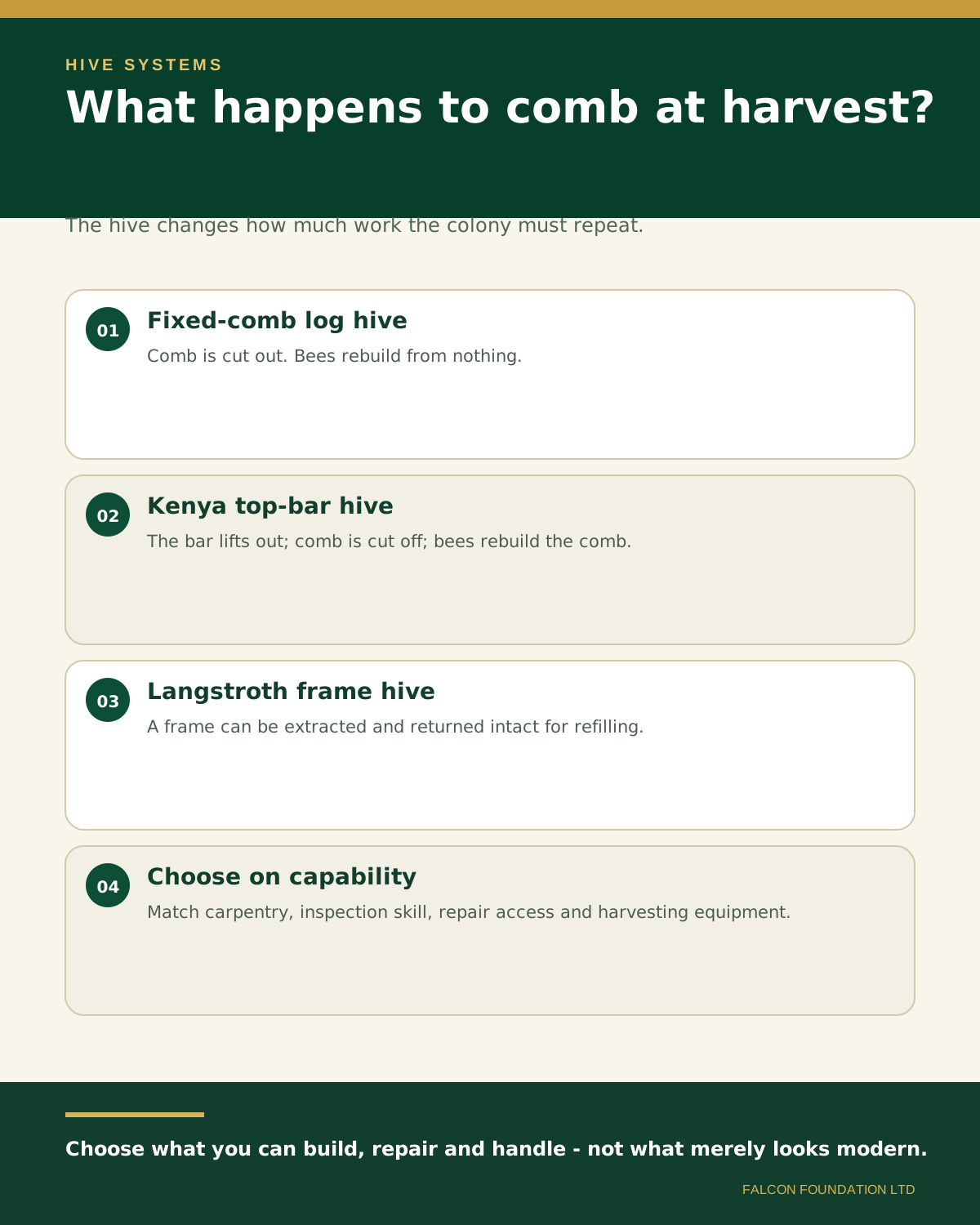
In a fixed comb hive, the bees build comb directly onto the inside of the hive. You cannot lift a comb out to look at it. At harvest the comb is cut out, and the colony rebuilds from nothing.
In a top bar hive, the bees build one comb hanging from each removable bar. You can lift a bar and inspect that comb. At harvest the comb is cut off the bar, so the colony rebuilds the comb but not the whole nest.
In a frame hive, the comb is built inside a four-sided frame that can be spun in a centrifugal extractor and returned to the hive intact. Bees for Development makes the point directly: with frame hives the combs remain intact and are returned to the hives after extraction, but the system requires complicated extracting equipment [2].
That single mechanical difference drives everything else: cost, skill, harvest labour, wax yield and how fast a colony recovers.
What the Ugandan evidence says about colonisation
An empty hive earns nothing. A field study in the north-western agro-ecological zone of Uganda, published in Livestock Research for Rural Development, tested what actually gets hives occupied [3].
Of the hives that were colonised, up to 51.1 per cent were Kenya top bar hives compared with 48.3 per cent local log hives. Langstroth hives were not included in that trial [3].
The far larger effects were not about hive type at all:
- Bait mattered enormously. Propolis-baited hives were colonised at 65.7 per cent, wax-baited at 28 per cent, hives baited with local materials such as cassava or cow dung at 1 per cent, and unbaited controls at 5.3 per cent [3].
- Height mattered. Hives hung above five metres on tree branches were colonised at 60.2 per cent against 39.8 per cent for hives hung at waist height [3].
- Management mattered most of all. In managed apiaries, 73.7 per cent of colonies reached "strong" status, against 6.1 per cent in unmanaged apiaries [3].
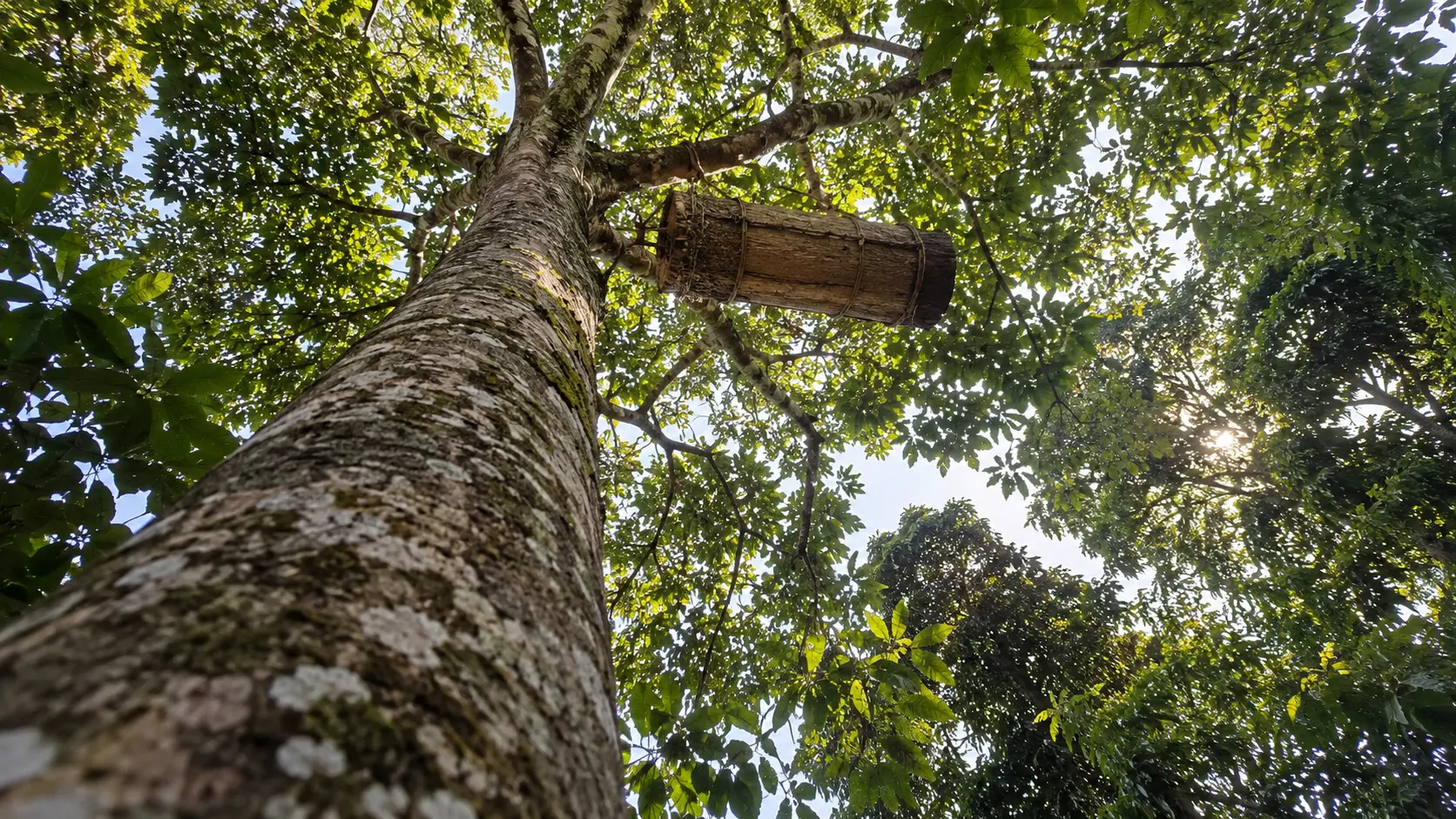
If you take one thing from this guide, take that last figure. The difference between a managed and an unmanaged apiary dwarfs the difference between hive types. Buying a better hive and then not visiting it is the most expensive way to fail.
What each system demands
Carpentry and cost
FAO's guidance on beekeeping in Africa is direct about the trade-off. A frame hive with two supers costs about three times as much as a Kenyan top bar hive with 27 bars. A top bar hive can be made by any semi-skilled carpenter, whereas frame hives demand precise dimensions and high carpentry skill, and FAO cites a Ghanaian example where imprecisely built frame hives simply failed [4].
FAO goes further, judging that most African countries were not yet in a position to adopt frame hives, and describing the top bar hive as a workable compromise even though it is less efficient [4].
That assessment was published in 1990 and conditions have changed in places. It remains the clearest statement of the underlying problem: a frame hive that is built a few millimetres out of specification does not work, and the bees will tell you so by gluing everything together.
Fixed comb hives can be made from cheap local materials including hollow logs, woven grass, bark and clay. Bees for Development reports that 90 per cent of honey produced in Africa comes from fixed comb hives and describes them as a proven technology [2].
Uganda's own code of practice
Uganda's code of practice for apiary management, handling and processing of bee products names recommended timbers for modern hives, including Musizi, Mukuzanyanya, Ngaku and Cedar [1]. If you are commissioning a carpenter, specify the timber.
The same code sets out harvesting and processing practice that applies whichever hive you choose. Harvest only sealed or capped combs. Use minimum smoke before opening hives. Leave about one centimetre of comb on the top bar to guide the bees to work the next honey crop. Strain honey through 500 micron or 200 micron cloth mesh, and store the finished product in airtight containers [1].
That document was published in 2006. We confirmed it was listed in Uganda's national standards catalogue as at 2015, as a voluntary standard [5]. We could not confirm from the standards body's current website whether it remains listed today, so verify its current status with the Uganda National Bureau of Standards before relying on it for any commercial or export purpose.
Inspection
Bees for Development states that any management technique that can be done with a frame hive can also be done with a top bar hive [2]. That is an important corrective to the assumption that only frame hives allow proper beekeeping. The top bar hive gives you the ability to inspect, which the log hive does not, at a fraction of the cost and skill of a frame hive.
The comparison
| Factor | Fixed comb log | Kenya top bar | Langstroth frame |
|---|---|---|---|
| Materials | Local, cheap | Timber, moderate | Timber, precise |
| Carpentry skill | Low | Semi-skilled | High |
| Relative cost | Lowest | Middle | About three times a top bar |
| Can you inspect | No | Yes | Yes |
| Comb at harvest | Cut out entirely | Cut off the bar | Returned intact |
| Extractor needed | No | No | Yes |
| Repairable locally | Yes | Yes | Only with skill |
Cost comparison is drawn from FAO's relative statement, not from Ugandan retail prices [4]. See the section below on figures we will not publish.
Honey yields, and why we are careful with them
FAO's Africa guidance states that a strong colony in a frame hive can yield over 200 kilogrammes of honey a year with multiple crops, and that top bar hives can still yield 50 to 120 kilogrammes a year with good management [4]. Those figures come from a document published in 1990 covering Africa broadly. They describe what is possible under good management, not what a Ugandan beekeeper should expect.
A Ugandan household survey published in 2019 reported a mean baseline holding among surveyed beekeepers of 14 log hives, 7 top bar hives and 4 Langstroth hives [6]. That same study modelled, using a ten-year Monte Carlo cost-benefit approach, that adding 20 hives would raise revenue by roughly ten times with log hives, sixteen times with top bar hives and eighteen times with Langstroth hives [6].
Those multipliers are modelled projections over ten years, not observed outcomes, and the authors themselves note that field validation is still needed. Treat them as an indication that hive type affects returns in the expected direction, not as a promise.
The only Ugandan prices and per-hive yields we could locate came from a Daily Monitor farming column [7]. A general-interest newspaper column is not an institutional source. We have not reproduced its figures here as a basis for planning. Obtain quotations from local hive makers and from the national apiculture body instead.
Which one should you actually choose?
Choose a fixed comb hive if capital is your binding constraint, you have local materials and no carpenter, and you are content to harvest by cutting comb. It works, it is proven at scale across Africa [2], and a fixed comb hive that is visited regularly beats a Langstroth that is not.
Choose a Kenya top bar hive if you want to inspect your colonies, you have access to a semi-skilled carpenter, and you can afford a moderate outlay. For most Ugandan beekeepers moving from traditional to managed beekeeping, this is the sensible step, and it is what FAO describes as the satisfactory compromise [4].
Choose a Langstroth only if you have, or can reliably access, an extractor, a skilled carpenter who can build to specification, and the capital for roughly three times the cost of a top bar hive [4]. Without the extractor, the main advantage of the frame hive disappears.
What beginners actually struggle with
A household survey covering 166 households in Arua, Soroti and Kitgum districts asked non-beekeepers why they had not started. Sixty-two per cent cited limited beekeeping knowledge, 59 per cent cited fear of defensive bees, 31 per cent cited insufficient capital and 24 per cent cited limited land [8]. The same survey found beekeeping contributed about 7 per cent of annual household income among the beekeepers surveyed [8].
Two of the top three barriers are knowledge and fear, not money. Both are addressed by training rather than by equipment, which is another reason not to spend your whole budget on hives.
The Uganda National Apiculture Development Organisation describes itself as the apex body recognised by the public and the government of Uganda to coordinate the apiculture sector, and publishes training videos, training manuals, annual reports and honey market reports [9]. That is a reasonable first stop before you buy anything.
Limitations and where to get help
This guide compares hive systems. It does not teach you to keep bees, and reading it is not preparation for opening a colony. African honey bees are defensive and absconding is common, which changes how colonies must be handled. Get practical training before you buy hives, and read our guides on siting an apiary and getting your first colonies and working African honey bees before you begin.
If you intend to sell honey commercially, verify the current status of Uganda's apiary and bee products standard with the Uganda National Bureau of Standards directly. Our guide to harvesting honey and honey quality covers the quality parameters that buyers test.
What to do next
- Decide first whether you will visit the apiary regularly. If not, stop here [3].
- Get training before you get hives. Contact the national apiculture body [9].
- Choose your hive type from the comparison table, based on your carpenter, your capital and whether you can access an extractor.
- If commissioning hives, specify the timber and the internal dimensions in writing [1].
- Budget for bait, protective clothing and a smoker, not only for hives.
- Plan to bait your hives with propolis and to place them high, because those decisions affect occupancy more than hive type does [3].
Read next: siting an apiary and getting your first colonies, and choosing a farm enterprise if you are still deciding whether beekeeping fits your holding.