
A Ugandan beekeeper who goes looking for information about hive pests will mostly find information about somebody else’s bees.
The global beekeeping literature is dominated by a colony-loss crisis in Europe and North America, in which the Varroa mite is the central character. That literature is extensive, well-funded and scientifically serious. It is also about managed European honey bee populations in temperate climates, with a management history and a genetic background that Ugandan colonies do not share.
Uganda’s bees are African honey bees. They absorb pressures differently, abscond rather than dwindle, and face a set of threats in which the most destructive entries are frequently not the ones the international literature is concerned with.
This guide sets out what the evidence actually supports for Ugandan conditions, pest by pest, and what physical protection works. It names no miticide, no chemical treatment and no product, because chemical treatment of colonies is outside its scope and because the controls that matter most here are structural.
The framing problem
Before the individual pests, one general point that determines how to read everything else.
In a temperate managed apiary, a colony under pressure typically dwindles. It loses population, becomes unable to maintain brood, and eventually fails in place, leaving a hive with dead bees in it. That failure mode is measurable, and it is what colony-loss surveys count.
An African honey bee colony under pressure frequently absconds. The colony leaves. It does not dwindle, it does not die in place, and it does not appear in a colony-loss count as a dead colony. It appears as an empty hive.
This matters enormously for interpretation. An empty hive in Uganda is not evidence of what killed the colony, because the colony may not have died at all. Absconding is a response to a wide range of pressures - pest pressure, disturbance, heat, smoke, lack of forage, water shortage, predation - and the empty hive looks the same in every case.
So the first discipline in Ugandan apiary pest work is to stop treating absconding as a diagnosis. It is a symptom with many causes, and the beekeeper’s job is to narrow them by what was observed before the colony left, not by what is in the box afterwards.
What the Ugandan record actually shows
Before going pest by pest, there is a Ugandan evidence base worth knowing about, because it reorders the priorities that the international literature would give you.
A national study of honeybee pests in Uganda, drawing on data collected from 2009 to 2012 across four of the country’s ten agro-ecological zones, documented eleven honeybee pests and predators affecting beekeeping production. Its finding on which of them matter is direct: the important pests causing economic losses were black ants, small hive beetles, wax moths and bee hornets.
Read that list against the international literature and the difference is obvious. Varroa is not in it. Ants are at the front of it.
The same work found that losses varied sharply by hive type, with honey production in traditional hives most affected by pests, top bar hives next, and frame hives least affected. That is worth weighing when you choose equipment, and the trade-offs between the three are set out in choosing a hive type. And it recorded what Ugandan beekeepers actually do about it: keeping the apiary tidy, not throwing combs around apiaries, frequent smoking to drive out small hive beetles, applying ash against ants, suspending hives with wires, and standing hives in used engine oil. At least 28 per cent of beekeepers in the study had developed their own bee-safe methods of pest control.
That is a Ugandan evidence base, it is peer-reviewed, and it points at physical and hygiene controls rather than chemical ones. The rest of this guide is largely an elaboration of it.
Varroa: what the Ugandan evidence actually says
Varroa destructor is present in Uganda. That is established.
The most directly relevant published work sampled apiaries in Uganda’s eastern and western highland zones between December 2014 and September 2015, at two sampling moments. It found mean apiary-level prevalence of forty per cent and fifty-three per cent at the first sampling, rising to fifty-nine and fifty-one per cent at the second. So the mite is widely distributed, and in those zones a substantial proportion of apiaries carried it.
Three further findings from that work matter more than the prevalence figures.
Colony productivity and strength were not correlated to mite infestation levels. That is the study’s own finding, stated directly. In the colonies sampled, the amount of Varroa present did not predict how the colony was performing.
Feral colonies were infested at levels not significantly different from managed colonies. Unmanaged colonies living without any intervention carried comparable mite loads.
All mite DNA sequenced was one hundred per cent identical to the Korean haplotype. This identifies which mite lineage is present, which matters for comparing Ugandan findings against work done elsewhere.
Pests and Predators of Ugandan Colonies: What Is Actually a Threat and What Is Not
A two-sided evidence panel setting the published Ugandan Varroa findings against the European and North American colony-loss narrative, with a central warning against transferring conclusions between them.
Set that beside the northern narrative. That narrative is real and it is seriously argued: a widely cited review of Varroa and honey bee health reports Canadian monitoring concluding that the Varroa mite was the main culprit causing reduced populations and death of overwintered colonies, and describes the mite as still decimating honey bee populations throughout the world, with losses reaching 50 to 100 per cent in many beekeeping operations in some United States winters.
Those are not small claims, and the two pictures do not align.
What should a Ugandan beekeeper conclude from this?
Not that Varroa is harmless. A single study in two highland zones across ten months is not a national assessment, and absence of a correlation in that sample is not proof of absence of harm everywhere in Uganda.
But equally, and more importantly: no Ugandan colony-loss rate can be inferred from European or North American data. If somebody tells you that Ugandan colonies are dying at the rates reported in northern surveys, or that Varroa is the cause of losses in your apiary, ask what Ugandan evidence supports that. There is a commercial incentive to import the northern narrative into East African markets along with the products that treat it.
The honest position is: the mite is present and widely distributed; the one substantial Ugandan study did not find it associated with reduced colony productivity or strength; Ugandan colony-loss data sufficient to quantify its impact does not exist; and treating an African colony with a product designed for a different problem in a different bee population is a decision that needs a veterinary or apicultural professional and a reason, not a marketing claim.
This guide gives no miticide, no treatment threshold and no treatment protocol.
Small hive beetle
The small hive beetle is native to sub-Saharan Africa. That single fact reframes the entire discussion, because the beetle is a devastating invasive pest in the Americas and Australia and a generally tolerable resident pest in its home range.
In its native range, strong colonies manage the beetle. Workers socially encapsulate or corral adult beetles, confining them and preventing them from laying in the comb, and the review literature reports this behaviour as more frequent in African bees and African bees as more aggressive towards the beetle. State that precisely rather than absolutely: European bees corral too, just less effectively. The beetle is present in many colonies and causes little damage while the colony is strong.
The same review is clear about where damage comes from: successful beetle reproduction appears most successful in weak and stressed honeybee colonies and is far less common in strong ones.
The damage happens when the colony is not strong. Beetle larvae tunnel through comb, feed on brood, pollen and honey, and produce a fermented slime that ruins the stored product and frequently triggers absconding. A weak, queenless, recently disturbed or over-supered colony is where that occurs, and a colony that cannot patrol all of its comb is a colony that gives the beetle an opening.
The same applies to harvested combs. Comb removed from the colony has no defenders at all, and beetle larvae will destroy stored honeycomb rapidly. Much of what beekeepers experience as beetle damage happens in the store rather than in the hive.
The controls are consequently about colony strength and storage rather than about killing beetles:
- Keep colonies strong and do not give a colony more comb space than it can occupy and patrol.
- Do not leave a colony queenless longer than necessary.
- Process harvested combs promptly rather than storing them.
- Keep the apiary floor clear of dropped comb, wax scraps and spilt honey, which support beetle populations between colonies.
- Keep the processing area clean and closed.
Wax moth
Wax moth is the pest most often blamed and least often the cause.
Wax moth larvae tunnel through comb, destroying it completely and leaving the characteristic webbing and frass. The damage is spectacular and unmistakable, and beekeepers seeing it naturally conclude the moth destroyed the colony.
In almost all cases the sequence runs the other way. Wax moth is a scavenger of undefended comb. A strong colony removes wax moth eggs and larvae continuously and is not troubled by them. Comb becomes vulnerable when the colony becomes too weak to patrol it, or when the colony has already absconded, or when the comb has been removed from the colony and stored.
So wax moth damage is a finding about what happened after the colony weakened, not usually an explanation of why it weakened. A beekeeper who responds to wax moth by focusing on the moth is treating the consequence.
Two practical implications. First, stored comb needs protecting, because it is defenceless. Second, when you find a destroyed colony full of wax moth, the investigation question is what weakened the colony first.
Ants
Ants are, for a great many Ugandan beekeepers, the single most destructive pest in the apiary, and they receive a fraction of the attention that Varroa does.
Ants raid hives for honey, brood and dead bees. Severe or sustained raiding weakens colonies and is a common cause of absconding. Some ant species will occupy a hive outright.
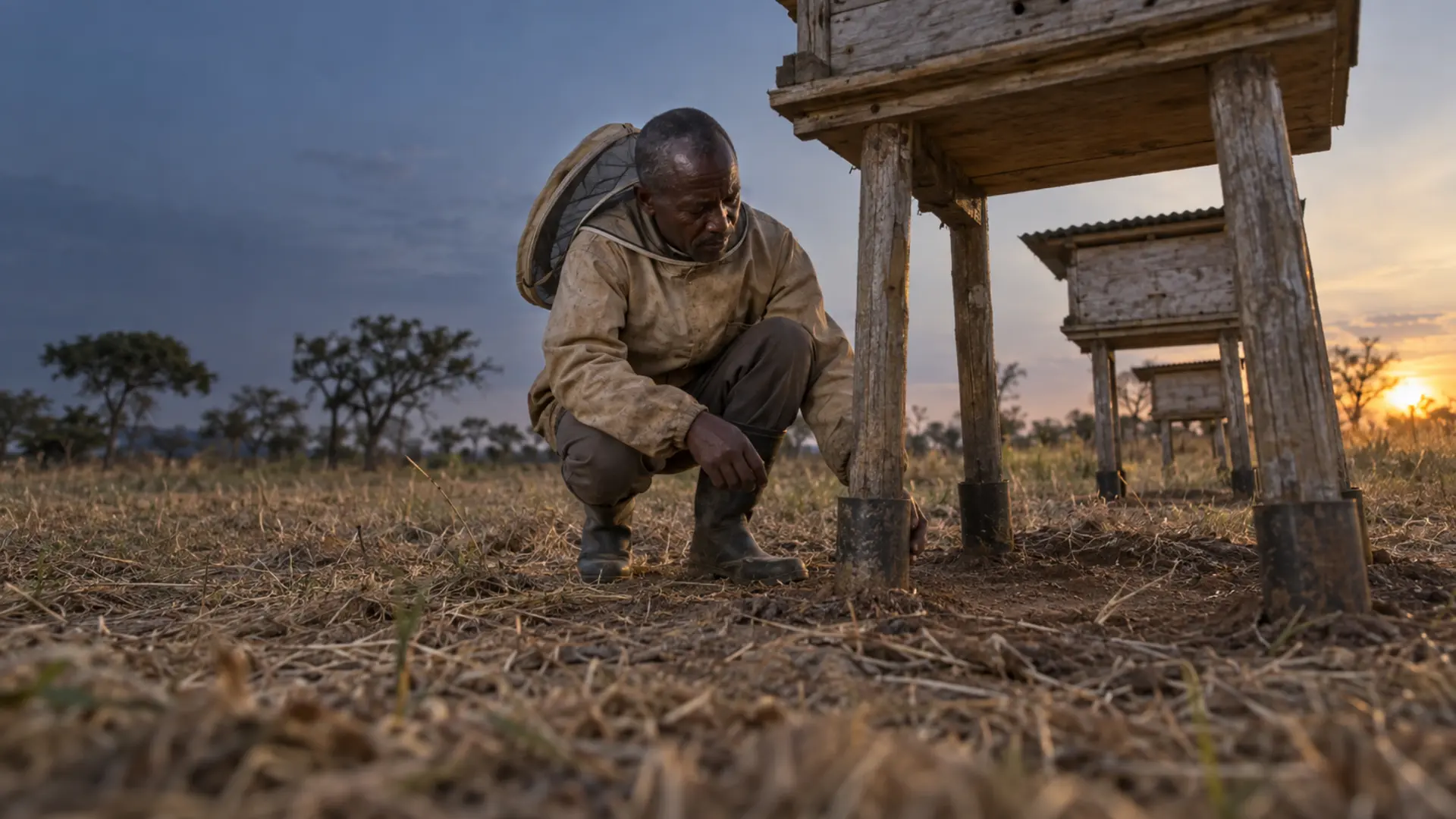
This is the pest the hive stand exists to control, and physical exclusion works.
Pests and Predators of Ugandan Colonies: What Is Actually a Threat and What Is Not
An annotated hive stand design showing raised legs, oil or grease barriers at each leg, a cleared ground ring, spacing from vegetation and an anchoring detail against vertebrate predators.
The principles:
Raise the hive on a stand with distinct legs. A hive sitting on the ground, on a log, or on a broad base offers a continuous path for crawling insects. A stand with four separate legs creates four interruptible paths. The Africa-focused guidance gives a figure: where hive stands are used they should be at least one metre above ground level.
Interrupt each leg. The standard control is a barrier of grease or a similar sticky material applied to the stand legs so ants cannot climb them. The same guidance notes waste engine oil or grease as suitable, a mixture of rubber latex and waste oil in some places, and the alternative of standing each leg in a cup of oil or even water. Ugandan beekeepers in the national study were recorded doing exactly this, standing hives in used engine oil.
Whatever arrangement is used, it must be maintained: barriers dry out, fill with debris, get bridged by a fallen leaf, and stop working silently.
Do not allow any barrier substance to contact the hive body or the bees. Oil, grease and similar materials are for the stand legs, not for the hive. This precaution is ours rather than the source’s: the published guidance describes the barrier without stating the caution, and we are flagging that rather than implying it is quoted.
Clear the ground around the stand. A ring of bare, cleared ground around each stand removes the cover that ant columns move under and makes it visible when a route has been established. The radius is a local judgement, not a prescribed figure.
Keep vegetation from touching the hive. The guidance is explicit about the mechanism: keeping vegetation clear from around and under the hive prevents it building up and providing a bridge for the ants to gain access into the hive. Grass, branches and creepers that touch the hive or the stand bypass every leg barrier you have built, and this is the most common reason a well-built stand stops working.
Do not leave spilt honey, dropped comb or dead bees around the apiary. These build ant populations right beside the colonies.
The Africa-focused guidance treats ant exclusion and site clearance as the core of apiary siting rather than as an afterthought, and the Ugandan study’s ranking of black ants as a leading cause of economic loss says that emphasis is right for Uganda.
Bee hornets
The Ugandan national study places bee hornets among the four pests causing economic losses, alongside black ants, small hive beetles and wax moths. They belong in any Ugandan threat list for that reason alone, and they are routinely absent from guidance written elsewhere.
We are going to be careful about what we say beyond that. The Ugandan study establishes that hornets are among the economically damaging pests recorded across four agro-ecological zones. It does not give a species, a seasonal pattern, a damage mechanism or a control trial, and we did not find a separate Ugandan source that does. So this is the honest extent of it: hornets are a documented Ugandan economic pest, they take bees at and around the hive entrance, and a beekeeper seeing sustained hornet activity at their entrances is seeing something the Ugandan evidence says matters.
What we are not going to do is import a control regime from the extensive Asian and European hornet literature, which concerns different species under different pressures, and present it as Ugandan practice. If hornets are taking your colonies, that is a question for an apiculture officer and a reason to record what you are seeing, including the time of year and the level of activity, because that record is the kind of observation the Ugandan evidence base is short of.
Honey badger and larger vertebrate predators
The honey badger is a serious and specific threat in many parts of Uganda. It is strong, persistent, nocturnal, and capable of destroying a hive outright to reach brood and honey. A colony does not survive a determined honey badger visit.
The controls are structural:
Height. The Africa-focused guidance names this as the best approach: raise the bees high enough off the ground to avoid the attention of the badger. It also records the traditional practice directly, noting that in many areas of Africa where the animal is common, beekeepers place hives high up in trees.
Robust stands, at height. Where hive stands are used, the same guidance states they must be strongly constructed and situated at least one metre off the ground. A light stand is an easier target than a heavy one.
Suspension. One documented approach is to suspend the hive on wire so that it swings or tips when the badger attempts to open it. The Ugandan national pest study also records hive suspension with wires among the control methods beekeepers use.
Site selection. An apiary sited where badger activity is known to be high will be visited. Local knowledge about where the animal is active is worth more than any design feature.
Other vertebrates matter regionally. Birds take flying bees, and while this is visually alarming it is rarely a colony-level threat to a strong colony. Lizards and geckos take bees at hive entrances and are similarly a nuisance more than a threat. Larger animals, including livestock, damage hives and stands by knocking into them, which is an argument for fencing the apiary rather than for anything more elaborate.
A note on proportion: it is common to find beekeepers deeply worried about birds and unconcerned about ants, when the ants are doing the damage. Watch what actually happens at your hives at night and in the early morning.
The threat table
Everything above can be compressed into one view, and it is worth having that view in front of you when somebody arrives at the apiary with an opinion about what is wrong with your bees.
The table is built around three questions rather than a list of species: what you actually see, what evidence exists for that pest under Ugandan conditions, and whether the control that works is physical or chemical. Reading it in that order is what keeps a beekeeper from buying a solution before establishing the problem.
Pests and Predators of Ugandan Colonies: What Is Actually a Threat and What Is Not
A four-column threat identification table listing each hive pest and predator against what you see, the Ugandan evidence status and the control type, covering black ants, small hive beetle, wax moth, bee hornets, Varroa mite, honey badger, birds and lizards.
The table above sets each pest against what you actually see, the status of Ugandan evidence, and the control type. Two columns deserve attention.
The evidence column is deliberately honest about what exists. For the four pests the Ugandan national study identifies as causing economic losses - black ants, small hive beetles, wax moths and bee hornets - there is Ugandan study evidence of occurrence and economic importance. For Varroa there is Ugandan study evidence of prevalence and infestation levels, but none of colony loss. For several other entries there is only regional African evidence or evidence from elsewhere. That is not a reason to ignore them; it is a reason to be careful about anyone quoting Ugandan figures for them.
The control column is dominated by physical measures. That is not an ideological position, it is what the evidence supports: for the pests that most reliably damage Ugandan colonies - ants and vertebrate predators - physical exclusion is effective, cheap and durable, and for the pests where chemical approaches exist, either the Ugandan evidence does not establish the need or the chemical approach is outside a beekeeper’s competence to apply safely.
Site selection: the control you only get to make once
Every physical control in this guide is easier on a well-chosen site and harder on a badly chosen one, and site is the one variable that cannot be adjusted afterwards without moving every hive.
Ground and drainage. An apiary on ground that floods, or that stays damp, is an apiary where stand legs rot, barriers wash out and the cleared ring reverts to vegetation within weeks. Higher, freer-draining ground costs nothing extra at the outset and saves maintenance indefinitely.
Vegetation and clearance. The clearance requirement is continuous, not a one-off. A site surrounded by fast-growing grass or creeping vegetation will need clearing every few weeks in the rains, and a site that is not cleared on that cycle will be bridged. Choosing a site you can realistically keep clear matters more than choosing a site that is clear today.
Distance from paths, homesteads and livestock. Disturbance is one of the commonest triggers for absconding, and disturbance in Uganda is usually human or bovine rather than predatory. An apiary on a footpath is an apiary that gets knocked, smoked, investigated and eventually abandoned by its bees.
Known predator activity. Ask people who live there. Honey badger activity is local and well known to those nearby, and it is the single piece of information that should most strongly influence whether hives are stood or hung at a given site.
Access for you. A site you cannot reach at dusk, in the rain, carrying equipment, is a site you will inspect less often than you intend. Inspection frequency is itself a pest control, because it is how problems are found while they are still small.
Water. Colonies need water and will find it. A site where the nearest water is a neighbour’s washing area or a livestock trough generates conflict that eventually ends the apiary.
None of these is a pest control in the narrow sense. All of them determine whether the pest controls you build will still be working in six months.
Identification before response
Almost every mistake in this field is an identification mistake.
Before responding to anything, establish what you are actually looking at. Specifically:
An empty hive is not a diagnosis. Absconding has many causes. Look for what was observed before the colony left.
Wax moth in a destroyed colony is usually the aftermath, not the cause. Ask what weakened the colony.
Beetle damage in stored comb is a storage failure, not a colony pest problem.
Dead bees at the entrance can mean many things, and a sudden large mortality event with no pest visible is a reason to think about poisoning and to talk to a professional rather than to reach for a pest control.
Brood that looks wrong is a diagnostic question, not a pest question. Brood diseases are laboratory diagnoses. Do not guess, do not treat, and do not move equipment between apiaries while you are guessing.
A pest you have not seen before in your area is worth reporting rather than quietly managing. The Ugandan evidence base on hive pests rests on a small number of studies, and what beekeepers report is what extends it.
When to involve a professional
Contact a district veterinary officer, an apiculture officer, a national research institute or a diagnostic laboratory rather than acting alone when:
- Brood shows discolouration, sunken or perforated cappings, an unusual smell, or larvae that are not the normal colour and texture. Brood disease diagnosis requires a laboratory and some brood diseases have regulatory implications for movement of equipment.
- A large number of adult bees die suddenly with no visible pest and no other explanation. This needs investigation, and if the cause is off-farm, it needs to be documented.
- A pest or predator appears that you cannot identify, or that is new to your area.
- Losses recur across seasons despite correct siting, stand protection and colony management.
- Somebody offers you a product for your colonies. Ask what it is registered for in Uganda, who registered it, what the residue implications are for honey, and what evidence exists that your colonies have the problem it treats. The general framework for that conversation is in safe pesticide use, selection, mixing and application, and the residue rules that apply to what you sell are covered in food safety and residue requirements.
Anything that enters the hive can enter the honey. That is the reason this guide names no product.
Common mistakes
Importing the northern Varroa narrative wholesale. Different bees, different climate, different management history, and Ugandan evidence that does not match the narrative.
Treating absconding as a diagnosis. It is a symptom of many things.
Blaming wax moth. It is almost always downstream of whatever actually weakened the colony.
Building a good hive stand and then letting grass grow against it. One touching stem bypasses four leg barriers.
Installing leg barriers and never checking them. They fail silently.
Putting oil or grease anywhere near the hive body.
Giving a colony more comb space than it can patrol, which is what opens the door to the beetle.
Storing harvested comb. Comb out of the colony is undefended comb.
Leaving comb scraps, dropped wax and spilt honey around the apiary, which feeds ants and beetles between colonies.
Siting an apiary without asking local people about badger activity.
Moving equipment between apiaries while a colony problem is unexplained.
Counting an empty hive as a Varroa loss because that is the explanation that was available.
A practical action plan
This week: walk the apiary at night or at first light. Most of the destructive activity in a Ugandan apiary happens outside the hours beekeepers normally visit. What you find will reorder your priorities.
This week: check every stand leg barrier, and check whether any vegetation, fallen branch or grass stem touches any hive or stand. Clear it.
This month: assess each colony’s strength against its comb space. Reduce space for colonies that cannot patrol what they have.
This month: clear a bare ring around each stand and remove all comb scraps, wax and dead bees from the apiary floor.
This month: deal with your storage. If harvested comb is being stored, either process it promptly or accept that it will be destroyed.
This season: start a hive record. For each hive, note the date of each visit, colony strength, anything unusual, and for any colony that absconds, what was observed on the last visit before it went. Within a year that record will tell you what is actually taking your colonies, which no general guide can.
Before buying anything: ask the registration question. What is this registered for, in Uganda, by whom, and what evidence is there that my colonies have the problem it treats.
Conclusion
The most useful thing a Ugandan beekeeper can do about hive pests is to stop reading about somebody else’s.
The Ugandan evidence on Varroa is thin but real, and what exists does not show the association with colony performance that the northern literature would lead you to expect. The small hive beetle is a native species that strong colonies handle and weak colonies do not. Wax moth is a scavenger, not a killer. And the pests that reliably destroy Ugandan colonies - ants and vertebrate predators - are defeated by a well-built, well-maintained, well-sited hive stand and a cleared apiary floor.
That is an unglamorous conclusion. It is also the one the evidence supports, and it is the one that costs a beekeeper a morning’s work rather than a recurring purchase.
Author: Falcon Foundation Ltd Editorial Team
The Falcon Foundation Ltd Editorial Team produces evidence-based agricultural guidance for Ugandan farmers, drawing on published research and institutional sources and translating them into practical decision support. Where evidence is unavailable or contested, we say so rather than filling the gap.
