The direct answer
Three things are true at once, and most published material on this subject admits only the first.
Biological options are real and some have been tested in Uganda. A trial in Mukono district on tomato, published in 2022, tested a fungal biopesticide against the tomato leafminer over two seasons in 2019 and 2020, and reported a marketable yield gain and a benefit to cost ratio in the region of three. That is Ugandan field evidence, and it is set out with its conditions below.
Ugandan law does not treat them as a separate, lighter category. The Agricultural Chemicals (Control) Act, Chapter 35, expressly brings bio-rationals, bio-pesticides and bio-fertilisers within the definition of agricultural chemicals. A biopesticide is an agricultural chemical in Ugandan law, and the registration requirement applies to it. So does the safe handling discipline that Falcon's published safe pesticide use article sets out.
Biological does not mean automatically safe and it does not mean automatically effective. These are living organisms or their products. Their performance depends on temperature, humidity, ultraviolet exposure, cold storage and shelf life in ways that conventional chemistry does not, and the same product that works in a trial can do nothing at all if it was stored on a hot shelf for six months. The limits section below is the most important part of this article.
This article publishes no dose rate, recommends no product, recommends no routine spraying, and states no product's or organism's Ugandan registration status. The only national register Falcon located is dated 6 October 2021 and no newer version was found, so registration is a question for MAAIF and not for this page.
Read the integrated pest management article first. A biological product is an intervention, and the decision to intervene at all comes before the choice of what to intervene with.
Who this article is for
You farm in Uganda and you are being offered, or are considering, a biological product: a fungal or bacterial biopesticide, a beneficial organism, or a product described as natural or organic. You want to know what is actually established, what the law says, and what will determine whether it works on your farm.
This is also for you if you are trying to reduce chemical use, whether for cost, for safety, for residue reasons in a market that demands it, or because a pest has stopped responding.
The problem this article solves
The marketing problem. Almost everything published about biological products is written by someone selling one. The word natural is doing a great deal of work in that material, and it is not a technical claim.
The regulatory misunderstanding. Many buyers assume biological products sit outside the registration and residue system. In Uganda they do not, and the statutory definition below says so directly.
The evidence problem. There is genuine evidence and there is promotional material, and they look similar. This article separates them and states which trials were done in Uganda and which were not.
The storage problem. This is the practical issue that decides most outcomes and it is almost never discussed at the point of sale. A living product that has been through a hot warehouse is a different product from the one that was trialled.
The decision you are making
- Has the pest management decision been made properly, before any product is considered?
- Is there evidence for this organism, on this pest, on this crop, under conditions resembling yours?
- Can you establish that the product is currently registered for this use in Uganda?
- Can the product reach you and be stored on your farm in the condition it requires?
- What are you comparing it against, and how will you know whether it worked?
You are not deciding whether biological products are good in general. That is not a useful question. You are deciding whether a specific organism, for a specific pest, is realistic here.
Uganda-specific context
The law is explicit, and it surprises people
The Agricultural Chemicals (Control) Act, Chapter 35, defines agricultural chemicals in terms that expressly name bio-rationals, bio-pesticides and bio-fertilisers among the substances covered. That definition is not incidental. It means that the registration prohibition in section 3(1), which bars importing into or selling in Uganda any agricultural chemical unless it is registered, packed and labelled in accordance with the regulations and conforming to prescribed standards, applies to biological products in the same way it applies to conventional ones.
Three consequences follow directly.
A biological product on sale is not thereby registered. Ask, and verify with MAAIF's Department of Crop Inspection and Certification.
The label is the legal instruction, for a biological product exactly as for any other.
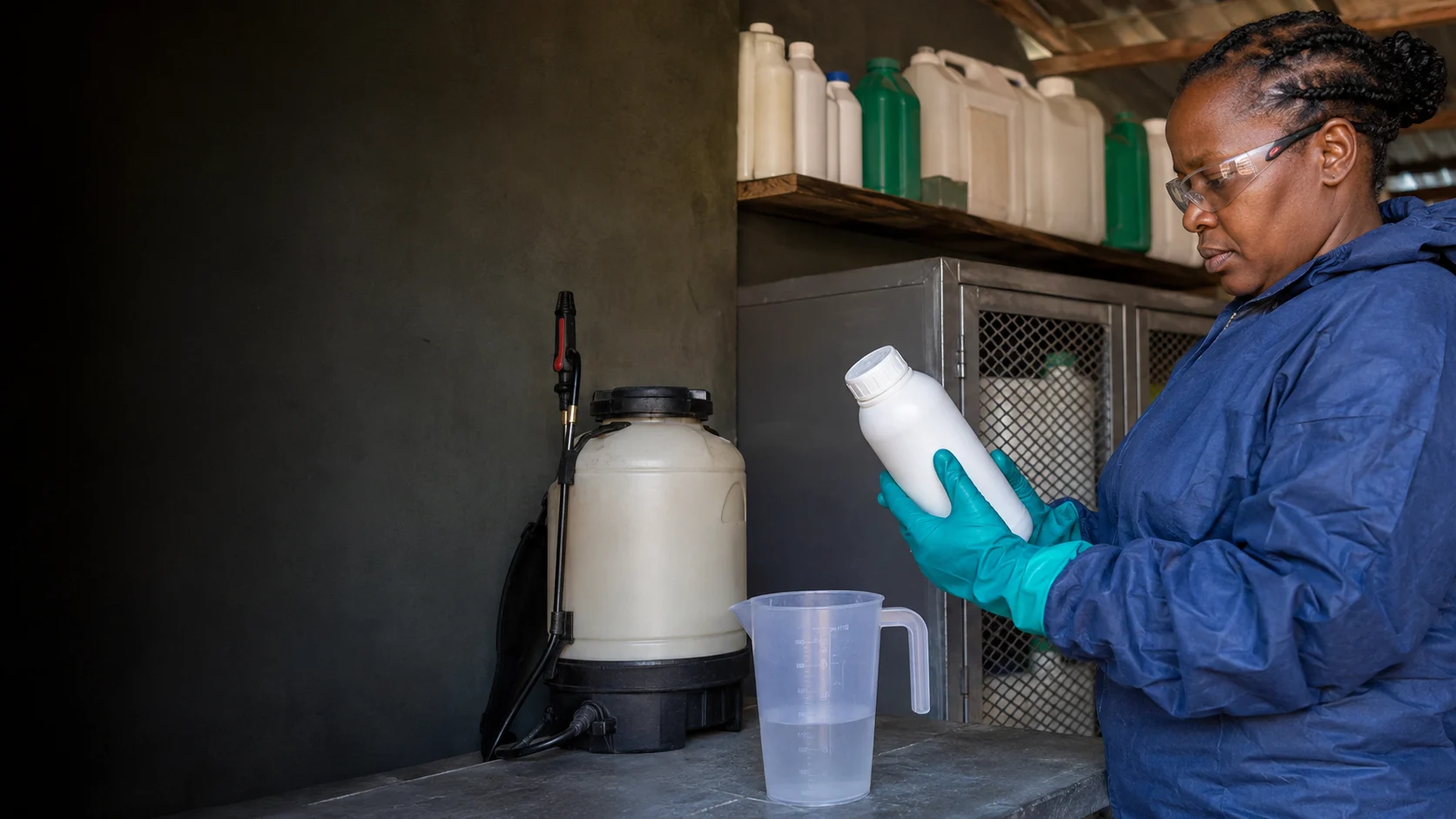
The handling discipline applies. Falcon's published safe pesticide use article covers selection, mixing, protective equipment, application, re-entry, pre-harvest intervals, storage, disposal and spray records, and none of that is suspended because a product is biological. This article restates none of it and routes there instead.
The register position. MAAIF publishes a register of agricultural chemicals registered under the Act. The version Falcon located is dated 6 October 2021 and no newer version was located during this research. This article therefore names no product, active ingredient or organism as registered in Uganda. That determination belongs to MAAIF on the current register.
For anything to do with residues, market limits and buyer specifications, including the point that a biological product is not automatically exempt from any of them, see the food safety and residue requirements article referenced at the end.
What is listed as available for Uganda
The CABI BioProtection Portal is a catalogue of biological and biopesticide products by country, and it has covered Uganda since March 2021. Its own description of where its listings come from is important: they are sourced directly from national governments' lists of registered pesticides and from partner biocontrol manufacturers.
Read that carefully before you use it. Part of the portal's content derives from national registers, and part derives from manufacturers who are partners. It is a useful starting point for finding out what exists and what claims are made for it. It is not a substitute for confirming a product's current Ugandan registration with MAAIF, and this article does not treat a listing as a registration statement.
The Ugandan trial evidence that exists
This is the most valuable content in this article because it is Ugandan, recent, and quantified with its conditions.
Tomato leafminer, Mukono district, 2019 and 2020. A study published in Sustainability in 2022 evaluated an entomopathogenic fungus, Metarhizium anisopliae isolate ICIPE 20, against the tomato leafminer Tuta absoluta on tomato in Mukono district in central Uganda, over two consecutive cropping seasons running from April to July 2019 and from December 2019 to March 2020. It reported a "marketable fruit yield gain exceeding 22%" and "a cost-benefit ratio greater than 2.8 (BCR~3)".
Every one of those conditions matters. It is one organism, at one named isolate, against one pest, on one crop, in one district, over two seasons. A different isolate is not the same product. A different crop or pest is a different question. And the benefit to cost ratio reported is specific to the prices and yields in that study at that time, not a prediction for your farm.
That study is nonetheless the strongest Ugandan field evidence located in this research, and it establishes something real: that a biological product, correctly applied under Ugandan field conditions against a pest it targets, produced a measurable and economically positive result in that trial.
Regional evidence, clearly labelled as regional
Trichoderma, and an honest gap. Trichoderma is among the organisms most commonly offered in the region, usually for soil-borne disease problems. Falcon located no Ugandan field trial of Trichoderma that it could open and verify during this research, and it therefore quotes no efficacy figure for it, from Uganda or from anywhere else. Regional work exists, but a figure Falcon has not read in full is not a figure Falcon will publish. If you are offered a Trichoderma product, apply the five evidence questions in the assessment section below and ask specifically for a trial on your crop, in conditions resembling yours.
Classical biological control and fall armyworm. A CABI evidence note of October 2018 on fall armyworm sets out what classical biological control means, which is the introduction and establishment of a natural enemy so that it becomes a permanent part of the system, and reports parasitism rates observed by natural enemies already present. Classical biological control is a national and regional undertaking, not something a farm does. What a farm can do is avoid destroying the natural enemies that are already present, which is one of the strongest arguments against routine calendar spraying.
Fall armyworm itself is owned by Falcon's published fall armyworm article and nothing about its identification, monitoring or control decisions is repeated here.
What the organisms are, in plain terms
Three families come up constantly and it helps to know what each actually is.
Bacillus thuringiensis, usually shortened to Bt, is a soil bacterium that produces proteins toxic to certain insect groups when eaten. It is highly specific: a strain effective against caterpillars does nothing to beetles or sucking pests. Specificity is its principal advantage and its principal limitation. It must be eaten to work, which means coverage and timing matter more than with a contact product, and it degrades under sunlight.
Metarhizium and other entomopathogenic fungi infect insects through the cuticle rather than requiring ingestion. Because they are living fungi, they need appropriate humidity and temperature to infect and are sensitive to ultraviolet exposure. Isolates differ substantially, which is why the Ugandan trial above names its isolate.
Trichoderma is a genus of fungi used against soil-borne plant pathogens, working through mechanisms including competition and antagonism in the root zone. Its performance is highly dependent on soil conditions and on the establishment of the fungus in the soil, which is a different kind of outcome from a spray.
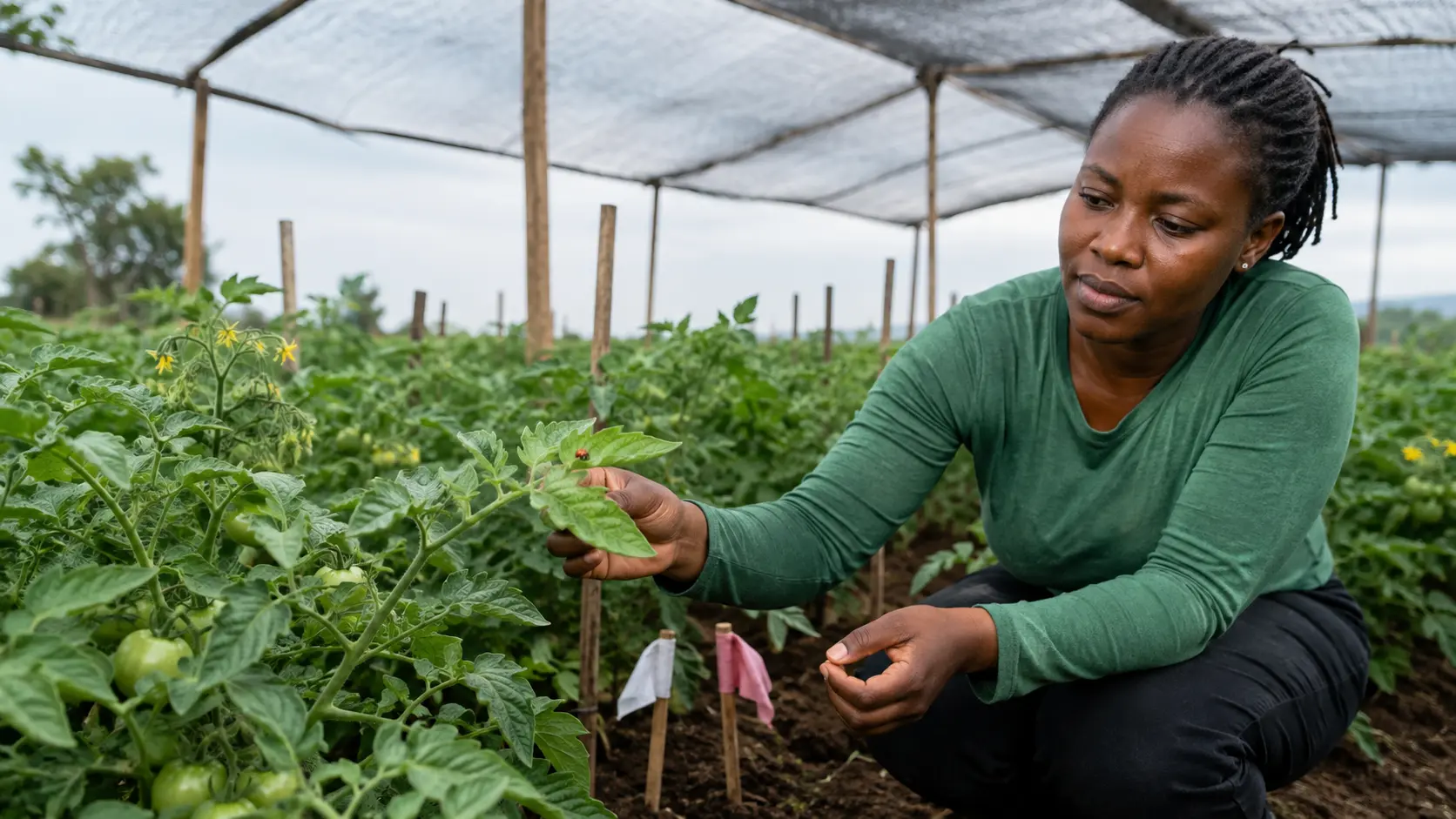
Naturally occurring natural enemies are the predators and parasitoids already present on your farm, and they are the cheapest biological control available. They cost nothing and they are destroyed by broad-spectrum spraying, which is one of the practical reasons the integrated pest management article's decision discipline matters.
The limits, which are the part that decides outcomes
This section exists because the batch standard requires it and because it is true. Nothing here should be read as a reason to dismiss biological products. It is a list of the conditions under which they fail.
Cold storage and shelf life. These are living organisms or their products. Many require cold storage, and most have a shelf life materially shorter than a conventional pesticide. A product that has sat in a hot shop or a warm store may contain far fewer viable organisms than the label states, and there is no way to tell by looking. This is the single most common reason a biological product does not perform.
Temperature and humidity at application. Fungal biopesticides need conditions in which the organism can infect. Applied in the wrong conditions they may do nothing at all, and the failure looks like a bad product rather than a bad application window.
Ultraviolet degradation. Sunlight denatures many of these products. This affects the time of day at which application is effective and how long any effect persists. Persistence is generally shorter than with conventional chemistry, which changes the whole approach to timing.
Specificity. Bt is the clearest example. A product effective against one insect group does nothing to another. A grower who buys a specific product for a general problem gets no result and concludes that biologicals do not work.
Speed of effect. Biological control is generally slower than a conventional knockdown. If the decision was left too late, a slow-acting product may not save the crop even if it works.
Registration and market status. Being biological does not exempt a product from registration under the Act, and it does not automatically exempt produce from residue or buyer requirements. Some markets and certification schemes have their own lists of permitted substances, and a product being natural does not place it on such a list. See the food safety and residue requirements article.
Safety. Biological is not a synonym for harmless. These products carry labels, they have handling requirements, and some carry sensitisation risks. All handling routes to the published safe pesticide use article, and the protective equipment duty on an employer in the farm safety article applies whether the product is biological or not.
Evidence transferability. A result obtained with one isolate, on one crop, against one pest, in one district, in named seasons, is evidence about that combination. It is not evidence about a different organism sold under a similar description.
Step by step: assess a biological option before buying anything
Step 1: make the pest decision first
Go to the integrated pest management article and work through scouting, identification and the decision to act. A product is an answer to a question, and if the question has not been asked properly the answer cannot be right.
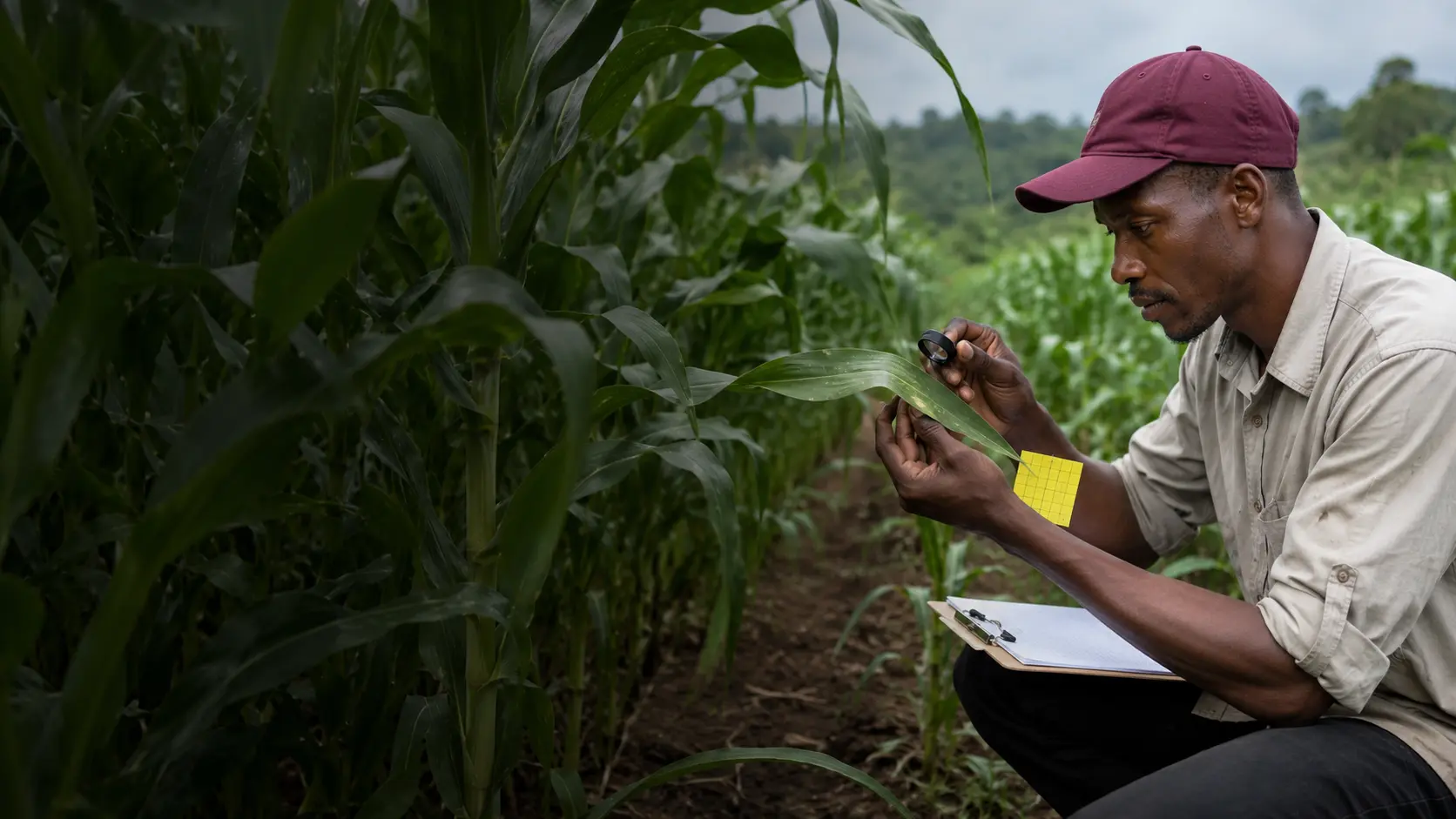
Identification matters more here than with broad-spectrum chemistry, because most biological products are specific. Misidentify the pest and a specific product is guaranteed to fail.
Step 2: check whether the cultural and preventive options have been used
Rotation, sanitation, resistant varieties, timing of planting, removal of crop residues, and preserving the natural enemies already present. The rotation article, the composting article, the biosecurity article and the integrated pest management article referenced at the end cover these. They are cheaper than any purchased product and they are what makes a purchased product work when it is needed.
Step 3: establish whether there is evidence for this exact combination
Ask five questions about any evidence you are shown, and the article on reading agricultural research referenced at the end explains why each matters.
- Which organism, and which isolate or strain?
- Which pest, at which stage?
- Which crop?
- Where, and in which seasons?
- What was it compared against, and what was measured?
If the person selling cannot answer those five, you have marketing rather than evidence.
Step 4: confirm the registration position with MAAIF
Do not rely on a catalogue listing, a shop's assurance or a project's endorsement. Confirm with MAAIF's Department of Crop Inspection and Certification, remembering that the register version Falcon located is dated 6 October 2021 and that a newer version may exist. Then read the label, which is the legal instruction.
Step 5: work out the cold chain and the shelf life before you buy
Ask three questions at the point of purchase and write down the answers.
- What is the storage requirement, and what is the expiry date?
- How has this specific stock been stored since it arrived in the country?
- Can I maintain that storage condition on my farm until I use it?
If the answer to any of those is unclear, the product may already have failed before it leaves the shop. This is not a hypothetical risk; it is the most common cause of a biological product not working.
Step 6: plan the application window against the product's requirements
Fungal products need suitable temperature and humidity. Products degraded by ultraviolet need the right time of day. Products that must be eaten need coverage on the surface the pest feeds on. All of this belongs to the published safe pesticide use article, and this article gives no rate, no timing instruction and no mixing guidance.
Step 7: leave a comparison and record the result
Treat part of the crop and leave a comparable part untreated or treated as you normally would. Record what you did, when, in what conditions, and what happened.
This is the only way you will ever know whether it worked on your farm, and it is what the reading research article's method is for.
Step 8: do not convert a result into a routine
If it worked, that tells you it can work under those conditions against that pest. It does not convert it into a calendar treatment. Routine application of any product, biological or conventional, is not recommended in this article, and with biological products it also wastes a short-lived and expensive input.
Decision framework: where biological options fit and where they do not
| Situation | Biological option realistic? | Why | What to do instead or as well |
|---|---|---|---|
| Pest not yet identified to species or group | No | Most biological products are specific and will fail against the wrong target | Identify first, using the integrated pest management article |
| Cultural and preventive measures not yet used | Not yet | These are cheaper and they determine whether any product succeeds | Rotation, sanitation, timing, variety, residue removal |
| Natural enemies present and pest below the action threshold | No product needed | The cheapest biological control is already working | Do not spray anything broad-spectrum; preserve what is there |
| A specific pest, matched to an organism with evidence under similar conditions | Realistic, if the registration and cold chain check out | This is the situation the evidence supports | Confirm registration, confirm storage, run a comparison |
| A specific pest, but the only evidence is from another country, crop or isolate | Treat as unproven for your situation | Evidence does not transfer across organism, isolate, crop or pest | Ask for evidence for your combination; consider a small trial |
| Cold storage cannot be maintained from supplier to application | No | The product may be inactive by the time it is used | Do not buy until the cold chain is solved |
| The pest is at an advanced stage and the crop is at immediate risk | Usually not | Biological control is generally slower acting | Go back to the pest decision process; take advice |
| Produce is destined for a market with residue restrictions | Possibly helpful, but verify | Biological does not automatically mean permitted or exempt | Check the buyer's permitted list and the residue requirements article |
| Soil-borne disease problem | Possibly, with soil-active organisms | Establishment in the soil is the outcome, not a knockdown | Address soil conditions too; see the composting and rotation articles |
| Fall armyworm | Owned by a separate article | That pest has its own decision rules | Go to the published fall armyworm article |
Field record: the biological trial file
| Section | What it holds | Updated |
|---|---|---|
| Pest decision record | Identification, scouting result, threshold reached, decision to act and why. Cross-referenced to the integrated pest management article | At each decision |
| Product enquiry record | Organism, isolate or strain if stated, target pest and crop as claimed, and the five evidence questions with the answers given | Before purchase |
| Registration check | Who at MAAIF was asked, on what date, and what was said | Before purchase |
| Storage record | Storage requirement, expiry date, what the supplier said about how the stock had been stored, and how it was stored on your farm | At purchase and until use |
| Application record | Owned by the published safe pesticide use article; cross-reference the record here | At each application |
| Conditions record | Temperature, humidity, cloud or sun, time of day at application | At each application |
| Comparison record | What was left untreated or treated differently, where, and how the two were compared | Each trial |
| Outcome record | What was observed, when, and what conclusion you drew | Each trial |
| Natural enemy observations | What beneficial organisms you see, and whether they change after any treatment | Continuously |
The storage record and the conditions record are the two rows that explain most failures. Without them, a product that failed because it was stored badly is indistinguishable from a product that does not work.
Cost categories
Falcon publishes no prices. No current Ugandan price for any biological product was verified, and no product is recommended.
- The product itself, which is often priced per unit area treated rather than per container.
- Cold storage on the farm, where required, which may be the largest hidden cost.
- Transport that maintains the storage condition.
- Application labour, which may be higher because coverage and timing matter more.
- Repeat applications, because persistence is generally shorter than with conventional chemistry.
- Protective equipment, which the employer must provide regardless of the product's biological status.
- The cost of the comparison trial, which is mainly record keeping.
- The cost of the cultural and preventive measures that should come first, covered in the rotation, composting and biosecurity articles.
Common mistakes
- Assuming that biological means outside the registration system, when the Act expressly names bio-pesticides among agricultural chemicals.
- Assuming that biological means safe, when these products carry labels and handling requirements.
- Assuming that biological means effective, without asking what evidence exists for that organism, pest, crop and conditions.
- Treating a catalogue listing as a registration statement, when the catalogue itself states that part of its content comes from partner manufacturers.
- Buying without knowing the storage requirement, the expiry date and how the stock has been stored.
- Storing a living product on a hot shelf and concluding, when it fails, that biologicals do not work.
- Applying a fungal product in conditions where the organism cannot infect.
- Applying a ultraviolet-sensitive product in full midday sun.
- Using a specific product against the wrong target, because the pest was never identified.
- Expecting a conventional speed of knockdown from a slower-acting biological option.
- Transferring a result from another country, crop, pest or isolate to your own situation.
- Skipping the cultural and preventive measures and expecting a product to compensate.
- Spraying broad-spectrum products routinely and destroying the natural enemies that were already controlling the pest for free.
- Converting one successful use into a routine calendar treatment.
- Assuming a biological product is automatically permitted by a buyer or certification scheme.
Warning signs and escalation points
| What you observe | What it means | What to do |
|---|---|---|
| A seller cannot name the organism and isolate or strain | You cannot match it to any evidence | Do not buy until it is named |
| A seller cannot state the storage requirement or expiry date | The product's viability is unknown | Do not buy |
| The product has been on an unrefrigerated shelf and requires cold storage | It may already be inactive | Do not buy; ask about the cold chain from import onward |
| The evidence offered is from a different crop, pest, isolate or country | It is not evidence for your situation | Ask for evidence for your combination, or treat it as unproven and trial it small |
| Registration cannot be confirmed with MAAIF | The register version located is dated 6 October 2021 and the position must be established | Do not buy until confirmed |
| A product is described as safe because it is natural | This is a marketing claim, not a safety classification | Read the label and apply the published safe pesticide use article's discipline |
| The product is being recommended on a calendar | Routine application is not recommended for any product here | Go back to the pest decision process |
| Natural enemies have disappeared from a field after treatment | A broad-spectrum treatment has removed free biological control | Review what was applied and why; see the integrated pest management article |
| The pest is advanced and the crop is at immediate risk | A slow-acting option may not be sufficient | Take advice; do not rely on a product for a decision that should have been made earlier |
| Your produce goes to a market with a permitted substances list | Biological status does not confer permission | Check the buyer's list and the residue requirements article before applying anything |
When these options work and when they do not
They work when the pest is correctly identified, the organism is matched to it, the product is genuinely viable when applied, the conditions suit the organism, and cultural measures are already in place.
They work as part of a system rather than as a substitute product. The Ugandan trial evidence quoted here comes from a properly conducted programme, not from a single opportunistic spray.
They do not work when the cold chain is broken, which is the most common failure and the least visible.
They do not work as a fast rescue for a decision left too late.
They do not work when the evidence has been transferred from a different organism, crop, pest or country.
They are not exempt from Ugandan registration law, from safe handling requirements, or from a buyer's residue and permitted substance requirements.
A low-risk first step
Before buying anything, do the free version.
Walk one field and look for the natural enemies already present: predatory insects, spiders, parasitised pests. Then look at what you have been applying routinely and ask whether it is removing them. Preserving the biological control you already have costs nothing and is the highest-return biological intervention available on most farms.
Then, if you still intend to buy, take the five evidence questions and the three storage questions in this article to the seller in writing, and record the answers before any money changes hands.
Limitations and professional-support triggers
Get professional support in these situations.
- Confirming whether any product is currently registered in Uganda for a specific use. MAAIF, Department of Crop Inspection and Certification. This article confirms nothing and names no product as registered.
- Identifying a pest or disease. Your district production office, the relevant NARO institute, or a qualified agronomist. Identification is more critical here than with broad-spectrum chemistry.
- Anything to do with applying any product. The published safe pesticide use article, and a qualified adviser.
- Market or certification permission for a substance. The buyer's written specification and the food safety and residue requirements article.
- A pest problem that has advanced beyond the point where a slow-acting option is realistic. Take advice rather than improvising.
Five verification gaps in this article are disclosed rather than hidden.
First, no product, active ingredient or organism is stated to be registered in Uganda. The only national register located is dated 6 October 2021 and no newer version was found.
Second, the Ugandan trial evidence located covers one organism at one isolate, against one pest, on one crop, in one district, in two named seasons. No wider Ugandan efficacy claim is made.
Third, no Ugandan field trial of Trichoderma was verified, and no efficacy figure for it is published here from any country.
Fourth, no Ugandan data on the availability, price, cold chain integrity or shelf life performance of biological products in the Ugandan market was located, which is precisely why the storage questions in this article are put to the seller rather than answered here.
Fifth, the product catalogue described states that part of its content is sourced from partner manufacturers, so a listing there is not treated in this article as a registration or an efficacy statement.
Clear next actions
- Work through the pest decision in the integrated pest management article before considering any product.
- Identify the pest to the level the product requires, because specificity is the defining feature of most biological options.
- Put the cultural and preventive measures in place first: rotation, sanitation, timing, variety and residue removal.
- Walk the field and record the natural enemies present, then review whether your routine spraying is destroying them.
- Ask any seller the five evidence questions: organism and isolate, pest and stage, crop, place and seasons, and what it was compared against.
- Ask any seller the three storage questions: storage requirement and expiry, how this stock has been stored, and whether you can maintain it.
- Confirm the registration position with MAAIF's Department of Crop Inspection and Certification before buying, and read the label.
- If you proceed, leave a comparison area, record the conditions at application, and record the outcome, so that next season's decision rests on your own evidence.
Author
Falcon Foundation Ltd editorial team. Falcon Foundation Ltd is a privately owned Ugandan agricultural company established in 2013, registered in Uganda and operating land in Uganda across greenhouse crops, poultry, sheep, goats and beekeeping. This article sets out what is established about biological control and biopesticides for Ugandan conditions, and where they do and do not belong. It publishes no dose rate, recommends no product, recommends no routine spraying, and states no product's, organism's or active ingredient's Ugandan registration status. All handling is covered in the company's published safe pesticide use article. Biological does not mean automatically safe and it does not mean automatically effective, and this article sets out the conditions under which these products fail. It is general information only. It is not agronomic or legal advice, and it is not a substitute for MAAIF, your district production office, NARO or a qualified agronomist.