The direct answer
Weeding is not a chore you fit in when there is time. It is a timed intervention, and the timing matters more than the method.
Agronomists call the window that matters the critical period of weed control. One peer-reviewed definition is that it "represents a time interval in the crop growth cycle, during which weeds must be controlled to prevent unacceptable yield losses." A university extension service puts the same idea more plainly: it is "the period during a crop lifecycle when weeds need to be managed to avoid a significant yield loss."
Weeds removed inside that window protect the yield. Weeds removed after it tidy the field and recover very little. That single fact should reorganise how most Ugandan farms allocate weeding labour.
For maize, MAAIF's own extension manual sets the first intervention early: "Early control of weeds recommended at 2-3 weeks after planting is extremely important", followed by a second pass, because "it is recommended to weed 5-6 weeks after planting to avoid weeds to adversely affect the quality."
The method you use inside that window is a labour and cost decision, not a moral one. There are three families of option and most successful Ugandan fields use two of them:
- Cultural, which prevents weeds from establishing: clean seed, timely planting, correct spacing, mulch, rotation and a competitive crop stand.
- Mechanical, which removes weeds physically: hand hoeing, hand pulling, and animal or machine-drawn weeders.
- Chemical, which uses a registered herbicide, applied by someone trained, inside the label.
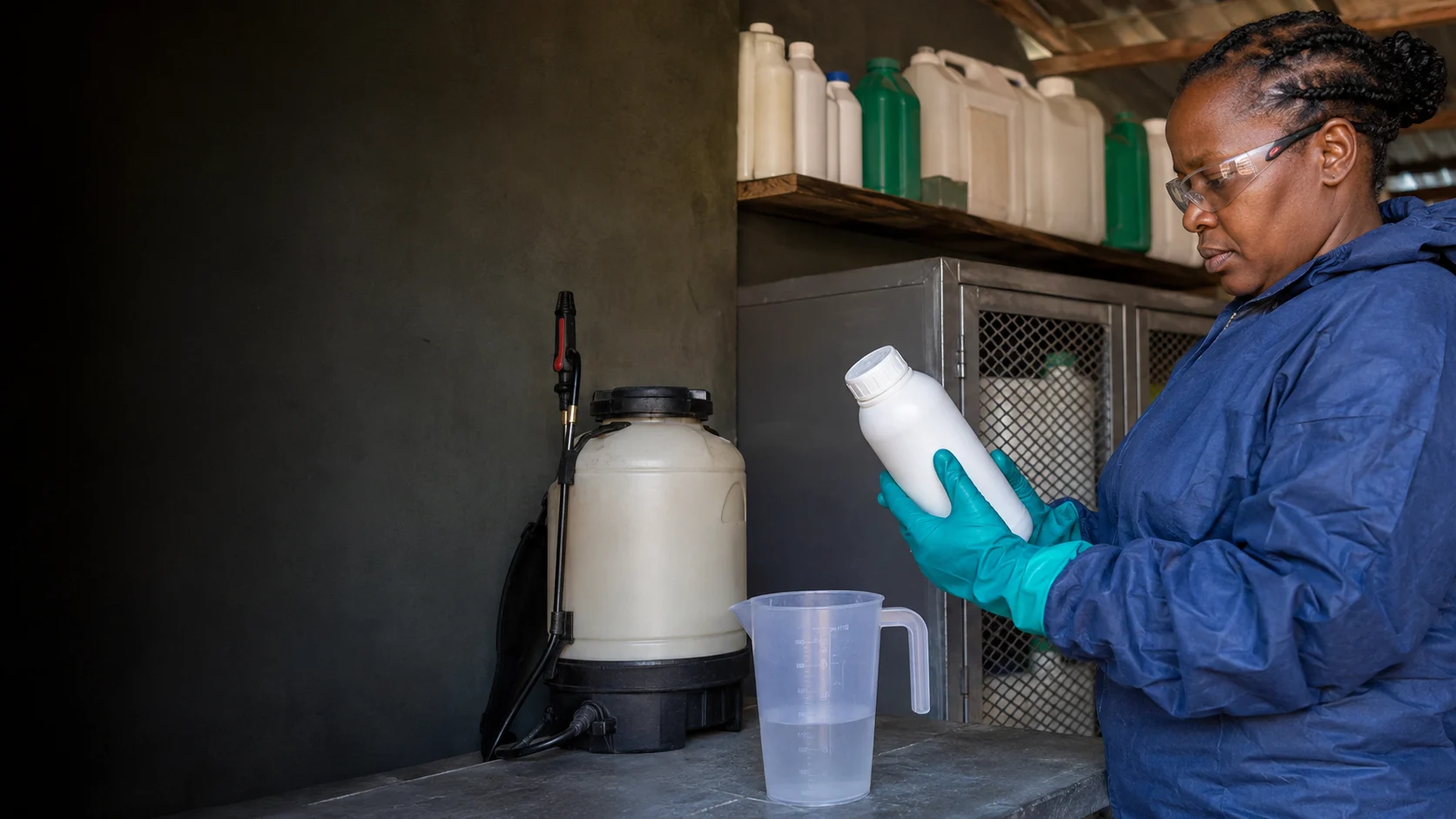
This article compares the three and helps you sequence them. It publishes no dose rate, recommends no product, and does not tell you to spray. Everything about selecting, mixing, wearing protection for, applying, storing and disposing of a chemical belongs to Falcon's published article on safe pesticide use, and this article routes you there rather than repeating it.
Who this article is for
Farmers and farm managers deciding how a field will be kept clean this season, and how much labour and money that will take. Extension officers advising on the same choice. Students learning why the timing matters. Input businesses who want their customers to understand what they are buying and why.
You will get most from this if you already know what you are planting and when. If weed pressure on your farm is dominated by one specific problem, such as Striga, read the general method here first and then take that specific problem to your district production office, because parasitic weeds behave differently from ordinary competition.
The problem this article solves
Three things go wrong with weeding on Ugandan farms, and none of them is solved by buying something.
Weeding happens too late. Labour is short at exactly the moment the critical period opens, because land preparation and planting are competing for the same hands. A field weeded at eight weeks looks clean and has already lost yield.
Weeding happens too often, in the wrong place. Late-season weeding after the crop canopy has closed consumes labour that would earn more elsewhere on the farm.
Chemical control is bought as a shortcut and used as one. A herbicide applied without knowing the weed, the crop stage or the label is money spent on a risk rather than on a result.
Behind all three sits a labour reality. Weeding is among the largest single labour demands on a Ugandan smallholding, and peak-season competition for workers is severe. Falcon's article on farm labour planning treats that as the scheduling problem it is.
The decision you are making
For one named field, this season, you are deciding:
- When the critical period opens and closes for your crop.
- Which method you will use for the first intervention, inside that window.
- Which method you will use for the second, if one is needed.
- What you will deliberately not do, and why.
- Who does the work, on which days, and what it costs.
- What you will record so that next season's decision is better than this one.
Point 4 is the one most plans omit. A weeding plan that never says "we stop here" turns into unlimited labour demand.
Uganda-specific context
The law on chemicals, stated accurately. In Uganda, herbicides are agricultural chemicals. The Agricultural Chemicals (Control) Act, Chapter 35, defines agricultural chemicals to include "plant protection chemicals, fungicides, insecticides, nematicides, herbicides, miticides, bactericides, rodenticides, molluscides, avicides, fertiliser, growth regulators, wood preservatives, bio-rationals, bio-pesticides, bio-fertilisers or any other chemicals used for promoting and protecting the health of plants, plant products and by-products."
Section 3(1) of that Act provides: "A person shall not import into or sell in Uganda any agricultural chemical unless that chemical has been registered, packed and labelled in accordance with regulations made under this Act and conforms to the standards specified in the regulations."
So registration is not a quality badge. It is the condition on which a product may lawfully be sold at all.
Where the register is, and its date. MAAIF publishes a national register of agricultural chemicals. The version Falcon located is headed "REGISTER OF AGRICULTURAL CHEMICALS REGISTERED UNDER SECTION 4 OF THE AGRICULTURAL CHEMICALS (CONTROL) ACT, 2006" and is dated "AS AT 06TH OCTOBER, 2021". It lists period of registration, registration number, trade name, active ingredients and concentration, registrant and local agent.
That register is dated 6 October 2021, and Falcon could not locate a newer published version. Registrations run for defined periods and lapse. Do not treat any product's presence in a 2021 register as proof that it is registered today. Ask MAAIF's Department of Crop Inspection and Certification, whose stated functions include "Registration and certification of seeds, planting materials, plant and plant products and agro-chemicals" and to "Enforce legislation, regulations and standards on plants/plant products (phytosanitary), seeds, planting materials and agro-chemicals".
A note on the herbicide names in MAAIF's own manual. MAAIF's maize extension manual states that "Selective herbicides are most effective if applied on weeds when they are actively growing. Examples include 2,4-D, Tembofrione, Auxo, Maguguma." Falcon reproduces that sentence because it is what a Ugandan government extension manual says, and for no other reason. It is not a Falcon recommendation, it is not a statement that any of those is currently registered, and it carries no dose rate. Verify current registration with MAAIF, and read the label.
Labour is the real currency. For most Ugandan fields the choice between hand weeding and chemical control is a choice between labour you can find and cash you can spare, at a moment in the season when both are tight.
Step by step: build the weeding plan
Step 1: identify what you are actually fighting
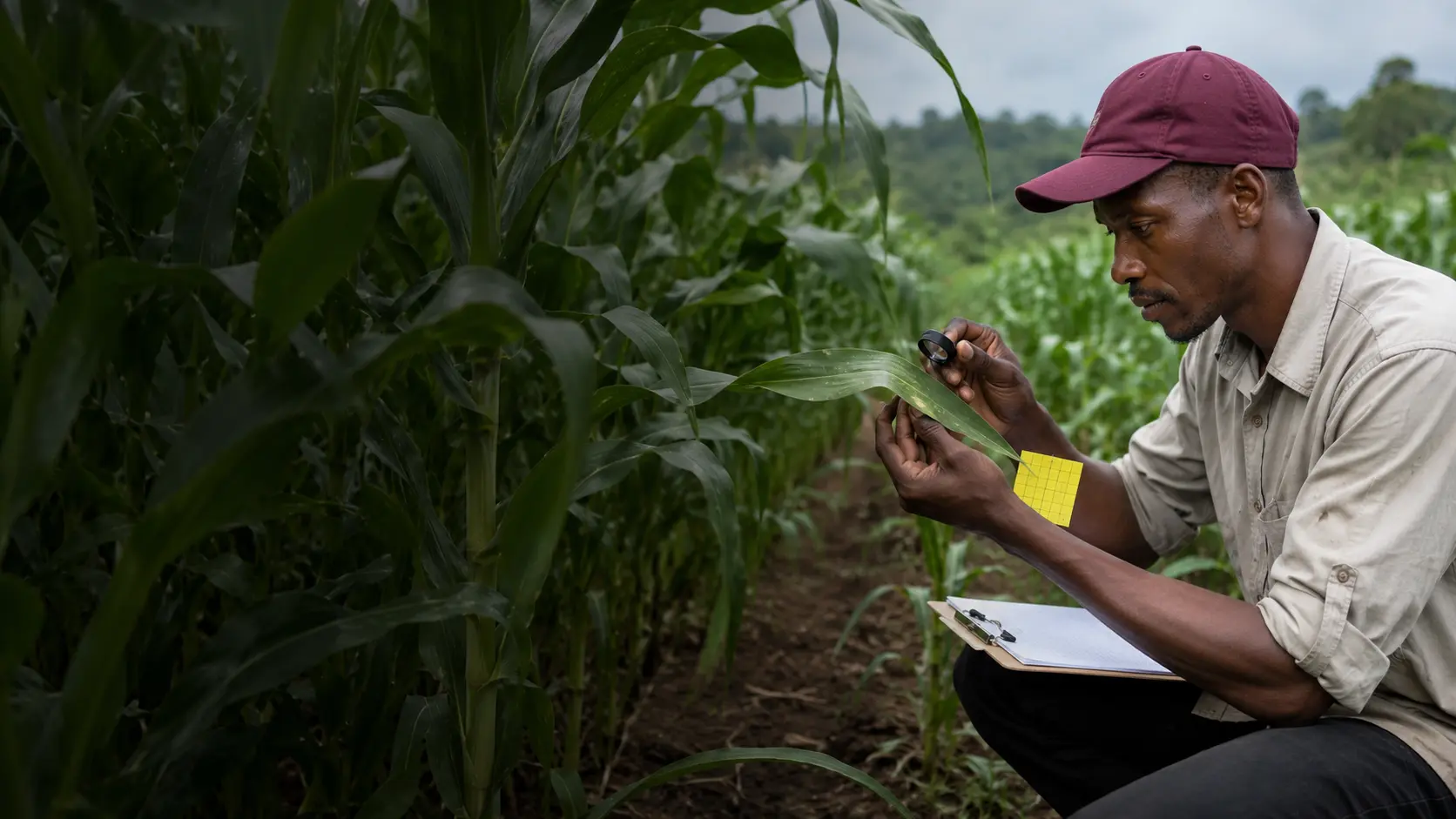
Walk the field before planting and again a week after emergence. Write down what you see, not what you assume.
- Annual broadleaf and grass weeds. The ordinary competition. Cultural and mechanical control work well if timed correctly.
- Perennial weeds with rhizomes or tubers. These regrow from underground parts and are not solved by one pass of a hoe.
- Parasitic weeds, above all Striga. These attach to the crop root and are a different problem entirely. MAAIF's manual states that "Striga is a parasitic weed and can cause up to 100% of maize yield losses at farm level", and that "Each striga plant is capable of producing up to 500,000 seeds which remain viable in the soil for over 10 years." The manual's own field instruction is: "Where Striga is a problem; Hand weed regularly (but is labor intensive) and burn all the weeds."
Read that seed number again. Half a million seeds per plant, viable for over a decade, is why Striga is a multi-season rotation and soil fertility problem rather than a weeding problem, and why letting one plant set seed is a decision with a ten-year consequence.
Step 2: fix the critical period for your crop
The critical period is not the same for every crop, every field or every season. What is consistent is that it sits early.
MAAIF's maize manual gives Uganda's own working answer for maize: first weeding at "2-3 weeks after planting", second at "5-6 weeks after planting".
Research puts a frame around why that shape works. A 2024 peer-reviewed study in Slovenia found the critical period ended between 39 and 58 days after emergence depending on tillage system, and recorded that season-long weed competition caused 22 to 41 percent maize yield reduction across the tillage practices tested. That study is European, on Slovenian soils and tillage systems, in 2021, and its day numbers do not transfer to a Ugandan field. What transfers is the structure: the window is measured in weeks after emergence, it closes, and weeds left through it cost a large share of the crop.
A United States extension service expresses the same window in growth stages for maize, as roughly the three to six leaf stage through the ten leaf stage. Again, that is American guidance and the stages, not the dates, are the transferable part.
The practical instruction: plan your first weeding for two to three weeks after planting, and treat a delay past that as a yield decision, not a scheduling inconvenience.
Step 3: choose the method for the first intervention
Use the comparison table below. Then commit the labour or the purchase in advance, because the whole point of the critical period is that it will not wait for you.
Step 4: decide whether a second intervention is needed
Walk the field at the end of the critical period. If the crop canopy has closed and is shading the inter-row, further weeding protects very little yield. If the canopy is open, because the stand is thin or the spacing is wide, weeds will keep competing and a second pass is justified.
A thin stand is a weed problem disguised as a weeding problem. Plant population is covered in Falcon's maize production article, and it is often the cheaper fix.
Step 5: stop, and record
Write down what you did, when, with how many people, and what the field looked like afterwards. That record is what makes next season's plan better, and it is the only evidence you will have when comparing two methods.
Decision framework: comparing the three families
| Factor | Cultural | Mechanical | Chemical |
|---|---|---|---|
| What it is | Prevention through clean seed, timely planting, spacing, mulch, rotation and a competitive crop | Hand hoe, hand pulling, mechanical or animal-drawn weeder | A herbicide registered in Uganda, applied under its label |
| Cash cost | Lowest. Mostly management | Low cash, high labour | Product plus equipment plus training |
| Labour cost | Low, spread across the season | Highest of the three, concentrated in the critical period | Lowest per hectare once equipment exists |
| Timing tolerance | Acts before the window opens | Must land inside the critical period | Must match both the weed stage and the crop stage on the label |
| Skill required | Moderate agronomy | Low | High. Selection, calibration, application and safety all matter |
| Works against perennials | Partly, through rotation and competition | Poorly. Cutting rhizomes can multiply them | Depends entirely on the product and the weed |
| Works against Striga | Rotation and fertility help. See the note below | MAAIF's stated instruction is regular hand weeding and burning the weeds, described as labour intensive | Not addressed in this article. Take it to your production office |
| Risk if done badly | Low | Crop root damage if hoeing is too deep or too close | Crop damage, operator harm, residue and market risk |
| Resistance risk | None | None | Real, and it builds where the same mode of action is used repeatedly |
| Residue and market consequence | None | None | Yes. See Falcon's article on residue requirements |
| Regulatory requirement | None | None | The product must be registered in Uganda and used according to its label |
How to read this table. Cultural methods are the cheapest and slowest to act. Mechanical methods are reliable and expensive in the one currency most Ugandan farms are shortest of at that moment. Chemical control is efficient per hectare and carries every category of risk the other two do not.
Most well-run Ugandan fields use cultural methods continuously and then choose between mechanical and chemical for the interventions inside the critical period.
Cultural control, in more detail
These are the interventions that reduce how much weeding you need in the first place. They cost management attention rather than money.
Start clean. Land prepared so that existing weeds are dead or buried before planting gives the crop a head start it never gets back later.
Plant on time and at the right population. A crop that emerges evenly and closes its canopy quickly shades out later weed flushes. This is the single most underrated weed control measure available, and it is free. Falcon's maize production article covers population.
Use clean seed. Weed seed travels in crop seed. Falcon's published article on verifying seed and planting material quality covers how to check.
Mulch where you have material. A covered soil surface suppresses germination. The material competes with other uses on a mixed farm, so decide that trade deliberately. Falcon's composting article covers residue allocation.
Rotate. Continuous cropping of one crop selects for the weeds that suit it, and this is especially true of Striga in continuous cereals. A 2025 peer-reviewed review of push-pull technology across Kenya, Uganda and Malawi reported a "Median reduction in infestation relative to cereal monocrops was 91.6%" for Striga. That figure is a median pooled across three countries and is not a Ugandan-specific result, and push-pull is a companion-planting system rather than a rotation, but it establishes that diversifying a cereal monocrop is a real Striga lever. Falcon's rotation article covers sequence design.
Manage fertility. Striga pressure is associated with depleted soils. Improving fertility is not a weed control measure on its own and it changes the conditions the weed exploits. Falcon's published soil testing article owns the diagnosis.
Mechanical control, in more detail
Hoe shallow and early. A small weed killed at the surface takes a fraction of the effort of a large weed pulled at depth, and shallow work does not damage crop roots. MAAIF's manual notes that the early window matters partly because "the root system of the plant develops at this stage".
Hand pull what the hoe will miss. Weeds inside the crop row, and weeds that will set seed before the next pass, are worth pulling by hand.
Never let a weed set seed. One season's seeding is many seasons' weeding, and for Striga the arithmetic in MAAIF's own manual, up to 500,000 seeds per plant viable for over ten years, makes the point without exaggeration.
Weeders and animal traction change the labour arithmetic on fields wide enough and level enough to use them. They do not change the timing requirement.
Plan the labour before the season, not during it. Falcon's article on farm labour planning covers task calendars, piece rates and supervision records, which is exactly the problem a two-pass weeding plan creates.
Chemical control, in more detail, and its boundaries
This section is deliberately short, because most of what a farmer needs to know about a herbicide is handling, and Falcon's published article on safe pesticide use owns handling completely.
What this article will say:
- Only a product registered in Uganda may lawfully be sold to you. Section 3(1) of the Agricultural Chemicals (Control) Act is unambiguous.
- The only national register Falcon located is dated 6 October 2021. Confirm current registration with MAAIF before you buy.
- The label is the instruction and the legal document. Crop, weed, growth stage, rate, interval and protective equipment are all on it.
- Selectivity is not a general property. A herbicide is selective for named crops against named weeds at named stages. Outside those, it is a crop damage risk.
- Resistance is real. Using the same mode of action every season on the same field selects for the weeds that survive it. Alternating modes of action, and combining chemical with cultural and mechanical control, is how that is delayed.
- There is a market consequence. Residues and pre-harvest intervals affect whether produce can be sold into a formal or export chain. Falcon's article on food safety and residue requirements covers it.
What this article will not do:
- It will not publish a dose rate.
- It will not recommend routine or calendar spraying. Spray when a decision rule says so, not on a schedule.
- It will not recommend a product.
- It will not repeat selection, mixing, personal protective equipment, application technique, re-entry intervals, storage or disposal. All of that is in Falcon's published safe pesticide use article and you should read it before you buy anything.
Field record: the weeding plan and log
One sheet per field per season. Fill in the plan before planting and the log as you go.
| Item | Entry |
|---|---|
| Field name and area, acres and hectares | |
| Crop and planting date | |
| Weed species and types observed before planting | |
| Perennial weeds present? Which | |
| Parasitic weeds present? Which | |
| Planned start of the critical period, weeks after planting | |
| Planned end of the critical period | |
| Cultural measures used this season | |
| Intervention 1: date planned, date done, method, people, hours | |
| Intervention 2: date planned, date done, method, people, hours | |
| Total labour used, person-days | |
| If a chemical was used: product registration confirmed with MAAIF on which date | |
| If a chemical was used: label read, applicator trained, records kept per the safe pesticide article | |
| Field condition at canopy closure | |
| Decision to stop, and the reason | |
| Any weed allowed to set seed, and where | |
| What I would change next season |
The two rows that improve next season are the labour total and the last one. Without the labour total you cannot compare methods; without the last row you will repeat this season.
Cost categories
Falcon publishes no prices for labour, herbicides or equipment, because no current verified Ugandan figure was obtained and a stale price is worse than none. Budget by category and get three written quotations for anything purchased.
| Cost category | What sits inside it | Notes |
|---|---|---|
| Labour, land preparation | Clearing and preparing so the crop starts clean | Reduces every later cost |
| Labour, weeding | The two interventions inside the critical period | The largest line on most fields. Plan it as a calendar item |
| Supervision | Checking that the work was actually done to depth and coverage | Covered in the labour planning article |
| Hand tools | Hoes, and their replacement | Small and recurrent |
| Mechanical weeder or animal traction | Purchase or hire, plus draught animal costs | Only worthwhile at scale and on suitable ground |
| Herbicide product | Only if chemical control is chosen | Ask for the registration status, not just the price |
| Application equipment and protective equipment | Sprayer, nozzles, calibration, protective clothing | Specified in the published safe pesticide article, and never optional |
| Training | Applicator training | The difference between a tool and a hazard |
| Mulch material | Where residues are diverted to mulching | An opportunity cost against feed and fuel |
| Cost of doing nothing | Yield lost to weeds left through the critical period | The peer-reviewed Slovenian study measured 22 to 41 percent under season-long competition in its own conditions |
Common mistakes
- Weeding when there is time rather than when the crop needs it. The critical period does not move.
- One late weeding instead of two early ones. The field looks better and the yield is already gone.
- Weeding after canopy closure. Labour spent for very little return.
- Treating a thin crop stand as a weed problem. Correct the population and half the weed pressure disappears.
- Hoeing deep and close. Root damage costs more than the weeds would have.
- Letting one weed set seed because it is nearly harvest. For Striga in particular, MAAIF's own figures make that a decade-long decision.
- Buying a herbicide without confirming current registration. The register Falcon located is dated October 2021.
- Assuming a herbicide is selective for your crop. Selectivity is crop-specific, weed-specific and stage-specific.
- Using the same product every season on the same field. That is how resistance is selected for.
- Spraying on a calendar. Spray on a decision, or not at all.
- Treating chemical control as a substitute for cultural control. The farms with the least weed pressure are the ones that prevented it.
- Not recording the labour. You cannot compare methods you did not measure.
Warning signs and escalation points
| Warning sign | What it means | What to do |
|---|---|---|
| The first weeding will be late and cannot be resourced | The critical period is about to be missed | Reduce the area you weed properly rather than doing all of it badly. A well-weeded smaller area beats a poorly weeded larger one |
| Weeds regrow within days of hoeing | Likely perennials regenerating from underground parts | Stop chopping them. Identify the species with your production office before continuing |
| Purple-flowered plants attached at the base of cereal plants | Probable Striga | Do not ignore it. Follow MAAIF's instruction to hand weed and burn, and take a sample to your district production office. This is a multi-season problem |
| The same weed survives a herbicide that used to control it | Possible resistance | Stop using that mode of action on that field and seek technical advice. Do not increase the rate |
| Crop damage after a herbicide application | Wrong product, wrong stage, wrong rate or drift | Stop applications. Consult the label and your production office. Falcon's safe pesticide article covers the handling review |
| Any operator feels unwell during or after application | A health matter, not an agronomy one | Stop work and seek medical attention. Follow the emergency guidance in Falcon's published safe pesticide article |
| A buyer asks about your herbicide records and you have none | A market access problem | Start records immediately. See Falcon's article on food safety and residue requirements |
| A seller cannot tell you whether a product is registered | You cannot verify what you are buying | Do not buy. Ask MAAIF |
| Weed pressure rises year on year on the same field | The seed bank is building, usually from weeds allowed to set seed | Change the rotation and tighten the timing. See Falcon's rotation article |
When each method works and when it does not
Cultural control works everywhere, always, and should be running whether or not you do anything else. It does not work as a rescue once weeds are established inside the critical period.
Mechanical control works where labour can be mobilised on the right days, on fields of a size that labour can cover, and against annual weeds. It does not work well against established perennials, and it does not work if the labour cannot be found in the two to three week window.
Chemical control works where the weed and crop are correctly identified, a registered product exists for that combination, the applicator is trained, the equipment is calibrated and the label is followed. It does not work as a substitute for timing, it does not work against a weed the product does not cover, and it should not be used at all by an untrained applicator without protective equipment.
No method works on a field where the crop stand is too thin to compete, or where the same weed is allowed to seed every year. Those are agronomy and discipline problems that no product solves.
A low-risk first step
You do not need to change your whole system this season.
- Choose one field. Write down the planting date.
- Diarise the first weeding for two to three weeks after planting, and arrange the labour for those specific days now, before the season starts.
- Split the field. Weed one half on time and the other half on your usual schedule.
- Record the labour used on each half, in person-days, honestly.
- Walk both halves at canopy closure and photograph them from a fixed point.
- Harvest and weigh the two halves separately. Not estimated. Weighed.
- Compare. The difference is your own local evidence about what timing is worth on your soil, and it is worth more to you than any figure in this article.
- Only then consider changing methods. If you are considering chemical control, read Falcon's published safe pesticide article first and confirm registration with MAAIF before buying anything.
Limitations and professional-support triggers
What this article does not do. It publishes no dose rate, no price, no product recommendation and no spray schedule. It does not state that any product is currently registered in Uganda. It does not cover herbicide selection, mixing, protective equipment, application, re-entry, storage or disposal, all of which belong to Falcon's published safe pesticide use article. It does not provide a Striga control programme. It does not diagnose a weed for you.
What Falcon could not verify, stated plainly. No published national register of agricultural chemicals more recent than 6 October 2021 was located. No current official Ugandan list of banned or restricted pesticides was located. No Ugandan critical-period-of-weed-control trial was located, so the timing evidence here is MAAIF's extension recommendation plus foreign research whose country and year are labelled at the point of use. No verified Ugandan figure for weeding labour in person-days per hectare was obtained, so none is stated.
Bring in a professional when:
- Your district production office or sub-county extension officer, to identify a weed you cannot name, and before acting on any suspected Striga infestation.
- MAAIF's Department of Crop Inspection and Certification, to confirm whether a product is currently registered.
- A qualified agronomist, before adopting a herbicide programme across a whole enterprise, and at the first sign of suspected resistance.
- A trained applicator, for any chemical application. Falcon's published safe pesticide use article sets out what that involves.
- Medical attention immediately, for any suspected exposure during or after an application.
Clear next actions
- Walk your fields this week and write down the weeds you can see, marking any you cannot name.
- Look up your planting date and count forward two to three weeks. Put the first weeding in the diary now.
- Arrange the labour for those specific days, before the season starts.
- Decide, in writing, what your second intervention will be and when you will stop.
- If you are considering a herbicide, read Falcon's published safe pesticide use article first, then ask MAAIF to confirm current registration.
- Check your plant population, because a thin stand makes every weeding decision harder.
- Start the weeding plan and log sheet for one field.
- Split that field and measure the difference timing makes.
Author
Falcon Foundation Ltd editorial team. Falcon Foundation Ltd is a privately owned Ugandan agricultural company established in 2013, registered in Uganda and operating land in Uganda across greenhouse crops, poultry, sheep, goats and beekeeping. This article compares weed control methods as a labour and timing decision and deliberately keeps all chemical handling guidance in the company's published safe pesticide use article. It publishes no dose rate, recommends no product, and states no product's registration status. It is general information only. It is not agronomic, legal or safety advice for a specific field, and it is not a substitute for your district production office, MAAIF, or a qualified agronomist.