Coffee quality is decided mostly after the cherry is picked. Two growers with identical trees on neighbouring plots can end up with beans a full grade apart, purely because of what happened between picking and the warehouse: which cherries were selected, how they were processed, how evenly they were dried, and whether moisture was actually verified rather than guessed. This guide sets out that post-harvest control chain step by step, sourced to Uganda's current coffee institutions, its research body, and international coffee-quality documentation.
Direct Answer
Protecting coffee quality after harvest in Uganda depends on a control chain, not a single step: pick only ripe, undamaged cherries; sort out immature, overripe, diseased or ground-fallen fruit before processing; choose a processing method (wet, dry or honey) suited to the coffee type, water availability and weather; dry in thin, evenly turned layers on a raised bed or dryer, testing moisture with a calibrated meter rather than by feel; store dried coffee in ventilated conditions on pallets, away from walls and damp; and keep a lot record linking each batch to its picking date, plot and processing method. Ugandan national quality documentation reported to the International Coffee Organization sets green-bean moisture ceilings of no more than 12.5 percent for Robusta and 12.0 percent for Arabica, referencing East African Standard EAS 130:1999; dried cherry (kiboko) at farm level is commonly targeted at 13 to 14 percent before hulling. Verification, not assumption, is the theme throughout.
Who this guide is for
This guide is written for smallholder coffee growers who sell dried cherry or parchment, cooperative and wet-mill staff processing cherry from multiple farmers, quality control officers, students of post-harvest technology, and anyone advising a coffee business on operational quality practice. It assumes the reader already grows or handles coffee and is not seeking planting or agronomy advice.
The problem it solves
Many quality losses in Uganda's coffee sector are not caused by the crop itself but by what happens after picking: mixed ripeness at harvest, cherries left too long before processing, uneven or over-fast drying, moisture judged by touch, and coffee stored without ventilation or a record of its origin. Research on Uganda's coffee value chain has found that traders often do not assess quality when buying from farmers and mix coffee from different origins, so premiums for better quality are often not passed back to the farmer who did the extra work (International Labour Organization, 2024). A documented control chain, even at small scale, gives a grower or cooperative something concrete to point to when quality is questioned or a premium is negotiated.
What the reader will decide or do
By the end, the reader should be able to: set clear picking criteria; decide, with reasons, between wet, dry or honey processing for a given lot; run a repeatable drying and moisture-verification routine; set minimum storage conditions; start a basic lot record; and know which questions to put to a cooperative, buyer or quality officer before a sale, rather than relying on assumption.
Selective harvesting criteria
Selective handpicking of ripe, mature cherries, rather than strip-picking whole branches, is the practice confirmed for both Robusta and Arabica coffee in Uganda's value chain (International Labour Organization, 2024). In practice this means:
- Picking only red or fully ripe cherries at each pass over a tree, and returning for a further pass as more cherries ripen, rather than picking a branch clean regardless of ripeness.
- Leaving green (unripe) cherries for a later pick; unripe cherries dried alongside ripe ones lower cup quality and skew defect counts at grading.
- Excluding cherries that are visibly diseased, insect-damaged, or that have dried and shrivelled on the tree, since these carry a disproportionate share of primary defects.
- Picking into clean containers, not directly onto bare ground, to reduce contamination and reduce the amount of ground-fallen coffee that has to be handled separately.
- Processing or at least sorting picked cherry the same day where possible; delay between picking and processing or drying increases the risk of fermentation defects and, in humid conditions, of mould growth associated with mycotoxin risk (International Coffee Organization, code of practice on ochratoxin A prevention).
Selective picking costs more labour than strip-picking. Whether that cost is justified depends on the buyer or market; a grower selling into a quality- or certification-linked channel has a stronger case for it, and this is a decision to confirm with the buyer or cooperative, not assume.
Sorting after picking
Before processing or drying begins, harvested cherry should be sorted to remove immature, overmature or defective fruit; the International Coffee Organization's ochratoxin A prevention guidance states explicitly that fruit should be sorted for this reason before drying starts. Floating cherry in clean water is a widely used first sort for wet-processed coffee, since underripe or damaged cherries and foreign matter tend to float while sound ripe cherries sink, though this only works where clean water is available and is not a substitute for visual sorting. Ground-fallen cherry needs particular caution: in wet or humid conditions, only cherry collected the same day it fell should join the main crop, and it should be stored and processed separately from hand-picked cherry (International Coffee Organization, ochratoxin A code of practice). Low tolerance for major defects should also apply at green-bean sorting, and beans carrying heavy black or sour defects should not be reblended into a clean lot without separate assessment, given the elevated contamination risk research associates with such defects.
Processing-method decision framework
Uganda's coffee is processed by three broad routes: dry (natural), wet (washed) and honey (pulped natural) processing. The choice depends on coffee type, water availability, weather and the target market, not preference alone.
Dry (natural) processing
Whole ripe cherries are spread out and dried without removing the skin or pulp; this is the dominant route for Robusta in Uganda, reflected in the far larger number of dry-processing stations recorded for Robusta compared with wet stations largely used for Arabica (International Labour Organization, 2024). It needs no processing water, which suits water-scarce areas, but demands attentive drying because the whole fruit, not just parchment, must dry evenly to avoid internal fermentation defects.
Wet (washed) processing
Cherries are pulped to remove the outer skin, mucilage is removed by fermentation and washing (or mechanically, in a semi-wash system), and the resulting parchment is then dried. This route depends on reliable clean water: a full-wash process has been described as using roughly 2 to 10 litres of water per kilogram of cherry, while semi-wash, which removes mucilage mechanically right after pulping, uses substantially less. Wet processing is mainly associated with Arabica in Uganda; the trade-off for its cleaner cup character is the water, equipment and fermentation-timing management it demands.
Honey (pulped natural) processing
Cherries are pulped as in wet processing, but some or all of the sticky mucilage is left on the parchment during drying rather than washed off. It uses less water than full washing and needs closer drying management than washed coffee, because retained mucilage is prone to sticking and uneven drying if the layer is too thick or turned too rarely.
Selection criteria in practice: choose wet processing where clean water is reliably available, the coffee is Arabica or destined for a market valuing washed character, and labour can manage fermentation timing; choose dry processing where water is limited, the coffee is Robusta, or washing is not required; consider honey processing only where pulping equipment already exists and close drying supervision is possible. None is inherently superior; each is a trade-off to confirm against buyer requirements before committing a lot.
Drying methods and moisture verification
Drying methods
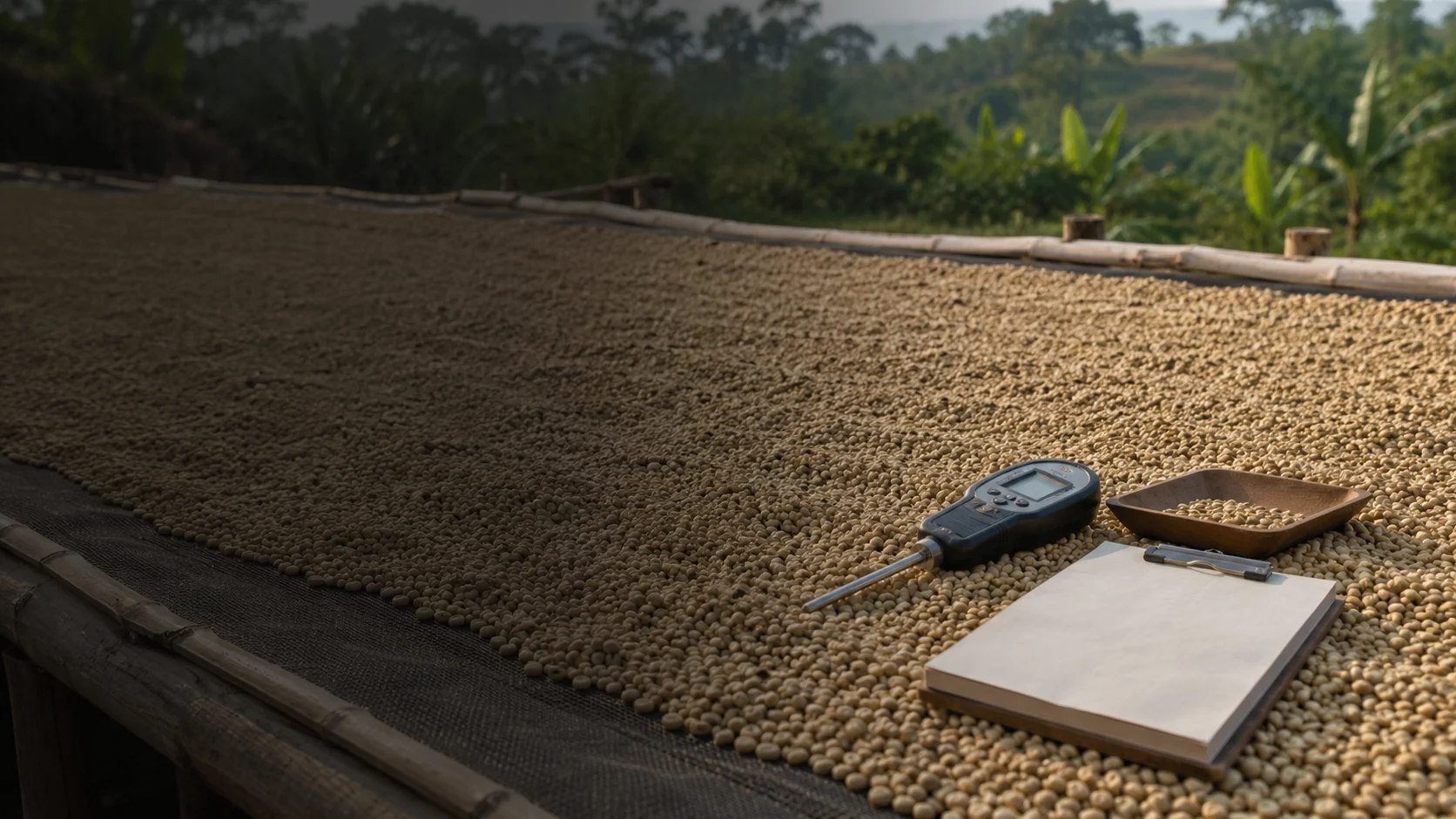
Coffee, whether whole cherry, parchment or honey-processed parchment, should be spread thinly and turned regularly. International Coffee Organization guidance on preventing mould-related contamination specifies thin layers of around 3 to 5 centimetres in depth, equivalent to roughly 25 to 35 kilograms per square metre, turned constantly during the day to speed even drying and limit time spent in the moisture range that favours fungal growth. Raised drying beds, lifting coffee off the ground on mesh or slatted platforms, allow air to circulate underneath as well as over the coffee and are widely used in Uganda for this reason, in preference to bare ground or ground-laid tarpaulins. In wetter regions, sun drying alone can be unreliable; a hybrid solar dryer combining solar heating with a biomass backup, developed by Makerere University's College of Agricultural and Environmental Sciences, has been adapted for Arabica drying in Kasese with Lutheran World Relief, keeping temperature and airflow more consistent and continuing drying through low-sunlight periods. Where such equipment is unavailable, covering coffee promptly when rain threatens and re-spreading once the surface has dried again limits re-wetting.
Moisture-verification procedure
Moisture should be measured, not judged by touch, colour or sound. The recommended approach, drawn from International Coffee Organization guidance, is to begin instrumental testing about two to three days before the coffee is expected to reach target moisture, then test daily until confirmed, using a meter calibrated against the ISO 6673 reference method. A simple field routine: draw a representative sample from several points across the drying layer, not just the surface; mix it and take a reading with a calibrated handheld meter; record the reading, date and lot identifier each time; stop drying once the target is reached and reconfirm with a second reading before bagging.
Target moisture ranges
Two moisture figures matter, at two different stages, and conflating them is a common source of confusion:
- Farm-level dried cherry (kiboko): drying is generally considered complete once dried cherry reaches a moisture content of around 13 to 14 percent, the range identified for Uganda's dry-processing stations (International Labour Organization, 2024).
- Export-grade green bean: Uganda's national quality standards, as reported to the International Coffee Council, set moisture ceilings of no more than 12.5 percent for Robusta and no more than 12.0 percent for Arabica for green (milled) coffee, referencing East African Standard EAS 130:1999 (International Coffee Organization, 2018). International Coffee Organization guidance on preventing ochratoxin A contamination separately identifies a moisture content below 12.5 percent (wet basis), together with a water activity of no more than about 0.67 to 0.70, as sufficient to protect coffee against the fungal growth associated with that contaminant during storage.
The gap between the two figures reflects hulling and further drying/equilibration between farm-level kiboko and milled export-grade green bean; a grower selling dried cherry should not assume the farm-level figure is the export specification, and should confirm the applicable target for the specific product being sold.
Storage conditions
Storage practice matters because dried coffee can reabsorb moisture and lose quality even after correct drying. International Coffee Organization guidance on ochratoxin A prevention sets out storage conditions relevant to Uganda's climate: keep ambient relative humidity below 60 percent where possible, since coffee starts reabsorbing moisture once surrounding relative humidity rises above about 80 percent; use a warehouse with a damp-proof cement floor, waterproof roof and windows, and a ceiling high enough for good air circulation; keep coffee out of direct sunlight and heat; stack bags on pallets away from walls; and keep different lots physically separated to avoid cross-contamination and preserve traceability. Coffee correctly dried can still be spoiled by re-wetting, mixing with a wetter lot, or prolonged exposure to humid air, so storage discipline matters as much as drying itself.
Traceability and lot records
A basic lot record links the harvesting and drying decisions above to any quality or price conversation with a buyer or cooperative. At minimum it should capture: a unique lot identifier; picking date range and plot of origin; processing method; drying start and completion dates; moisture readings with dates; storage location; and quality observations at intake or dispatch. Cooperative-level traceability systems in Uganda increasingly use digital record-keeping and geolocation data, partly driven by certification schemes and international supply-chain transparency requirements (Rainforest Alliance). A smallholder does not need a digital system to start; a simple paper or spreadsheet log, kept consistently, achieves the same purpose and can be digitised later. See Falcon's related guide on farm record-keeping and gross-margin analysis for Ugandan farmers for cooperative-level record systems.
Buyer-specification awareness
Buyers, cooperatives and certification schemes typically specify requirements in several general categories, without this guide asserting any specific figures a given buyer will apply, since these vary by buyer, market and season:
- Physical grade: screen (bean) size and defect-count tolerances, assessed against a grading scale.
- Moisture content: an upper limit at delivery, generally consistent with the ranges above but confirmed by the specific buyer.
- Processing method: some buyers specify washed, natural or honey-processed coffee only, or pay differently by method.
- Certification status: schemes such as organic, Fairtrade or Rainforest Alliance carry their own documented production, labour and environmental requirements, audit processes, and sometimes a defined premium structure (Rainforest Alliance describes a "Sustainability Differential" paid over market price to certified farmers, alongside a "Sustainability Investment" buyers commit to certified farms).
- Traceability documentation: increasingly, geolocation and lot-level records linked to international deforestation and supply-chain rules.
Because none of these is uniform across buyers, ask for the buyer's written specification before committing a harvest plan or processing method to it, rather than assuming a figure from general reading.
Field and quality-control log table
| Field | What to record | Why it matters |
|---|---|---|
| Lot ID | Unique code per batch | Links picking, processing, drying and sale records |
| Picking date(s) | Start/end date of harvest for this lot | Supports freshness and processing-delay checks |
| Plot/farmer of origin | Location or farmer identifier | Supports traceability and certification requirements |
| Processing method | Wet, dry or honey | Confirms method matches buyer specification |
| Drying start date | Date spread on drying surface | Basis for moisture-testing schedule |
| Moisture readings | Reading, date, meter used | Evidence of verified (not assumed) moisture |
| Drying completion date | Date target moisture confirmed | Marks readiness for storage/sale |
| Storage location | Warehouse/section, date moved | Supports lot separation and stock rotation |
| Quality observations | Visible defects, odour, colour notes | Early warning of quality loss |
| Buyer/cooperative delivered to | Name, date, quantity | Closes the traceability loop |
Warning signs of quality loss
- Musty, mouldy or fermented smell from a drying or stored lot.
- Visible mould growth on cherry, parchment or bagged coffee.
- Uneven colour across a drying layer, a sign the layer was too thick or under-turned.
- A moisture reading that has crept upward between storage checks, indicating re-wetting.
- Condensation inside storage bags or on warehouse walls, indicating excess humidity.
- A rising share of black, sour or insect-damaged beans at sorting, which can point back to harvesting or delayed processing rather than the current lot alone.
Common mistakes
- Strip-picking rather than selective picking, mixing ripe and unripe cherry in one lot.
- Leaving picked cherry in sacks for extended periods before processing, particularly in humid weather.
- Drying in thick, unturned layers, which slows and unevens drying and widens the window of fungal risk.
- Judging moisture by biting, sound or feel rather than a calibrated meter.
- Bagging coffee before moisture is confirmed stable across a re-check.
- Storing coffee directly on the ground or against walls, or near produce that adds moisture or odour.
- Mixing lots of different origin, ripeness or processing method without recording the blend.
- Assuming a farm-level dried-cherry moisture figure is the same as an export green-bean specification.
When methods work, and when they do not
Selective picking and careful drying add the most value where a buyer pays a genuine quality or certification premium, or a cooperative can demonstrably pass a premium back to the farmer; into an undifferentiated market, the return on the extra labour is less certain and is a decision to weigh against local buyer practice. Wet processing works well where clean water is reliably available and fermentation timing can be managed closely; it is a poor fit where water is scarce, where dry or honey processing may be more practical. Hybrid or mechanical drying equipment helps most in wetter regions where sun drying alone cannot reliably beat rain or high humidity; in consistently dry conditions, a well-managed raised bed may be sufficient without added equipment cost.
Cost categories to plan for
Without asserting specific prices, budget in principle for: labour for selective picking and sorting, typically higher than strip-picking; processing inputs where wet or honey processing is used (water, fermentation tanks or pulping equipment, and maintenance); drying infrastructure (raised beds, tarpaulins, or solar/hybrid dryer capital and running cost); a calibrated moisture meter and its recalibration or replacement; storage infrastructure (pallets, a properly built store, damp-proofing); and, where certification is pursued, audit fees plus any required traceability tools. Exact costs depend on scale, region and supplier pricing, and should be quoted locally.
Questions to ask cooperatives, buyers and quality officers
- What is your moisture requirement for this product (dried cherry, parchment or green bean), and how is it measured on delivery?
- What screen size and defect-count grade are you buying, and what happens to coffee outside it?
- Do you pay differently by processing method, and do you require documentation of which was used?
- What certification do you require, and what does its audit check at farm and storage level?
- What traceability or lot documentation do you require at delivery?
- Who is the current responsible office for regulatory or licensing questions, given the 2024 restructuring?
A low-risk pilot or validation approach
Before changing practice across a whole harvest, validate a revised routine on a small batch: select one lot, for example one day's picking from a defined plot, apply the selective picking criteria, dry it separately with a documented turning schedule, record moisture readings on the schedule described above, store it separately with its own lot label, and compare the outcome, such as sorted-out defect rate or buyer feedback, against a lot handled under the prior routine. This limits the labour and cost of testing a new routine while producing a comparable result to inform a wider rollout decision.
Next actions
- Set written selective-picking and sorting criteria for your team or outgrowers.
- Confirm, in writing, the moisture and grade specification your buyer or cooperative actually requires.
- Formalise a drying routine (layer thickness, turning frequency, moisture-testing schedule) and arrange access to a calibrated moisture meter.
- Start a simple lot record, even on paper, covering the fields in the table above.
- Review your storage area against the conditions described above and correct any gaps.
- Run a small-batch pilot of any changed practice before a full harvest.
- For unresolved regulatory, licensing or certification questions, contact the Coffee Department of MAAIF (successor to UCDA) or your cooperative's quality officer directly.
Limitations, Risks and When to Seek Professional Support
This guide describes a general post-harvest control chain and does not replace a specific buyer's, cooperative's or certification scheme's written specification, which should always be confirmed directly before a sale or certification decision. It does not cover pre-harvest production agronomy, price forecasting, or export-law or customs matters; readers with questions there should consult a qualified agronomist, the current regulator, or a qualified legal or trade adviser. Moisture and grading figures here are drawn from the sources in Sections D and E and reflect the position verified on the access date stated; standards, institutional names and mandates can change, so a reader should reconfirm current figures and contacts with the relevant body before relying on them for a transaction. Uganda's coffee-sector institutional structure changed in late 2024, and readers should treat any reference to the "Uganda Coffee Development Authority" found elsewhere with the same caution applied in this article, checking current status directly with MAAIF or the coffee department's own materials. Storage and drying guidance around contamination risk (for example, moisture thresholds linked to ochratoxin A) is technical guidance, not a food-safety certification; a grower or processor with a specific contamination concern should seek testing from a qualified food-safety or quality laboratory rather than relying on visual guidance alone.