
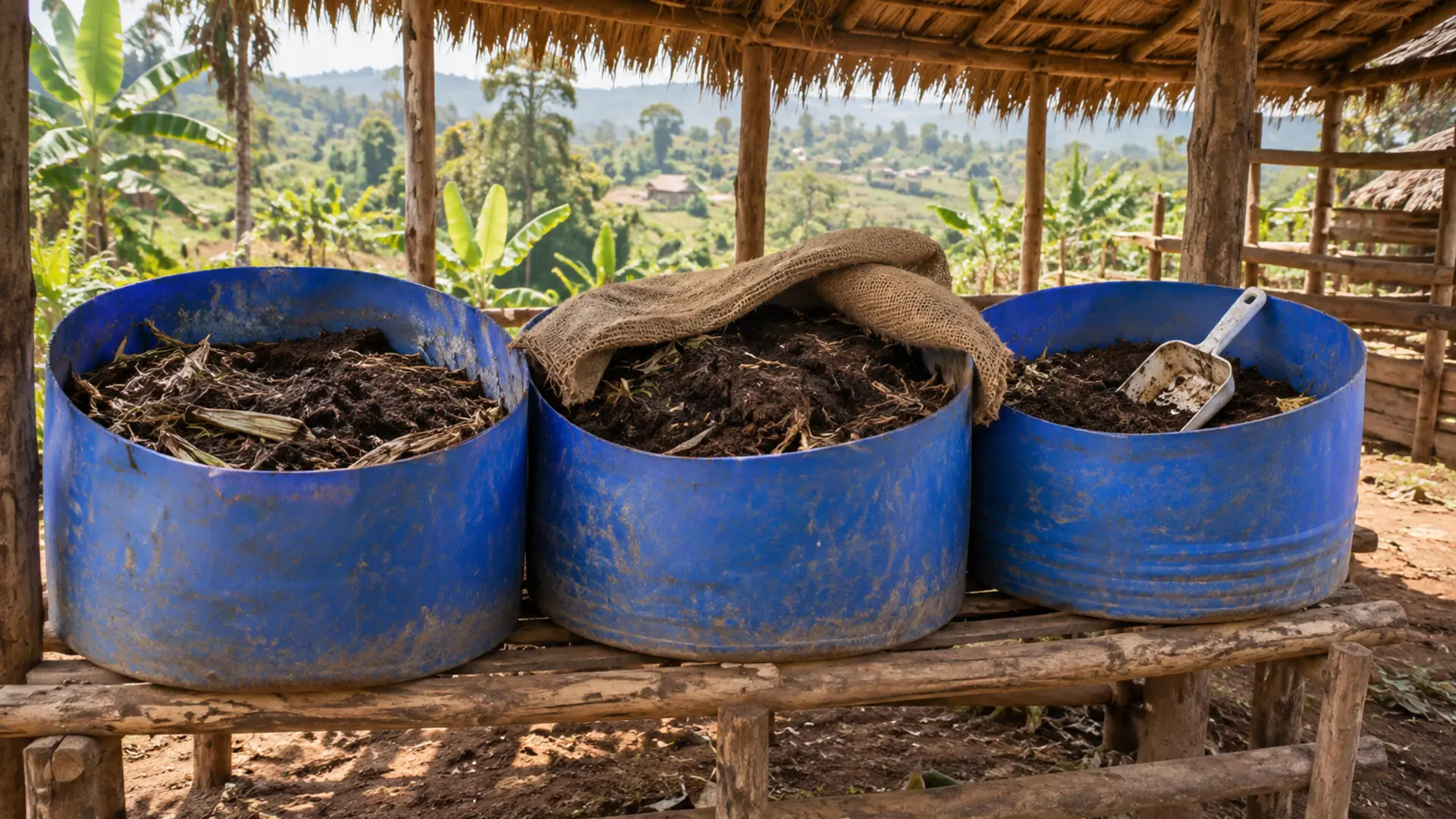
Protein is the most expensive component of any Ugandan feed ration, and three alternatives are promoted hard as the answer to that: black soldier fly larvae, azolla and duckweed.
They are not equivalent propositions. One of them has Ugandan production research behind it, national research institutions working on it, and a national standard that appears to cover the product category. The other two have no Ugandan trial data at all that we could find, feeding evidence gathered mostly on other continents, and documented contamination risks that the promotional material does not mention.
This guide sets out what is verified for each, states clearly what is not, and gives you a list of questions to put to anybody selling a system. It contains no inclusion rate presented as established practice, because for none of the three did we find a Ugandan trial that would justify one.
It deals with these three emerging options only. Conventional protein cakes and by-products are a separate subject, and the starting point for any feed decision is knowing what your current ration actually costs, which is in diagnosing what your feed is actually costing you.
The three options side by side
The three are usually presented together, as though they were variants of one idea. They are not, and the differences are clearest when the evidence and the regulatory position are read in the same row.
Insect Larvae, Azolla and Duckweed as Feed in Uganda: What the Evidence and the Regulation Actually Say
A comparison table of the three feed options against what each is, what producing it requires, the strength and origin of the evidence, and the current regulatory position.
The table sets out what each is, what production requires, the documented protein figure, the strength of the evidence, and the regulatory position. What follows takes each in turn.
Black soldier fly larvae
This is the option with genuine Ugandan research behind it, and the detail is worth having.
What is actually produced in Uganda
A study published in Frontiers in Insect Science in November 2022 examined black soldier fly production in Uganda and documented three production systems in use at different scales: a “plastic drum system used by small-scale farmers”; a “modified greenhouse system by medium-scale farmers using half-cut jerrycans”; and a “greenhouse system by large-scale farmers.” The study records “eight production cycles” achievable per year.
Insect Larvae, Azolla and Duckweed as Feed in Uganda: What the Evidence and the Regulation Actually Say
Three schematic production arrangements for insect larvae at small, medium and large scale as documented in Ugandan research, with the stated annual cycle count and the environmental conditions the larvae require.
An important qualification on that study. Its economic findings come from a survey of fourteen farmers combined with economic modelling. It is not a feeding trial and it does not report animal performance. It tells you what production arrangements exist in Uganda and at what scale, which is genuinely useful, and it does not tell you what the product does when fed.
The conditions the larvae require
A Ugandan newspaper report of institutional work states conditions that matter for anybody setting up: “BSFL do not survive well in direct light or in extreme dry or wet conditions. They prefer to be 8-9 inches deep in their food source.” The same report gives composition as “up to 50 percent crude protein, up to 35 percent lipids.”
Those conditions are the practical crux. Direct light, drying out and waterlogging are the three commonest failure modes of a small drum system, and all three are about siting and covering rather than about the insects.
That report also identifies the Ugandan institutional landscape working on this, naming the national fisheries research institute, a zonal agricultural research institute, a centre for insect research and development established at Kawanda in 2021, and the regional insect science institute.
The national agricultural research organisation has separately announced a black soldier fly project through its forestry research institute, operating in Kyegegwa, Buikwe, Nakaseke and Kamuli districts, with the environment authority, the national university and a zonal research institute as partners. A regional research programme on insects as feed for poultry and fish covers Kenya and Uganda and names the two countries’ standards bodies among its collaborators.
So the institutional activity is real and it is Ugandan. That is a meaningful difference from the other two options in this guide.
What the feeding evidence says, and where it comes from
Production is one question and performance in an animal is another. The figures that circulate on the second are worth setting out with their provenance attached.
Insect Larvae, Azolla and Duckweed as Feed in Uganda: What the Evidence and the Regulation Actually Say
A panel of documented feeding results for insect larvae by animal type, each labelled with what was measured, the reported result, the source type and the geography.
A news report of regional research gives four figures. Black soldier fly meal at “49.5 percent” crude protein on a dry matter basis. “Replacement of 20 percent fishmeal” in a layer ration “resulted in higher (53 percent) egg production.” Catfish achieving “37% higher growth rate” and tilapia “23% heavier.” And a reported reduction in “protein cost of feed production” of “at least 25-37.5 percent.” The same report gives a production figure: a “screen house of 5 m x 10 m could yield 2 tons of fresh BSF per month.”
We report those figures and we label them precisely. They come from a news report of research conducted outside Uganda. We were not able to open a peer-reviewed feeding trial that reports them directly. A farmer should treat them as claims to be verified with the researchers, not as established performance.
What this guide will not do. It will not give you an inclusion rate. The figure that circulates most, twenty per cent replacement of fishmeal, comes from the news report above and describes one trial in one ration for one animal type. Converting that into a recommendation for a Ugandan farm would be exactly the kind of unfounded specificity this guide exists to avoid.
The regulatory position, stated carefully
This is where precision matters most, because the regulatory claim is the one most often overstated.
Three converging secondary reports, from a Ugandan news outlet, a regional food industry publication and an international development research body, indicate that Uganda has a standard numbered US 1712:2017, titled “Dried Insect Products for Compounding Animal Feeds - Specification,” approved in June 2017.
A peer-reviewed regional review supports the broader position, stating that “Kenya, Uganda, Tanzania and Malawi are exceptions in having standards for use of insects as food and feed,” and identifying the Kenyan standard as KS 2711:2016.
Now the limits of what we can say.
We could not open the standard itself. The national standards body website was not reachable from our research environment. The standard’s existence rests on three converging secondary sources and a peer-reviewed review, which is reasonable evidence that it exists. It is not the text.
No source we examined names black soldier fly inside it. The title refers to dried insect products generally. Whether the standard specifically covers or approves this species is something we cannot state, and nor should anybody else without producing the text.
A separate 2025 set of standards does not cover it. Fifteen standards reported in 2025 cover crickets, locusts, bee larvae, termites, white ants and dung beetles. Black soldier fly is not among the species named in the reporting.
What to do with this. If you are being told that black soldier fly is an approved feed ingredient in Uganda, ask for the standard number and read it. The correct position from what we could verify is that a standard covering dried insect products for animal feed exists, and that whether it covers this species is a question only the text answers.
The wider framework for how Ugandan residue and food safety requirements work is in food safety and residue requirements.
Azolla
Azolla is a small floating fern promoted widely across the region as a cheap protein source. The evidence behind it is much thinner than the promotion.
Protein. An international feed database gives the “protein content is in the 19-30% DM range in optimum growth conditions.” Note the qualifier. That figure is for optimum growth, which is not what a farm pond delivers by default.
Ruminant evidence. The database notes that the ruminant trials were “carried out in India.”
Poultry. Inclusion is described as “limited to 5%.”
Fish. This is the finding that deserves attention, because azolla is promoted hardest for fish. The database states that “Most of azolla experiments on cichlids have been negative.” Tilapia are cichlids.
The safety warning. The database is explicit: azolla is a bioaccumulator, and where it has been used for water treatment or bioremediation it “should not be fed to animals.”
The Ugandan evidence. We searched for Ugandan azolla research and found only newspaper and promotional coverage without a named author, institution or method. No Ugandan or East African trial was identified.
The honest summary is that azolla has a plausible protein content under good conditions, a documented negative result in the fish species it is most often promoted for, a documented bioaccumulation risk, and no Ugandan evidence at all.
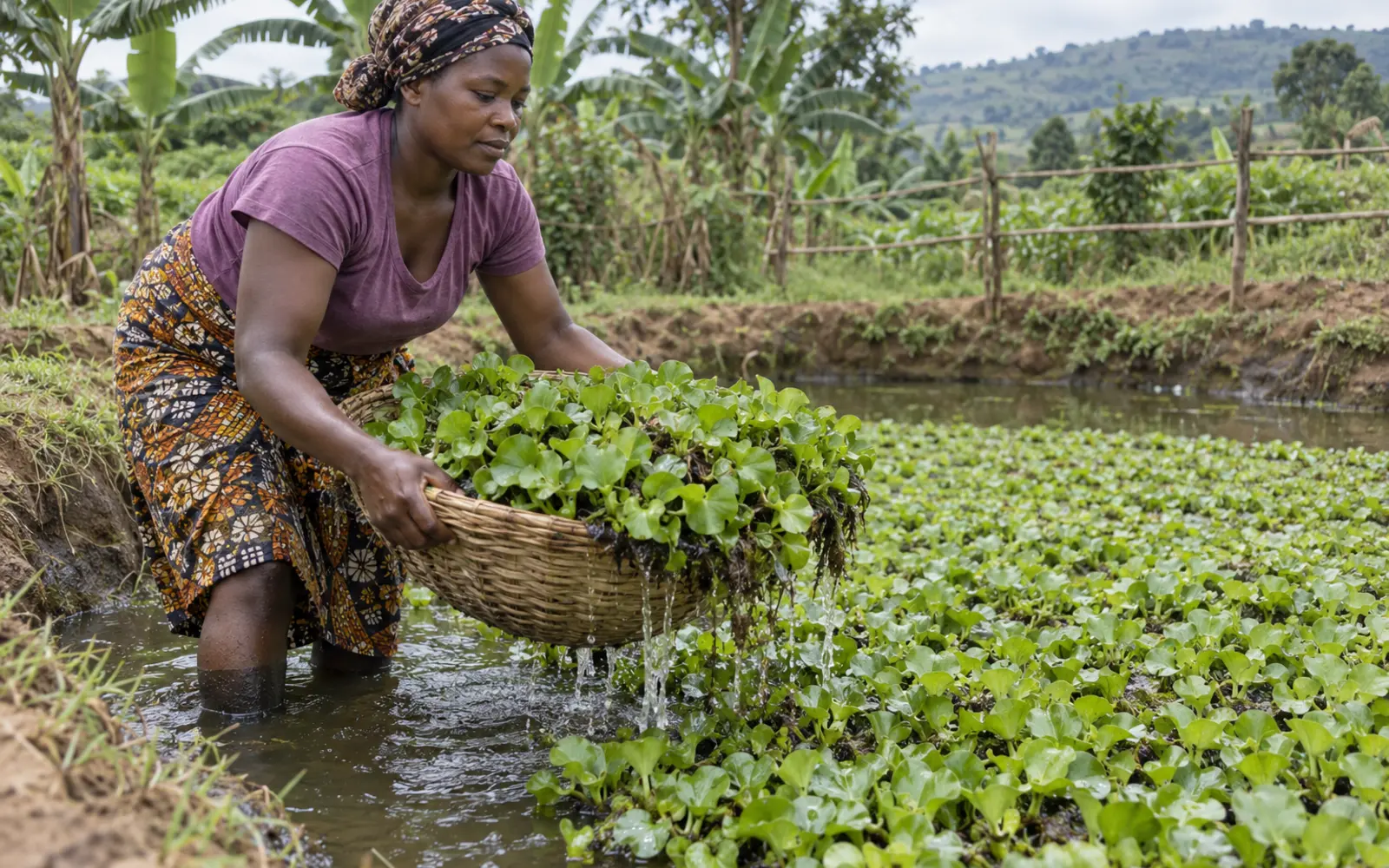
Duckweed
Duckweed is the option with the widest reported variability and the clearest warnings.
Protein. The international feed database gives a crude protein range of “7 to 45% DM,” with material grown in nutrient-enriched water reaching “30-40% DM.”
That range, seven to forty five per cent, is the single most important figure in this section. It means that duckweed is not a feed ingredient with a known protein content. It is a plant whose protein content depends almost entirely on the nutrient status of the water it grew in, and it can be as low as seven per cent, which is below most grasses.
Fish. The database states that “13.5-40% can support growth.”
Poultry. Described as suitable in “relatively limited amounts.”
Ruminants. The database states that “full substitution resulted in lower performance.”
Risks. Three documented. Oxalic acid content. And, quoted directly, “Pathogens, heavy metals and organic toxins” as hazards. And the instruction that wastewater-grown duckweed “should not be used for feed and food production.”
The Ugandan evidence. None. We searched and found no Uganda or East Africa trial data.
The practical position for a Ugandan farmer is that duckweed grown on clean water of unknown nutrient status has an unknown protein content somewhere in a range spanning a factor of six, and duckweed grown on the nutrient-rich water that would raise its protein content is precisely the water most likely to carry the contaminants the source warns about. That tension is the central problem with the crop, and no promotional account of it mentions the tension.
What growing the aquatic options actually requires
Both aquatic options are promoted as effectively free, which is where the reasoning usually stops. It is worth carrying it one step further.
A surface area, held at a stable depth. Both plants are surface growers, so production is a function of water surface rather than volume. A deep pond and a shallow one of the same area produce similarly, which means the constraint is land, not water.
Nutrient input, which is the whole problem. The protein figures quoted above are conditional. Azolla’s 19 to 30 per cent is stated for optimum growth conditions, and duckweed reaches the upper part of its enormous range only in nutrient-enriched water. Achieving those figures means deliberately enriching the water, and enriching it with the materials most readily available on a farm is exactly what raises the contamination question the sources warn about. There is no version of this where high protein and an uncharacterised nutrient source go together safely.
Harvest labour, repeatedly. These are standing crops that are skimmed, not crops that are harvested once. The labour is small each time and continuous, which is a different demand on a farm than a seasonal one, and it is the cost most often left out of an enthusiastic calculation.
Somewhere for the water to go, and something to keep out of it. An open nutrient-rich pond in a Ugandan farmyard is attractive to livestock, to children and to mosquitoes. None of the feed sources addresses that, and it belongs in the siting decision rather than being discovered afterwards.
None of this makes the aquatic options unworkable. It makes them a small managed enterprise rather than free material, and a farmer weighing them should price them that way.
The risk that runs through all three
The three options have little in common agronomically. They share one hazard, and it has the same origin in every case.
Insect Larvae, Azolla and Duckweed as Feed in Uganda: What the Evidence and the Regulation Actually Say
A panel of the documented contamination risks across the three options, grouped by heavy metals, micro-organisms and plant compounds, with the substrate and water quality link stated for each.
Every documented hazard in this article traces back to the same place: the substrate the larvae were reared on, or the water the plants grew in.
A peer-reviewed regional review sets out the contamination picture for insects. It documents cadmium accumulation in black soldier fly and crickets, arsenic in mealworms, and lead in one edible grasshopper species. It documents microbiological hazards including Bacillus, Staphylococcus and Clostridium among bacteria, Aspergillus, Fusarium and Penicillium among fungi, and protozoan parasites. Critically, it ties these to substrate quality rather than to the insect itself.
That is the whole control point, and it is good news in one sense: contamination is a function of an input the farmer controls, not an inherent property of the product.
It is bad news in another. It means a black soldier fly operation reared on uncontrolled mixed waste, which is exactly the economic case usually made for it, carries a risk that is proportional to how uncontrolled the waste is. An operation reared on a known substrate from a known source is a different proposition from one reared on whatever the market dumps.
The same logic applies to the aquatic plants. The bioaccumulation warning for azolla and the wastewater warning for duckweed are both about water source. A farmer who cannot state what the water carried should not feed the plant.
Three practical rules follow.
Know the input, specifically. Not “food waste” but which food waste, from where, and what else might be in it.
Do not use material grown for treatment purposes as feed. Both the azolla and duckweed sources say this explicitly, and it is the single most likely way a well-intentioned integrated system causes harm.
Processing does not fix contamination. Nothing in the sources suggests drying, milling or heating removes heavy metals. A contaminated input produces a contaminated feed.
What to ask anybody selling you a system
None of the above tells you whether a particular offer is sound. These questions do, and they work whether the offer concerns larvae, ferns or floating plants.
Insect Larvae, Azolla and Duckweed as Feed in Uganda: What the Evidence and the Regulation Actually Say
A blank checklist of eight questions to put to anyone selling or promoting an alternative protein feed system, with ruled space for the answer, its source and the date.
The checklist has eight questions. Three of them are the ones a weak proposition fails.
What is the substrate or water source, specifically, and who controls it? If the answer is vague, the risk assessment above cannot be done at all.
What published trial supports the inclusion rate being recommended, and where was it conducted? A promoter recommending a proportion of the diet is making a claim that a trial somewhere supports. Ask which one.
What has your own operation actually produced, measured rather than projected? The distinction between a measured output and a modelled projection is the distinction between evidence and a spreadsheet. The Ugandan production study cited above is explicitly economic modelling from a fourteen-farmer survey, which is a legitimate piece of research and is not a production record.
Two further points on how to use the sheet.
Write down who answered. As with any technical claim, a named person and a date is worth more than a recollection.
Start small and keep records. The strongest argument in favour of all three of these options is that they can be trialled at very small scale on a farm without much commitment. The strongest argument against acting on the published figures is that none of them was measured in Uganda. Those two facts point in the same direction: run a small trial, feed a defined group, record what happens, and compare. The approach to doing that so the result means something is in reading agricultural research for a Ugandan farm.
Running a small trial that actually tells you something
The honest conclusion of every section above is the same: the Ugandan evidence does not exist, so build your own. That is only useful if the trial is designed so its result means something, and most on-farm trials are not.
Four things make the difference, and none of them costs money.
Feed a defined group and keep a comparison group. A trial with no comparison group tells you what happened, not what the feed did. Two groups of similar animals, similar age and similar starting condition, one fed the new material and one not, is the minimum design that separates the two.
Change one thing. A trial that introduces a new protein source and a new basal feed and a new feeding schedule in the same month produces a result that cannot be attributed to anything.
Measure something specific, before and after. Eggs collected per day. Weight at a fixed interval. Fish weight at a fixed interval. Feed consumed. Not an impression of how the animals look.
Write down what the material was. Which substrate, from where, over what period. This is the record that lets you repeat a good result and diagnose a bad one, and it is also the record that matters if anything goes wrong.
And run it small enough that failure is affordable. All three of these options can be trialled on a handful of animals. There is no reason to commit a whole flock or a whole pond to an input whose performance has not been measured anywhere in this country.
What these three do not replace
It is worth being clear about what problem is actually being solved, because these options are frequently presented as solving a larger one than they do.
They are a protein component, not a ration. Substituting part of a protein source in a balanced ration is a different operation from feeding a new material and hoping. The energy, mineral and bulk components of the ration are unchanged by anything in this article.
They do not remove the need to know your current cost. The case for any of these rests on the cost of the protein they displace. A farm that cannot state what its current protein is costing per unit cannot evaluate a replacement, which is why the feed cost diagnosis comes before this decision rather than after it.
They do not remove a biosecurity obligation. Introducing any new input into a poultry or fish enterprise is an introduction, and the contamination evidence above makes that literal rather than theoretical. For poultry, the relevant framework is in poultry biosecurity.
And they are not a waste disposal solution and a feed solution at the same time. This is the most common conceptual error in the promotion of all three. The economic case usually rests on using waste that has no other value. The safety evidence says the value of the product depends on the quality of that input. Those two things pull in opposite directions, and an operation has to choose which one it is optimising. A system designed to dispose of uncontrolled waste is not a system producing a feed ingredient whose safety you can vouch for.
Where this leaves each option
Black soldier fly larvae has documented Ugandan production systems at three scales, active Ugandan institutional research, a regional programme involving the standards body, a standard covering dried insect products for animal feed whose text we could not read, and feeding performance figures that come from a news report of research conducted elsewhere. It is the most developed of the three by a wide margin, and its evidence base is still not one that supports a specific inclusion recommendation for a Ugandan farm.
Azolla has a documented protein range under optimum conditions, a documented negative result in the fish species it is most promoted for, a documented bioaccumulation warning, and no Ugandan evidence.
Duckweed has a protein range spanning a factor of six depending on growing water, documented risks including oxalic acid, pathogens, heavy metals and organic toxins, an explicit instruction against wastewater-grown material, and no Ugandan or East African evidence.
None of that means any of them should be dismissed. Small trials on farms are how evidence gets built, and a farmer who runs one carefully and records it has done something genuinely useful.
What it does mean is that anybody presenting these as proven feed cost solutions for Ugandan livestock is going considerably further than the published evidence goes. Ask them for the document. If they have it, you have learned something. If they do not, you have learned something more important.
Author: Falcon Foundation Ltd Editorial Team
The Falcon Foundation Ltd Editorial Team produces evidence-based agricultural guidance for Ugandan farmers, drawing on published research and institutional sources and translating them into practical decision support. Where evidence is unavailable or contested, we say so rather than filling the gap.
