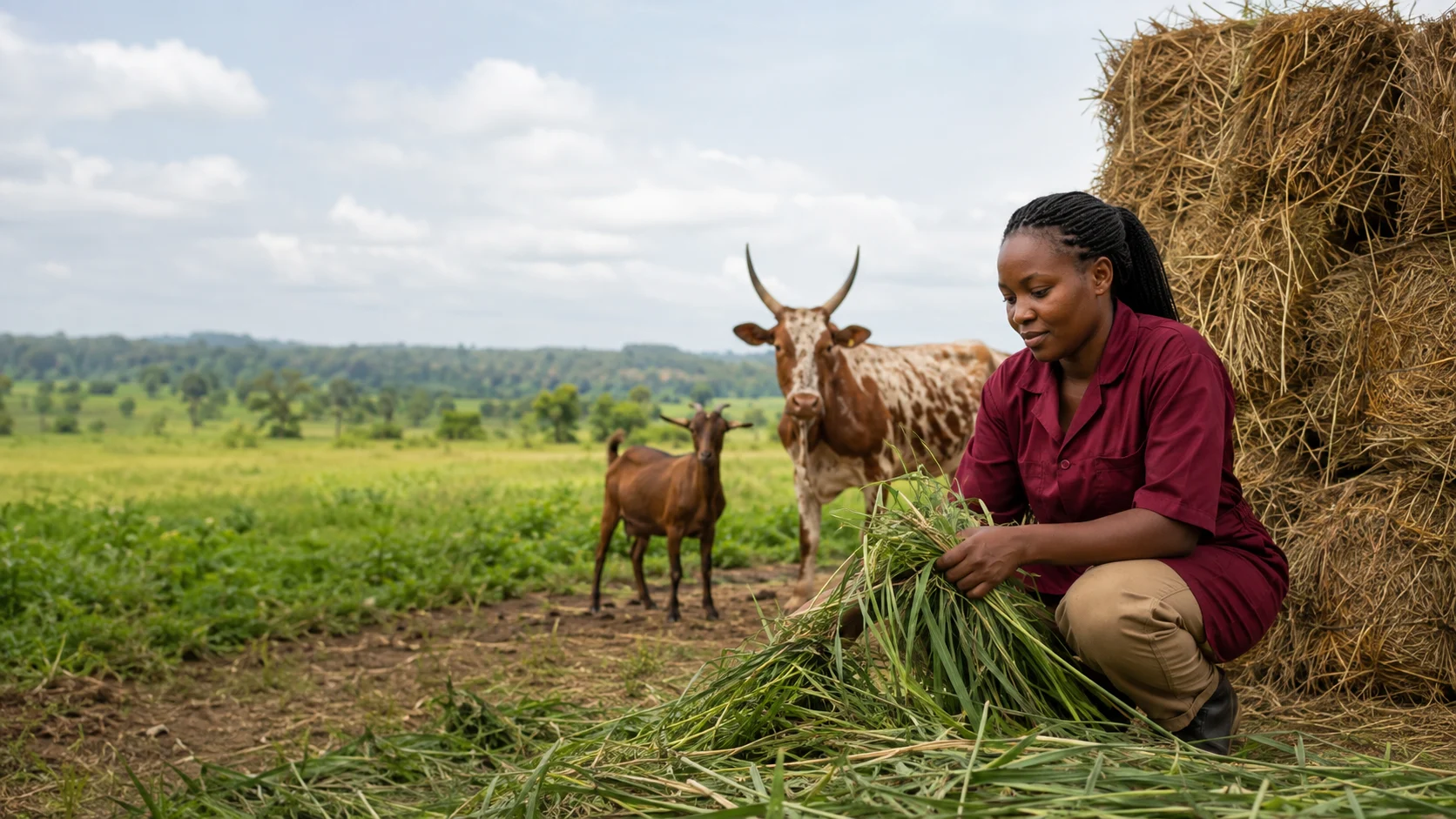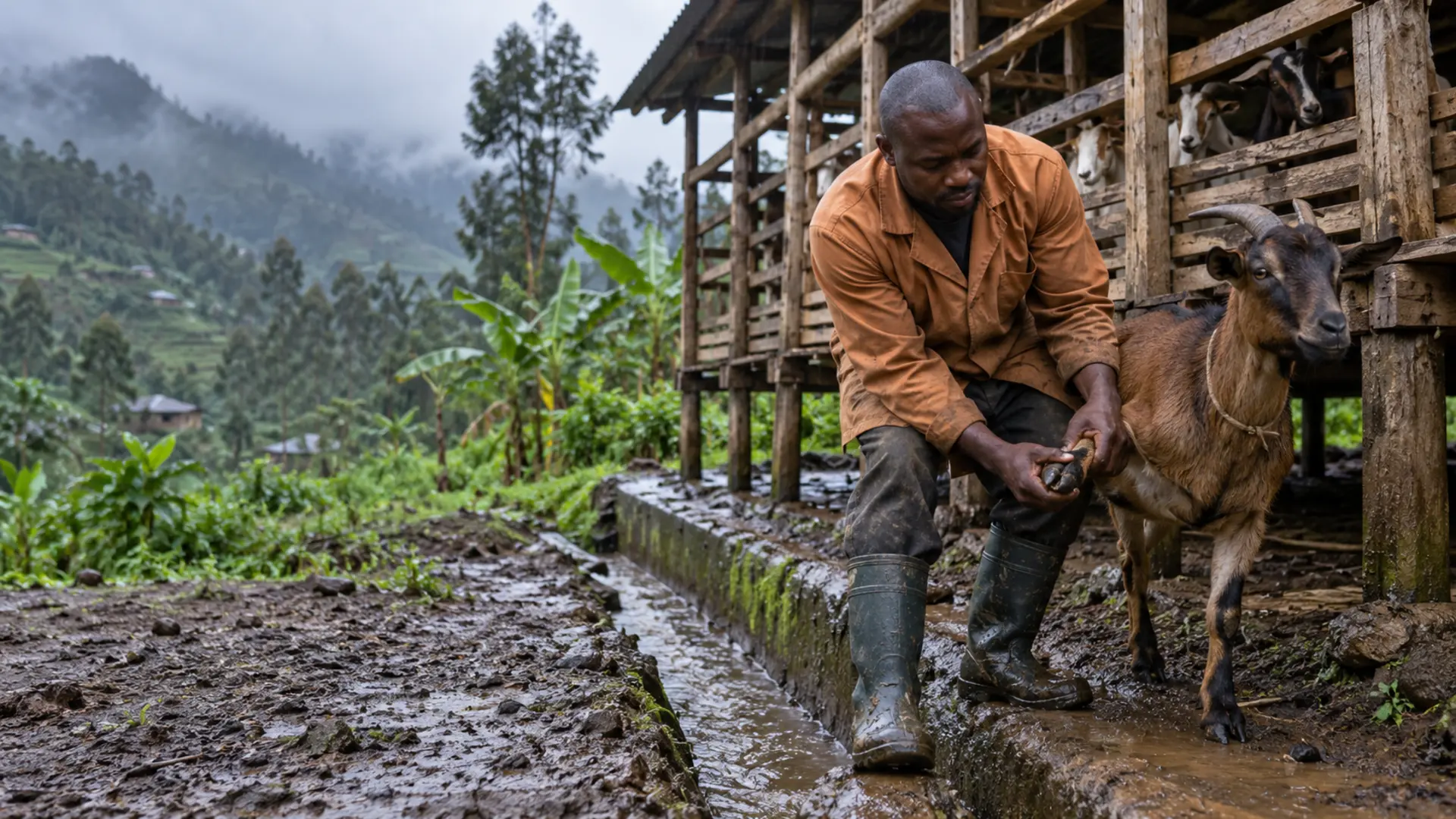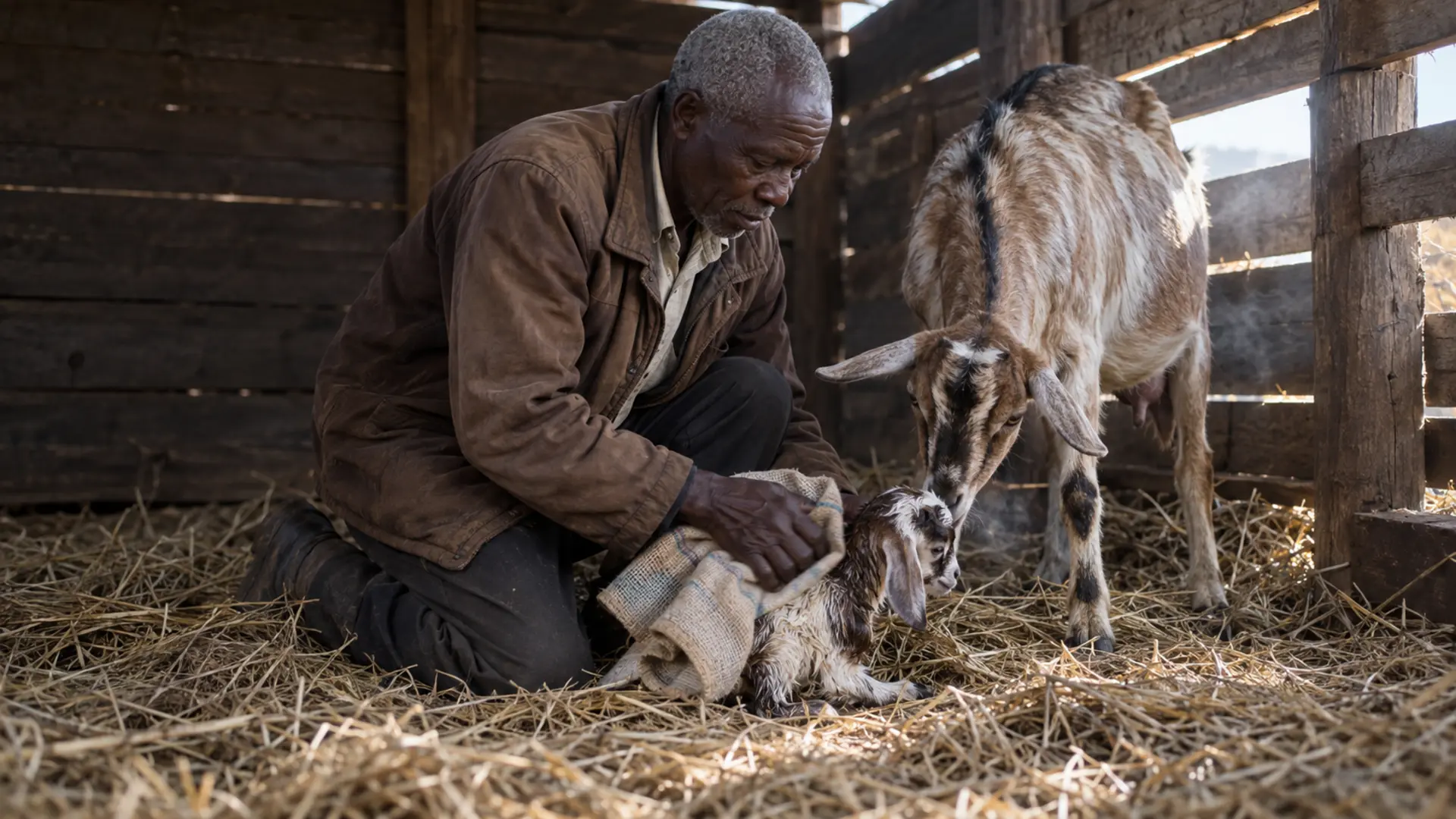
The kids that die tend to die quietly and early, and the losses tend to get absorbed into a general sense that this is what goats do. A doe kids overnight in the corner of the yard. In the morning one kid is up and one is flat, cold and has not fed. By the time anybody notices, the window in which anything could have been done has closed.
Almost none of the work that would have changed that outcome happens at the birth. It happens in the four weeks before it, and in the first hour after it, and it consists almost entirely of things that require no medicine, no equipment and no veterinary training.
This guide covers exactly that: preparation, observation, and the newborn care that a keeper can safely give. It contains no obstetric procedure, no drug, no dose and no instruction on how to assist a difficult delivery, because those are veterinary matters and describing them would do more harm than good.
Why the first days matter, and what the Ugandan evidence actually says
We looked hard for a Ugandan figure for kid mortality specifically in the first hours and days of life, and we did not find one. That gap is worth stating plainly rather than filling with a number from somewhere else.
What Uganda does have is a two-year flock study at the Bulindi Zonal Agricultural Research and Development Institute in Hoima District, running from July 2020 to June 2022. Of 61 total goat deaths recorded over that period, 49 per cent, or 30 animals, were kids. The deaths clustered mainly in the October to December 2021 heavy rain period, and the majority of the kids that died were reported to have died of worm infestation. The authors’ recommendations included separating kids and other vulnerable goats, providing adequate warmth during heavy rain, and ensuring kids suckle adequate colostrum following birth.
Read that carefully, because it is easy to misuse. That 49 per cent is the kid share of all goat deaths across a whole two-year period, at every age up to weaning, from all causes. It is not a first-days mortality figure and this article does not present it as one. What it does establish is that kids are where a Ugandan research flock lost most of its animals, that wet cold weather coincided with the losses, and that a Ugandan institution’s own remedy list starts with warmth and colostrum.
A wider systematic review of dairy goat management under smallholder systems in Eastern Africa, covering Kenya and Tanzania, states that pre-weaning kid mortality was high across the systems reviewed, without giving a quantified figure and without covering Uganda.
What this guide helps you decide
What to do in each of the four weeks before a doe is due. What a kidding pen has to provide and what it costs to build. What to do, in what order, in the first six hours of a kid’s life. How to tell a normal labour from one that has stopped progressing. And exactly which signs mean the job has stopped being yours.
The short answer
Know roughly when each doe is due. Have a clean, dry, sheltered pen ready before you need it. Be present, or check often, when a doe is close. When a kid is born, clear the airway, dry it, make sure it is warm, attend to the navel, and get colostrum into it fast. If it is cold, warm it before you feed it. And if a doe has been straining hard with no progress for about half an hour, stop and telephone.
Knowing when
Merck’s veterinary reference gives gestation in goats as an average of 150 days, and notes that fetal viability is compromised if delivery occurs before day 144. Extension guidance gives a working range of 146 to 155 days.
That means a doe you saw served can be given a due window, and a doe you did not see served has to be watched. Write the service dates down. A calendar on the wall of the goat house is the cheapest kidding management tool available.
The physical signs, with the timing each source gives:
Relaxation of the pelvic ligaments on both sides of the tail head, described by extension guidance as beginning about two weeks before kidding, so that the area feels soft and sunken where it was firm.
Udder development and filling, given as the last three to four days.
Teat enlargement, restlessness and pawing at the bedding, one to two days before.
A vulval discharge, thin at first and thickening as parturition approaches.
Continuous bleating in roughly the last twelve hours.
Merck’s reference summarises the same picture as udder development, behaviour changes including isolation, vocalisation and nesting, and vulvar discharge.
None of these is precise. Together they are enough to tell you which doe to move into the pen tonight.
The four-week countdown
Four weeks is not an arbitrary figure. It is roughly the period over which the doe’s udder develops, over which her feed requirement climbs steeply as the kids complete most of their growth, and over which a kidding area can be built, dried out and bedded without hurrying. Shorter than that and you are reacting; longer and the preparation drifts.
The countdown below is a checklist, not a schedule of events. Each item is something that must be true before the doe kids, and the week against it is the latest sensible point to deal with it rather than the only point.
Kidding Season: Preparing Before the Doe Gives Birth
Four-week countdown checklist before kidding, with tasks grouped by week for the doe, the pen and the supplies
Four weeks out: the doe’s condition. The last stage of pregnancy is when most fetal growth happens and when the doe’s nutritional requirement rises sharply. University extension guidance describes the last trimester as the period of most fetal growth, with nutritional needs nearly doubling. A goat-health resource notes that roughly 60 to 80 per cent of foetal growth occurs in the final month while dry matter intake declines, because the growing kids crowd the rumen.
Body condition is the practical handle. Merck’s guidance on pregnancy toxaemia states that does should not enter the last six weeks of gestation with a body condition score below 2.5 out of 5, and that it takes about six weeks to raise body condition by one point. That arithmetic is the reason this is a four-week task and not a last-week task: if the doe is thin now, you are already late.
Note the other half of that instruction, which is easy to miss. Overfeeding in mid-pregnancy is also a documented risk factor, because internal fat crowds the abdomen. The target is steady, adequate condition, not fattening.
Three weeks out: the pen. Identify or build it, and see the specification below. Clean it out and let it dry.
Two weeks out: reduce handling and disturbance. Extension guidance recommends against stressful handling in the run-up to kidding, and recommends grazing does close to the homestead where they can be watched easily. One useful piece of practical advice from an American extension source is to feed concentrate at night, on the observation that this tends to shift births towards more convenient hours.
One week out: the supplies. Gather them now, in one place, so that nothing has to be found in the dark. Dry sacking or old towels for drying kids. Clean bedding. A torch with working batteries. Iodine or another navel antiseptic and a small clean container to dip into. Blunt-ended scissors or a clean blade and a piece of clean string, kept together. A record book. The telephone number of your veterinarian or animal health worker, written on the wall rather than only in a phone.
And, if you can, stored colostrum. See below.
The kidding pen
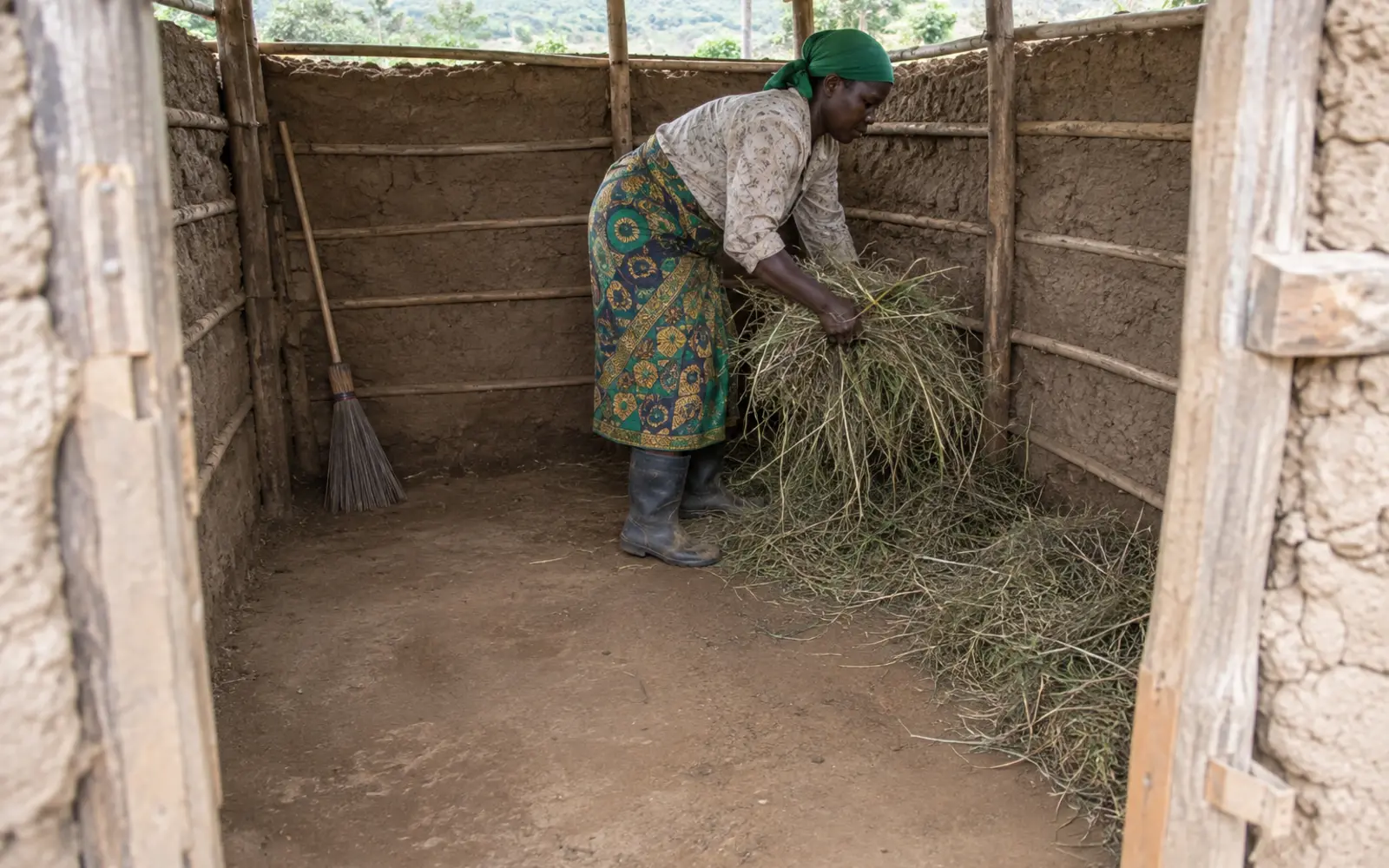
The published specification is simple and consistent. Extension sources describe a small individual pen, commonly called a jug, of about 5 feet by 5 feet, or roughly 1.5 metres square, for one doe and her kids.
What it has to provide: a dry floor, clean and generous bedding, shelter from wind and rain, and enough separation that the doe can bond with her kids without being pushed around by the rest of the flock. Extension guidance is direct that bedding should always be kept dry and clean, and that pens should be cleaned and disinfected between family units.
For a Ugandan smallholder, the practical version is a corner of the existing goat house partitioned off with poles or a hurdle, swept out, and bedded deep with dry grass. It does not need to be built. It does need to be dry, and it needs to exist before the doe needs it.
The first six hours
This is the protocol. Do it in this order.
Kidding Season: Preparing Before the Doe Gives Birth
First six hours timeline for a newborn kid showing breathing, drying, warmth, navel care and colostrum, with the check at each point and the published window for colostrum
1. The airway, immediately. Clear mucus and any membrane from the mouth and nostrils. If the kid is not breathing, extension guidance describes vigorous rubbing of the chest and ribcage as a stimulus, and one source describes gently inserting a piece of clean straw a short way into a nostril to provoke a sneeze reflex in a weak newborn.
There is one thing you should not do, and it is a widely taught practice. Merck’s veterinary reference states plainly that hanging newborn kids upside down is an outdated technique, and extension guidance from Alabama independently advises avoiding suspending kids by the hind limbs. The reasoning is that it presses the abdominal contents against the diaphragm and impairs lung expansion rather than helping it.
2. Dry the kid. A wet newborn in moving air loses heat fast. Rub it dry with sacking or a towel, briskly, over the whole body. This doubles as the breathing stimulus in step one.
3. Check that it is warm. Merck’s reference names hypothermia as a leading killer of neonates. Extension guidance from Alabama defines hypothermia in small ruminants as body temperature below 39 degrees Celsius, with bands of mild at 37 to 39, moderate at 34 to 37 and severe below 34 degrees. Kansas State guidance gives a simpler field threshold of 99 degrees Fahrenheit, about 37.2 degrees Celsius.
The warming methods described in the literature are drying with towels, a heat lamp used from a safe distance, and for severe cases warm water immersion at about 40 degrees Celsius keeping the head above water.
Here is the single most important sequencing instruction in this article. Kansas State guidance states that if the kid’s temperature is below 99 degrees Fahrenheit, you should avoid tube feeding colostrum, and warm the kid first. A chilled kid cannot use the feed and feeding it can do harm. Warm first. Feed second. Every time.
4. The navel. The umbilical cord is a direct route into the kid’s bloodstream. South Dakota extension guidance describes it as able to serve as a wick for bacteria, with navel ill producing unthrifty, lame, arthritic animals with swollen joints, typically at one to three weeks of age.
Extension guidance describes cutting the cord to a short length, commonly given as about 1.5 inches, and treating it. On what to treat it with, the literature describes two antiseptic classes: iodine, historically as a 7 per cent tincture and now often at lower concentrations, and chlorhexidine at 2 to 4 per cent, which research cited by South Dakota extension found as effective as 7 per cent iodine. Two explicit warnings appear: alcohol alone should not be used, as it is not effective at preventing bacterial colonisation; and teat dip is a poor choice for navel care, because it is formulated to keep skin soft, which is the opposite of what a navel needs.
We should record an honest disagreement here. Alabama extension guidance takes a different position, warning that strong iodine dips cause inflammation and favouring a clean environment plus adequate colostrum over disinfectant. Both views are held by credible extension services. What all of them agree on is that a clean, dry pen matters more than what is in the dip cup.
5. Colostrum. This is the highest-value single action in the whole article.
Colostrum, and why it is not simply milk
A kid is born with essentially no circulating antibody. This is not a deficiency; it is anatomy. Ruminants have a placenta structured in a way that, in the words of a 2025 review, effectively precludes the prenatal transfer of maternal antibodies to the foetus, leaving the newborn with none. Everything the kid has for its first weeks of life comes through colostrum, and only through colostrum.
The window. Here the sources differ substantially, and averaging them would be dishonest. The tightest and most recent figure, from the 2025 review, is an optimal window within the first 4 to 6 hours of life, with absorption becoming negligible by 24 hours, and a specific warning that delaying the first meal from the initial 4-hour window to 12 to 16 hours after birth severely impairs the resulting antibody level. Purdue extension gives about twelve to fifteen hours. Florida extension states that absorption starts to decline after about 12 hours and that after the initial 24 hours the intestinal tract no longer allows absorption. Maryland extension gives 24 to 36 hours, with the memorable formulation that thirty minutes is optimum whereas eighteen hours is a must.
The range across those sources is nearly tenfold. What every one of them agrees on is that earlier is better and that the gut closes. The practical instruction that survives all of them is: within the first hour if you possibly can, and treat anything past six hours as an emergency rather than a schedule.
Kansas State guidance puts the target at the first 30 to 60 minutes of life. Extension guidance elsewhere gives within half an hour or so.
The quantity. The most frequently repeated figure across extension sources is 10 per cent of the kid’s bodyweight over the first 24 hours. Florida extension gives 10 to 20 per cent, split into four equal feeds at birth, 6 hours, 12 hours and 18 hours. The 2025 review gives 7.5 per cent of bodyweight, or 160 millilitres per kilogramme.
For a 3 kilogramme kid, 10 per cent is about 300 millilitres over the first day. Split it rather than forcing it in one feed.
Heating and storage. If you are thawing stored colostrum, do not use direct heat and do not use a microwave. Extension sources warn that overheating destroys the antibodies, and specify warming in water at around 90 to 100 degrees Fahrenheit, roughly 32 to 38 degrees Celsius, to body temperature. For banking, freeze in small portions, an ice cube tray being the method extension sources describe, labelled with the date; storage life is given as six months by one source and up to twelve by another.
If the doe has none. The order of preference in the literature is colostrum from another doe in your own herd, then cow colostrum, which one source notes needs roughly 30 per cent more volume, then a commercial replacer, described explicitly as not as effective.
That order is the reason to freeze surplus colostrum from an easy kidding when you have it. It costs nothing and it is the only version of insurance available on a smallholding.
Normal labour, and the point at which it stops being normal
The published figures for how long a normal labour takes vary widely, and the variation is real rather than a reporting error: sources separate first-time does from experienced ones, and different sources measure different stages.
Extension guidance describes a normal delivery as usually taking five hours, with cervix dilation usually requiring four hours and delivery one. Oklahoma State gives stage one as four to eight hours in mature does and six to twelve in first-timers, with stage two under an hour in mature does and up to four hours in first-timers. A university veterinary source gives typical delivery of 20 to 30 minutes for a single kid and 15 to 20 minutes per kid for twins. Kansas State states that delivery should occur within 30 to 45 minutes after a yellowish, fluid-filled water bag appears.
Do not try to reconcile these. Use the action trigger instead, which is where the sources converge much more tightly.
The trigger: a doe pushing hard, with visible straining, and no progress for about thirty minutes. Extension guidance, Merck’s veterinary reference, Oklahoma State and Kansas State all name roughly thirty minutes as the point at which assistance is likely required. One university veterinary source uses fifteen minutes as its rule of thumb.
At that point, this article’s instruction is simple and complete: telephone your veterinarian or animal health worker. It does not tell you how to examine or assist, because a lay intervention on a malpresented kid can kill both the kid and the doe, and because Merck’s reference puts the incidence of genuine dystocia in goats at under 5 per cent, meaning most of what looks like a stuck birth to an anxious owner is not one.
When to call a veterinarian
The signs below are not a list of things to watch with interest. They are the points at which the correct action is to stop and make a phone call, because the alternative - attempting an intervention from written guidance - is how does and kids are lost.
Know the number before you need it. A district veterinary officer’s contact obtained at nine in the evening, from a neighbour, while a doe is straining, is not a plan.
Kidding Season: Preparing Before the Doe Gives Birth
Veterinary referral panel listing the signs in the doe and in the kid that require calling a veterinarian immediately
In the doe. Hard straining for about thirty minutes with no progress. A water bag that appeared 30 to 45 minutes ago with no kid. The cervix not dilating. A presentation you do not recognise. Any attempt at correction that has gone on more than about fifteen minutes without success, which is a stop signal, not an instruction to try. A retained placenta, or fever persisting more than three days after kidding. In late pregnancy: going off feed selectively, dullness, unsteadiness on her feet, apparent blindness, or going down, which are the described signs of pregnancy toxaemia and are an emergency.
In the kid. Not standing. No suckle reflex. A cold mouth, a hunched back, shivering, a hollow flank, or no vocalisation. A kid that was up and feeding and has stopped. Swelling, heat or discharge at the navel in the following days.
There is nothing on that list this article asks you to treat yourself.
Common mistakes and failure points
Not writing down service dates, so no doe has a due window. Leaving the pen until the night it is needed. Letting a doe enter the last six weeks thin, when it takes six weeks to correct. Overfeeding in mid-pregnancy on the theory that more is better. Hanging a newborn upside down. Feeding a chilled kid instead of warming it. Assuming a kid that is breathing has fed. Assuming a doe with two kids has fed both. Waiting for the doe to sort out a birth that has visibly stopped. Using a teat dip as a navel dip. Warming stored colostrum over direct heat. And throwing away surplus colostrum from an easy kidding, which is the cheapest insurance on the farm.
A practical action plan
Today. Put a calendar or a notebook in the goat house and start recording service dates. Walk the goat house and decide where the kidding pen will be.
Four weeks before the first doe is due. Assess body condition on every pregnant doe and act on the thin ones now, not later. Clean and dry the pen area.
One week before. Assemble the supply box and put the veterinarian’s number on the wall. Move the doe into the pen when the ligaments go soft and the udder fills.
At the birth. Airway, dry, warm, navel, colostrum, in that order, with the warming step gating the feeding step.
Afterwards. Write down what happened: the date, the number of kids, whether they fed unaided, and anything unusual. Three seasons of that record will tell you whether your losses are a pen problem, a colostrum problem or a nutrition problem, which is a question no article can answer for your herd.
Conclusion
Kidding is one of the few parts of livestock keeping where preparation almost entirely determines the outcome and intervention almost entirely does not.
The keeper who has a dry pen ready, a calendar on the wall, a box of dry sacking and a bag of frozen colostrum in the freezer will lose very few kids. The keeper who has none of those things will lose some every season, and will keep believing that this is simply what goats do.
Author: Falcon Foundation Ltd Editorial Team
The Falcon Foundation Ltd Editorial Team produces evidence-based agricultural guidance for Ugandan farmers, drawing on published research and institutional sources and translating them into practical decision support. Where evidence is unavailable or contested, we say so rather than filling the gap.