
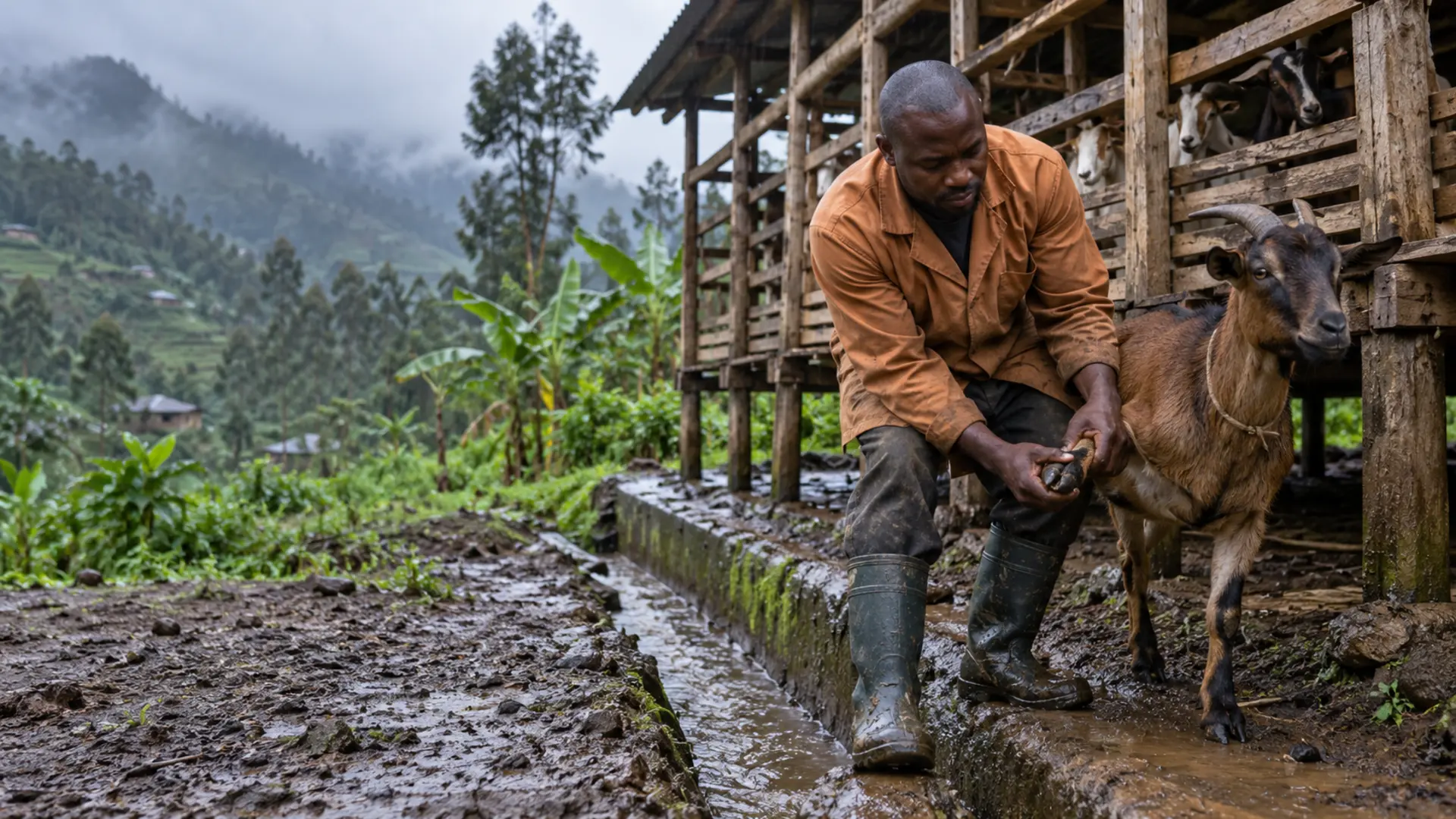
Consider a group of goats that are thin, slow to rise and reluctant to walk. They have been tethered on the same damp patch for months, and their night shelter has an earth floor that stays wet between rains. The cause cannot be diagnosed from appearance alone, but their feet and housing conditions require immediate attention.
Persistent exposure to wet ground is an important and sometimes overlooked contributor to hoof problems in wet districts. Poor condition can also involve inadequate feeding, internal parasites or disease, so housing should not be treated as the only possible cause. A goat with persistently sore feet may graze and browse less, lose condition and require veterinary assessment as well as better footing.
The fix is structural, and then it is a routine. This guide covers both. It names no medicines, no antibiotics, no footbath chemicals and no doses, and it is explicit about the point at which a qualified veterinarian is required.
What this guide helps you decide
Whether your housing is contributing to lameness. What the published sources actually specify for a raised goat house, and where they disagree so sharply that you have to choose rather than average. How to trim a hoof without cutting into live tissue. How to score lameness so that you notice a trend instead of a crisis. And when the problem has stopped being a husbandry problem and become a veterinary one.
The short answer
Get the goats up off the ground, keep the space under the floor cleared and drained, and look at feet on a schedule rather than when an animal is already limping.
The disease mechanism is well documented. Foot rot results from two microorganisms, Dichelobacter nodosus, which can be found in contaminated soil, and Fusobacterium necrophorum, and outbreaks occur most often during persistent rainy weather along with high temperatures when animals walk across wet pastures and muddy soil. Purdue extension guidance makes the important addition that neither organism alone is capable of causing foot rot, and that incidence rises when pastures have been consistently wet with no dry spells. Guidance from Idaho notes that the bacteria require irritation between the claws to gain entry, which can occur due to moisture or trauma.
Uganda’s climate makes this a live problem across much of the country. A climate risk profile records annual precipitation of 1,000 to 1,600 millimetres in most parts of the country, with the south carrying a bimodal regime with rains from March to May and from September to December.
What Ugandan practice looks like now
A peer-reviewed study of goat feeding systems among smallholders in semi-arid Uganda, in an area averaging about 1,200 millimetres of rain a year, found tethering to be the major practice at 90 per cent, followed by free range at 9 per cent, with 55 per cent of respondents keeping goats in a house at night. It named disease as a major constraint alongside shortage of land and inadequate pasture.
That is the baseline this article is trying to move. Tethering on damp ground with night housing on an earth floor is precisely the exposure pattern the foot rot literature describes.
The dimensions, and the disagreement
This is where honest advice diverges from confident advice. The published sources do not agree, and the disagreements are large enough that averaging them would produce a specification nobody published.
Floor space per animal. Uganda’s national agricultural advisory service, in its 2022 guide to goat enterprise technologies and practices, gives 0.3 square metres for a baby goat, 1.5 for an adult goat, 1.9 for a pregnant goat and 2.8 for a billy goat. A Zimbabwean smallholder manual gives 1.5 square metres per goat. A Kenya-oriented dairy goat handbook gives at least 2 square metres per animal. The Food and Agriculture Organization’s tropical farm structures guidance and a Philippine national engineering standard both structure the allowance by live weight, giving roughly 0.8 to 1.4 square metres for a doe depending on weight on a solid floor, and 0.7 to 1.1 on a slotted floor, with 2.5 to 3.0 square metres for a buck. United States extension sources describe a different production context again, giving 20 square feet per mature goat in complete confinement with an additional 25 square feet of exercise yard, or 10 to 15 square feet in a bedded area with outside access.
The Ugandan figure of 1.5 square metres for an adult is a reasonable planning number for a Ugandan reader, since it comes from a Ugandan institution and agrees with two regional sources. Note that the weight-based sources would give a smaller figure for a small local doe and a larger one for a heavy improved animal, which is a more precise way to think if you know your animals’ weights.
Slats. The Food and Agriculture Organization’s tropical farm structures guidance specifies slats 70 to 100 millimetres wide and 25 to 30 millimetres thick, laid with 25 millimetre spaces. A Philippine engineering standard gives the same width and thickness with a slot spacing range of 10 to 25 millimetres. An Indian source citing published work gives a gap of 14 to 16 millimetres. Two African handbooks, one South African and one Kenya-oriented, both specify gaps of about half an inch, which is roughly 12.7 millimetres.
That is a twofold spread on the single dimension that matters most, and this article is not going to pretend otherwise. What we can tell you is what the gap has to achieve: dung and urine must fall through, and no animal, particularly a young kid, must be able to get a foot through and be injured. If your kids are small, build to the narrower end of the range and observe. If your dung is not clearing, the gap is too narrow for your bedding-free system and the floor will need more frequent clearing rather than a rebuild.
We should be clear about one thing: we could not find a published source that states the reasoning about kids’ legs and dung clearance explicitly, so treat that as our editorial reading of why the range exists rather than as a sourced claim.
Floor height. The disagreement here is even sharper. The Food and Agriculture Organization describes stilted houses with a slatted floor raised 1 to 1.5 metres above the ground to facilitate cleaning and the collection of dung and urine. Uganda’s advisory service guide gives the same, about 1 to 1.5 metres. An Indian commercial source agrees, and a Philippine standard sets a minimum of 1 metre. Against that, two African smallholder handbooks specify a floor raised 1.5 feet, which they gloss as just below knee height, roughly 0.45 metres.
Choose deliberately. The higher floor makes it easy to walk under and clear the dung with a rake, and it dries faster. The lower floor is cheaper, needs less timber, and is easier to get animals in and out of, but the space beneath is harder to clean, which matters because an uncleared space beneath the floor recreates the wet contaminated ground you built the house to escape.
Roof and overhang. Published roof heights vary with the scale of the building: about 2 to 3 metres in one smallholder manual, higher in commercial Indian designs, and a Philippine standard specifying a front eave of at least 2 metres and a rear eave of at least 1.5 metres. On roof overhang specifically, we could not find a dimension from an authoritative institution and we are not going to invent one. The requirement is clear enough without a number: driven rain must not reach the slatted floor or the area immediately beneath it.
Ventilation. Cornell’s guidance for dairy goat barns gives a usable rule that needs no instrument: if you can detect the smell of ammonia with your nose, the air quality is poor and ventilation is insufficient. It gives minimum airspace of 13 to 16 cubic feet, about 4 to 5 cubic metres, per doe, and a summer ventilation rate of 150 to 200 cubic feet of air per minute per animal.
Goat Housing and Hoof Care: Getting Goats Off Wet Ground
Cross-section of a raised slatted goat house showing slat width and gap, floor height, drainage slope, dung clearance and roof overhang, with each figure labelled by its source
What Uganda’s own guidance says about floors
Worth recording carefully, because it is not what many people assume. The Ugandan advisory service guide states that gravel floors are the best option for goats although some people prefer wood, and that the floor of the shelter should always be kept dry. It advises constructing the shelter in an elevated area or on a slight slope to prevent water and urine stagnation.
So the Ugandan document supports the objective, a dry floor and no stagnation, without prescribing slats. The slatted-floor specification in this article comes from the Food and Agriculture Organization, the Philippine standard and the regional handbooks. One East African handbook makes the link to disease explicitly, stating that floor racks made of rafters put where the goats feed and sleep stop foot rot when it is wet.
Both approaches can meet the objective. A well-drained gravel floor under a sound roof that is cleared regularly can stay dry. A raised slatted floor achieves the same thing with less daily labour and is the more forgiving option in a genuinely wet district.
Drainage, which is the part that gets forgotten
A raised house solves nothing if the ground beneath it becomes a permanent wet dung heap.
Cut the ground beneath the floor to a slope so that liquid runs out to one side, away from where the animals stand and away from any water source. Clear the solids on a fixed schedule, weekly at minimum in the rains. Keep the drainage channel open, and check it after heavy rain rather than assuming it is working.
The advisory guide’s instruction to site the shelter on elevated or slightly sloping ground is the cheapest part of the whole specification and it is decided once, at the moment you choose the site.

Hoof trimming: technique, and the line you do not cross
Trimming is a husbandry skill, not a treatment. Done carelessly it causes exactly the injury that lets infection in.
Restraint. Two published approaches. One is to work with the goat standing, with one side of its body against a wall or other sturdy barrier so it cannot move away. The other is to have an assistant hold the animal seated or lying. Choose whichever you can do calmly. A struggling animal and a sharp tool is how people and goats get hurt.
Tools. Hoof shears are the standard tool, with a hoof pick or the shear tip for clearing debris and a paring knife in some descriptions. Keep them sharp; blunt shears tear rather than cut.
The procedure, following a southern African goatkeepers’ animal health manual and an animal sanctuary guide, is: clear the debris packed into the cleft and around the wall with the tip of the shears or a pick; determine the level of the sole before cutting any of the wall away; then trim the wall down gradually, working from the point of the hoof backwards, taking small amounts at a time.
The stopping point. Two independent signals. The manual describes trimming down gradually until you can see the white line of new hoof growth. The sanctuary guide gives the safety rule: take care to trim only a little at a time, and stop if you start to see pink areas, which typically means you are approaching live tissue that will bleed.
The finished shape. In a properly trimmed hoof, the bottom edge of the hoof will be parallel to the coronary band, the band of softer tissue where hoof meets skin.
Goat Housing and Hoof Care: Getting Goats Off Wet Ground
Four-stage illustration of goat hoof trimming showing debris removal, locating the sole level, trimming the wall, and the white line as the stopping point
Frequency. Here we have to be honest about a gap in the sources. We could not find a goat-specific trimming interval from an authoritative institution. One extension source gives one to two times per year, but that figure is stated for sheep in a joint sheep and goat article and should not be presented as a goat rule. What the goat-specific guidance says is to trim as needed, more often for older, less active or laminitic animals.
The practical answer that follows from that is a schedule of inspection rather than a schedule of trimming. Look at feet at a fixed interval you will actually keep, monthly is realistic for a small herd, and trim the animals that need it. An animal on soft wet ground grows more horn and wears less of it than one on rocky ground, so wet-district goats will need attention more often than the same animals would elsewhere.
Scoring lameness so you see it coming
A published five-point gait scoring system for dairy goats runs from score 1, a normal gait with an even stride on all four legs, tracking up and walking with a fluid motion, through intermediate scores keyed to shortened stride and stiffness and whether the affected leg can be identified, to score 5, severely lame, where one or more legs may be affected and there is a severe limp, walking on the knees or pronounced high goose stepping.
Use it as a monitoring tool. Walk the herd out in the morning, score them, and write the scores down. A herd whose average score is drifting upward over a month is telling you something about the ground or the routine before any single animal becomes a crisis.
Goat Housing and Hoof Care: Getting Goats Off Wet Ground
Five-point goat lameness scoring card with the gait description for each score and the action to take
When it is no longer a husbandry problem
This is the most important section in the article.
Lameness in goats has many causes that look alike from a distance and require different responses. Veterinary reference material states that abnormal gait in goats is a nonspecific sign common to many diseases and conditions, and that conditions of the nervous system can mimic musculoskeletal disease.
The differentials that matter include: foot abscess, presenting with swelling of the affected claw and at the coronary band, heat and acute lameness; laminitis, presenting with lameness, a stiff gait, feet that are noticeably hot, and pain and sensitivity at the coronary band, and caused by dietary events such as sudden access to concentrates or a high-grain low-roughage diet, or as a complication of acute infections, sometimes producing deformed hooves with elongated toes; caprine arthritis and encephalitis, which produces a joint disease occurring primarily in adult goats but possible in kids as young as six months, with an acute or chronic onset but a clinical course that is always progressive, and which is confirmed by a blood test; white line disease and physical injury; and mineral or vitamin deficiency, for which veterinary guidance describes checking serum calcium, phosphorus and vitamin D concentrations.
Call a veterinarian if: an animal scores 4 or 5 on the scale above; lameness does not resolve within a few days of getting the animal onto dry ground and trimming; more than a few animals are affected at once; there is swelling above the hoof at the coronary band, or heat in the foot; an animal is walking on its knees; or the same animals go lame repeatedly.
Do not treat on guesswork. This article deliberately contains no medicine names, no footbath chemicals and no doses, because choosing them is a veterinary decision that depends on a diagnosis you cannot make from the outside of a foot.
Cost categories
No prices. The lines are: timber or poles for the frame and the slatted floor, which is the largest single item; roofing; nails, wire and fixings; site preparation and the drainage cut; a rake and a means of moving dung, which will be used weekly; hoof shears and a pick, plus a sharpening stone; a restraint arrangement, which can be as simple as a post and a short rope; and the labour of weekly clearing, which is the recurring cost that decides whether the structure keeps working.
Common mistakes
Building the raised house and then never clearing beneath it. Siting it in the lowest corner of the plot. Making the slat gap so narrow that dung bridges across it. Trimming hard once a year instead of inspecting often and trimming lightly. Cutting until it bleeds and treating that as normal. Trimming a lame foot and assuming the lameness is therefore addressed. Tethering on the same wet patch for months. Assuming an animal that is thin has a feeding problem without looking at its feet. And treating repeated lameness as a routine cost of keeping goats in a wet place.
Warning signs and escalation points
In the house: standing water beneath the floor, a smell of ammonia at head height, dung bridging the slats, timber that is soft where the animals stand, a roof that lets driven rain onto the floor.
In the animals: any score of 4 or 5; heat or swelling at the coronary band; separation of the hoof wall; a foul smell from the foot; loss of condition in an animal that is eating; kids reluctant to move.
Escalate to a veterinarian in all of the animal cases above and in any case that does not improve on dry ground within a few days.
Where it works and where it does not
Raised housing earns its cost in wet districts, in herds large enough that daily labour is a real constraint, and where timber is available at a sensible price.
It is less compelling in genuinely dry areas, where a well-drained gravel or hardcore floor under a sound roof, kept clean, will achieve the same dry-foot objective for less money. The objective is dry feet, not slats.
What does not work anywhere is a good house combined with all-day tethering on wet ground. The house is where the animal spends the night; the ground is where it spends the day, and the day is longer.
A low-risk first step
Before building anything, walk the herd out one morning and score every animal on the five-point scale, then look at the feet of the three worst.
Then walk your own site after the next heavy rain and find the place that dries first. That is where the house goes. Those two hours will tell you whether you have a housing problem, a ground problem or a veterinary problem, and they cost nothing.
What to do next
Read year-round fodder planning for goats and cattle for the nutrition side of thrift, and whole farm biosecurity before you bring any new animal onto the place, since foot rot is commonly introduced rather than generated. Planning farm layout and flooding, waterlogging and drainage recovery will help with siting and with the drainage cut. Our forthcoming guides to internal parasites in small ruminants - scheduled in this programme, to kidding management - scheduled in this programme and to the differences in sheep management - scheduled in this programme complete this cluster.
About the author
The Falcon Foundation Ltd Editorial Team produces evidence-based agricultural guidance for Ugandan farmers, drawing on published research and institutional sources and translating them into practical decision support. Where evidence is unavailable or contested, we say so rather than filling the gap.