Most of what you lose in storage was decided before the grain went into the store. It was decided on the drying floor, when somebody judged by feel that the maize was dry enough, and it was not.
Grain that goes into a bag two percentage points too wet will heat, mould and attract insects no matter how good the bag is. Grain that goes in properly dry will keep for months in fairly ordinary conditions. Getting the moisture right is the cheapest intervention available to a Ugandan farmer, and it costs nothing except attention.
What this guide helps you decide
This guide helps you answer two connected questions: is my grain actually dry enough to store, and is it worth investing in better storage?
It gives you the safe moisture figures crop by crop, three field tests you can do without a meter, the drying practices that reduce contamination, and the published evidence on hermetic bags and metal silos so you can judge whether the investment pays.
It covers maize, beans, groundnuts, soybean, rice and sorghum. It does not cover the health effects of aflatoxin, which our separate guide addresses, and it does not cover animal feed storage or grading for market.
The numbers that matter
FAO's guidance on grain storage in the tropics gives equilibrium moisture contents at 27 degrees Celsius and 70 per cent relative humidity, which is a reasonable approximation of many Ugandan storage conditions [1]:
| Crop | Safe moisture |
|---|---|
| Maize | 13.5 per cent |
| Sorghum | 13.5 per cent |
| Rice | 13.0 per cent |
| Beans and cowpeas | 15.0 per cent |
| Groundnuts, shelled | 7.0 per cent |
A second FAO manual gives a near-identical table, with maize, rice and sorghum at 13 per cent, beans at 15 per cent and groundnuts at 7 per cent [2].
Bag storage generally tolerates one to two percentage points higher moisture than sealed bin or hermetic storage, because a woven bag breathes [1]. That means the safer your storage, the drier the grain must be going in, which is the opposite of what many people assume.
Uganda's own maize training manual for extension workers, produced by the Ministry of Agriculture, Animal Industry and Fisheries with Makerere University and partners, instructs drying maize from 18 to 24 per cent at harvest down to 12 to 13 per cent for safe handling [3].
Notice the groundnut figure. Seven per cent is much drier than maize, and groundnuts that feel dry to the hand are frequently nowhere near it.
The market standard, and why the number moves
If you sell maize, moisture is a specification, not just good practice.
The East African Standard for maize grains, EAS 2:2011, sets moisture content at a maximum of 13.0 per cent by mass for all three grades, and also sets total aflatoxins at a maximum of 10 parts per billion, aflatoxin B1 at 5 parts per billion and fumonisin at 2 parts per million [4].
Uganda's national standards body cites a later edition, US EAS 2:2017, with a moisture maximum of 13.5 per cent [5]. Both editions are real and we could read both figures. Which one applies to a given transaction is a question for your buyer and for the standards body, so confirm before you contract on a number.
Separately, the Ugandan standard for fortified milled maize products, US 509:2006, sets moisture at a maximum of 14 per cent, but that applies to meal and flour, not to raw grain [6].
Verify the current compulsory status of any standard directly with the Uganda National Bureau of Standards. We could not confirm this from the bureau's own live pages during preparation of this guide.
Three ways to check moisture without a meter
Uganda's maize extension manual describes four practical field methods, and FAO independently describes one of them in detail [1] [3]. These are not laboratory methods and they will not settle a dispute with a buyer, but they are far better than judging by feel.
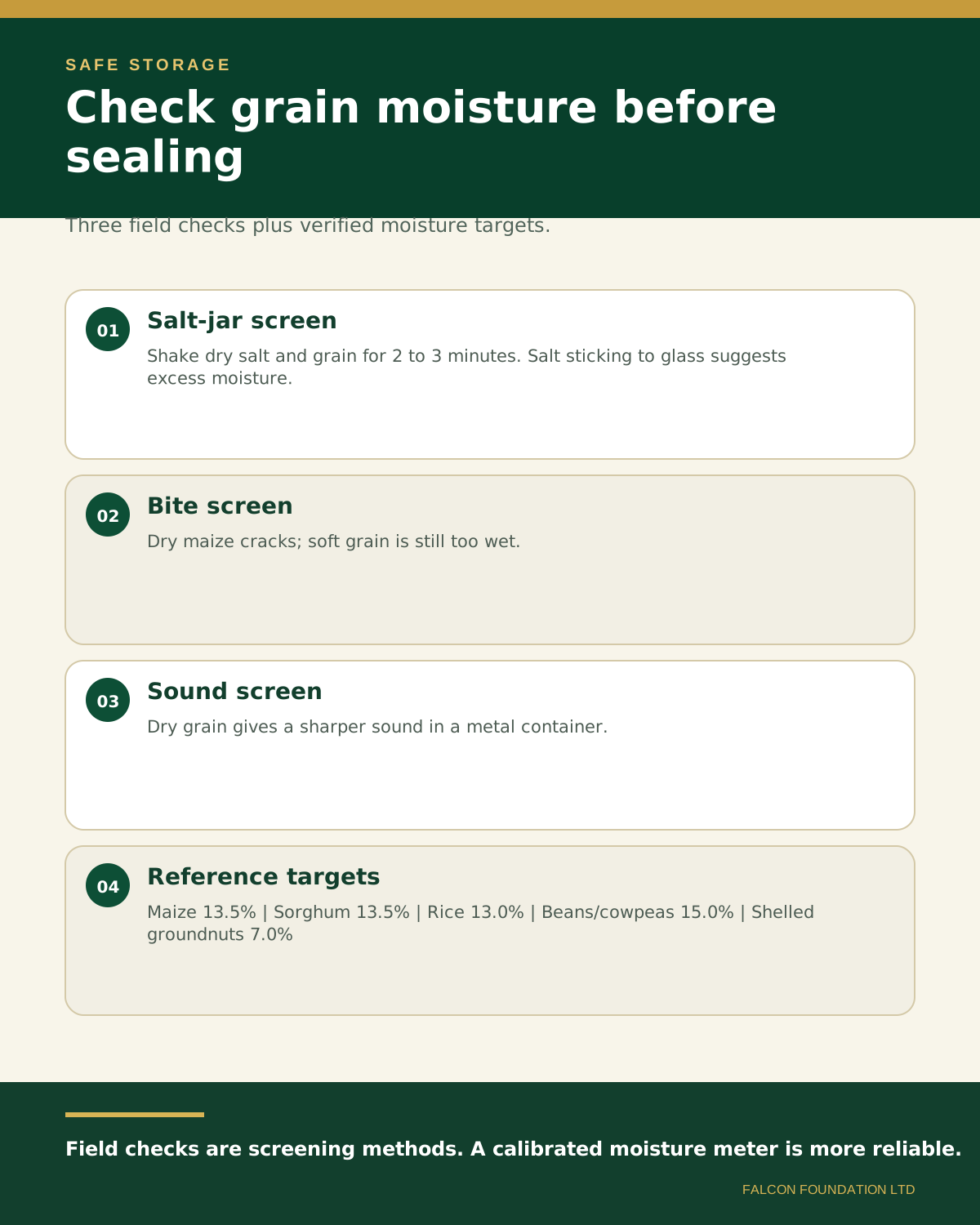
The salt jar test. Put dry, non-iodised salt and grain together in a clean, dry glass jar, seal it and shake vigorously for two to three minutes. FAO's version states that if the salt does not lump or adhere to the sides of the jar, moisture is usually below 15 per cent [1]. Uganda's manual puts it the other way round: if the salt becomes wet and sticks to the wall of the jar, the grain is above 15 per cent moisture [3]. Both are describing the same test.
The bite test. Dry maize grain is hard and cracks when bitten. Grain with high moisture content is soft [3].
The shake test. Grain with high moisture gives a dull sound when shaken in a tin, compared with the sharp sound made by dry grain [3].
A fourth method, hand penetration, relies on the fact that wet grain offers more resistance to penetration than dry grain [3].
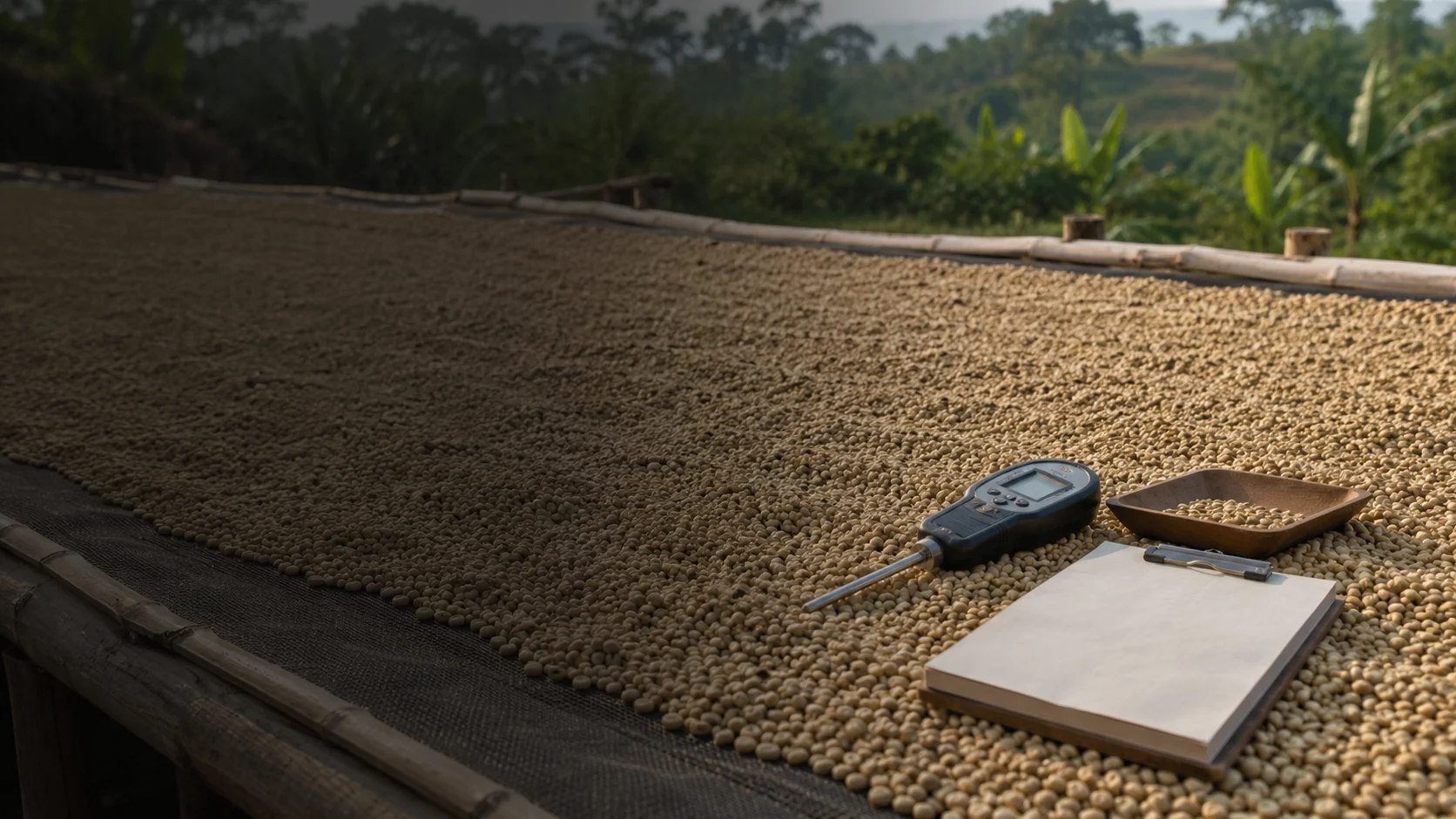
Use two of these together rather than one alone. If you are selling regularly, a moisture meter pays for itself, and any serious buyer will have one.
Drying practice: the surface matters more than you think
This is where the Ugandan evidence is strongest and most usable.
A field study in Kamuli and Apac districts, carried out by Makerere University researchers, compared drying surfaces directly. Bare ground drying gave losses of 3.04 per cent, against 1.56 per cent on tarpaulins and 0.43 per cent on raised racks. The paper states that bare ground drying produced 1.94 times higher losses than tarpaulins and 7.07 times higher losses than raised racks [7].
The contamination result is more striking still. Maize dried on bare ground showed 100 per cent aflatoxin incidence, against 72.7 per cent for maize dried on raised racks [7].
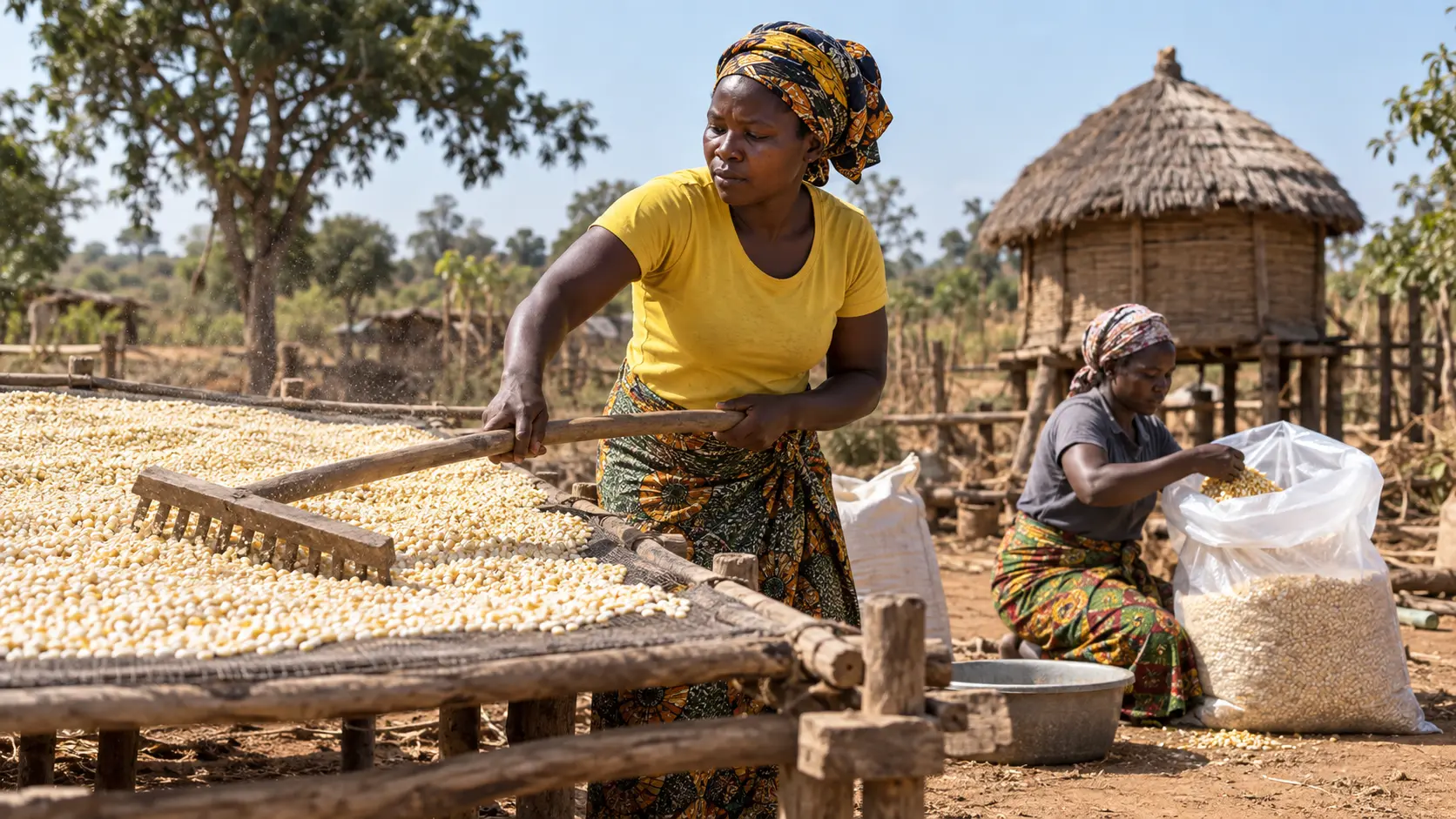
Uganda's extension manual is consistent with this, recommending tarpaulins, drying yards, collapsible dryers, drying racks or cribs over bare ground, and warning explicitly that throwing cobs on bare ground and using dirty containers during harvesting increases the risk of aflatoxin and other contaminants [3].
The manual also gives four practical drying rules: turn the grain regularly to speed drying and make it uniform; keep animals away to avoid droppings contamination; cover the grain against weather; and if using mechanical drying, keep the temperature at or below 40 degrees Celsius for maize [3].
FAO adds a rule that matters in Uganda's climate: shallow-layer natural drying is standard practice but the grain must be brought in or covered every evening and before rain, and in climates too humid for adequate sun drying, forced-air or heat drying becomes necessary [1].
If you change one thing after reading this guide, get the grain off the ground.
Why speed matters: the aflatoxin clock
Drying is a race. FAO's mycotoxin guidance describes newly harvested grain at 26 to 35 per cent moisture needing quick drying to 12 to 14 per cent, with sun drying taking two to three days depending on spreading density and weather [8].
The reason for the hurry is that storage fungi need relative humidity of about 65 per cent or above, which corresponds to roughly 13 per cent moisture content in cereal grain. Different species have different thresholds: one FAO document gives minimum moisture requirements of 13.5 per cent for Aspergillus restrictus, 14 per cent for A. glaucus and 18 per cent for A. flavus, with fungal growth possible between 10 and 40 degrees Celsius, and notes that mycotoxins can appear within 24 hours of fungal infestation [9].
FAO's aflatoxin inspection guidance states that mould growth on maize is negligible below 13 per cent moisture, and describes reducing moisture below 13 to 14 per cent before mould growth starts as the safest and most reliable method of preventing aflatoxin contamination [10].
The Ugandan field data shows what happens when this fails. In the Kamuli and Apac study, maize dried on bare ground and stored in polypropylene bags reached 90.54 per cent mould infection and an average aflatoxin content of 53.47 parts per billion by the sixth month of storage [7]. A separate Ugandan value chain study in Masindi and Soroti found 45 per cent of maize samples and 30 per cent of groundnut samples positive for aflatoxin, rising from 31 per cent at farm level to 42 per cent at the point of consumption [11].
Our guide to maize post-harvest handling and aflatoxin covers the toxin itself in detail.
Does better storage pay?
Once the grain is dry, the storage container decides how long it stays that way and whether insects get into it.
Hermetic bags
Hermetic bags are triple-layer or lined bags that seal the grain away from outside air, so insects inside consume the available oxygen and die.
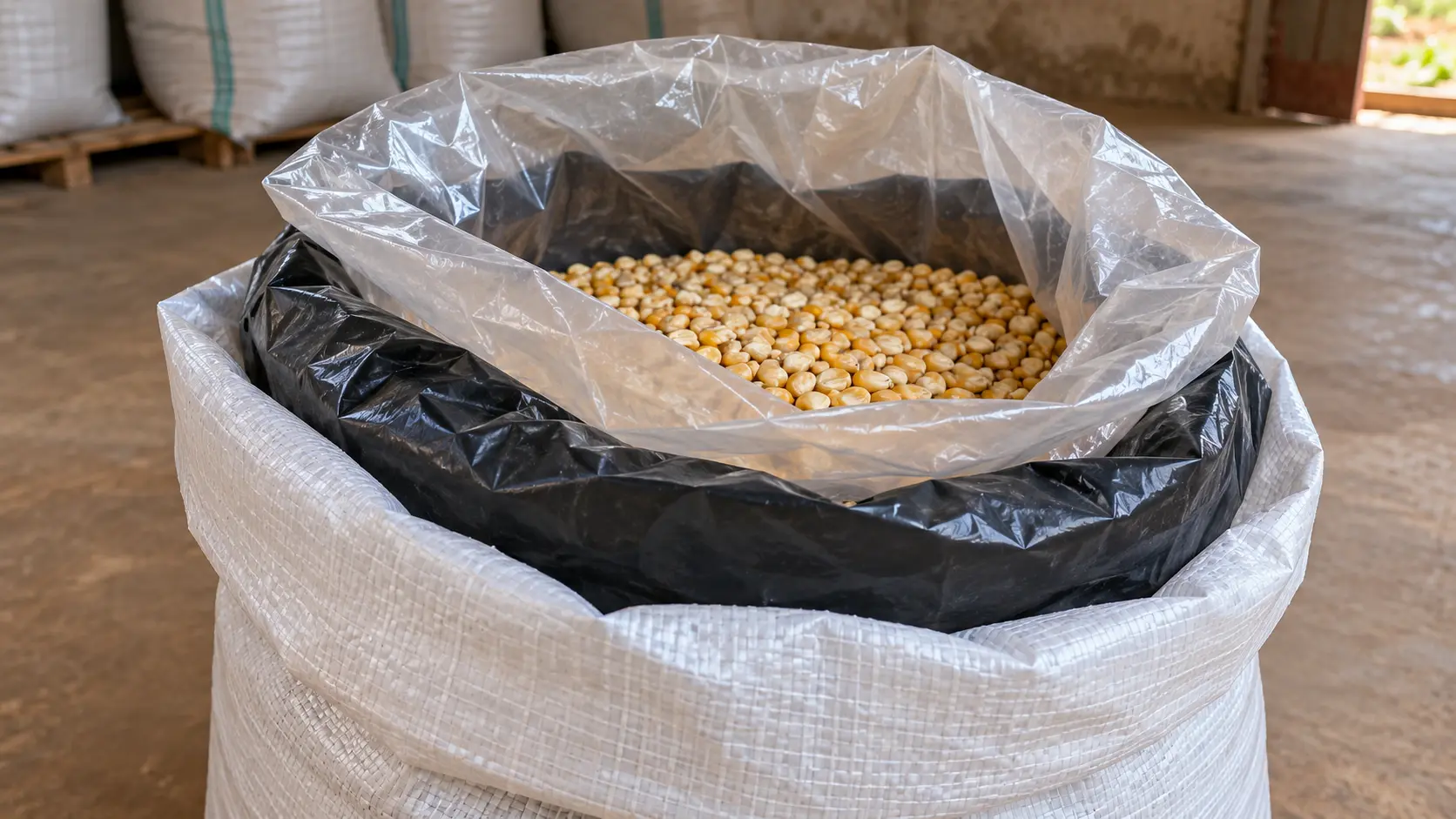
The Ugandan study found hermetic bags gave 6.33 per cent storage loss at six months against 23.7 per cent for polypropylene bags and 0.28 per cent for metal silos. Mould infection at six months was 89.00 per cent in polypropylene bags, 70.49 per cent in hermetic bags and 61.48 per cent in metal silos. Most telling for food safety, the share of samples exceeding 10 parts per billion of aflatoxin was 93.54 per cent for polypropylene bags, 21.67 per cent for hermetic bags and 16.12 per cent for metal silos, and polypropylene bag storage gave 4.4 times and 6 times higher aflatoxin levels than hermetic bags and metal silos respectively [7].
Evidence from elsewhere points the same way. In Niger, under extreme heat ranging from 11 to 45 degrees Celsius, hermetic bags gave zero grain weight loss in cowpea after four and a half months against 16.7 to 29.2 per cent in woven bags [12]. In an Indian trial on groundnuts, hermetic bags cut bruchid pod damage to 21.3 per cent against 92.7 per cent in cloth bags, and reduced seed weight loss to 1.4 per cent against 39.6 per cent [13].
The Nigerien and Indian figures are from those countries and should be read as evidence for the mechanism rather than as Ugandan expectations.
One important qualification. Whether hermetic bags pay depends on your market. A sub-Saharan analysis found hermetic storage profitable within around 50 days in markets with strong seasonal price swings, but not recouped in a low-volatility market [14]. If prices in your area barely move between harvest and the lean season, storage technology earns less. Bags are also physical objects: inspect them for punctures and rodent damage before each refill, because a hermetic bag that is not airtight is simply an expensive sack.
Metal silos
FAO's guidance on household metal silos describes units holding roughly 100 to 3,000 kilogrammes, noting that a 1,000 kilogramme silo can feed a family of five for a year, built from 0.5 millimetre galvanised sheeting, with durability of 15 years or more if properly maintained [15].
The Ugandan study recorded metal silos at 0.28 per cent loss over six months, the best performance of any option tested, together with the lowest mould infection and the lowest share of samples exceeding the aflatoxin limit [7].
There is a safety condition attached. The FAO metal silo system relies on hermetic sealing combined with non-residual fumigation using aluminium phosphide tablets [15]. We are not publishing a dose. Phosphine-releasing fumigants are acutely toxic, they have killed people in domestic settings, and their use is restricted. If a storage system requires fumigation, it must be carried out by a person trained and licensed for it, and you must confirm the current registration status of any product with the relevant Ugandan authority before it is used anywhere near a household.
Limitations
The safe moisture figures given here are equilibrium values at a stated temperature and humidity, taken from FAO guidance. They are a sound working target, not a guarantee under every condition.
Field moisture tests are indicative. They will not satisfy a buyer, and they will not settle a dispute.
The strongest Ugandan evidence used here comes from a single field study in two districts [7]. It is genuinely Uganda-specific and its findings are consistent with regional work, but it is one study.
We have deliberately given no prices, either for grain or for storage equipment. Get local quotations, and compare the cost of a bag or a silo against what your own local price actually does between harvest and the lean season.
What to do next
- Before harvest, decide where the crop will dry. If it is bare ground, change that now [3] [7].
- Do a salt jar test before bagging anything, and repeat it after two more days of drying [1] [3].
- Dry groundnuts far longer than feels necessary. Seven per cent is much drier than maize [1].
- Turn the grain regularly, cover it every evening and before rain, and keep animals away [1] [3].
- Ask your buyer which moisture standard and which edition they contract on [4] [5].
- Before buying storage equipment, check what your local price does between harvest and the lean season. That gap is what pays for it [14].
- If a storage system requires fumigation, arrange a trained and licensed operator. Do not do it yourself.
Read next: grading, sorting and packaging for market, and feed storage, mould and feed testing if you are storing for livestock rather than for sale.