
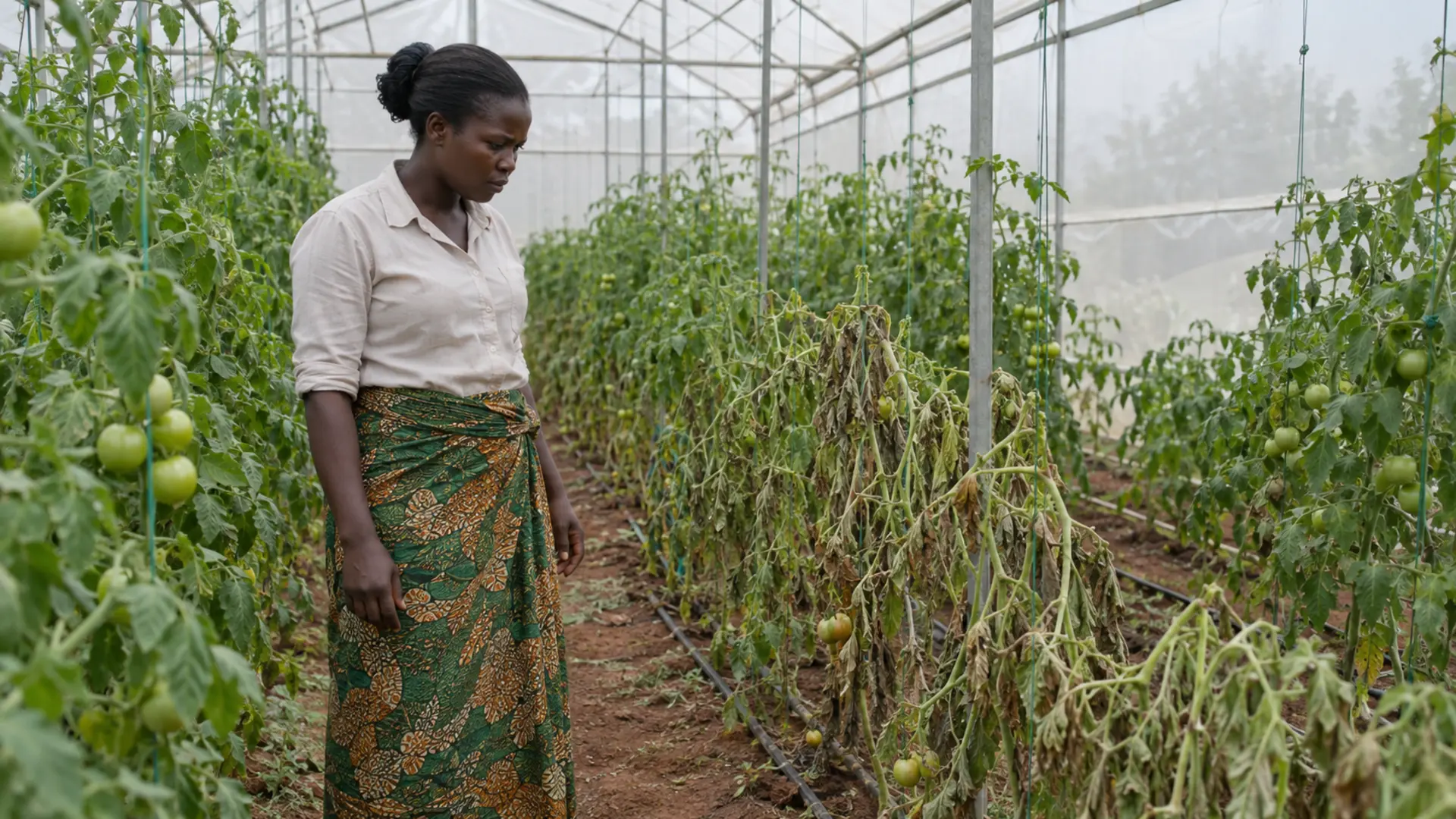
The pattern is always the same, and every grower who has seen it recognises the description.
A patch of plants collapses. Not yellowing first, not gradually: standing one day, hanging limp the next, leaves still green. The plants either side are fine. Next season the patch is bigger, or there are two patches. The season after that, the house is no longer worth planting to that crop.
A Ugandan study from the national crops resources research institute puts the scale of it plainly, describing bacterial wilt as the biggest challenge facing tomato growers in Uganda.
Once the causal organism is established in a greenhouse floor, it does not leave because you want it to. This guide sets out the three strategies that actually exist, compares them honestly, and gives the grafting procedure in enough detail to attempt. It names no fumigant, no chemical soil treatment and no pesticide, and it does not discuss them.
Why this is a different problem inside a structure
In the open field a farmer with a wilt problem moves. Inside a greenhouse the crop is tied to a fixed, expensive structure, so the usual response is unavailable.
That single constraint is what makes protected cultivation a special case, and it is why the strategies below exist at all.
First, does rotation solve it?
The instinctive answer is rotation, and it is worth dealing with before anything else.
Soil-Borne Disease Under Cover: Choosing Between Solarisation, Grafting and Getting Off the Soil
An evidence panel on whether rotation removes bacterial wilt, showing the Ethiopian rotation trial results alongside the finding that the pathogen was still detected in soil and roots regardless.
An East African trial in Ethiopia tested exactly this. One season of rotation with bean or maize gave average final wilt incidence reductions the study reported at 6 and 16 per cent respectively. Two seasons of rotation gave about a 29 per cent average reduction.
That is a real benefit. But the same study reported the finding that settles the strategic question: the pathogen was detected in rhizosphere soils and roots after 120 days from inoculation regardless of the rotation crop used.
Extension guidance agrees. A United States extension source describes the disease as very persistent if introduced and says rotation can reduce soilborne populations, without claiming elimination. An East African plant health resource is blunter, stating that crop rotation is not effective as the pathogen can survive for a long period.
So: rotate, because reducing pressure is worth having. Do not plan on rotation clearing the house. The general rotation logic is covered in crop rotation and cover crops, and it applies inside a structure with the obvious difficulty that your rotation options are constrained by what the house was built for.
The three strategies
If rotation will not clear the house, what will? Three approaches exist, and it is worth being clear at the outset that none of them removes the organism from your soil. They work by killing part of the population, by giving the plant roots that resist it, or by keeping the plant’s roots away from it altogether.
That framing matters because it sets expectations correctly. A grower who chooses one of these expecting eradication will be disappointed and will abandon it. A grower who chooses one expecting a workable crop in an infested house will often get one.
Soil-Borne Disease Under Cover: Choosing Between Solarisation, Grafting and Getting Off the Soil
A four-column comparison of soil solarisation, grafting onto resistant rootstock, and growing in clean media off the soil, against cost, skill required, recurring effort, evidence strength and reversibility.
Option one: treat the soil by solarisation
What it is. Covering wetted soil with clear plastic during the hottest period so that trapped solar heat raises soil temperature to levels lethal to many soil organisms.
How it is done, from the published guidance. Use clear polyethylene film. One extension source specifies clear film of various thicknesses in the range of roughly 0.5 to 4 mil and states that coloured films should not be used. Another specifies clear ultraviolet-stabilised plastic 1 to 4 mils thick and explains why the colour matters: white or black plastics will not transmit enough solar radiation. Black plastic feels like it should work better. It does the opposite, because it absorbs the heat at the surface instead of letting it into the soil.
Wetting. The soil should be thoroughly watered to a depth of about 12 inches before covering. Moist soil conducts heat and moist organisms are more easily killed than dry ones.
Duration. Four to six weeks during the hottest part of the year.
Temperatures reached. Trials in Oklahoma reported highs around 126 degrees Fahrenheit at 1 inch depth and 98 degrees Fahrenheit at 12 inches, with desert environments reaching around 140 degrees in the top 6 inches. One source identifies 140 degrees Fahrenheit as lethal.
Soil-Borne Disease Under Cover: Choosing Between Solarisation, Grafting and Getting Off the Soil
A soil cross-section showing solarisation with clear plastic, the wetting depth, the temperatures reached at different depths, and a panel listing what the method does not control.
Now the limits, which matter more than the method.
The published guidance is explicit that none of the target pests will be eradicated. Effective depth is given as up to 6 to 8 inches. Results against nematodes are described as variable. Certain perennial weeds and sedges are noted as not reliably controlled. And in lighter soils, organisms may survive at depths below the lethal temperature zone.
Look at that depth figure against your problem. A wilt organism that survives in the root zone and on plant debris, at depths below 6 to 8 inches, is not reached. Solarisation is a genuine tool against a range of soil organisms in the upper layer. It is not a reset button for a wilt-infested floor.
And the honest gap. We searched for East African or Ugandan solarisation research and found none we could open. Every temperature figure above comes from United States trials in climates with different solar intensity, different soil types and a different seasonal pattern from Uganda’s. Uganda’s cloud cover and bimodal rainfall mean there may not be a four to six week window of the kind the method assumes.
That is a significant gap, and a grower attempting solarisation here is effectively running an experiment. Doing so is reasonable. Doing so while recording soil temperature at depth, which is the only way anyone will ever know whether it works here, is better.
Option two: graft onto resistant rootstock
What it is. Growing the variety you want to sell on the root system of a different plant chosen for resistance to the soil organism. The top of the plant is your commercial variety; the roots are something the disease does not kill.
Does it work? This is the option with the strongest evidence, and uniquely among the three, some of that evidence is Ugandan.
A study by researchers at Uganda’s national crops resources research institute investigated grafting for bacterial wilt management and reported survival and recovery of grafted plants reaching over 80 per cent in most cases, identified a rootstock that was the top performer for graft recovery, yield production and bacterial wilt resistance, and identified a best-performing scion among those tested.
Regional evidence is stronger still on effect size. Work in Tanzania by the World Vegetable Center’s regional centre with international partners found two named rootstocks to be the most effective, reducing wilting by 49.8 and 51.0 per cent and improving yields by 57.2 and 27.7 per cent respectively. Combined with a reduced irrigation regime, the same study reported an average reduction in wilting of 76 per cent while boosting yields several-fold.
Work in Kenya tested locally available rootstocks including eggplant and a wild relative, reporting compatibility from 73.3 to 100 per cent and graft healing established within 14 days. Extension and outreach work in Kenya has used eggplant seedlings as the resistant rootstock grafted with susceptible high-yielding tomato scions.
That last point matters enormously for a Ugandan smallholder. Eggplant works as a rootstock, and eggplant seed is obtainable. You are not dependent on importing a named specialist rootstock line to try this.
One caution on rootstock names. A widely documented resistant line appears in the literature under a spelling that differs by one digit between sources. We are not going to silently correct either, because we cannot tell which is the typographical error. If you are ordering a named rootstock, confirm the exact designation with the supplier rather than relying on a spelling from an article.
Other named rootstocks appear in United States extension guidance, which states that the use of bacterial wilt resistant rootstocks has been used successfully in fields where bacterial wilt is prevalent or widespread.
Option three: get off the soil
What it is. Growing in bags, pots or beds of clean media that sits on, rather than in, the greenhouse floor. If the crop’s roots never touch the infested soil, the infested soil cannot infect them.
What the published guidance says. Extension guidance on preventing soil-borne disease in greenhouses notes that many growers plant in soilless substrates and advises choosing a well-drained potting medium to prevent soil-borne diseases.
The trade-offs, which are substantial. The same guidance sets out what this approach actually requires: the medium must be treated or certified to be free of pathogens; growers must avoid re-using media; and contact must be prevented with used media, used tools or equipment, diseased plants, water run-off from outside, or outside soil.
Read that list as an operating discipline rather than a purchase. A bag system where the bags sit directly on infested floor, water runs from bag to bag across that floor, and the same tools move between them, has not got the crop off the soil in any meaningful sense. It has just raised it slightly.
Media preparation and the nursery-scale version of the same problem are dealt with in raising your own seedlings.
The grafting procedure
If you choose grafting, here is the procedure from the published protocols. It is a skill and the first attempt will have poor take-up; that is normal.
Soil-Borne Disease Under Cover: Choosing Between Solarisation, Grafting and Getting Off the Soil
A seven-stage annotated splice grafting procedure showing seedling stage and stem diameter, the matched diagonal cuts, clip fitting, and the recovery chamber conditions day by day.
Stage and size. A United States extension protocol specifies grafting when the seedling stem is about 1.5 to 2 millimetres in diameter, roughly two to three weeks after sowing. Another published protocol specifies grafting before secondary growth is noticeable, at the two to four true leaf stage.
The diameter is the operative measurement. Rootstock and scion must match in stem diameter, which means starting them at different times if they germinate and grow at different rates. Work backwards from that requirement: put the slower one in first.
The cut. For splice grafting, the rootstock is cut at the stem at a deep angle and the scion is cut at the same angle so the two faces match. A separate cleft-graft protocol describes a wedge on the scion with sides about 4 millimetres long, formed by two diagonal cuts at about a 65 degree angle, with the rootstock split to a depth of about 4 millimetres.
Use a clean, genuinely sharp blade. A crushing cut does not heal.
The clip. Silicone grafting clips in the range of about 1.5 to 3.0 millimetres hold the joint.
The recovery chamber. This is where grafts are won or lost, and here the two published protocols differ.
One protocol specifies relative humidity between 85 and 95 per cent for the first 48 to 72 hours, temperature between about 22 and 29 degrees Celsius, low light initially, with light introduced over four to eight days and a total healing period of six to ten days.
The other specifies for days one to seven humidity at 90 per cent with light reduced by half and temperature 18 to 21 degrees by day and 16 to 18 by night, then for days eight to fourteen humidity at 50 per cent with full light restored.
Those are different protocols, not one consensus, and neither was developed for Ugandan conditions. What they agree on is the shape: very high humidity and low light at first, then both returned to normal gradually over roughly one to two weeks. A simple chamber made from a frame, clear plastic and shade netting, kept damp and shaded, is the practical version.
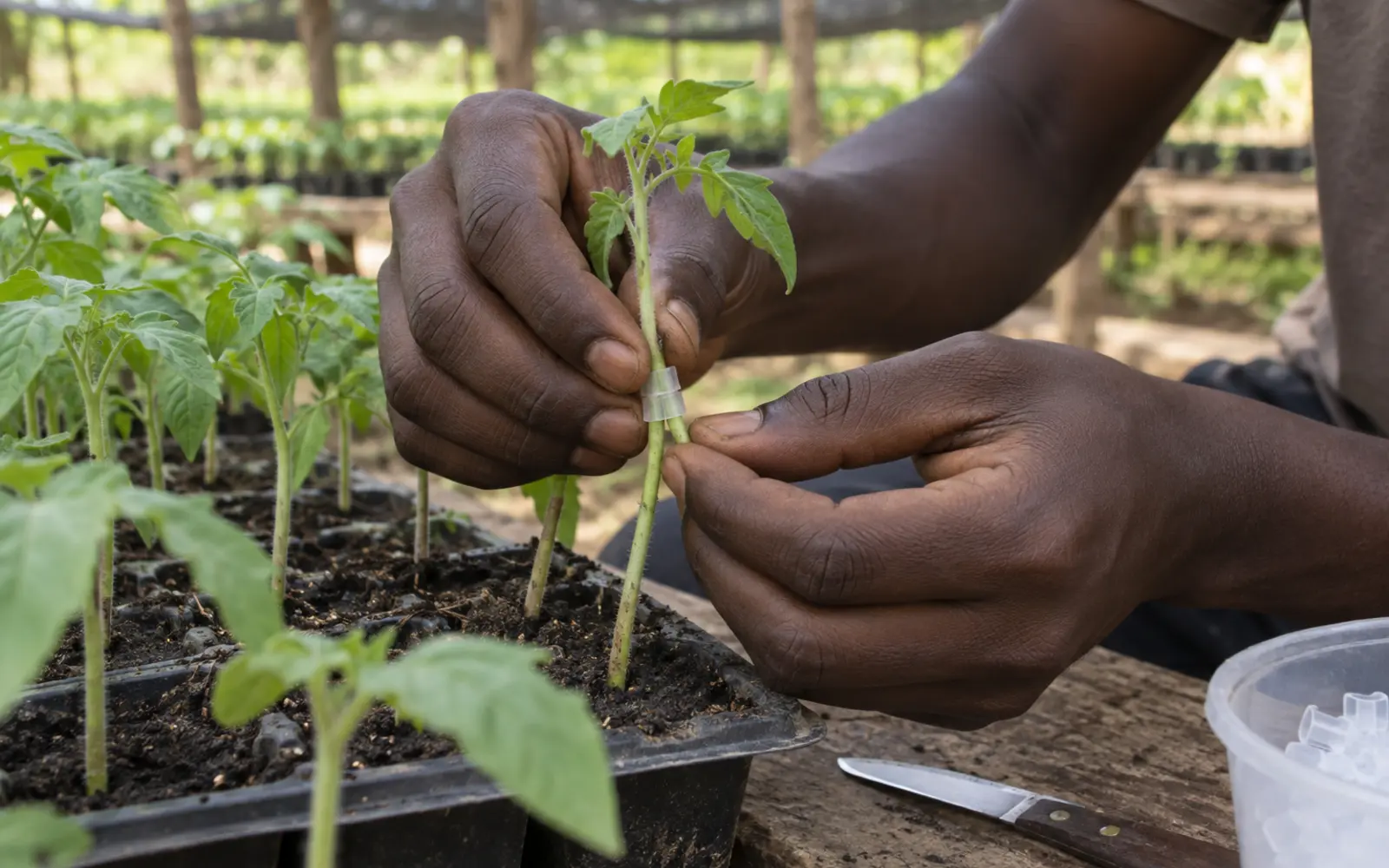
The Kenyan study’s observation that graft healing was established within 14 days is a useful benchmark for what to expect.
Planting out. Harden the grafted seedlings back to full light and normal humidity before they go into the house. And plant them so the graft union stays above the soil line: if the scion roots into the soil, you have bypassed the rootstock and undone the whole exercise.
Choosing between them
The three are not mutually exclusive and the choice depends on your situation rather than on which is best in the abstract.
Choose grafting if the problem is specifically bacterial wilt, you can source or grow a resistant rootstock, and you or someone on the farm can learn a fine manual skill. It has the strongest evidence, including the only Ugandan evidence, and it addresses the organism rather than the soil.
Choose getting off the soil if you can commit to the full sanitation discipline and the recurring media cost, and particularly if your problem includes organisms that grafting does not address.
Consider solarisation if you have a genuine hot dry window, your problem is in the upper soil layer, and you are willing to treat it as an experiment and record soil temperature.
Do all three partially and none properly and you will get the cost of all three and the benefit of none. Pick a strategy and run it completely.
One combination is worth noting because it has evidence behind it. The Tanzanian work found that grafting combined with a reduced irrigation regime produced a substantially larger reduction in wilting than grafting alone. That is a reminder that water management is part of this problem: a saturated floor moves the organism between plants, and an irrigation habit that keeps the surface wet is working against whichever strategy you have chosen. Reviewing how and how much you irrigate costs nothing and may be the cheapest improvement available.
What does not change whichever you choose
Sanitation. Every one of these strategies is undone by the same handful of habits.
The published guidance on preventing soil-borne disease in greenhouses names the routes precisely: used media, used tools and equipment, diseased plants, water run-off from outside, and outside soil.
In a Ugandan greenhouse that translates to: boots that walk from an infested house into a clean one; a knife used in both; water that runs across the floor between beds; seedling trays reused without washing; and diseased plants pulled and left at the end of the row. The general framework is whole-farm biosecurity.
Common mistakes
Rotating and expecting the house to be clean. The Ethiopian trial found the pathogen still present regardless.
Using black plastic for solarisation. It will not transmit enough radiation.
Solarising without wetting the soil first.
Expecting solarisation to reach a deep-seated wilt problem. The published effective depth is 6 to 8 inches.
Grafting seedlings of mismatched stem diameter.
Cutting with a blunt blade.
Opening the recovery chamber to check on the grafts in the first two or three days, which is exactly when humidity must stay high.
Planting grafted seedlings with the union at or below soil level, letting the scion root and bypass the rootstock.
Standing bags on an infested floor with run-off flowing between them and calling it soilless.
Reusing media from a crop that failed.
Moving tools and boots between houses.
When to involve a professional
Contact an extension officer, a plant health inspector or a diagnostic laboratory, rather than choosing a strategy on your own, when:
- You have not actually confirmed what the problem is. Every strategy here is aimed at a specific organism, and a wilt that is fungal, or a root-knot nematode problem, or a waterlogging problem, calls for different action. Rapid collapse with leaves still green is suggestive, not diagnostic.
- You are about to make a capital commitment on the basis of a self-diagnosis.
- You want to source a named rootstock and need to confirm the designation and its documented resistance.
- Symptoms appear in a house that has been clean, which raises the question of how the organism arrived and whether it came in on planting material.
- You are considering any product. This guide names none, and a product offered for a soil-borne problem should be met with questions about what it is registered for and what its pre-harvest interval is.
A practical action plan
First: confirm the diagnosis. Nothing below is worth doing for the wrong organism.
Map the house. Draw it and mark exactly where plants have collapsed, this season and, if you can remember, in previous ones. A spreading map tells you the problem is in the floor. Scattered single plants suggest something else.
Decide the strategy, and decide it fully. Cost it, including the recurring part, before starting.
If grafting: obtain rootstock seed, and work out the sowing offset so stem diameters will match. Build a simple recovery chamber. Practise on a small batch before committing a season’s seedlings. Expect losses on the first attempt.
If getting off the soil: write down the sanitation rules before you buy anything, because that is the part that fails, not the bags.
If solarising: identify your hot window honestly, wet the soil properly, use clear film only, and bury a thermometer at depth so you have a record. Uganda has no published data on this and yours would be the first many growers had seen.
Always: fix the movement rules. Dedicated tools per house, a boot discipline, no run-off between beds, and diseased plants removed from the site rather than dropped at the row end.
Record what you did and what happened. Given the state of the evidence for Uganda, a grower with two seasons of honest records is contributing something that does not currently exist.
Conclusion
There is no product answer to this problem in this guide, and that is not an omission. Once a soil-borne wilt organism is established under a fixed structure, the options are to change the soil’s condition, change the plant’s roots, or stop using the soil.
The evidence is uneven across those three, and knowing where it is thin matters as much as knowing what it says. Grafting has real trial evidence including a Ugandan study reporting recovery rates over 80 per cent, and regional work reporting substantial reductions in wilting alongside yield gains. Getting off the soil is sound in principle and depends entirely on a sanitation discipline most operations underestimate. Solarisation is well described in United States trials and, so far as we could find, has never been tested in East Africa.
The encouraging part is that the best-evidenced option is also the one available to a smallholder. Eggplant grafts, a blade, some clips and a damp shaded box are within reach of almost any Ugandan greenhouse operation willing to learn the skill.
Author: Falcon Foundation Ltd Editorial Team
The Falcon Foundation Ltd Editorial Team produces evidence-based agricultural guidance for Ugandan farmers, drawing on published research and institutional sources and translating them into practical decision support. Where evidence is unavailable or contested, we say so rather than filling the gap.
