
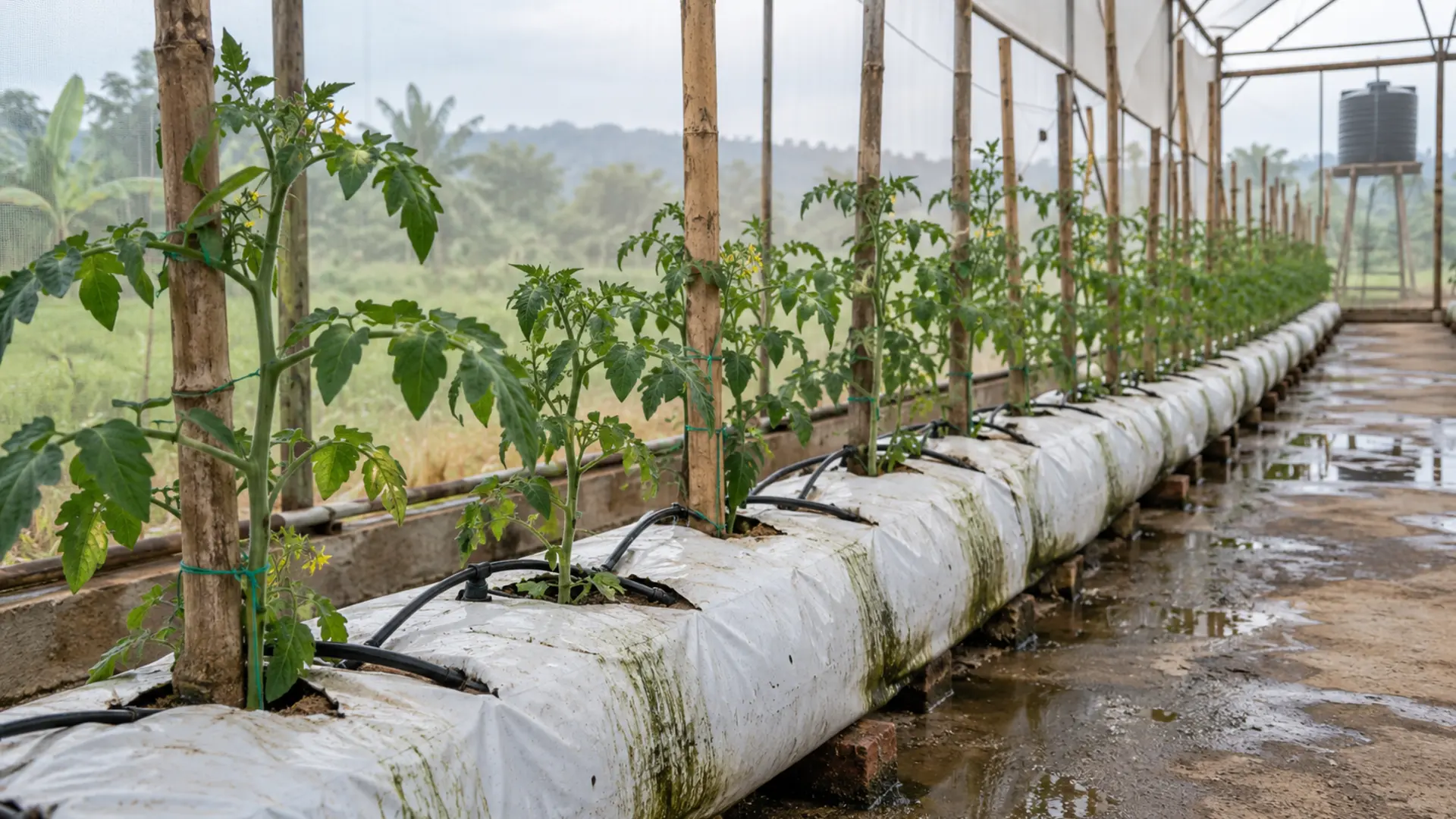
A greenhouse grower in Uganda will spend a great deal of thought on the structure, the variety and the market, and then fill the production bags with whatever is available and affordable.
That is backwards. The material in the bag determines how often you have to irrigate, how much air the roots get in a warm humid house, how quickly salts accumulate, and whether the nutrients you apply are available or locked up. It is the single decision that constrains every other one.
This guide compares the candidate materials on documented physical properties, sets out what preparation each requires, specifies the bag and its drainage, and gives the leaching targets. It deals with nutrient solution chemistry only where it touches the substrate, because that is a separate subject covered in greenhouse water quality and fertigation.
One thing to say at the outset. We searched for a Ugandan or East African substrate trial and found none we could open and verify. Every figure below comes from a university extension reference, a tropical study conducted elsewhere, or a peer-reviewed horticultural paper from another continent. Where a figure is temperate, we say so. A Ugandan grower is working without local data on this subject, and should know it.
What a substrate has to do
Before comparing materials, it helps to know what target you are comparing them against.
Greenhouse Substrate and Bag Culture in Uganda: Choosing What Goes in the Bag
A panel of the documented target ranges for a container substrate covering total pore space, air-filled porosity, water holding capacity, pH, and electrical conductivity for two crop stages.
A university greenhouse management reference sets out the ranges. For air-filled pore space, “an air-filled pore space of 10 to 20% has generally been recommended for most containerized greenhouse crops.” For water, “a common recommendation has been that the substrate should have a water-holding capacity of 50% to 65%.” For acidity, “an initial substrate pH within a range of 5.3 to 6.3 is generally desirable.” Total pore space is given as 70 to 90 per cent, and bulk density as 0.15 to 1.3 grammes per cubic centimetre.
Salinity is split by crop stage. “For rooting of cuttings and germinating seed, an E.C. of less than 2.0 is desirable. For well rooted crops… an initial E.C. of 2.5 or less is desirable.”
Two of those five matter more than the others in a Ugandan house.
Air-filled porosity is the one that bites. A greenhouse in a warm humid climate has a root zone that stays warmer and wetter than the same bag would in a temperate house. A substrate near the bottom of the 10 to 20 per cent band is closer to trouble here than the same figure would be elsewhere. Heat and humidity management in a Ugandan house is dealt with in managing greenhouse heat and humidity.
Electrical conductivity is the one that surprises people. A material can arrive with a salt load already in it. That is not a nutrition question, it is a material question, and it is why the coir section below is as long as it is.
The materials
Each candidate is described below against the same properties, with the source figures quoted rather than rounded or reconciled. The table gathers them for comparison; the sections that follow explain what each number means in practice.
Greenhouse Substrate and Bag Culture in Uganda: Choosing What Goes in the Bag
A comparison table of eight candidate substrates against documented total porosity, air-filled porosity, water holding, bulk density, pH, electrical conductivity, cation exchange capacity, preparation required and principal risk.
Coir and coco peat
The most widely promoted greenhouse substrate, and the one with the most documented preparation requirement.
The university reference reports that “Typically coir will hold 73% to 80% of its volume in water,” that “typical coir will have 9.5% to 12.5% air-filled pore space,” that “coir typically has a pH 5.8 to 6.9,” that “electrical conductivity of coir has been reported to range from 0.3 to 2.9 mmho/cm depending upon source,” and that it has a “cation-exchange capacity of 39 to 60 meq/100g.”
A tropical study conducted in Sri Lanka reports different figures for medium particle-size coco peat: bulk density 108.29 grammes per litre, water holding capacity 550 millilitres per litre, air-filled porosity 25 per cent, pH 6.1, electrical conductivity 325 microsiemens per centimetre, and cation exchange capacity 86 milliequivalents per 100 grammes.
The cation exchange capacity figures are the ones that genuinely disagree: 39 to 60 against 86. That is not a rounding difference. It most likely reflects different source material and particle size, and this guide reports both rather than choosing.
Three practical readings.
Air-filled porosity is the weak point of coir, or it is not, depending on the material. The temperate figure of 9.5 to 12.5 per cent sits at or below the bottom of the target band. The tropical figure of 25 per cent sits above the top of it. A grower cannot know which their sack resembles without measuring, and the difference is the difference between a well-aerated bag and a waterlogged one.
The electrical conductivity range spans the acceptable threshold. From 0.3 to 2.9 covers material that is fine as received and material that exceeds the stated limit for a well-rooted crop before any fertiliser has been added.
The buffering step is not optional. The Sri Lankan study describes the procedure: “Calcium nitrate (Ca(NO3)2) super soluble grade was used for buffering coco peat (4 kg per cubic meter)” with repeated washing until electrical conductivity dropped, then drying to “16-20% moisture content.”
The reason is chemical rather than mysterious. Coir holds a large exchange capacity loaded with sodium and potassium. Calcium applied as a buffering salt displaces those from the exchange sites into solution, where washing removes them. Skip the step and the displacement happens later, during the crop, releasing salts at a time when you cannot wash them out without also washing out the nutrition you have applied.
Rice hull
Rice husk is the substrate with the strongest case for Ugandan use, because it is a domestic by-product rather than an import.
The university reference distinguishes three forms.
Parboiled fresh rice hulls have “a low bulk density (0.1 g/cm3), a high total pore space of approximately 90% and a high air-filled pore space of approximately 69%,” with pH “near neutral to slightly alkaline,” low electrical conductivity, and “significant levels of phosphorus and potassium” plus manganese.
Composted rice hulls have “total pore space of 85%, and air-filled pores space of 18% and water-holding capacity of 67% and a bulk density of 0.2 g/cm3,” with “pH in the range of 5.0 to 5.6 and an E.C. of 0.4 to 0.6 mmho/cm.”
Carbonised rice hulls, from a Brazilian study, have “near neutral pH (7,5 in H2O),” a bulk density of “about 220 g/l,” “high total porosity, with a air:water ratio near 3:1 at container capacity,” and a “low volume of water in micropores (9% water held at 100 cm water tension).”
Read those three sets together and the picture is clear. Raw rice hull has extraordinary air-filled porosity, around 69 per cent, which is far above the 10 to 20 per cent target. On its own it is a drainage material, not a growing medium. Composted rice hull, at 18 per cent air-filled porosity and 67 per cent water holding, sits neatly inside both target bands. Carbonised hull drains freely, with an air to water ratio near three to one.
So rice husk is best understood as three different materials depending on preparation, and only one of them is a complete substrate on its own.
What we could not find. No study directly comparing raw and carbonised rice hull in a single trial, and no rice-husk-specific nitrogen immobilisation study, was found in an accessible source. The Brazilian carbonisation paper does not address nitrogen immobilisation.
Sawdust
Sawdust is cheap, widely available in Uganda, and carries two documented problems.
Nitrogen immobilisation. The university reference explains the mechanism: “If the organic matter being broken down has a carbon:nitrogen ratio of greater than 25:1, the microorganisms must obtain nitrogen from another source… microorganisms may out-compete the plant for the available nitrogen and induce a nitrogen deficiency (often referred to as nitrogen tie up).”
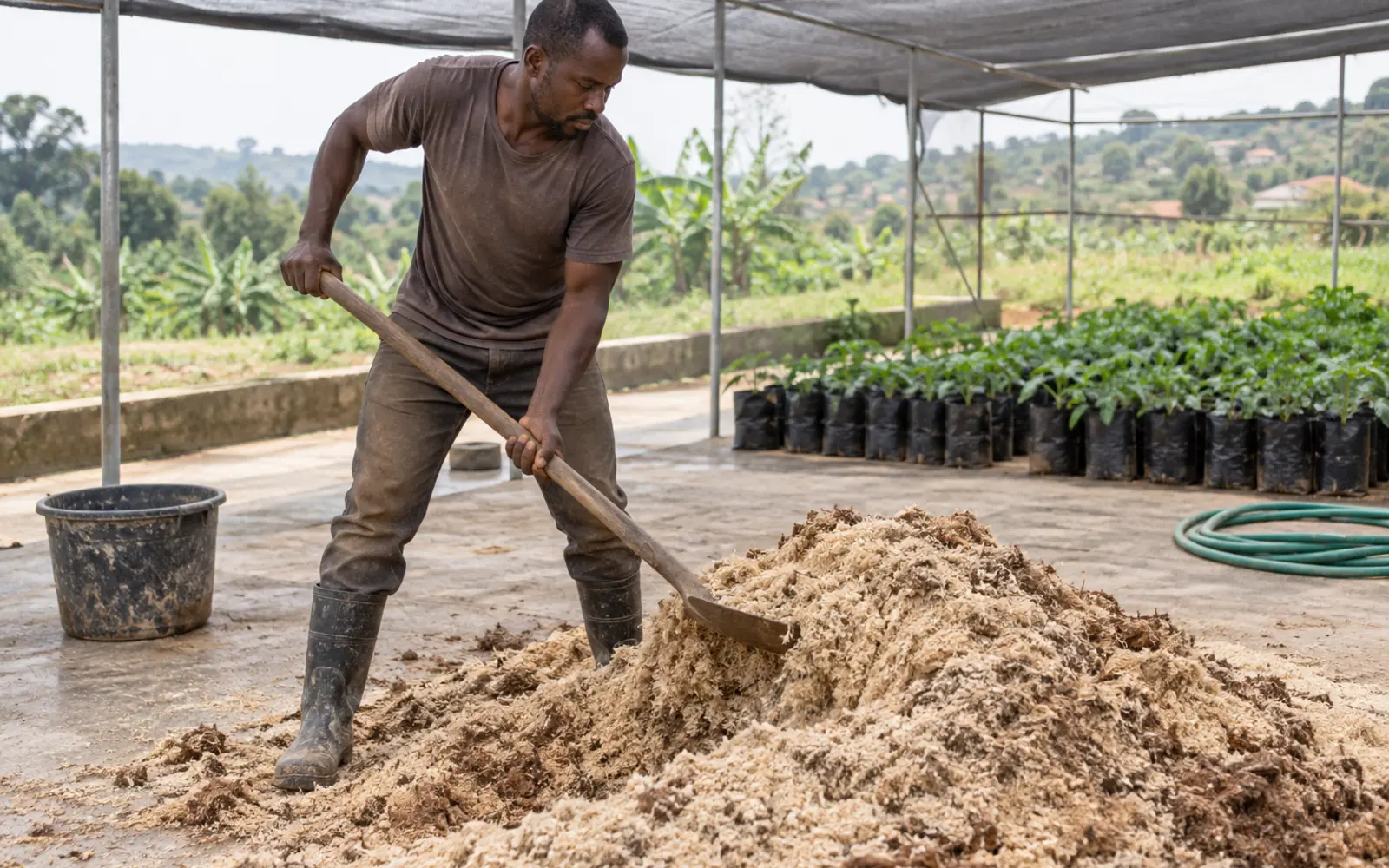
On sawdust specifically it is unambiguous: “Sawdust is not commonly used as a substrate component for containerized greenhouse crop production. It must be thoroughly composted for at least a year or nitrogen depletion can occur.”
A year. Not a few weeks.
Species phytotoxicity. A Canadian study of sawdust substrate risk found that “Thuja sp. based substrates were phytotoxic for tomato, cucumber and pepper seedlings, while other tree species did not reduce plant biomass and leaf area.” The mechanism it describes is that “forestry waste products can contain phytotoxic compounds such as manganese, heavy metals, terpenes and phenols,” with “serious consequences owing to the direct root contact with the concentrated form.”
Note what that finding actually says: one genus was phytotoxic, others were not. The practical implication for a Ugandan grower buying mixed sawdust from a timber yard is that the species composition is unknown, and the evidence that some species are harmful means unknown composition is a real risk rather than a theoretical one. The three crops tested are the three crops most Ugandan greenhouses grow.
Perlite, vermiculite, sand and bark
Perlite. The reference gives “a total pore space of 63%, a water-holding capacity of 38% and an air-filled pore space of 25% at container capacity,” with “negligible cation-exchange capacity” and a pH of 7.0 to 7.5. It is an aeration material with essentially no buffering.
Vermiculite. Cation exchange capacity of 10 to 23 milliequivalents per 100 grammes. A detail relevant to this region: “most U.S. vermiculite has a pH of 7.0 - 8.0 while African vermiculite may have a pH of as high as 9.0.” A grower sourcing regionally should treat pH as a question to ask rather than assume.
Sand. “Negligible cation-exchange capacity and has little effect of the chemistry of the substrate unless it is contaminated.” Weight and drainage, nothing else.
Composted bark. Bulk density approximately 0.12 to 0.2 grammes per cubic centimetre, total pore space approaching 80 per cent, water holding capacity approximately 60 per cent and air-filled pore space 20 per cent. That places it inside both target bands.
Preparation: the part that cannot be done later
Every material in the table above arrives in one of four states, and which one it is determines what has to happen before a plant goes into it. Two of the four outcomes take time that has to be built into the planting plan.
Greenhouse Substrate and Bag Culture in Uganda: Choosing What Goes in the Bag
A decision tree routing each candidate substrate to the preparation it requires, ending in one of four outcomes: buffer and wash, compost, use as received, or blend.
The decision tree routes each material to one of four outcomes, and two of them take time that has to be planned for.
Buffer and wash applies to coir and coco products, using the procedure described above.
Compost first applies to sawdust and other high carbon to nitrogen materials, at a documented minimum of a year for sawdust.
Use as received applies to the inert aggregates.
Blend to correct applies to anything whose air-filled porosity sits outside the target band. A material that is too water-retentive needs a free-draining component added; one that is too free-draining, such as raw rice hull at 69 per cent air-filled porosity, needs a water-retentive component.
We give no blend ratios, because we found none in a source we could open and verify. A grower blending should establish proportions by measurement rather than by a figure from an article.
The bag and its drainage
Once the material is chosen, the container specification is what determines whether it drains. The documented figures below come from vegetable extension guidance, and the drainage placement detail is the one most often reversed.
Greenhouse Substrate and Bag Culture in Uganda: Choosing What Goes in the Bag
A schematic cross-section and plan of a production bag showing media volume per plant, plant number per bag, drainage slit placement and the documented dimensions.
Volume per plant. Extension guidance states that “about 1/3-1/2 cubic foot of media mix should be made available for each plant.”
Plants per bag. The same source states that “two to three tomato plants can be accommodated in each lay-flat bag” and gives “two cucumber plants” per half cubic foot perlite bag.
Bag dimensions. A lay-flat bag is described as “approximately three feet long, six to eight inches wide, and four inches tall.”
Drainage placement. This is the detail that is most often got wrong. The guidance states that “Small slits should be made in the near bottom of the bags so that excess water will not build up.” Near the bottom of the wall, not in the floor. A bag with holes only in its base sits on wet ground and the holes seal against it.
For a different system, the same source describes “Several (40 to 50) small slits” made in the bottom of a perlite bag used with start trays. The two figures apply to different arrangements and should not be mixed.
A much larger alternative. A trial in Scotland used “30 litre bags of perlite with a shallow reservoir of nutrient solution” for greenhouse tomatoes. Thirty litres is far larger than a half cubic foot, and it is included here to show that bag volume is a design choice with a wide documented range rather than a fixed rule.
Leaching
Every drain-to-waste system deliberately over-irrigates, so that salts move out of the bag rather than concentrating in it. The question is by how much.
Greenhouse Substrate and Bag Culture in Uganda: Choosing What Goes in the Bag
A five-step leaching fraction measurement procedure alongside a reference table linking source water electrical conductivity to the recommended leaching fraction, with the conflicting published targets shown together.
The published targets do not agree, and all of them are worth having.
Florida extension guidance for greenhouse vegetables states: “leach about 10 to 15% at each irrigation event for tomato. Leaching rate for cucumber might need to be 20%.”
Alabama extension guidance for greenhouse tomato states: “irrigate with enough water to saturate the growing media and provide 10 to 25 percent leachate from the pot.”
Container nursery guidance from Virginia gives a target “typically 0.15 (15%) to 0.30 (30%),” scaled to water quality: above 2.0 decisiemens per metre, 0.3; at 1.5, 0.2; below 1.0, 0.1.
North Carolina nursery guidance states that “Values under 20% are good” and that the fraction “should be 20% (0.2) or less to avoid over watering.”
Two of those four come from ornamental container nursery work rather than vegetable bag culture, and we label them as such. They are included because they carry the measurement method and the scaling rule, which the vegetable sources do not.
The scaling rule is the useful part. The Virginia guidance ties the leaching fraction to source water electrical conductivity: poorer water requires a larger leaching fraction. That is a principle a Ugandan grower can apply directly once they know their own water, which is why testing source water comes before choosing a leaching target.
Measuring it. The documented method is simple. Place a lined container or sealed bucket under a representative planted bag, irrigate normally, measure what went on and what came out, and divide. The formula as stated is “LF (%) = leachate volume (ml) / Total irrigation volume (ml) x 100.”
The same guidance adds a step worth taking: “You can also monitor the electrical conductivity (EC) of container leachates to prevent a build up of salts.” Volume tells you whether you are over-irrigating. Conductivity of the drainage tells you whether the over-irrigation is achieving anything.
How long a bag lasts
Substrate is usually treated as a one-off purchase and then quietly reused for several crops, which is a reasonable economic instinct and a poorly documented practice.
What can be said from the properties above is physical rather than biological, and it is enough to make a decision with.
Organic substrates lose air-filled porosity as they break down. Coir, composted rice hull, composted bark and sawdust are all organic. Decomposition reduces particle size, and smaller particles hold more water in smaller pores. A material that started at the top of the 10 to 20 per cent air-filled porosity band drifts downward with each crop. The inert aggregates, perlite and sand, do not change in this way, which is the main argument for including one of them in a blend intended to last.
Salts accumulate unless the leaching fraction is doing its job. This is why the drainage conductivity measurement described above is worth taking even when the volume looks right. Rising drainage conductivity between crops, measured the same way each time, is the signal that a bag is approaching the end of its useful life.
Reused substrate has a lower starting cation exchange capacity than the table suggests. The exchange sites in coir arrive loaded and are washed during buffering. After a crop they carry whatever the fertigation left there. A second crop in the same bag is not starting from the same chemistry as the first, and the only way to know the difference is to measure.
There is no documented figure we could verify for how many crops a given substrate supports, and we will not invent one. What a grower can do instead is record two numbers at the end of each crop, the air-filled porosity measured by saturation and drainage on a sample, and the drainage conductivity, and replace the material when either moves outside the band it started in. Two crops of that record tells you your own answer, which is the only one that applies to your material.
What is missing, and what to do about it
Four gaps in the evidence are worth naming, because a grower will otherwise assume the numbers above are firmer than they are.
No Ugandan or East African substrate trial. We searched for one and found none we could open. Everything here is transferred from elsewhere.
No sodium and chloride figures for untreated coir. We found electrical conductivity ranges but not the underlying ion concentrations in an accessible source. That means the buffering procedure is documented but the size of the problem it solves is not quantified here.
No documented drainage hole count or diameter for a standard production bag. The guidance says slits near the bottom. It does not say how many or how big for a standard upright bag.
No documented raw versus carbonised rice hull comparison. The two forms are described separately by different sources and never in one trial.
The practical response to all four is the same, and it is the response that makes this guide useful rather than frustrating. Measure on your own farm. Air-filled porosity can be estimated by a simple saturation and drainage test on a known volume. Electrical conductivity of your substrate and your drainage can be read with a meter. Leaching fraction can be measured with a bucket. None of that requires a laboratory, and one season of those measurements tells you more about your material than any published table can.
Whether a greenhouse is the right structure for your enterprise at all is a prior question, dealt with in greenhouse or open field, and the siting and layout decisions that precede filling any bag are in greenhouse siting, orientation and layout.
The short version
Choose against the target bands, not against price. Air-filled porosity between 10 and 20 per cent, water holding 50 to 65 per cent, pH 5.3 to 6.3, electrical conductivity under 2.5 for an established crop.
Prepare before you plant. Coir is buffered and washed. Sawdust is composted for a year or not used. Raw rice hull is blended, not used alone.
Give each plant a third to a half of a cubic foot, and put the drainage slits near the bottom of the bag wall.
Leach deliberately, measure the fraction with a bucket, and scale it to your water.
And measure your own material, because the Ugandan evidence that would let you skip that step does not exist.
Author: Falcon Foundation Ltd Editorial Team
The Falcon Foundation Ltd Editorial Team produces evidence-based agricultural guidance for Ugandan farmers, drawing on published research and institutional sources and translating them into practical decision support. Where evidence is unavailable or contested, we say so rather than filling the gap.
