Someone has told you a greenhouse will change your farm. Higher yields, cleaner produce, better prices, production through the dry season. The person telling you this is often the person selling the structure.
They may be right. Protected cultivation is a real technology with real advantages. But across East Africa, a large share of greenhouses that get built stop being used within a few seasons, and the reasons are consistent and knowable in advance. This guide exists so that you can find out, before you spend anything, whether you are the farmer for whom this works.
What this guide helps you decide
This guide helps you answer one question: should I build a greenhouse at all, or should I put the same money into my open field?
It is the only guide in our greenhouse series that is allowed to tell you no. Everything else, siting, structure design, ventilation, crop management, assumes you have already passed this stage.
It does not give you construction costs. We explain below why we will not.
The evidence nobody selling a greenhouse will show you
Three independent studies from Kenyan counties, the closest well-documented comparison to Ugandan conditions, tell the same story.
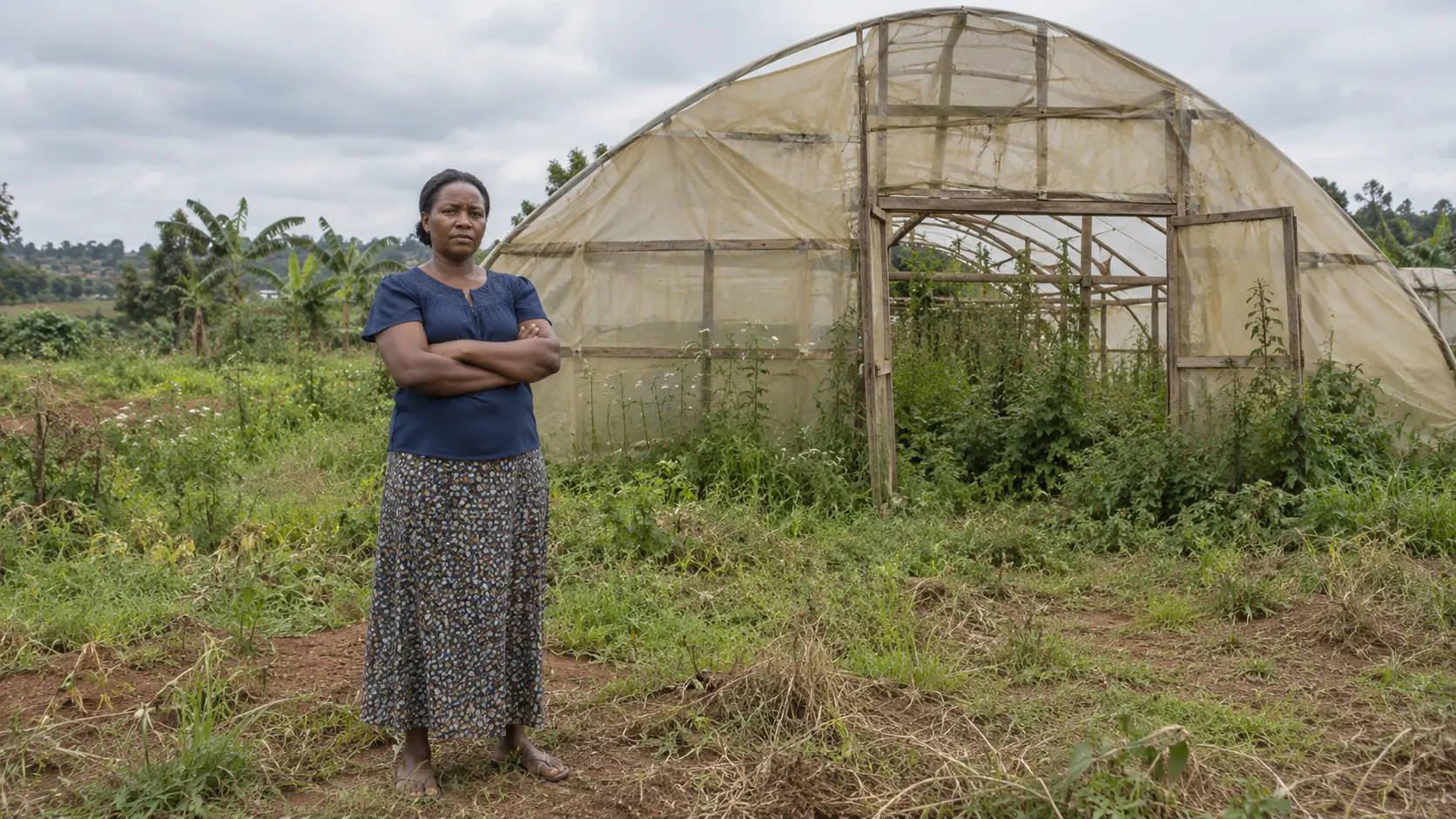
A survey of 138 smallholder greenhouse farmers in Kisii County found that 48.6 per cent of the greenhouses surveyed were no longer functional. The constraints farmers reported were, in order: pests and diseases, cited by 27.1 per cent; inadequate water supply, 23.1 per cent; high input costs, 17.2 per cent; and insufficient training and information [1].
That study also found that ownership mattered enormously. Abandonment was 60.5 per cent for institutionally owned greenhouses, 55.6 per cent for group-owned ones, and 38.2 per cent for individually owned ones [1]. A greenhouse with one owner who checks it every day survives. A greenhouse owned by a committee usually does not.
A separate study in Kericho County, covering 59 greenhouse farmers and 16 extension agents across six sub-counties, ranked the constraints independently and got a very similar list: pests and diseases, input costs, maintenance costs, inadequate water supply, and initial investment costs. The pest and disease burden was statistically significant against a neutral response [2].
A third study in Nakuru County reports that between 30 and 70 per cent of greenhouses fail. It also recorded something that surprises people: bacterial wilt caused 100 per cent crop loss inside the greenhouse against 64 per cent in the open field [3].
Read that last finding carefully. A greenhouse does not remove disease. It creates a warm, humid, enclosed space where a pathogen that gets in has nowhere to go and no weather to knock it back. Protection cuts both ways.
These are Kenyan studies. We have labelled them as such because we could not find equivalent published Ugandan survey data. The agro-ecological and market conditions are close enough to be instructive, but they are not Ugandan figures and should not be quoted as such.
Why greenhouse advice from abroad often does not fit Uganda
Most greenhouse literature in circulation was written for climates where the problem is cold. A European or North American greenhouse is a heat trap: sealed tightly, glazed to retain warmth, with small vents. Uganda has no winter. Here the entire design problem runs the other way, and it is about shedding heat and moisture.
Design work for subtropical conditions carried out by Wageningen University and Research illustrates the difference. For a naturally ventilated greenhouse to hold temperature near ambient with insect netting fitted, that study recommends a vent area of at least 0.5 square metres for every square metre of floor. It also recommends a non-thermic plastic film with more than 75 per cent diffuse light transmission and high infrared transmission, so heat can escape, together with shading and fogging rather than pad and fan cooling [4].
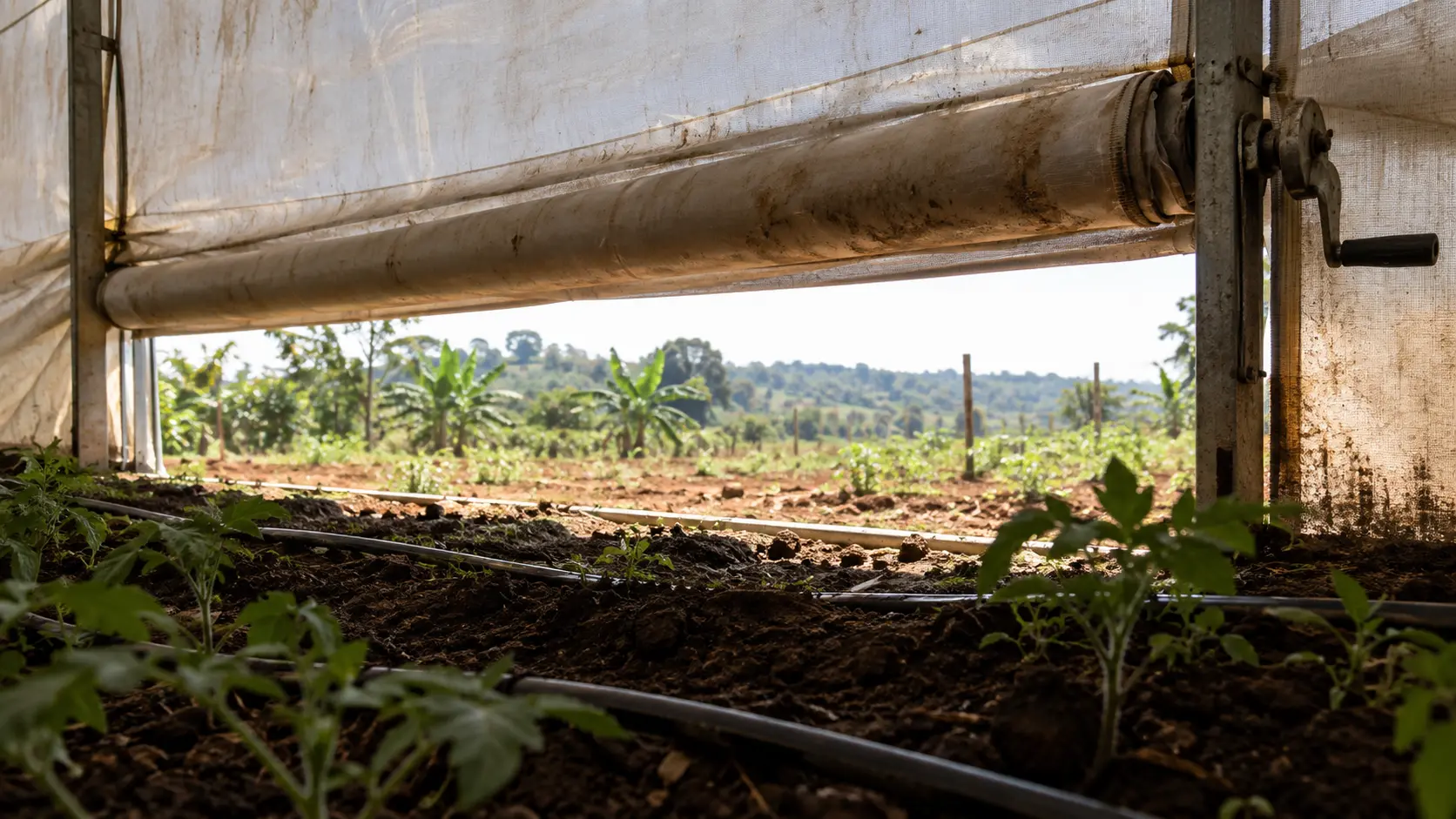
That is close to the opposite of a temperate specification.
Even FAO's widely used greenhouse good agricultural practice guidance was written specifically for Mediterranean climate areas, developed with specialists from North Africa and the Near East. That document warns against simply transferring northern European solutions to other parts of the world without adapting them [5]. If FAO applies that caution to its own Mediterranean guidance, a Ugandan buyer should be at least as careful with a supplier's standard design.
Why we will not give you a cost figure
Search for the cost of a greenhouse in Uganda and you will find numbers. We have checked where they come from.
The figures in circulation are of two kinds. The first are supplier quotations published on the websites of companies that sell greenhouses. A supplier's quotation is a price for that supplier's product, not an independent market figure. The second are individual grower accounts in the Ugandan farming press. One such account, published by the Daily Monitor, describes a grower in Mukono district who reported spending about ten million shillings on his greenhouse setup and running five structures over 2,000 square metres [6]. Another Monitor piece quotes a research associate giving a figure of around three million shillings for a solar irrigation system [7].
Those are real published figures and we have cited them. They are one farm and one component, reported on one date. They are not an average, they are not a benchmark, and they are not a basis for your budget.
We found no institutional, government or peer-reviewed source giving a verified typical construction cost for a greenhouse in Uganda. Rather than invent one, we have built this guide so that you supply your own numbers from your own quotations. If a source gives you a cost figure without telling you which farm and which year it came from, treat it as marketing.
There is an active greenhouse construction and training market in Uganda, which is why quotations are easy to obtain [8]. Get three of them, in writing, before you plan anything.
The seven gates
Work through these in order. Failing any one of them is a reason to stop, not a detail to sort out later.
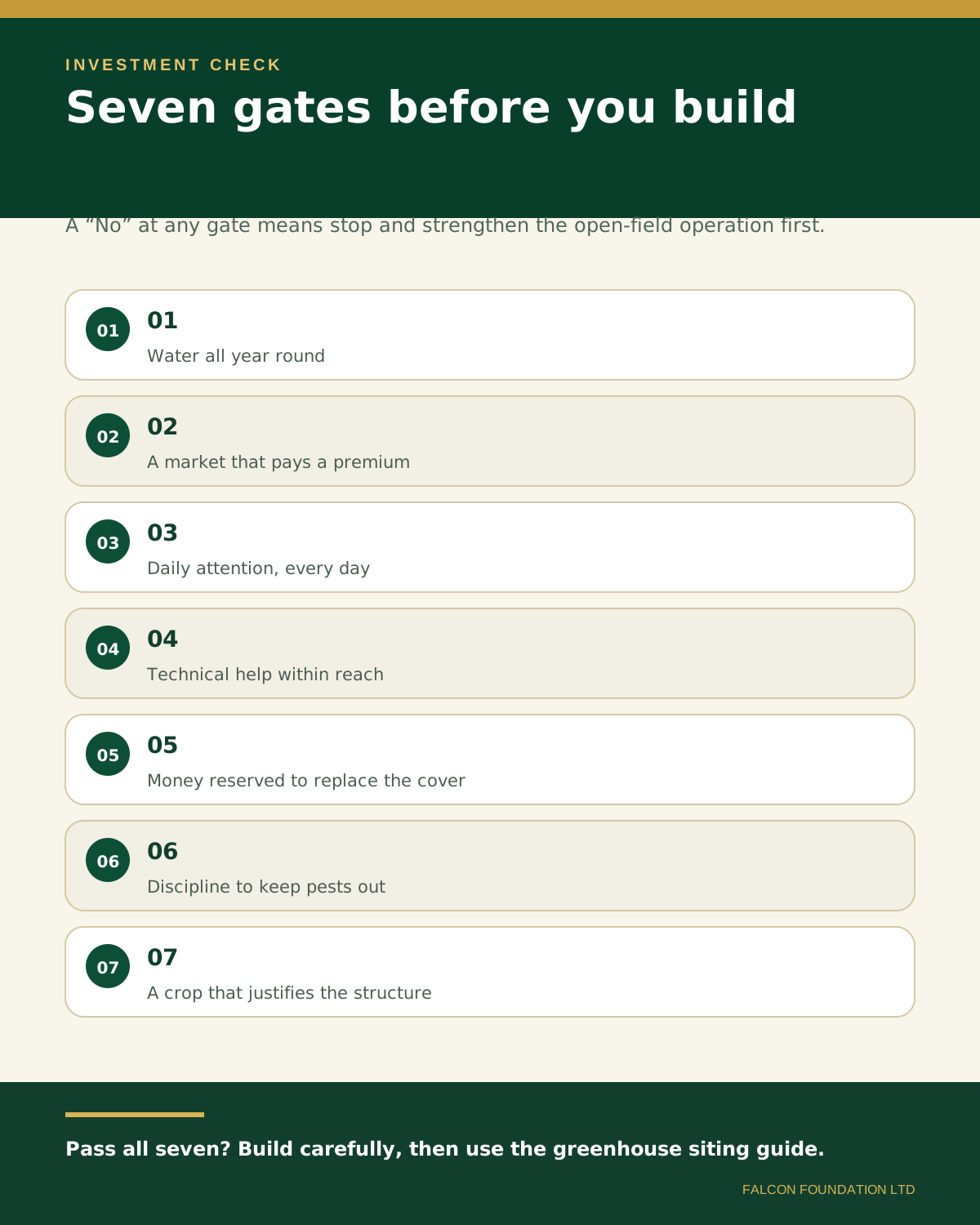
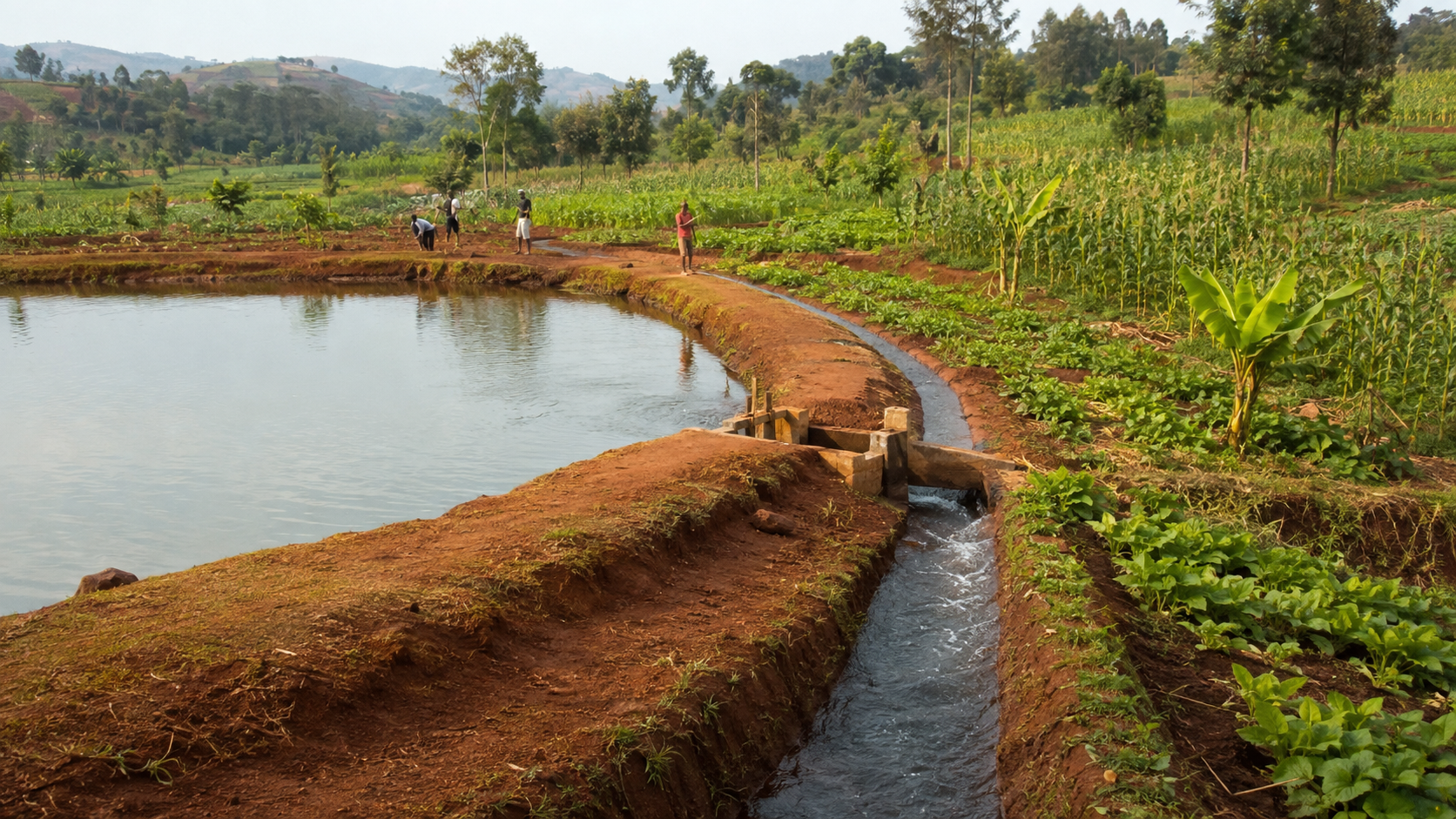
Gate 1. Water, all year round. Inadequate water was among the top constraints in all three studies [1] [2]. A greenhouse crop transpires heavily and has no rainfall reaching it. You need a source that does not fail in the dry season, and you need it close enough that watering does not depend on someone carrying it. If your water fails in January, your greenhouse fails in January.
Gate 2. A market that pays a premium. A greenhouse only pays if the produce sells for more than open-field produce, or sells when open-field produce is unavailable. Before you build, find out who buys the crop you intend to grow, what they pay, and whether they pay more for better quality or off-season supply. If your only outlet is the same local market at the same price, the structure is a cost with no matching return.
Gate 3. Daily attention. The Kisii ownership finding is the clearest signal in the evidence: individually owned structures survived far better than group or institutional ones [1]. A greenhouse needs somebody who opens it, closes it, waters it, inspects it and reacts, every single day. If nobody on your farm can do that seven days a week, do not build.
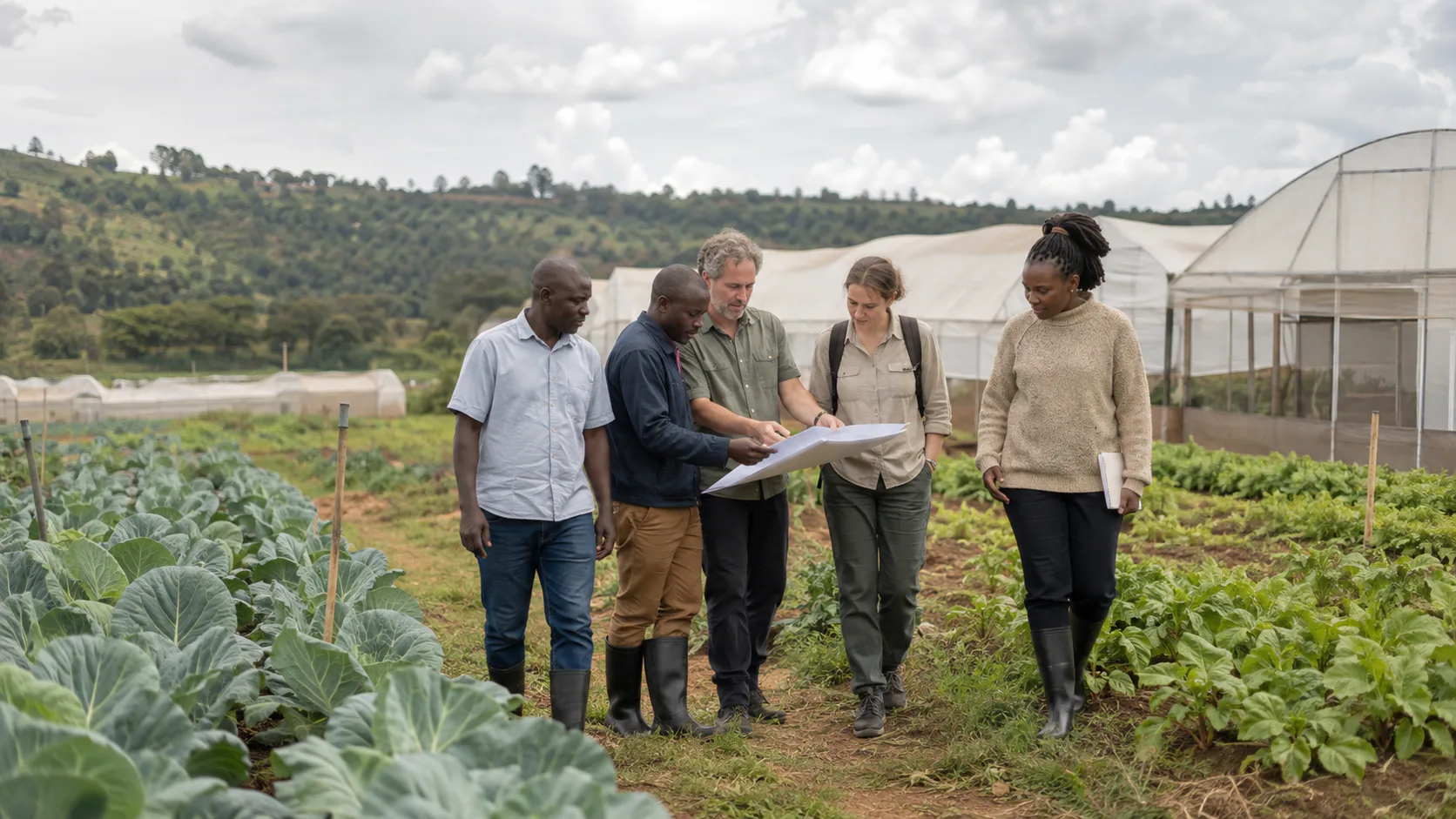
Gate 4. Technical help within reach. Insufficient training was a named constraint in the Kisii study [1]. When a crop starts to fail inside a structure you cannot wait a fortnight for advice. Identify, by name, who you will call. If the answer is the supplier, ask what happens after the warranty ends.
Gate 5. Money set aside for the cover. The polythene cover is a consumable, not a permanent part of the building. Equatorial ultraviolet load is high all year. Maintenance cost was ranked as a top-five constraint in the Kericho study [2]. If replacing the cover would be a crisis rather than a planned expense, you are not ready.
Gate 6. Discipline to keep pests out. Pests and diseases were the number one constraint in both Kisii and Kericho [1] [2], and the Nakuru finding on bacterial wilt shows how badly an enclosed structure can amplify a soil-borne disease [3]. This means controlled entry, clean tools, clean footwear, and refusing to bring in seedlings of unknown origin. If that discipline will not hold, the structure works against you.
Gate 7. A crop that justifies it. Not every crop earns the cost of a structure. High-value crops that are damaged by heavy rain, that benefit from a longer season, or that fetch an off-season premium are the candidates. A staple that sells at the ordinary market price is not.
If you fail a gate
Failing a gate is useful information, not a defeat. The same money can go into things with a far better record: reliable water storage, better seed, soil fertility, drying and storage that stops losses after harvest, or a simple shade structure rather than a full clad greenhouse.
Our guides on choosing a farm enterprise and starting a farm with limited capital set out how to sequence that spending.
If you pass all seven
Then the next decisions matter and they are technical. Where exactly the structure sits, what it is made of, how much vent area it has, and whether a shade net house would serve you better than a full plastic greenhouse are all separate questions with real consequences. See our guides on siting and orientation, shade net house or full greenhouse, and operating costs and small commercial planning.
If you are set on sweet pepper as your first protected crop, our guide to greenhouse sweet pepper farming in Uganda covers that crop specifically.
Limitations of this guide
The failure and abandonment figures used here are Kenyan. They are the best available published evidence for smallholder greenhouse outcomes in East Africa, and no Ugandan equivalent was found. Ugandan outcomes may differ.
Nothing here should be read as a statement that greenhouses do not work in Uganda. They demonstrably do work for growers who meet the conditions above. The point of this guide is that the conditions are not optional.
Before committing capital, take independent advice from someone who is not selling you the structure: a district agricultural officer, an extension worker, or an experienced grower whose structure has been running for more than three years.
What to do next
- Write the seven gates on one sheet of paper and answer each one honestly, in writing.
- If you fail a gate, stop and cost the alternative use of the same money.
- If you pass, obtain three written quotations and require each to state cover thickness, ultraviolet treatment, vent area and warranty.
- Visit two greenhouses in your area that have been running for more than three years and ask the owners what has broken and what it cost to fix.
- Ask each supplier who provides technical support after installation, and for how long.
- Only then read the siting guide and choose a location.