
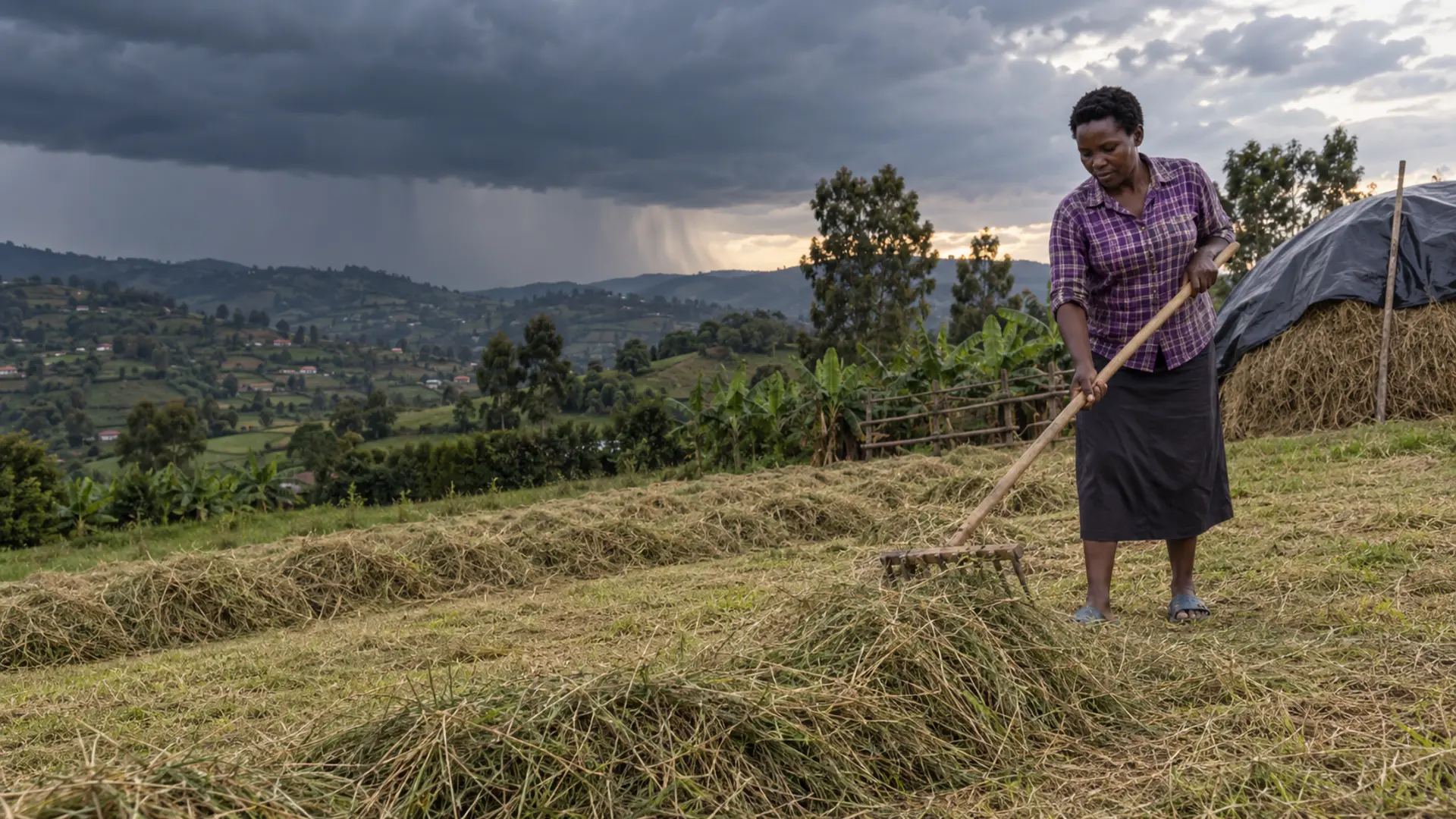
Many conventional hay instructions assume a predictable run of dry weather after cutting. That assumption is unreliable in much of Uganda, where rain during curing is a recurring production risk rather than a rare exception.
In much of Uganda that assumption does not hold. The grass is at its best when the rains are on, which is exactly when a guaranteed dry window is least likely. The result is a familiar pattern: grass cut on an optimistic morning, rained on the second day, turned, rained on again, and eventually gathered damp because it has to go somewhere. It heats in the stack, moulds, and by the dry season when it is needed it is worth very little.
This guide is therefore as much about deciding not to cut as it is about cutting. That is not a counsel of defeat. It is the honest shape of the problem, and a farmer who cuts three good crops of hay a year and refuses four risky ones will end the dry season with more feed than one who cuts seven and loses four.
What this guide helps you decide
Whether to cut this week at all, given the forecast and the season. When the crop is ready to gather, using your hands rather than a meter. How to build a stack that survives humid air. And, at the point where the answer is that hay will not work here, when to make silage instead.
It gives no machinery prices anywhere.
The short answer
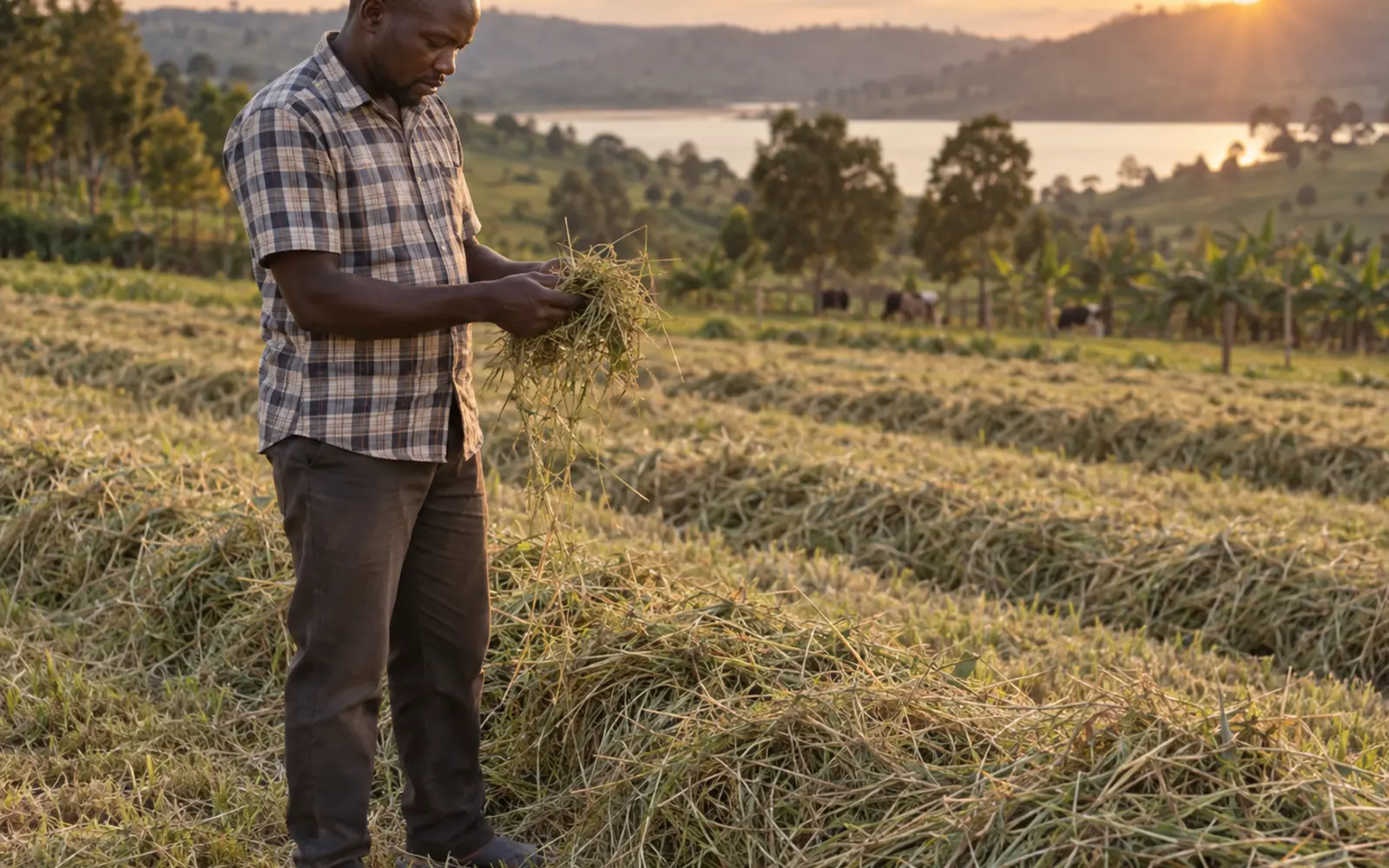
The Food and Agriculture Organization’s guidance on hay and straw conservation for small-scale and pastoral conditions gives the hand test that this article is built around: when the herbage feels crisp in the hand and does not show moisture when twisted, it is probably at 25 to 30 per cent moisture and ready to bale.
Note the word probably. It is the source’s own word, and it matters.
The same guidance gives the warning that shapes the whole cutting decision: re-wetting of partially dried hay is much more serious than rain on newly cut herbage, and can cause both leaching and increased mould damage. That single sentence tells you where the risk lies. A shower on the day you cut is survivable; a shower on day two or three, when the crop is half cured, is the one that destroys the value.
And the honest alternative, from the Food and Agriculture Organization’s companion volume on silage making in the tropics: hay making is difficult in tropical regions because at the time when the forage is of acceptable quality for conservation, early in the wet season, the weather is likely to be too unreliable for sun drying, and what remains is fermentation by silage making, which can be done using fresh or, preferably, wilted material.
When to cut, and when not to
Two questions decide this, and they must both be answered before the first swathe.
Is the grass at the right stage? For tropical grasses, the general principle from the Food and Agriculture Organization’s hay guidance is direct: hay from coarse, over-mature tropical grass is little better than straw or stover, and Rhodes grass and Guinea grass are among the best tropical hay grasses. The tropical forage selection literature gives Rhodes grass, Chloris gayana, in useful detail: it makes good hay if cut at or just before very early flowering, and feeding value declines rapidly with the onset of flowering. Hay cut earlier, for example at 21 days of regrowth, may have a protein content of about 15 per cent of dry matter; protein decreases to 9 to 10 per cent after 10 weeks of regrowth and can be lower than 8 per cent after 15 weeks. The same source notes that Rhodes grass is generally harvested for hay at a late stage of maturity, when protein is in the 5 to 8 per cent range, which is a description of common practice rather than a recommendation.
The general maturity penalty across warm-season grasses is documented too. For Bermuda grass, in vivo organic matter digestibility of fresh grass or hay decreased with maturity by an average of one or two percentage points per day, and voluntary intake was 20 per cent lower for mature forage at 84 days than for younger grass at 28 days. That is Bermuda grass rather than Napier or Rhodes, and it is included here as general warm-season evidence for the yield and quality trade-off, not as a figure for any particular species.
The trade-off is real in both directions: cutting early gives better feed and less of it, cutting late gives bulk with little value. In a humid climate there is a third consideration, which is that a lighter, earlier crop dries faster.
Is the weather going to let you finish? This is the gate. You need consecutive drying days, and the second and third of them matter more than the first. Consult the Uganda National Meteorological Authority’s seasonal forecast products and its shorter-range outlooks rather than the sky alone. A seasonal forecast bulletin we were able to read gives district-level rainfall probability breakdowns and sector advisories for agriculture, and states its own accuracy expectation, which is the right way to read a forecast: as a probability that shifts your decision, not a promise.
We should be plain that the bulletin we could open is several years old and that the authority’s current pages could not be reached at the time of writing. Check the authority’s own current products before you rely on a named bulletin.
The rule. If the forecast does not give you a run of drying days, do not cut for hay. Cut for silage, or leave it standing. Cutting hopefully is the single most expensive habit in this whole business.
Making Hay Where There Is No Dry Summer: Cutting, Curing and Storing in a Humid Climate
Curing timeline showing the hand twist check at each stage and a weather decision gate where the choice switches from hay to silage
Curing: what actually speeds it up
Once you have cut, everything depends on getting water out of the plant before microbes get into it.
Time of day. The Food and Agriculture Organization’s guidance recommends mowing as early as possible on a fair day, or starting while there is still dew on the herbage when cutting by scythe. An extension source on speeding field curing recommends mowing first thing in the morning and raking in the late afternoon.
Conditioning. Where a mower-conditioner is used, the same extension source specifies the standard: at least 90 per cent of the stems should be either cracked or crimped or show some mechanical abrasion. Where you are cutting by hand, the equivalent is to avoid leaving thick uncut clumps that will dry at a completely different rate from the rest.
Spread it wide. This is the most under-used lever available to a smallholder and it costs nothing. The same source states that the swath width should be about 70 per cent of the actual cut area, that drying forage in wide swaths can significantly speed up drying, and that faster drying in wide swaths results in less chance of rain damage. A tight windrow made immediately after cutting is a decision to dry slowly.
Turn it. The Food and Agriculture Organization’s guidance states that turning and tedding must be prompt and adequate, to dissipate heat and avoid fermentation damage in the swath. In practice this means going through the crop with a fork and lifting and rolling the windrows, more often on humid days than dry ones.
Sun is the main variable. The extension source is blunt: exposure to the sun is the single most important weather factor to speed drying.
If rain threatens mid-cure. The Food and Agriculture Organization’s guidance gives the emergency measure: if rain threatens a partly dried crop, it should if possible be gathered into bigger windrows or cocks. A large heap sheds a lot of water; a thin spread absorbs it.
Judging moisture without a meter
This is where honest advice matters most, because the published numbers and the available tools do not match.
What the numbers are. Published safe baling moisture targets come from meter or oven measurement. The Food and Agriculture Organization gives, as a very rough guide, 25 per cent moisture as a maximum for long loose hay, and states that a crop to be baled in big bales should be drier than for standard baling and preferably less than 18 per cent. A university extension source gives less than 22 per cent for small rectangular bales and less than 18 per cent for large bales. Another gives 20 per cent for small square bales, 18 per cent for round bales and 15 per cent for large square bales, with the general principle that the larger the forage package, the lower the moisture should be at baling. A third gives under 20 per cent for small and 17 per cent for large bales in a fire-safety context. Mould and dry matter loss to bacterial degradation are reported above 20 per cent, and some heating is reported to occur in any baled hay at 15 per cent moisture or higher.
Those figures differ because they were written for different purposes, some for quality and some for fire risk, and they should be read as a converging range rather than a single threshold. The larger the package, the drier it must be, because a big dense bale cannot lose heat.
What you can actually do. The twist test given at the top of this article is the one the Food and Agriculture Organization offers for hay, and it is offered with a hedge. There is no published hand test we could verify that gives you a percentage.
We looked specifically for the fingernail-scrape and stem-snap tests that circulate in farming advice, and we could not find an extension or institutional source that names and validates them. We are therefore not going to describe them as though they were established. What we can say is what the sources support: crisp in the hand, bright in appearance, no moisture appearing when a bundle is twisted hard.
A caution about the squeeze test. You may have been shown a test in which a handful of chopped forage is squeezed for ninety seconds and the behaviour of the ball on release indicates moisture. That test is real and published, but its moisture bands run from about 60 to 85 per cent, which is the range for silage and baleage, not for hay approaching baling. Its own authors describe it as not precise, a fast and practical field test that should not be used alone. Do not use it to judge hay readiness.
And a caution about the hand generally. An extension source on curing recommends a moisture tester and cross-checking readings by another method such as the microwave method, and does not endorse hand assessment for the baling decision at all. If you can borrow a meter for the first few crops, do; calibrating your hand against a meter two or three times is worth more than either alone.
Making Hay Where There Is No Dry Summer: Cutting, Curing and Storing in a Humid Climate
Comparison of published safe baling moisture targets by bale type, with the mould and heating thresholds marked alongside
What happens if you get it wrong
Worth knowing precisely, because the consequences are not only economic.
Heating and nutrient loss. Wet-baled hay heats through microbial activity, and a chemical reaction between proteins and carbohydrates reduces dry matter and digestibility. Extension guidance identifies thermophile bacteria reaching optimum growth between 131 and 149 degrees Fahrenheit, roughly 55 to 65 degrees Celsius.
Mould and animal health. Hay baled with moisture contents greater than 20 per cent can develop mould and lose dry matter and quality to bacterial degradation, and moulded hay can be detrimental to livestock health.
Fire. This is not a theoretical risk. Extension guidance states that bale temperatures above 160 degrees Fahrenheit, about 71 degrees Celsius, can stimulate heat-generating oxidative reactions that further increase temperatures, and that with enough oxygen spontaneous combustion may occur. Another source describes an exothermic reaction starting when internal temperature rises above roughly 130 to 175 degrees Fahrenheit, states that temperatures above 175 degrees signal that a fire is imminent, and notes that the time from the onset of heating to combustion can vary from a few days to ten weeks.
If you have stacked hay you are not sure about, monitor it. A stack that is warm to the arm in the first fortnight is telling you something, and a stack that is hot needs to be taken apart in the open air rather than left.
Storage and stack design
The storage decision carries the largest published loss numbers in this article, which makes it the cheapest place to improve.
The base must be dry. The Food and Agriculture Organization’s guidance states that storage areas should have a dry foundation throughout the year. Poles, pallets, a bed of stones or old timber, anything that keeps the bottom layer off wet soil.
Pack the centre. The same guidance states that the centre must be tightly packed, otherwise the stack will sag as it settles and rain may penetrate. A stack that dishes in the middle becomes a rain collector.
Leave air between rows. Extension guidance recommends a minimum of three feet between bale rows for air circulation, and to place bale rows in the same direction as the prevailing winds.
Cover it. The Food and Agriculture Organization’s guidance is direct: if the store cannot hold a whole stack, the remainder left outdoors must be protected from rain and wind by heavy plastic sheeting or a tarpaulin, otherwise the hay will be spoilt, weathered and possibly blown away. Lap the cover over the top and well down the sides, and secure it, but do not seal the stack to the ground, because trapped moisture is its own problem.
What it is worth. Extension guidance on hay storage quantifies the difference: total loss for high quality hay stored outside on the ground could be 25 to 30 per cent, while losses at feeding could reach 40 per cent, against initial losses of a few per cent for hay under cover. That is the strongest argument in this article for spending money on a roof rather than on anything else.
Making Hay Where There Is No Dry Summer: Cutting, Curing and Storing in a Humid Climate
Stack design diagram showing a raised dry base, row spacing for air movement, orientation to the prevailing wind and covering against rain
When silage is the better answer
Sometimes the honest conclusion is that this crop should not be hay.
The Food and Agriculture Organization’s silage volume states the general case for the tropics plainly, as quoted above. It also carries a nuance worth keeping: in humid and subhumid climates with green forage available year-round, forage conservation is generally not profitable at all. In other words, if you genuinely have green fodder available every month, the labour of conserving anything may not repay itself, and the question to ask first is whether your dry season really does leave you short.
For Uganda there is one economic comparison we were able to verify, and it needs to be reported with all its qualifications attached. A study of dry season feeding technologies in south-western Uganda, covering seven districts, interviewed 105 farmers during the wet season in December 2018 and January 2019 and 45 others in the dry season in May 2019, and conducted a benefit-cost analysis. It reported a benefit-cost ratio of 5.5 and a net profit per tonne of 725,502 shillings for silage, against a benefit-cost ratio of 2.7 and a net profit per tonne of 434,562 shillings for hay.
Three caveats belong with those numbers and none of them is optional. They are from seven named districts of south-western Uganda in 2018 and 2019, not from Uganda as a whole and not from today. The authors themselves state a serious limitation: that the wet season occurring in most of the study districts throughout the study period interfered with generation of the planned data, so that the available data was inadequate for satisfactory statistical analysis. And the journal in which the study appeared is one whose peer review process has been the subject of debate. We report the figures because they are the only Ugandan comparison we could verify, and we report the caveats because a farmer making a decision deserves to know how much weight the number will bear.
The practical rule stands independently of the economics. If the weather will not give you a curing window, silage is the technology that does not require one.
Cost categories
No prices, and no machinery prices in particular. The lines are: cutting labour or hire; the fork or rake for turning, which is the tool this method uses most; twine or the means of tying if you bale by hand; the stack base, whether poles, pallets or stone; the cover, which is the item most worth buying well; a store or roof, which the loss figures above justify more strongly than anything else on this list; and the labour of turning, which is the recurring cost that determines whether the crop cures before the next shower.
Common mistakes
Cutting on hope rather than on a forecast. Making a tight windrow immediately after cutting instead of spreading wide. Turning too little on humid days. Judging readiness from the top of the windrow rather than from inside it. Baling or heaping in the evening when dew is already returning. Stacking on bare ground. Building a stack with a loose centre that dishes and collects rain. Leaving a stack uncovered because the rains seem to have finished. Cutting Rhodes grass at a late stage because there is more of it. And treating a warm stack as normal.
Warning signs and escalation points
In the field: a curing crop that has been rained on twice; grass that smells sweet or fermented in the windrow rather than smelling of hay; material that is crisp on top and cold and damp underneath.
In the stack: warmth detectable by arm in the first fortnight; a strong caramel or tobacco smell; visible steam or condensation under the cover in the morning; mould visible at the cut faces.
Act on heat immediately. A hot stack should be opened in the open air and spread, not left in the hope that it settles.
Where it works and where it does not
Hay works in Uganda in the reliably drier parts of the year and in the drier districts, on lighter crops cut earlier, spread wide, and stored under cover.
It works badly in a wet season, on heavy mature grass, in a tight windrow, stacked outdoors. In those conditions the material is not really hay; it is partly fermented grass that has been dried badly, and it will not carry stock through a dry season.
Where the weather never gives a window, the answer is not better hay technique. It is silage.
A low-risk first step
Before your next cut, do three things.
Write down the forecast for the coming week from the meteorological authority’s own product, and note whether it gives you consecutive drying days. Look at the crop and decide honestly whether it is at or just before very early flowering, or well past it. And identify now, before you cut, where the stack will stand and what will keep it off the ground and out of the rain.
If those three questions have good answers, cut. If any of them does not, either wait or make silage. Deciding that before the grass is on the ground is worth more than any technique that comes after.
What to do next
Read year-round fodder planning for goats and cattle for the calendar this fits into, and rainfall records and seasonal forecasts for farm planning for the forecast discipline the cutting decision depends on. Drought preparedness, triggers and response covers what conserved feed is ultimately for. Our forthcoming guides to silage making - scheduled in this programme, to establishing planted fodder - scheduled in this programme and to buying compounded feed - scheduled in this programme complete this cluster.
About the author
The Falcon Foundation Ltd Editorial Team produces evidence-based agricultural guidance for Ugandan farmers, drawing on published research and institutional sources and translating them into practical decision support. Where evidence is unavailable or contested, we say so rather than filling the gap.
