
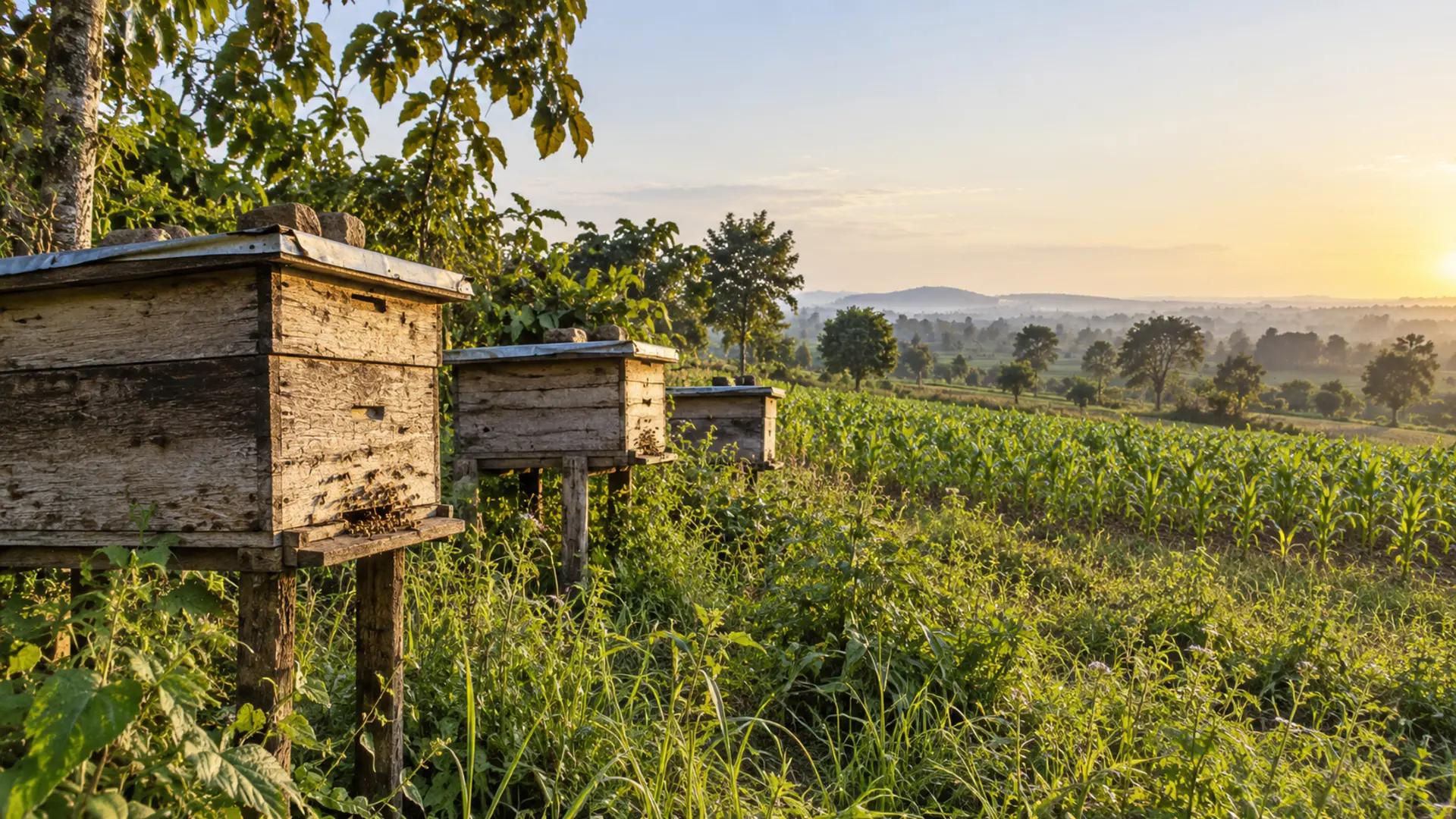
A beekeeper in Uganda usually has hives on land they do not farm, next to land somebody else does farm. The colonies forage over a radius that no fence contains. The neighbour sprays when the neighbour needs to spray, and the first the beekeeper hears of it is a heap of dead bees at the hive entrance.
This guide is written for that situation. It gives you a written agreement to put in front of a neighbour, a calendar to fill in with them, a procedure for the day itself, and a clear account of what is actually documented and what is not.
It begins with a statement that shapes everything that follows. We read the Ugandan instruments. There is one bee-specific sentence in the whole of the agricultural chemicals control framework, and it is a label precaution rather than a duty owed to a beekeeper. Nothing in Ugandan law requires anybody to tell you before they spray.
That is not a reason to give up. It is the reason the agreement in this guide matters.
What Ugandan law actually requires
Four instruments were checked directly for this article, and the result is worth setting out plainly rather than summarising vaguely.
Protecting Bees From Pesticide Exposure in Uganda: Notification, Timing and Colony Protection
A panel summarising the four Ugandan instruments checked for bee protection provisions, what each one does and does not contain, and the resulting gap.
The subsidiary regulations. The Control of Agricultural Chemicals (Registration and Control) Regulations prescribe the wording that must appear on product labels. Among the precautionary statements in the Second Schedule is one that concerns bees directly: “Toxic to bees - Spray must not contact plants in flower if they are likely to be visited by bees.” That sentence is the entirety of the bee-specific content we could find in the Ugandan chemicals framework.
Read it carefully, because it is more useful than it first appears. It is not addressed to the beekeeper. It is addressed to the person applying the product, and it makes the condition of the plants, not the presence of hives, the trigger. A field in flower is the hazard, whether or not anybody nearby keeps bees.
The principal Act. The Control of Agricultural Chemicals Act establishes the regulatory board and its registration, inspection and seizure powers. We were unable to open a clean readable copy of the full principal text, and so this guide makes no claim about what else it may or may not contain.
The 2024 amendment. We did open the Agricultural Chemicals (Control) (Amendment) Act, 2024 in full. It dissolves the Agricultural Chemicals Board and moves its functions into the Ministry. It contains no provision about bees, pollinators, apiaries, notification or application timing.
The apiary standard. Uganda Standard US 641:2006, the code of practice for apiary management, handling and processing of bee products, does address siting. It requires that “The site shall be hygienic with no potential sources likely to contaminate the forage especially agrochemicals” and that “There shall be low frequency of insecticide application in the area.”
That is a real requirement and a useful one, but notice what it does. It puts the obligation on the beekeeper, at the point of choosing a site, and it gives no distance. It does not tell you how far is far enough, and it does not reach the neighbour who begins spraying three seasons after your hives went in.
What this adds up to. There is no Ugandan notification duty, no statutory buffer distance around an apiary, and no legal requirement about time of day. Everything practical in this guide is therefore voluntary. The agreement below works because a neighbour agrees to it, not because anybody can be made to sign it.
If you want the wider framework for handling agricultural chemicals safely on your own land, that sits in safe pesticide use and application. This article deals only with the boundary between a sprayer and somebody else’s bees.
The neighbour notification agreement
The single most effective thing a Ugandan beekeeper can do about pesticide exposure is to stop being a surprise to the person next door.
Protecting Bees From Pesticide Exposure in Uganda: Notification, Timing and Colony Protection
A blank two-party neighbour notification agreement sheet with fields for both parties, hive locations, notice period, contact method, spray window and a signature block.
The template above is deliberately short. It is a private arrangement between two people, not a contract, and presenting it as a contract is the fastest way to have it refused. Print two copies, fill them in together, keep one each.
Five things belong on it and nothing else does.
Who, with a telephone number that works. The commonest failure of these arrangements is not bad faith. It is that the beekeeper’s number has changed, or the person who sprays is a hired worker who never had the number in the first place. Put a second contact on the sheet.
Where the hives are and how many. A neighbour who does not know the hives are there cannot take them into account. A neighbour who knows there are twelve colonies behind the scrub line behaves differently from one who thinks there might be a couple somewhere.
How much notice, and by what method. Agree a number of days rather than a vague promise. Agree whether notice comes in person, by call, or by message, because the three fail in different ways. A message to a phone that is switched off is not notice.
What happens in the window. State what the beekeeper will do and when: nothing, confine, or move. This matters because it converts the notice from information into a plan, and because it tells the crop farmer that the notice has a purpose.
When you will look at it again. A season is the right interval. Cropping changes, hive numbers change, and the person doing the spraying changes.
A version of this idea operates formally elsewhere. A voluntary United Kingdom scheme lets farmers register a field they intend to spray by dropping a pin on a map, entering the product, the crop and the date, and having a notification sent to beekeepers registered nearby, with the beekeeper choosing the notification radius “up to a maximum of 5km” and deciding “what action to take, if any.”
That is the same logic as the sheet above, with a database instead of a conversation. We include it because it shows the design of the thing works where it has been tried, not because a Ugandan equivalent exists. None was found.
The spray window calendar
An agreement without a calendar becomes a promise nobody remembers in the third month of the season.
Protecting Bees From Pesticide Exposure in Uganda: Notification, Timing and Colony Protection
A blank season-long spray window coordination calendar with rows for weeks and columns for crop flowering, planned application, notice given, colony action and confirmation.
Fill the first two columns in together, before the season starts. The flowering column is the one that decides everything, because the label precaution quoted above is triggered by plants in flower, not by a date.
Three practical points about completing it.
Observe flowering, do not predict it. A planting date does not reliably give a flowering date in a Ugandan season with variable rainfall. Walk the field. The entry belongs on the calendar when the flowers are there.
The ground cover counts. A crop that is not yet in flower can be standing over a carpet of flowering weeds that bees are working hard. If the field is attractive to bees, the field is the hazard, whatever the crop is doing.
Write the confirmation down. The last column, confirming it is safe to return or release, is the one people skip. It is also the one that prevents a colony being confined for two days because nobody told the beekeeper the job was done.
Why timing works, and where it stops working
The advice to spray in the evening is repeated everywhere. It is sound, and it is also narrower than it sounds, and a beekeeper negotiating with a neighbour should understand both halves.
The Food and Agriculture Organization’s pesticide registration guidance states the principle directly: honeybees “are generally active during daylight and remain in the hive/nest at night,” so “Changing the timing of application of the pesticide to the evening or night, when honeybees are not active, will avoid direct overspraying of the bees.”
That is the first half. Here is the second, from the same source: “Pesticide application in the evening is only an effective risk mitigation method if the pesticide deposit degrades enough during the night not to be hazardous to bees anymore in the morning.”
This is the point most summaries lose. Evening application removes the bees from the moment of application. It does not remove the residue from the flowers the bees will visit at first light. Whether the tactic works depends on how fast that particular deposit stops being dangerous.
The technical measure used for this is residual toxicity, expressed as the time taken for a residue to fall below the level that kills a quarter of exposed bees. The FAO guidance states that pesticides with a residual time to 25 per cent mortality of less than eight hours “may pose limited acute risks to honeybees if applied in the evening.” A published systematic review of pollinator protection guidance records the same threshold in the opposite direction: a product with extended residual toxicity is one where that time exceeds eight hours.
Two consequences follow for a Ugandan beekeeper.
First, you cannot judge this from the field. The residual behaviour of a product is a property of the product, and the only document that carries a bee statement for a specific product is its own label. That is why the first rung of the decision ladder below asks what is being applied, not just when.
Second, a long-residual product defeats the timing tactic entirely. United States extension guidance on protecting honey bees puts the practical consequence plainly: “If the insecticide has a long residual life and is being applied to a plant where bees are foraging, it may be best to move your bees,” because exposure can continue “for a period of time well beyond the treatment date.”
The FAO guidance also records a limit that a beekeeper should know even though it concerns bees they do not own: “Spraying at night does not prevent exposure of solitary bees and bumblebees that fly at night or nest in the field or its near vicinity.” Evening timing is a honeybee measure. It is not a pollinator measure.
Hive placement, and the distance we could not find
This is a section where the honest answer is the useful one.
We searched for a documented safe distance between an apiary and a sprayed field that is applicable to Uganda, and did not find one. The Ugandan apiary standard requires a site free of likely agrochemical contamination but states no distance. The Ugandan national beekeeping training and extension material we were able to open contains a general instruction to spray early or late and to avoid open flowers, and no siting distance. A peer-reviewed study of physical barriers around apiaries was identified but could not be opened, and is therefore not used here.
What does exist is a notification distance from a non-Ugandan source. United States extension guidance recommends that “All beekeepers within 2 to 3 miles of the area to be treated should be notified at least the evening before.” That figure is a notification radius chosen to cover foraging range, not a safe siting distance, and it comes from a different country with a different regulatory system. We report it because it tells you the scale at which the problem is thought about, and we decline to convert it into a Ugandan siting rule, because nobody has published one.
So the placement rule this guide gives you is a rule about information rather than metres.
Place hives where you know what happens on the neighbouring land. Distance you cannot verify is worth less than a boundary you can see and a neighbour you can call. An apiary two hundred metres from a field you know nothing about is in a worse position than one at the edge of a field whose owner rings you.
Prefer boundaries with standing vegetation. A hedge, a scrub line or a treed strip between hives and cropland is not a documented barrier, and this guide does not claim it is one. It is, however, the arrangement the apiary standard’s requirement for a hygienic site free of likely forage contamination points towards, and it costs nothing to prefer it.
Site so that the colonies can be reached quickly. Every protective action in the next section depends on somebody getting to the hives on the day. An apiary that takes two hours to reach cannot be confined at dusk.
Give the colonies their own water. A peer-reviewed study of water provision to honeybees in agricultural landscapes states that water “is essential for honey bees” but that “contaminated sources of water in agricultural environments represent a risk of exposure to potentially harmful contaminants,” and suggests that providing clean water “could be an efficient and cost-effective measure for beekeepers to reduce bee mortality associated with pesticides.” That same study is honest about its own result: the waterers tested “did not reduce worker mortality or increase overall colony weight” in the trial. The reasoning for clean water is sound and the demonstrated benefit is not established. Provide it because it is cheap and sensible, not because a trial proved it works.
Siting interacts with hive type, and if you are still deciding that, it is covered in choosing a hive type.
The colony protection procedure for the day
Notice arrives, and then somebody has to do something before dark. The ladder below is that something, arranged so the limits sit beside the actions rather than in a footnote.
Protecting Bees From Pesticide Exposure in Uganda: Notification, Timing and Colony Protection
A five-step decision ladder for the day before an application, running from confirming the product and timing through to the decision to leave, confine or move colonies, with the documented limits of each printed alongside.
The ladder above is the procedure. Work down it in order, and read the limit box on each rung, because the limits are what stop a protective action from becoming the thing that kills the colony.
The confinement guidance is worth setting out in full, because it is the step most often done badly. United States pollinator protection guidance states the method: “Place a metal mesh screen material that bees cannot pass through across the hive entrance,” and “Leave the screen in place for a full 24 hours.”
It then states the risks, in terms that should be read twice by anyone working in Ugandan daytime heat. “Colonies may be at risk for overheating even during a 24-hour period and certainly over longer periods.” And: “We do not advise fully covering or sealing colonies, because temperatures in the hive can reach lethal levels very quickly.” Where a cover is used, it should be light coloured rather than dark, because of heat absorption. If confinement runs beyond a day, the same guidance says to “add an internal feeder filled with light sugar syrup or water.”
Three rules follow from that, and they are not negotiable.
Screen, never seal. A screened entrance keeps bees in and air moving. A sealed or covered hive is a heat trap.
One day is the working limit. Beyond a day you are managing a heat and water problem as well as a chemical one, and the guidance says so.
Shade and water are part of the procedure, not an extra. If you are confining colonies in the middle of a bright Ugandan day, the ventilation and the internal water are the difference between a protected colony and a cooked one.
The same source states the alternative plainly: “The most effective way to limit risk is to move your colonies from the spray area.” Relocation is the strongest option and the one that needs the most preparation, because it requires somewhere to go and time to get there. If the agreement in this guide gives you notice measured in days rather than hours, relocation becomes possible. That is the main practical reason the notice period on the sheet is worth negotiating hard.
That guidance also records the limit of any notification arrangement: “Generally, government agencies provide little notice before they make area-wide insecticide sprays.” A private agreement with a neighbour does nothing about area-wide operations, and this guide does not pretend otherwise.
Reading the hive after a suspected poisoning
If you arrive to find dead bees, the first question is not what to do. It is what happened, because the response to a chemical kill, a parasite decline and a starvation event are entirely different.
Protecting Bees From Pesticide Exposure in Uganda: Notification, Timing and Colony Protection
A three-column comparison panel setting the documented signs of a pesticide kill against the documented signs of a slow parasite decline and the documented signs of starvation.
United States extension entomology guidance describes the chemical picture: “You may see many dead bees in front of the hive one day” and “You may also see trembling bees because most insecticides are nerve toxins.” The same source contrasts the speed, describing a pesticide kill as “usually rapid (1-3 days)” with large piles of dead or dying bees, against parasite damage that is “usually slow (over weeks)” with “generally fewer, scattered bees dead outside hive.”
The starvation picture is different again. United States university bee laboratory guidance describes starvation as showing “numerous dead bees between the combs and on the floor, many positioned head first in a cell.”
That last detail is the most practically useful line in this section, because it is a picture you can check inside the hive in a minute, and it is visually unmistakable. Bees head-down in cells is a starvation sign, not a spray sign.
Three cautions about using this.
These are non-Ugandan sources. We found no Ugandan diagnostic guide for distinguishing causes of colony loss. The descriptions above are behaviour and pattern rather than climate-dependent, which is why we consider them transferable, but the reader is entitled to know where they come from.
Signs narrow, they do not confirm. A pile of dead bees at the entrance after a known spray event is strong circumstantial evidence. It is not proof, and this guide has no laboratory procedure to offer you.
Brood loss and queen failure are not covered. We looked for documented brood and queen signs specific to pesticide poisoning and did not find them in any source we could open. If your colony shows brood problems after a spray event, this guide does not let you attribute that to the spray, and we will not invent a link.
What the Ugandan evidence shows, and what it does not
There is one Ugandan study on this subject that we were able to open and read in full, and its result is not the one a beekeeper might expect.
A 2017 study published in PLOS ONE examined environmental contaminants in Ugandan honeybee products using laboratory screening. Of 36 pesticides screened, 20 were detected. Fungicides were the most prevalent chemical class, and the detected insecticides spanned several classes. The highest frequencies “occurred in beeswax and in samples from apiaries located in the proximity of citrus and tobacco farms.” Sampling covered agro-ecological zones in northern Uganda, and one zone returned no detections at all.
Then the finding that matters most: “All detected pesticide levels were below maximum residue limits (according to EU regulations) and the lethal doses known for honeybees.”
Set that out precisely, because it is easy to misread in either direction.
What it establishes. Agricultural chemicals are demonstrably present in Ugandan hive products, more so near particular cropping systems, and the pattern is not uniform across the country.
What it does not establish. It does not show Ugandan colonies being killed by pesticides. The measured concentrations were below the levels known to kill bees. The authors themselves call for “future risk assessment” to determine effects on the African honeybee genotype, which is an explicit statement that the question is open.
What we searched for and did not find. No Ugandan or East African survey of colony losses attributed to agrochemicals was located. There is no national figure. Anyone who quotes you one should be asked for the document.
This is why the guide is built around an agreement and a procedure rather than around a threat. The mechanism is real and documented from elsewhere. The Ugandan exposure is documented. The Ugandan loss data does not exist. A beekeeper who acts on the mechanism is acting sensibly. A beekeeper who is told that pesticides are destroying Ugandan apiaries at some stated rate is being told something nobody has measured.
The residue finding also has a second implication that belongs in an honest article. Because detections were below regulatory residue limits, that study is not evidence that Ugandan honey fails residue standards either. It is a contamination survey, not a compliance verdict, and it should not be used as one in either direction. The wider question of residue requirements in Ugandan produce is dealt with in food safety and residue requirements.
Putting it to work this season
The sequence is short.
Before the season. Walk the boundary with the neighbour. Fill in the agreement sheet and the first two columns of the calendar together. Establish who calls whom, and put a second name on the sheet.
When the notice comes. Work down the decision ladder. Ask what is being applied, because the label is the only document that carries a product-specific bee statement. Ask about timing. Look at the field yourself and ask whether anything in it is in flower, including underneath the crop.
On the day. Screen rather than seal. Provide shade and internal water if there is any chance of a hot confinement. Prefer moving the colonies if you have the notice and the place to move them to, because that is what the guidance calls the most effective option.
Afterwards. Look at where the dead bees are, not just how many there are. Record what happened on the calendar sheet, with the date and the product name from the label if you were given it. Two seasons of those records is the only Ugandan evidence base on this subject that you will ever personally control, and it is worth more than any figure repeated at a meeting.
And treat the arrangement as the protection. Ugandan law gives you one label sentence and a siting clause addressed to you. The neighbour who rings you two days before spraying is, in practice, the entire protective system. Everything in this guide is in service of making that call happen.
Author: Falcon Foundation Ltd Editorial Team
The Falcon Foundation Ltd Editorial Team produces evidence-based agricultural guidance for Ugandan farmers, drawing on published research and institutional sources and translating them into practical decision support. Where evidence is unavailable or contested, we say so rather than filling the gap.
