
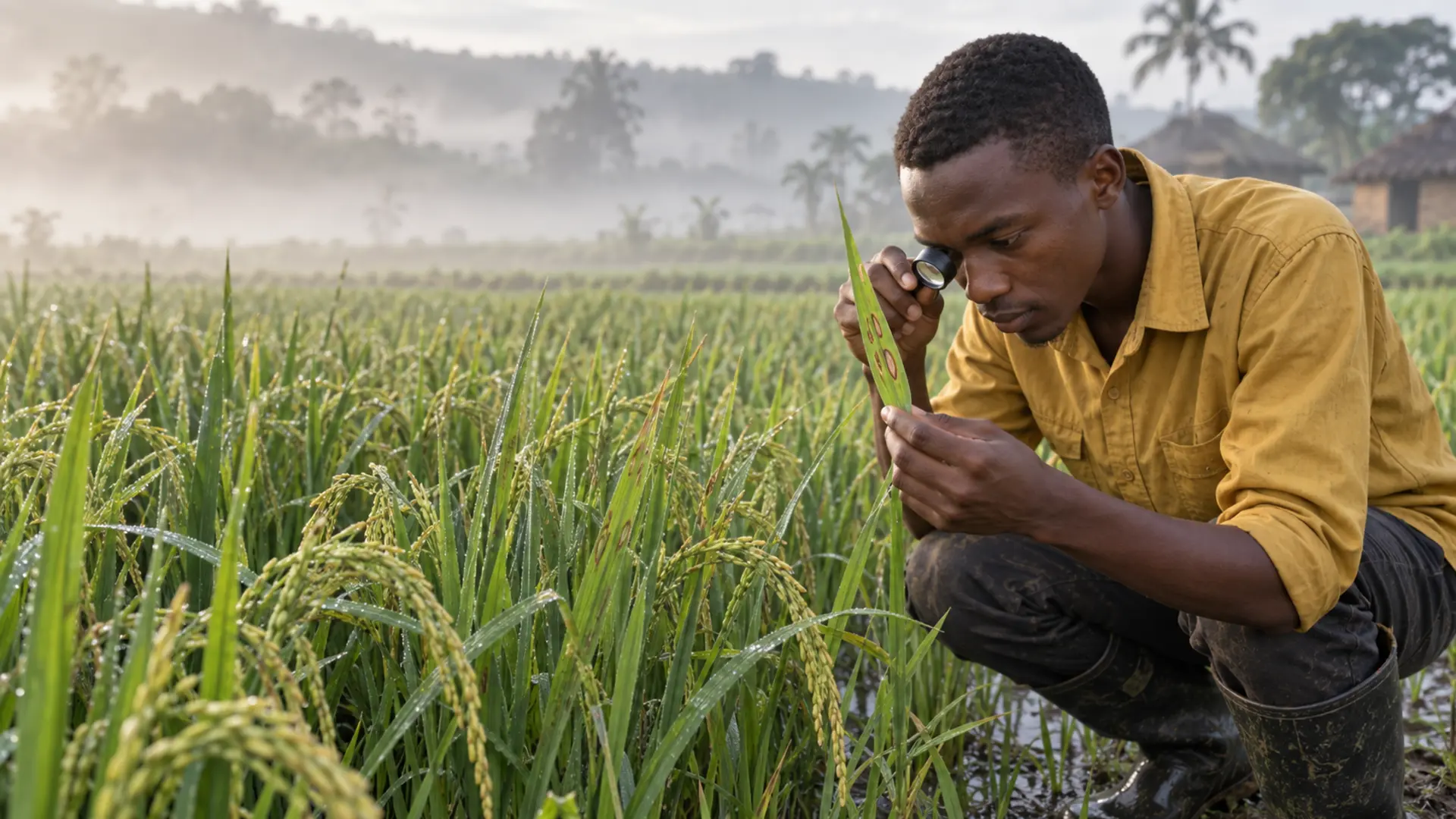
There are two conversations about rice blast in Uganda. In the first, a grower describes spots and is told it is drought, or the fertiliser, or the seed. In the second, the same grower stands in front of a field of whitened panicles in the fourth month and asks what can be done, and the honest answer is nothing, this season.
The gap between those two conversations is the subject of this article. Blast is not hard to recognise once you know what you are looking at, and the misidentification is well documented in Uganda. A survey of 224 farmers across northern, eastern and central districts found that farmers ranked rice yellow mottle virus as the most important disease, followed by leaf blast, brown spot, sheath rot, panicle blast and bacterial leaf blight, but that while 60 per cent of farmers identified rice yellow mottle virus, fewer than 30 per cent could clearly diagnose the symptoms of each of the other diseases, and fewer than 6 per cent practised any form of management for them. A separate survey across 27 Ugandan districts in the 2015B and 2016A seasons found average blast prevalence of 72.61 per cent, and concluded that the majority of small-scale rice farmers do not know rice blast disease regardless of years of experience in rice production.
This guide is a diagnostic and a triage. It tells you what you are looking at, which stage the crop has reached, and what is still worth doing. It gives no product names, no active ingredients and no application rates, anywhere.
What this guide helps you decide
Whether what you are seeing is blast at all. Which of the four blast expressions you have: leaf, collar, node or neck. Whether the yield is already determined or still in play. What to change now, and what to record for next season, which for a late diagnosis is the only real decision left.
The short answer
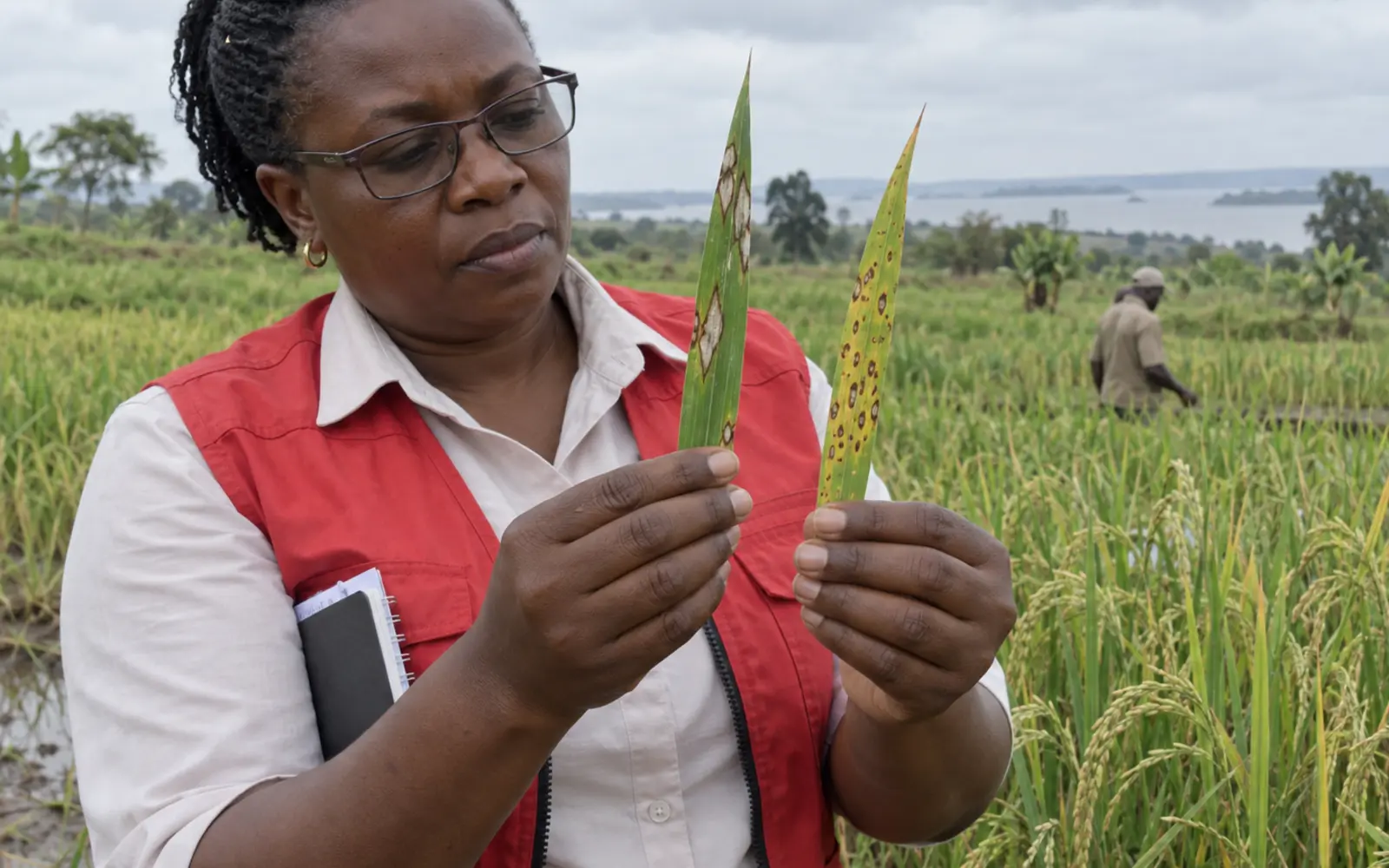
Blast lesions on the leaf blade are diamond or spindle shaped, with a grey or white centre and a brown to reddish-brown border, and on a susceptible variety they enlarge, sometimes to several centimetres. That shape is the diagnosis. Brown spot, its commonest look-alike, makes circular to oval lesions with a distinct reddish-brown margin. Drought and nutrient problems do not make discrete lesions at all; they affect whole leaves.
If the lesions are on the leaves and the crop has not yet headed, you still have levers: water, nitrogen management, and how you plan the next season. If the neck has been infected and the panicles are whitening, the yield outcome is already set. Your remaining work is recording, sanitation and seed decisions for next time.
What causes it, and what favours it
The disease is caused by a fungus, referred to across the literature as Magnaporthe oryzae or Pyricularia oryzae. The American Phytopathological Society’s teaching material states that rice blast is favoured by moderate temperatures around 24 degrees Celsius and periods of high moisture lasting 12 hours or longer.
That single sentence explains most of what you will observe. Blast worsens after runs of overcast, humid days with long dew periods, and it appears in the parts of a field that stay wet on the leaf longest.
Reading the lesions
Blast expresses itself in four places on the plant, and each one tells you something different about where you are in the season. Work through them in order, and compare what you find against the look-alikes in the section that follows.
Rice Blast: Reading the Lesions and Deciding Whether the Crop Can Be Saved
Lesion identification chart comparing rice blast with brown spot, narrow brown leaf spot, bacterial leaf blight, drought scorch and nutrient deficiency
Leaf blast. The University of California’s rice guidance describes lesions on the leaf as usually diamond shaped with a grey or white centre and a brown or reddish-brown border. The American Phytopathological Society adds that on susceptible cultivars, lesions may initially appear grey-green and water-soaked with a darker green border and expand rapidly to several centimetres in length, while on resistant material lesions often remain small at one to two millimetres and brown to dark brown. The International Rice Research Institute’s diagnostic material describes them as elliptical or spindle shaped with brown borders and grey centres.
That variation matters. A field of small brown one to two millimetre specks and a field of expanding grey-centred spindles may carry the same fungus on differently susceptible plants.
Collar blast. Infection at the junction of the leaf blade and the sheath, producing what the University of California describes as the typical brown collar rot symptom. It is easy to miss because you have to part the plant to see it, and it matters because it can kill the whole leaf above the infection.
Node blast. The International Rice Research Institute describes lesions on the node as blackish to greyish brown, occurring in a banded pattern. The University of California notes that stem nodes may be infected as the plant approaches maturity, causing the complete death of the entire stem above the infection.
Neck blast. This is the one that costs the crop. The International Rice Research Institute describes lesions on the neck as greyish brown, capable of girdling the tissue and making the neck and the panicle fall over, and states the consequence precisely: if infection of the neck occurs before the milky stage, no grain is formed, but if infection occurs later, poor quality grains are formed.
A practical distinction worth knowing. Whitened panicles can also be caused by stem borer. The International Rice Research Institute gives a simple test: with blast, tugging on the stem will not result in its removal, whereas a borer-damaged tiller pulls away.
Rice Blast: Reading the Lesions and Deciding Whether the Crop Can Be Saved
Growth stage progression diagram showing leaf, collar, node and neck blast with a colour band under each indicating where intervention still changes the outcome
What blast is confused with, and how to tell
Brown spot. The closest look-alike. The International Rice Research Institute describes fully developed lesions as circular to oval with a light brown to grey centre surrounded by a reddish brown margin, and 5 to 14 millimetres long on susceptible varieties. The distinguishing feature is shape and margin colour together: round with a reddish rim, rather than diamond with a brown rim.
Narrow brown leaf spot. Short, linear lesions, typically 2 to 10 millimetres long and 1 to 1.5 millimetres wide, running parallel to the leaf veins. Shape alone separates it.
Sheath blight. Small greenish-grey ellipsoid or ovoid lesions on the sheath that enlarge and coalesce into larger lesions with an irregular outline, a greyish-white centre and dark brown borders. Location on the sheath rather than the blade is the first clue.
Bacterial leaf blight. A water-soaked lesion usually starting at the leaf margins, becoming yellowish to light brown as it dries, with a yellowish border between the dead and green areas. It progresses inward from the margin rather than appearing as discrete spots on the blade.
Drought scorch. Not a lesion at all. Under water stress, rice rolls its leaves as an acclimatisation response, leaves age and yellow as chlorophyll is lost, and leaf area shrinks. These are whole-leaf and whole-canopy responses. If the affected leaves are rolled and uniformly discoloured rather than spotted, you are looking at water, not fungus.
Nutrient deficiency. Nitrogen deficiency shows as general stunting with an overall yellowing, older leaves turning yellowish-green. Potassium deficiency shows as yellowish-brown areas around the leaf margin with dark brown necrotic spots, with leaf tips eventually drying and becoming necrotic in severe cases. Again the pattern is the tell: margins and tips, spreading inward, not discrete spots scattered across the blade.
Nitrogen, and what this article will not say
Excess nitrogen increases blast severity. This is one of the most consistently reported findings in the literature and the mechanism is understood.
The University of California explains it directly: high nitrogen rates, especially in nitrate form, cause rice plants to produce rapid new tissue growth that is more susceptible to the pathogen than older tissue. It adds a field observation that is worth carrying into your own paddy: leaf blast often appears first on field headlands, where the fertiliser equipment turns and overlaps the nitrogen application. The American Phytopathological Society states that overuse of nitrogen fertilisers increases the amount of rice blast in fields while often failing to significantly increase yields. A review of blast in sub-Saharan Africa states that the disease is well known to be most severe under water stress or high nitrogen levels. Kenyan farmers in a published survey themselves attributed the disease in part to excessive use of nitrogen fertiliser.
What this article will not do is turn that into a fertiliser recommendation. The correct nitrogen rate for your field depends on your soil, your variety, your water regime and your target yield, and that is a soil fertility question with its own guide. The blast-specific point is narrower and worth stating on its own: if you have a blast problem and you are applying nitrogen heavily, or applying it unevenly so that some parts of the field receive a double dose, you are making the problem worse.
Water, and why it matters more than most people expect
The University of California states that continuous flooding limits blast development by reducing the availability of nitrate in the soil and by reducing drought stress on the plants. The sub-Saharan African review makes the converse point: drought stress, or even suboptimal flood depth, leads to increased susceptibility to the pathogen.
This is the single most useful lever for a grower who has leaf blast and has not yet headed. If your water management is intermittent, if the field dries between irrigations, or if the bunds leak so that parts of the field run shallow, that is where blast will be worst, and it is fixable.
Upland rice, grown without standing water, is by this logic more exposed, which is one of several reasons the upland and lowland decision deserves its own analysis.
Other levers, honestly rated
Seed source. The University of California recommends using certified seed to ensure that seed originates from seed fields inspected for the disease, and notes that maintaining a flood during establishment helps reduce transmission from infected seed to seedlings. We looked for evidence on non-chemical seed treatment specifically against blast and could not verify a usable source; we are not going to describe a treatment we could not confirm.
Silicon. There is real evidence here. The American Phytopathological Society describes silicon deposition in the leaf epidermis, with silicified cells acting as a physical barrier impeding penetration by the fungus, and a silica layer of approximately 2.5 micrometres beneath the cuticle. It also states that silicon plays an active role in resistance rather than simply forming a physical barrier. This is a genuine lever, though whether a practical silicon source is available and affordable in your district is a question this article cannot answer for you.
Variety. The most-cited lever and the one requiring most care. A 2021 review of irrigated and rain-fed lowland rice breeding in Uganda records that 450 lines were screened progressively across 2014, 2015, 2016, 2017, 2018 and 2020 for sources of blast resistance, and describes released varieties: Komboka as moderately tolerant to rice yellow mottle virus and tolerant to rice blast and bacterial leaf streak, Agoro and Okile as moderately tolerant to all three, and WITA-9 and NERICA-6 as resistant to rice blast and bacterial leaf streak.
Read that with the date attached and the caveat that the same literature insists on. The review is from 2021. The sub-Saharan Africa review states plainly that blast resistance can be overcome through genetic changes in the pathogen population, and a West African research programme summary concludes that although resistant varieties are the most effective means of combating the disease, resistance breaks down through pathogen adaptation, so the management approach centres on resistance gene rotation and gene pyramiding. A variety described as resistant five years ago may not be resistant in your district today. Ask your local research station or extension officer what is currently holding, and treat any confident claim about a named variety without a current date behind it as unverified.
Sanitation. Residue and volunteer plants carry inoculum between seasons. This is routine good practice rather than a documented cure, and we present it as such.
Triage: what is still worth doing, by stage
Leaf blast, before panicle initiation. The most useful stage to be at. Fix the water regime so the field does not dry between irrigations. Stop any further nitrogen top-dressing until you have taken advice, and check for the overlapping-application pattern at headlands and turns. Record where in the field it started.
Collar and node blast, stem elongation. The window is closing. The same water and nitrogen actions still apply but their effect on this season’s yield is smaller. Begin the record for next season in earnest: variety, seed source, where it appeared first, and the weather in the week before you saw it.
Neck and panicle blast, heading onward. This season’s outcome is determined. The International Rice Research Institute’s statement about infection before or after the milky stage tells you what has already happened to your grain. What remains is to avoid making next year worse: harvest, manage the residue, do not save seed from a badly affected crop, and write down what you have learnt.
Rice Blast: Reading the Lesions and Deciding Whether the Crop Can Be Saved
Field record sheet for a rice blast season showing what to write down for use in planning the following season
What the loss figures do and do not tell you
You will find alarming numbers in the literature. The sub-Saharan Africa review compiles country-level losses attributed to blast: Ghana and parts of the Gambia up to 100 per cent, Nigeria 35 to 65 per cent, Burkina Faso 1 to 22 per cent in rain-fed lowland and 4 to 45 per cent in irrigated systems, Sierra Leone more than 80 per cent, Kenya 48 per cent, and other East African countries 30 to 40 per cent. A Kenyan study in the greater Mwea region reported that in 2009, at 55.5 per cent disease occurrence, average production per acre fell to 10.5 ninety-kilogramme bags from 21.9 the previous year, a 47.9 per cent decline.
None of those figures is a Ugandan measurement. The Uganda rice handbook produced with Japanese development cooperation and the national research organisation states that in severe infections yields may be reduced by 50 per cent, but that is a general handbook statement with no study, season or method behind it, and it should not be quoted as a Ugandan statistic.
What Uganda does have is prevalence and incidence data. The 27-district survey found average blast prevalence of 72.61 per cent, with the highest mean incidence of 96.8 per cent recorded in Luwero district and the lowest at 21.3 per cent in Amuru, and the eastern region recording the highest average incidence at 74.5 per cent. Prevalence and incidence are not yield loss. They tell you how widely the disease is present, not how much grain it took.
Where blast appears first, and why that tells you something
Blast is not evenly distributed in a field, and where it starts is diagnostic information you get for free.
At the headland, or wherever the applicator turned. The University of California’s observation that leaf blast often appears first on field headlands where the fertiliser equipment turns and overlaps the nitrogen application is one of the most useful field clues in this whole article. If your worst patch is a band along the turn line, the cause is not the weather.
Where the water is shallowest or the field dries first. A high corner, a leaky bund, the far end of a run that never quite floods. If the disease follows your water map rather than your fertiliser map, water is the lever.
Where the canopy is densest. A thick canopy holds leaf wetness longer, and the disease needs long wet periods. A patch that is both the most vigorous and the most affected is telling you something about the interaction of nitrogen and canopy rather than about a seed problem.
Uniformly across the field from the seedling stage. This pattern is different in kind, and it points towards the seed rather than the field. It is the pattern that should make you change seed source for next season rather than adjust management this one.
Take a few minutes to sketch the field with the affected areas marked before you decide anything. The picture usually names the cause.
The one honest conversation about upland rice
A great deal of Ugandan rice is grown upland, without standing water, and the water lever that this article leans on is simply not available there.
That does not make the article useless for upland growers, but it does change the emphasis. Where you cannot flood, blast management rests almost entirely on three things: choosing a variety with current, locally verified standing against the disease; keeping nitrogen moderate and even; and reducing drought stress by the means you do have, which are planting date, spacing, weed control and soil organic matter.
It also raises the honest question of whether the field should be in upland rice at all. The sub-Saharan Africa review’s point that drought stress increases susceptibility is not a management note; it is a description of the growing system. A field that is chronically water-stressed at the wrong time of year will keep producing blast whatever else is done, and the more useful decision may be about the system rather than the season.
Cost categories
No prices. The cost lines relevant to a blast decision are: certified seed, which is where most of the durable benefit sits; water management, including bund repair and the labour of maintaining a consistent depth; soil testing, if the nitrogen question needs settling properly; the labour of scouting, which is the cheapest line here and the most neglected; and residue management after harvest.
Common mistakes
Calling it drought because the weather has been dry, without looking at whether the marks are discrete lesions or whole-leaf rolling. Calling it blast because there are spots, without checking whether the margin is reddish and the shape round. Increasing nitrogen in response to a yellowing crop that is actually diseased. Applying nitrogen unevenly and creating a blast nursery at the headland. Saving seed from a badly affected crop. Trusting a variety’s resistance claim without a current date behind it. And waiting until the panicles whiten before asking anybody.
Warning signs and escalation points
Get a proper diagnosis, from an extension officer or a plant clinic, if: you have discrete lesions and cannot confidently place their shape; the pattern in the field does not match your water or fertiliser layout; lesions appear on the neck or nodes; or the same variety fails in the same way two seasons running, which suggests a resistance question rather than a weather one.
If you are being sold a treatment on the strength of a diagnosis nobody made, that is a reason to stop and ask someone independent.
Where it works and where it does not
The identification and triage in this guide works anywhere in Uganda, because the lesions look the same everywhere. The management levers work best where you have control of water. In a fully rain-fed upland field you have fewer of them, which pushes the weight onto variety, seed source and nitrogen discipline.
Where none of this works is after heading. There is no honest version of this article that offers a late rescue.
A low-risk first step
Walk the field this week with the identification chart in your hand and look at ten plants in five places, including the wettest corner and the headland where the fertiliser turns.
Write down what you find on the record sheet: date, growth stage, where, lesion type, rough proportion affected, the previous week’s weather, the variety and the seed source. Whether or not this season is saveable, that page is what makes next season’s decisions better than this one’s.
What to do next
Read our guide to integrated pest management scouting and thresholds for the scouting discipline this article assumes, and verifying seed and planting material quality before you buy next season’s seed. Soil testing and fertility is where the nitrogen question is properly settled, and reading agricultural research for a Ugandan farm will help you judge a variety claim. Our guide to choosing between upland and lowland rice systems covers the water regime decision behind much of this article.
About the author
The Falcon Foundation Ltd Editorial Team produces evidence-based agricultural guidance for Ugandan farmers, drawing on published research and institutional sources and translating them into practical decision support. Where evidence is unavailable or contested, we say so rather than filling the gap.
