
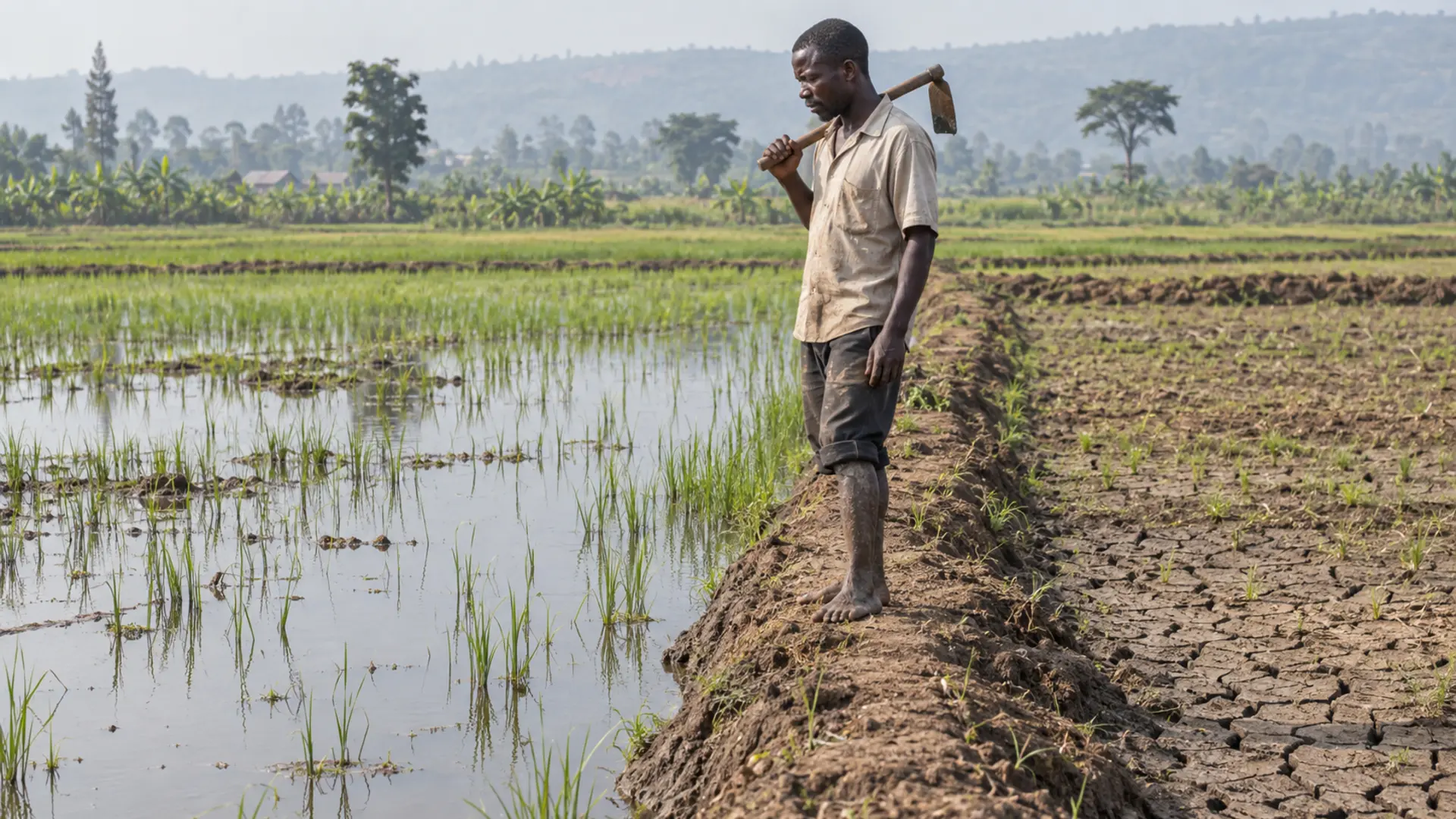
A neighbour grew rice last season and did well. Seed is bought from the same source, planted the same way, at roughly the same time.
It fails. The plants are thin, patchy, and by flowering half the field is yellow. The conclusion is that the seed was fake, or the fertiliser was wrong, or the rains were bad.
Very often none of those is the answer. The answer is that the neighbour’s field holds water and yours drains, or the other way round, and the variety was bred for one of those two situations and not the other.
Rice is the crop where the land decides more than the seed does.
What this guide helps you decide
By the end you should be able to classify your own field’s water regime honestly, choose between upland, rainfed lowland and irrigated systems on that basis, understand what NERICA actually is and why the name alone tells you nothing, and build a bund to a specification rather than by eye.
It does not cover rice blast or other diseases, irrigation scheduling, the legality of cultivating in wetlands, or milling and marketing. Wetland legality in particular is a serious matter with its own guide and is not settled here.
The short answer
Go and look at your field after the next heavy rain. Whether water stands on it, how deep, and for how long, is the single fact that decides everything else.
If water does not stand, you have upland ground and you need an upland variety, good drainage and enough rainfall.
If water stands but stays shallow and you can build a bund to hold it, you have rainfed lowland ground, which is the largest rice system in Uganda by area.
If water stands deep for weeks, that is deepwater ground and it needs advice this guide does not give.
Do not choose the variety first and then hope the field cooperates.
The four rice systems, and the number that separates them
Rice is grown in distinct ecosystems and the boundaries between them are defined by water, not by altitude or region.
Rainfed upland. No standing water at any point. The crop lives on rainfall as it falls, like maize. AfricaRice’s own upland production handbook specifies siting in an ecological zone with at least 14 to 20 millimetres of fixed daily rainfall, on land with good drainage. Note what that means: an upland variety is not bred to survive standing water, it is bred to grow without it.
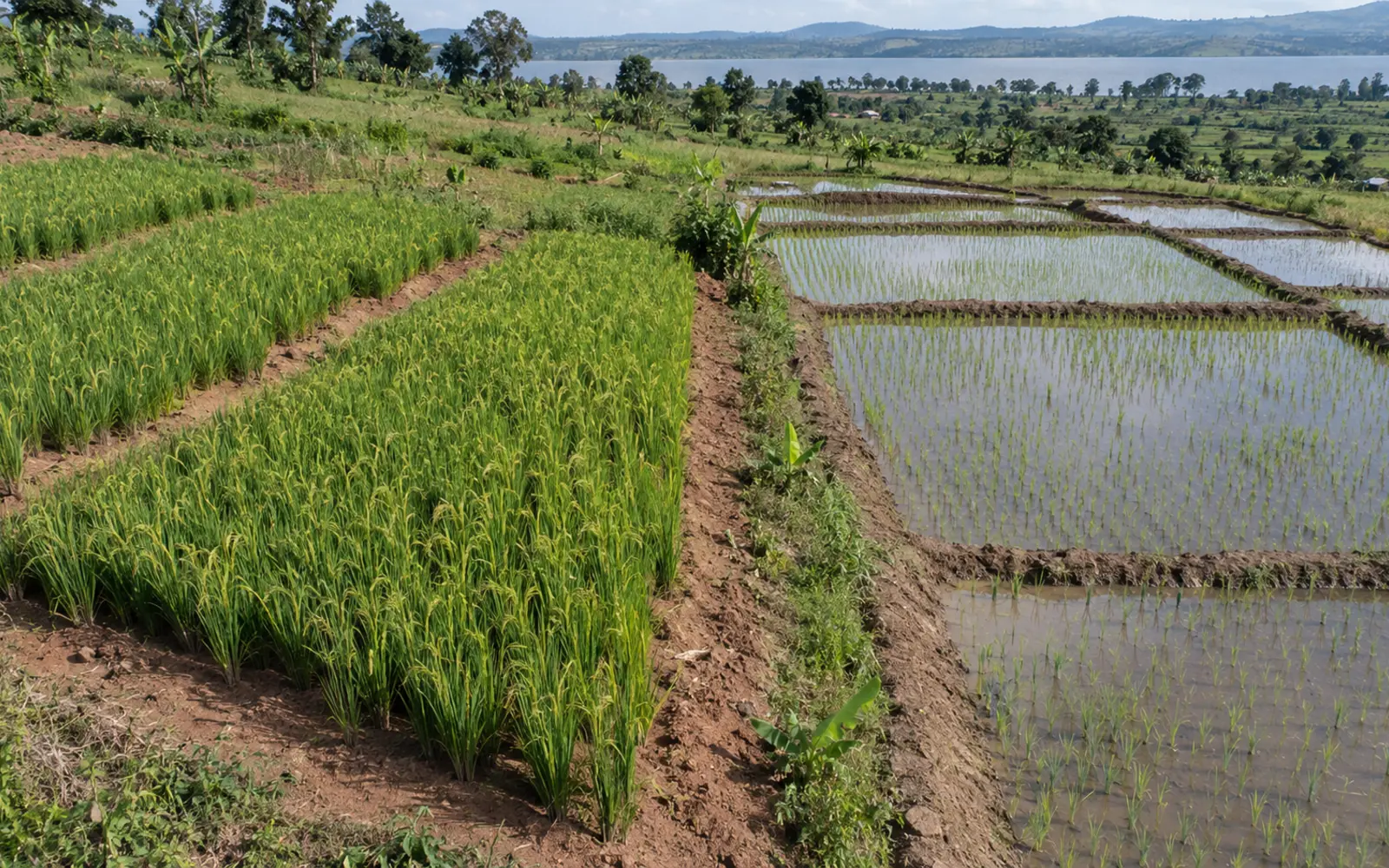
Rainfed lowland. Water stands for part of the crop cycle but does not get deep. The field is bunded to hold rain and runoff. This is the system most Ugandan rice grows in.
Irrigated lowland. Water is controlled and brought on deliberately.
Deepwater or flood-prone. Sustained deep flooding.
The threshold. Two independent sources give the same figure. A CGIAR review of rice research states that rainfed lowland is flooded for part of the crop cycle but is not deepwater rice because the flooding depth is less than 50 centimetres, and that flood-prone rice is defined as growing where sustained water depth exceeds 50 centimetres. A Japanese research institute’s work on West African lowland rice states that areas prone to submergence by less than 50 centimetres are generally suitable for rice production, beyond which lie floating rice plants which can grow in more than 50 centimetres of water. A 2023 review of flood-tolerant rice for Africa describes flooding-prone areas as those where water can accumulate to depths exceeding one metre for more than a month.
Fifty centimetres, sustained. That is the line between a field you can farm with ordinary rice and a field that needs something else.
Classifying your own field
This is the work the article is really asking you to do, and it takes a rainy season rather than an afternoon.
Watch it after heavy rain. Not once. Several times, across the season, and note each time: does water stand, where, how deep, and for how long before it goes.
Measure the depth. Push a marked stick in at the lowest point and read it. The 50 centimetre threshold is not something to judge by eye.
Look at the slope. Uganda’s own land preparation guidance, produced under the ministry’s rice development project, gives the plain rule: uphill or sharp slope fields should be used for upland crops, while lowland rice needs standing water. It adds, usefully, that upland rice also likes water, meaning that upland does not mean dry, it means not flooded.
Ask whether you can bund it. A field that would hold water if it were bunded is a rainfed lowland field waiting to be developed. A field too steep to bund economically is not.
Look at the soil. Uganda-oriented training material developed with the ministry advises that the soil should ideally be loam or clay, and that site selection should assess how deep the water table is, as this affects water availability for the crop, and the risk of flooding, to ensure it is manageable. A sandy field that drains fast is a poor lowland site whatever its shape.
An honest gap. We found no authoritative source giving numeric thresholds for soil permeability or water table depth that a farmer could measure against. The criteria above are qualitative in the sources, and we are not going to invent numbers for them.
Upland or Lowland Rice: Matching Rice Type to Your Water, Not Your Neighbour
Field water regime self-assessment flow leading to an upland, rainfed lowland or irrigated recommendation
What NERICA actually is
NERICA is the name most Ugandan rice growers know, and the name causes more confusion than any other single thing in this subject.
What it is. AfricaRice, the institution that developed it, describes NERICA as the product of crossing Oryza sativa, known as Asian rice, with Oryza glaberrima, often called African rice, to obtain varieties that might combine the high yield potential of Asian rice with the local adaptation of African rice.
The part everybody misses. There is no single NERICA. AfricaRice states that there are now 82 NERICA varieties: 18 upland, 60 rainfed lowland, and 4 irrigated.
Eighteen upland and sixty lowland. Asking for NERICA seed without specifying which ecosystem it was bred for is like asking for a bag of seed without saying which crop.
Uganda’s own releases. The Uganda National Rice Development Strategy for 2020 to 2030 records the release history. Upland varieties: NP-2, NP-3 and UK-2 released in 1995, then NERICA-4, NARIC-1 and NARIC-2 released in 2002, then Namche-1 through Namche-6 released in 2013. Irrigated varieties: AGORO, OKILE, WITA-9, NERICA-6 and KOMBOKA released in 2014. Research from NaCRRI documents the Namche releases with their pedigree codes, noting that Namche-1 also carries the designation ARICA-5.
A discrepancy you should know about. The ministry’s own Rice Cultivation Handbook lists NERICA-6 as suited to upland and lowland conditions, while the national strategy lists it among the irrigated varieties released in 2014. Those are the two most authoritative Ugandan documents on this subject and they do not agree. Before you plant NERICA-6 on the strength of either, ask NaCRRI which ecosystem it is currently recommended for.
What to ask for at the seed shop. Not “NERICA”. Ask for a named variety, ask which ecosystem it was released for, and ask to see the certification. The published guide to verifying seed and planting material quality covers how to check what you have been sold.
Where Uganda’s rice actually is
The national strategy gives the area split: rainfed upland covers 50,000 hectares, rainfed lowland covers 60,000 hectares, and irrigated lowland covers 6,000 hectares.
Read that carefully. Rainfed lowland is the largest system. Irrigated rice, which is what most people picture, is a small fraction. Most Ugandan rice depends on bunding to hold rain, not on a canal.
The same strategy records domestic production and consumption of milled rice at about 166,000 and 247,000 metric tonnes respectively, giving a self-sufficiency ratio of 67 per cent. That is a demand picture and a policy context, not a promise of a market at your farm gate.
On yields, we give none for Uganda. The published Ugandan sources do contain yield figures, and they disagree with each other in ways we could not resolve. The 2020 national agricultural survey reports a national rice yield well above the ecology-level figures given in earlier strategy documents, and we could not establish whether that reflects genuine productivity gains, a paddy against milled unit difference, or a survey methodology difference. Rather than pass on a figure we cannot stand behind, we give none. Anyone quoting you a Ugandan rice yield should be asked which document it comes from and whether it is paddy or milled.
The one comparative figure we will give is labelled as regional rather than Ugandan: a 2023 review of African rice systems reports rainfed upland yields of 1 to 1.6 tonnes per hectare against a potential of 2 to 4 tonnes per hectare. The gap between actual and potential is the point, not the numbers themselves.
Bunding
If you have decided on rainfed lowland, the bund is the whole system. It is what turns rainfall into a water regime.
The dimensions, and the fact that sources differ. Uganda’s Rice Cultivation Handbook states that bunding with 30 to 60 centimetres and levelling is recommended for higher yield, without specifying whether that is height or width. The ministry’s land preparation guidance specifies 30 to 40 centimetres width. The international rice research institute’s knowledge bank specifies standard bunds no wider and taller than 50 by 30 centimetres, with narrower 30 by 30 centimetre bunds where rat control matters.
Those are not the same specification. Build to whichever your own extension guidance names, and be aware that the range across sources is real.
What matters more than the exact dimension. The knowledge bank’s requirement is that bunds be well compacted and properly sealed, with no cracks or holes. A bund that leaks is not a bund. Rat holes and dry-season cracks are the two usual failure points, and both need closing before the rains.
The spillway. A notch cut to a controlled depth so that excess water leaves in one place rather than breaching the bund somewhere you did not choose. The knowledge bank specifies a spillway height of 3 to 5 centimetres for storing the same depth of water.
Plot size on slope. AfricaRice’s upland handbook instructs dividing the field into plots of 50 or 100 square metres and constructing bunds depending on the slope. On a slope, several small level basins work where one large one will not.
Levelling. Uganda’s own handbook pairs bunding with levelling for a reason. Water in an unlevelled basin is deep at one end and absent at the other, and the crop reflects that exactly.
Upland or Lowland Rice: Matching Rice Type to Your Water, Not Your Neighbour
Bund construction specification showing height and width in section, compaction, sealing and the spillway, with the published dimension ranges labelled
Managing water once the bunds are up
AfricaRice’s lowland production handbook gives the operating rule: maintain the water level in the field up to 5 centimetres from one week after transplanting until the grain matures, and drain about a week before harvesting.
Five centimetres is shallower than most people assume. Deep water is not better water.
What goes wrong when the match is wrong
An upland variety in standing water. It was bred without submergence tolerance. It will not thrive and, in a flood, it will not survive.
A lowland variety without water control. It depends on standing water to suppress weeds and to buffer dry spells. Without a bund it competes with weeds on equal terms and dries out between rains.
Flooding, in Uganda specifically. The 2023 review of flood-tolerant rice records that in Uganda over 2,000 acres of rice fields suffered significant damage due to floods, resulting in substantial yield losses, and that cultivar screening found none of the cultivars possessed the submergence tolerance allele that confers flash-flood survival. That is a direct Ugandan finding and it matters for anyone farming rice on flood-prone ground: the varieties in circulation are not bred to survive being submerged.
Iron toxicity, which most Ugandan guidance does not mention. In waterlogged reduced soils, iron becomes soluble in a form that damages the crop. Research on the subject describes it arising in soils high in active iron and potential acidity, particularly certain acid soil types, producing reddish brown, yellow or purple bronzing discoloration of the lower leaves, with roots becoming scanty, coarse, short and blunted, and yield losses of 12 to 100 per cent depending on intensity. The 2023 African review reports that in West Africa nearly 60 per cent of cultivated rice areas are affected.
We found no East African or Ugandan iron toxicity data at all, and Uganda’s own rice handbooks do not address iron toxicity or soil acidity. That is a documented gap in Ugandan guidance rather than only a research gap. If your lowland rice shows bronzed lower leaves and stunted roots in a persistently waterlogged patch, iron toxicity is worth raising with NaCRRI or your district agricultural officer rather than treating it as a fertiliser problem.
Cost categories
No prices. Budget across:
- Land development: bunding, levelling and any channel work, which is the largest one-off cost and the one that defines the system
- Certified seed of a named variety released for your ecosystem
- Bund maintenance every season, which is recurring and always underestimated
- Weeding, which is far heavier in upland rice without standing water to suppress weeds
- Bird scaring, which is a labour cost people forget until the crop is filling
- Harvest labour
- Drying and threshing space
- Transport to a mill
Common mistakes
Choosing the variety before classifying the field. The error this whole guide exists to prevent.
Asking for NERICA without specifying the ecosystem. Eighteen upland and sixty lowland varieties carry that name.
Judging standing water depth by eye. Use a marked stick. Fifty centimetres is a real threshold.
Building bunds that leak. Rat holes and dry-season cracks. Both need closing before the rains.
Bunding without levelling. Uganda’s own guidance pairs them, and an unlevelled basin has too much water at one end and none at the other.
Holding water deeper than needed. The published operating rule is up to 5 centimetres, not as much as the bund will take.
Copying a neighbour whose land behaves differently. Two fields a few hundred metres apart can be different rice systems.
Assuming the variety will tolerate flooding. Ugandan screening found the submergence tolerance allele absent from the cultivars tested.
Warning signs and escalation points
- Water standing deeper than about 50 centimetres for extended periods, which puts you outside the guidance in this article
- Bronzing or reddish-brown discoloration of the lower leaves in a permanently wet patch, with stunted blunt roots
- Bunds breaching in the same place every season, which means the spillway is in the wrong place or absent
- A field that is waterlogged in one corner and dry in another, which is a levelling problem
- Rice that grew well last season failing this season in the same field with the same seed, which usually means the water regime changed
- Any suggestion that the field is within a wetland
That last point needs its own line. Cultivating in a wetland is a legal question in Uganda, not an agronomic one, and it is not settled in this guide. It is covered in wetland cultivation and the law - scheduled in this programme, and it should be resolved before any land development begins.
Where this works, and where it does not
It works for a farmer with a field they can observe across a full rainy season before committing, and with a genuine choice between systems.
It works less well in three situations. Where land is rented season by season, investing in bunding and levelling that you may not farm next year is a poor decision, and upland rice on unimproved ground may be the only sensible option. Where the field is flood-prone, the Ugandan screening finding on submergence tolerance means that no variety currently in circulation is bred to survive it, and rice may be the wrong crop. And where the field sits in or on the edge of a wetland, the legal question comes first.
Evidence limits. Uganda’s two most authoritative rice documents disagree on the ecosystem classification of at least one widely grown variety. Two editions of the national handbook differ on a variety yield figure. The published national yield statistics could not be reconciled with the ecology-level figures. And no Ugandan iron toxicity or soil acidity data for rice could be found. We have said each of those in the text rather than smoothing them over.
A low-risk first step
Buy a stick, mark it in centimetres, and drive it into the lowest point of the field you are considering.
Then, this rainy season, go and read it after every heavy rain, and write down the date, the depth and how many days it took to drain. Nothing else.
At the end of one season you will have the single piece of information that decides your rice system, measured on your own land rather than guessed. That costs you a stick and five minutes after each storm, and it is worth more than any variety recommendation anyone can give you without it.
What to do next
- Mark a stick and start recording standing water depth and duration at the lowest point of the field this season.
- Watch the slope and decide honestly whether you can build and hold a bund on it.
- Classify the field as upland, rainfed lowland or irrigated using the flow in this guide, and write the classification down.
- Ask NaCRRI or your district agricultural officer for a named variety released for that ecosystem, not for NERICA generally.
- Confirm with NaCRRI which ecosystem NERICA-6 is currently recommended for, if that is the variety on offer.
- If lowland, build bunds to a stated specification, compact and seal them, and cut a spillway.
- Level the basins before you plant, not after.
- Resolve the wetland legality question before any land development, if there is any doubt at all.
Related reading: the published guides to choosing a farm enterprise and on-farm water sources cover the decisions either side of this one, and drip, sprinkler and furrow irrigation covers water delivery. Within the programme, see rice blast and other rice diseases - scheduled in this programme and irrigation scheduling - scheduled in this programme.
About the author
This guide was researched and written by the Falcon Foundation Ltd Editorial Team. Falcon Foundation Ltd is a privately owned Ugandan agricultural company producing greenhouse crops, livestock and honey. Our Knowledge Hub is written for Ugandan farmers making practical decisions with incomplete information. We give no Ugandan yield figure here because the published sources disagree, and where two government documents classify the same variety differently we show you both.
