The question almost always arrives in the wrong form. A grower asks whether to build a greenhouse, and what they are really asking is whether to spend money on a structure at all, what that structure should be made of, and whether the thing being quoted to them will help or hurt the crop they intend to grow.
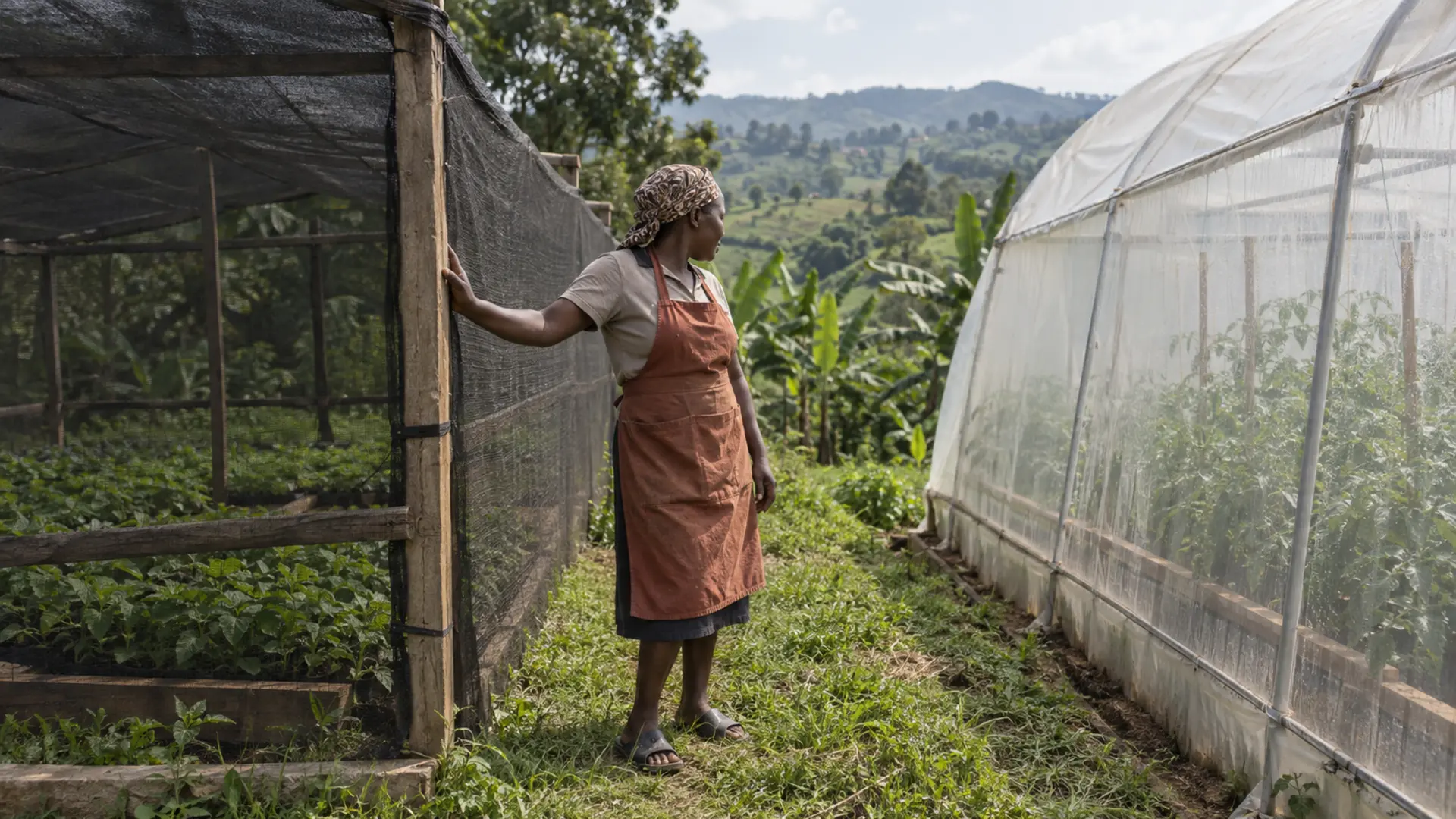
There are three structure classes, not two, and most Ugandan growers are only ever shown two of them. There is the shade net house, which intercepts radiation and wind but lets the rain through. There is the fully clad plastic greenhouse, which excludes the rain and manipulates the climate but traps heat. And there is the roof-only rain shelter, which excludes the rain and does almost nothing else, and which in a hot, wet, low-altitude site is frequently the most sensible of the three.
The choice between them is made by the crop, the rainfall, the disease pressure and the altitude of the site. It is not made by the catalogue.
Why this decision matters more in Uganda than in most places
Uganda spans an unusually wide altitude range for a country of its size. The Food and Agriculture Organization’s country report records that most of Uganda lies between 900 and 1,500 metres above sea level, with the lowest point at Nimule around 600 metres and the highest on the Rwenzori at about 5,100 metres, and gives mean annual maximum temperatures across the country ranging between 18 and 35 degrees Celsius.
That spread means a single national answer to the greenhouse question is not available. A clad house that behaves reasonably in a cool highland district can become unmanageable at a low, hot, humid site a few hours’ drive away.
The physics behind that is not in dispute. Solar radiation entering a clad structure heats the interior and the accumulated heat has to be removed by ventilation. Where the radiation load is high and the ventilation is inadequate, interior temperatures rise far above ambient. A 2025 review of greenhouse microclimate in arid regions describes uncooled greenhouse air temperature reaching over 60 degrees Celsius where outdoor ambient often exceeds 45 degrees, and quantifies the removal task at around 100 kilojoules of accumulated heat per square metre of floor area per day under natural ventilation. Those specific figures come from an arid Arabian Peninsula setting and are not Ugandan measurements, but the mechanism they illustrate is general.
The regional evidence points the same way. A 2017 review of protected cultivation for smallholders in sub-Saharan Africa concluded that cultivation of tomato in greenhouses covered by polyethylene films would be limited by high temperature problems all year round in equatorial areas, and that for equatorial sites in the study, including Dar es Salaam in Tanzania, even insect-proof nets restricted favourable cultivation to between one and four months of the year. It states plainly that low-technology greenhouses are not suitable for use all year round in most areas of sub-Saharan Africa.
What this guide helps you decide
Which of the three structure classes fits the crop you actually intend to grow. Whether your site’s altitude and heat load rule out a fully clad house. Whether your crop’s problem is rain on the leaf, radiation and heat, wind, insects, or some combination, because each of those has a different structural answer. And whether a rain shelter, which almost nobody in Uganda is offered, would solve your problem for a fraction of the material.
It does not cover frame design, film specification or insect-net aperture selection. Those are separate decisions taken after the structure class is settled, and each has its own guide.
The short answer
Ask what the crop is losing to, and build against that.
If the loss is rain on the leaf and split fruit, the answer is a roof. It may not need to be a whole house.
If the loss is heat, radiation burn and water stress, the answer is shade, and a clad house will usually make the problem worse rather than better.
If the loss is insects and the viruses they carry, the answer is an insect-proof mesh, which is a different material from a shade net and carries its own ventilation penalty.
And if the loss is several of these at once and the site is cool enough to carry a clad structure, then a full greenhouse becomes defensible, provided its ventilation capacity is designed rather than assumed.
What the East African record actually shows
This is the part of the argument most likely to be left out of a sales conversation, so it is worth setting out with its geography attached.
In Kenya’s humid coastal lowlands, a 2018 survey of greenhouse farming across Kwale, Kilifi and Mombasa counties found low productivity averaging around 10 per cent of the potential, with only about 30 per cent of surveyed greenhouses operational and widespread abandonment. The coastal belt where those structures stood runs maximum mean temperatures of roughly 26.8 to 33.6 degrees Celsius with relative humidity reaching around 72 per cent, and already carries heavy disease pressure in the open field.
That is Kenyan coastal data. It is not Ugandan data and this article does not present it as such. What it establishes is that clad structures in hot, humid, low-altitude East African conditions have a documented record of underperforming, and that a grower being sold one for a hot Ugandan lowland site is entitled to ask what makes their site different.
A separate 2026 survey in Nakuru County, Kenya, spanning sites from about 800 to 2,110 metres, found bacterial wilt causing 100 per cent losses on greenhouse-grown tomato against 64 per cent in open fields. That finding deserves careful reading. Bacterial wilt is a soil and water-borne disease, not a foliar one, so this is not evidence that clad houses increase leaf disease. It is evidence that enclosing a crop over infected soil concentrates a soil-borne problem, which is a hygiene and rotation warning rather than an argument about cladding.
What a shade net actually does
Shade netting works by intercepting radiation. The measured consequences are consistent across studies, although almost all of the quantified work comes from outside East Africa and should be read as general horticultural science rather than local measurement.
A 1996 study in Egypt found that under 30 per cent shade, air and leaf temperatures were lower than the open field during the day by an average of about 2 degrees Celsius, with reduced sunscald and no yield penalty on tomato. A study of sweet pepper under semi-arid conditions in Jordan found 50 per cent shade reducing daytime air temperature from a range of 32 to 37 degrees in the open to 22 to 28 degrees under the net, with light falling correspondingly.
A 2024 review in Scientia Horticulturae found reflective nets at a 40 per cent shade factor reducing photosynthetically active radiation by 48.3 per cent and solar radiation by 46.3 per cent, with significant decreases in the canopy temperatures of tomato and bell pepper, and reported that shading decreased crop water requirements and raised soil water content in bell pepper.
The important qualification is that shade percentage is not interchangeable between studies. Published trials range from 11 per cent shade to 75 per cent, in black, green, blue, pearl, silver and reflective materials, with different results each time. An Australian eggplant trial found 11, 21 and 30 per cent shade cutting the daily light integral by 12.6, 22.6 and 30.8 per cent respectively while leaving temperature and humidity broadly similar to the open field, with 21 per cent shade giving the best marketable yield.
The most instructive result in this article
A Tanzanian cabbage trial compared two insect-proof nets: a white net at 17.2 per cent shade and a silver net at 50.1 per cent shade. Temperatures under the nets ran above the open field by 10.4 degrees Celsius in the first season and 6.5 in the second under the white net, and 6.3 and 5.9 degrees under the silver. Both nets significantly reduced insect pest populations.
The yield results then split in opposite directions. The white nets increased marketable yield by 45.4 per cent in the first season and 16.4 per cent in the second. The silver nets reduced yield by 18.6 and 15.0 per cent respectively.
The net that kept the structure coolest produced the worst crop, because its shading cost the plants more light than its cooling gained them. That is the single most useful thing a grower can carry away from the shade net literature: more shade is not more protection, and a structure cannot be judged on temperature alone.
Shade Net House or Full Greenhouse: Matching the Structure to the Crop and the Climate Zone
Three stacked comparison cards showing what a shade net house, a rain shelter and a clad greenhouse each do and do not do, with the evidence behind each claim named
What a clad structure does that a net cannot
It keeps rain off the leaf, and that matters more than growers usually expect.
A trial in Bhutan at about 1,450 metres compared plastic roofing against a 75 per cent shade agro-net and thatch over tomato during a single wet season. Plastic roofing produced better yield and quality fruit than the other roofing materials and protected against late blight and fusarium wilt seen under the net and thatch treatments. Fruit cracking occurred only in the open-field control.
An Ethiopian trial with a low-cost plastic shelter reported that the structure prevented direct contact of rain with tomato stems and leaves, raised the temperature slightly beneath it, and prevented frequent periods of leaf wetness, with the best-performing varieties producing marketable fruit free from visible damage due to diseases, insects and physiological disorder.
Shade alone gives some of this benefit but not all of it. An Indonesian wet-season trial under 50 per cent shade found fruit cracking incidents were low under shading compared with full sun, though flowering and harvest were delayed. That is a radiation effect rather than a rain-exclusion effect, and it should not be confused with what a roof does.
The World Vegetable Center’s own tomato cultural practices guidance lists shelters to manage excessive rainfall among the special management practices required for a successful wet-season tomato crop, alongside suitable variety choice and raised beds.
The third option: the rain shelter
This is the structure class most Ugandan growers are never offered, and for a rain-sensitive crop at a hot site it is frequently the right one.
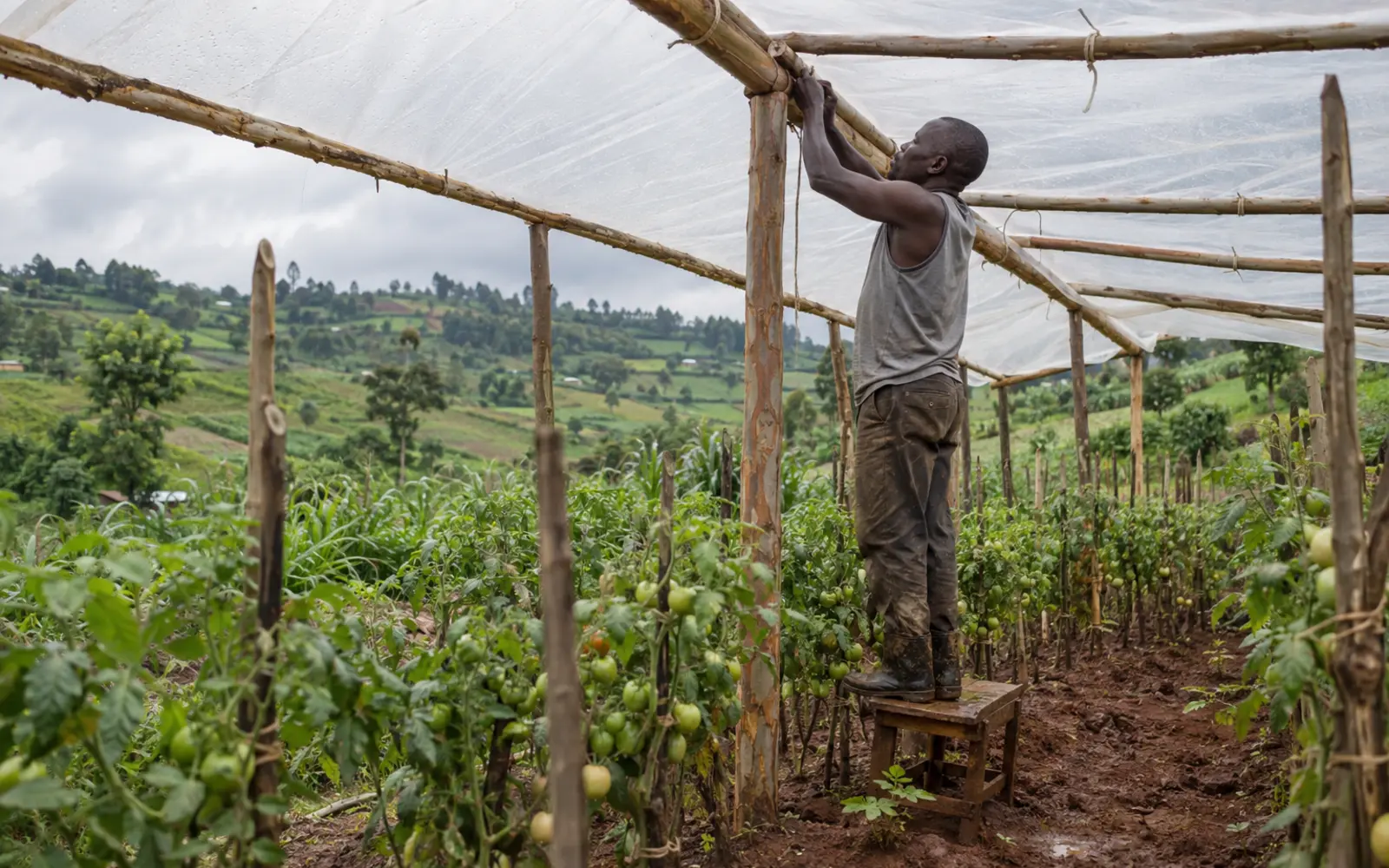
A rain shelter is a roof and nothing else. There are no side walls. The two trials described above are the clearest documented examples: the Ethiopian shelter was plastic sheeting on wooden poles at about 1.5 metres height, diverting rainfall into furrows and leaving the sides entirely open; the Bhutanese structures were roof-only overhead sheeting compared against net and thatch roofing.
The logic is straightforward. If the crop’s problem is leaf wetness and splash, a roof solves it. If the site is hot, walls are the part of a greenhouse that traps the heat, and removing them removes most of the heat penalty while keeping the rain exclusion. What you give up is climate control, insect exclusion and protection from wind-driven rain, which will still reach the outer rows.
Shade Net House or Full Greenhouse: Matching the Structure to the Crop and the Climate Zone
Annotated cross-section and end view of a roof-only rain shelter showing eave height, roof pitch, overhang beyond the crop, open sides and the drainage furrow
A practical caution before you build one. The published trials give the eave height figure of about 1.5 metres and the roof-only, open-sided principle. They do not give a roof pitch, an overhang dimension or a pole spacing that has been validated for Ugandan conditions, and we are not going to supply numbers that no source measured. Treat the roof pitch, the overhang beyond the outermost crop row and the pole spacing as decisions for your own site, driven by your rainfall intensity, your prevailing wind and the timber you can get. What is not optional is the drainage: a roof concentrates the water it sheds, and if it runs back into the root zone you have moved the problem rather than solved it.
Ventilation is the design variable, not an afterthought
Whichever clad option you choose, the ventilation capacity decides whether it works.
Wageningen University and Research’s Africa-focused greenhouse toolbox describes net houses as low-cost, non-waterproof structures providing shade and, if entirely closed, insect protection, widely found in Africa for seedlings, shade plants and ornamentals. For tropical lowland conditions it recommends three-span covers with tilted walls and chimney-style top vents to maximise natural ventilation, and states that glass should be considered only under high-technology conditions where yields and profits are high. For a desert-climate case study it gives a ventilation opening of around 40 per cent.
We looked for a Wageningen ventilation capacity figure stated specifically for tropical Africa and did not find one. The 40 per cent figure is for Algeria and a similar figure appears for subtropical Taiwan with insect nets installed. Use them as an indication of the order of magnitude that hot-climate design requires, not as a Ugandan specification, and treat vent sizing as a question for the ventilation guide rather than something to settle from this article.
The decision matrix
Work through it in this order.
First, name the loss. Write down what the crop is actually losing to, from your own records rather than from a general worry. Rain on the leaf and split fruit. Heat and sunscald. Wind damage. Insects and the viruses they carry. Soil-borne wilt. Each has a different structural answer and some of them have no structural answer at all.
Second, place your site. Note the altitude band and whether your season is genuinely wet or merely humid. A hot lowland site and a cool highland site do not get the same recommendation.
Third, read the matrix.
Shade Net House or Full Greenhouse: Matching the Structure to the Crop and the Climate Zone
Structure class decision matrix crossing crop rain sensitivity and disease pressure against altitude band, showing which of the three structure classes fits each combination
Fourth, price the ventilation before you price the cladding. A clad house whose vent area you cannot afford to enlarge is a clad house that will cook.
Fifth, ask what happens in year four. Film has a service life. A 2023 study of agricultural film ageing found that low-density polyethylene greenhouse films typically last anywhere from a few months up to three to four years, while a fluoropolymer film such as ETFE is regarded as durable for more than twenty years. We could not find an equivalent published service life for shade netting, and we are not going to guess one. The point stands regardless: cladding is a recurring cost and netting is a different recurring cost, and a comparison that leaves out replacement is not a comparison.
Cost categories
We give no prices, and no comparative cost figures, because we cannot verify them and a comparison built on unverified numbers is worse than none. When you collect your own quotes, make sure each one covers the same list.
The frame and its foundations. The cladding or netting itself, priced per square metre of material rather than per metre of structure, because a folded or oversized screened vent area needs more material than the opening it covers. Fixings, battens and the profile that holds the film or net, since material fixed badly tears at the fixing. Doors and, if you are excluding insects, a vestibule. Vent openings and whatever operates them. Drainage, which for a rain shelter is not optional. Replacement cladding at the interval your supplier states in writing. Repair materials kept on site. And the labour of the weekly inspection that keeps any of it working.
Common mistakes
Buying a structure class before naming the loss. Assuming a clad house is simply a better version of a net house. Choosing shade percentage by feel rather than by what the crop needs, when the Tanzanian cabbage result shows more shade can cost yield. Treating a shade net as an insect barrier, which it is not unless it is specified as an insect mesh. Building a clad house at a hot low-altitude site because it worked for someone in a highland district. Sizing vents to the structure rather than to the heat load. Building a rain shelter without drainage. Comparing a net house and a clad house on purchase price alone with no replacement interval attached. And accepting a Kenyan or Tanzanian trial result as though it were Ugandan evidence, which this article has been careful not to do.
Warning signs and when to get help
Stop and get independent advice if: the interior of a clad structure is regularly more than a few degrees above ambient at midday and you cannot enlarge the vents; the crop shows sunscald or heat-related fruit disorders under a structure that was supposed to protect it; disease appeared or worsened after the structure went up, which usually points to humidity, soil hygiene or drainage rather than to the cladding; or the supplier cannot tell you the ventilation opening as a percentage of floor area.
Get a plant health diagnosis, not a structural quotation, if the problem is a soil-borne wilt. The Nakuru finding is the warning here: enclosing a crop over infected ground makes a soil-borne problem worse, and no structure fixes that.
A practical action plan
This week. Write down, for the last two seasons, what the crop lost and to what. Measure or estimate your altitude. Note how many days in your main season carry rain during the crop’s fruiting period.
Before you take a quotation. Decide the structure class from the matrix, and put it in writing before you talk to a supplier, so the conversation is about executing your decision rather than making it for you.
When you take quotations. Require every one to state the ventilation opening as a percentage of floor area, the cladding or netting specification, and the expected service life in writing.
Before you build. If the answer was a rain shelter, build one bay first, over one bed, for one season, and compare it against an uncovered bed of the same variety planted the same week. That single comparison will tell you more about your own site than this whole article.
Conclusion
The structure is not the point. The crop is the point, and the structure is a tool for removing one specific thing that is standing between the crop and a yield.
A grower who can say in one sentence what their crop is losing to can choose a structure class in an afternoon. A grower who cannot will end up owning whatever the market happened to be selling that year, and in Uganda’s hotter and wetter districts that has too often been a clad house standing empty.
Author: Falcon Foundation Ltd Editorial Team
The Falcon Foundation Ltd Editorial Team produces evidence-based agricultural guidance for Ugandan farmers, drawing on published research and institutional sources and translating them into practical decision support. Where evidence is unavailable or contested, we say so rather than filling the gap.