
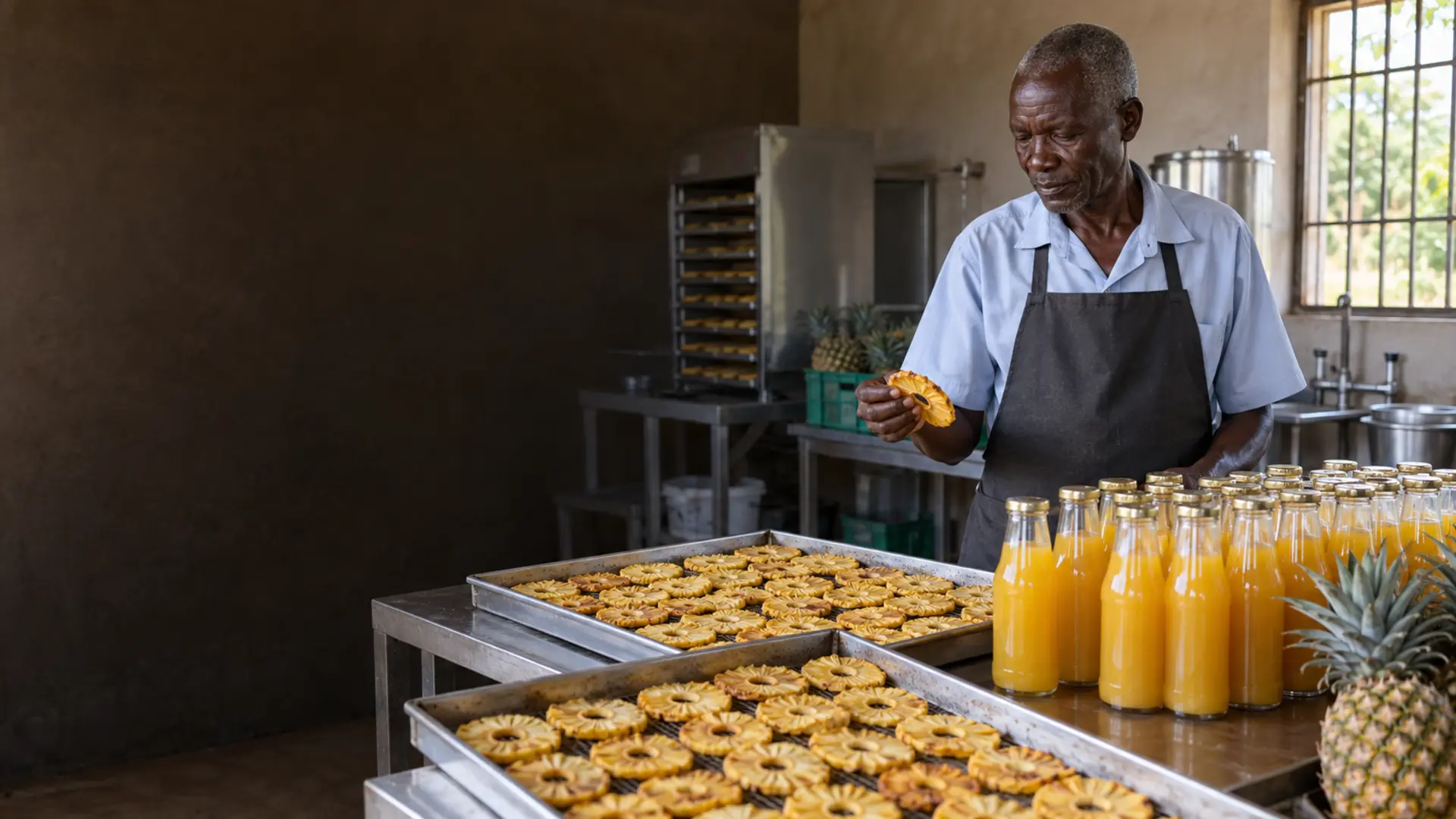
There is a particular kind of shed you find all over Uganda. It has a machine in it. The machine was bought with a grant, or a loan, or the sale of a plot, and it is clean because it has hardly run. Somebody in the group can tell you what it cost and what it can produce in an hour. Nobody can tell you who was going to buy the output.
This is not a story about bad machines or lazy groups. It is a story about the order in which decisions were taken. Uganda’s own institutions have documented the pattern at national scale. A working paper for the International Growth Centre found that most agro-processing industries in Uganda, including cotton ginning, coffee processing, dairy processing, grain milling, oilseed processing and animal feed milling, were operating at less than half of capacity. A 2020 assessment prepared under Operation Wealth Creation reported maize processing plants running at 23 to 56 per cent, dairy at 35 to 50 per cent, fish at 35 to 45 per cent, meat processing at 20 to 25 per cent and rice mills at 57 per cent, attributing this largely to insufficient and seasonal raw material supply. The National Planning Authority’s 2023 paper on scaling up value addition put average dairy operating capacity at 36 per cent and named the absence of cold storage for peak-season production as a constraint.
Those figures come from different reports in different years and do not agree with one another on any single sub-sector, which is exactly why they should be read as a pattern rather than a statistic. The pattern is that Uganda does not, on the whole, lack processing machinery. It lacks the throughput to keep the machinery busy.
What this guide helps you decide
This guide is for the decision that comes before the purchase. It helps you choose which value addition activity, if any, suits your produce, your skills, your capital and your market, by screening the realistic routes against six criteria. It gives you a rule about buyers that, if you follow only one thing from this article, is the thing to follow.
It does not tell you how to get certified or licensed. That is a procedure with its own requirements and its own timelines, and it belongs in its own guide. It does not tell you how to grade and pack for the fresh market, which is a separate discipline. It gives no equipment prices, no margins and no profit projections, because we cannot verify them and a projection you cannot verify is worse than no projection.
The short answer
For most small operators in Uganda, the routes worth screening seriously are the shelf-stable ones: drying, milling, pressing, packing of dry produce, and honey processing. Chilled and frozen products are a different order of difficulty, because they depend on a cold chain that is thin in this region.
The evidence on that last point is regional rather than Ugandan and should be labelled as such. A joint report on sustainable food cold chains records that in Rwanda only 5 per cent of firms in the food and agriculture sector have refrigerated trucks and only 9 per cent have a cold room, and that average cold storage capacity in the least developed countries is around 20 cubic metres per thousand inhabitants against roughly 200 in North America, Western Europe and Oceania. For Uganda specifically, the World Bank has described the fish value chain, lacking access to adequate cold chains, collapsing under the additional pressures of the pandemic period, and reporting has described Uganda relying on Kenyan infrastructure for storage, processing and export logistics, with unreliable rural electricity among the constraints. We could not verify a Uganda-only figure for cold storage capacity, and we will not invent one.
The pre-purchase evidence rule
Before the screening matrix, the rule.
No processing equipment is purchased until a named buyer exists, has agreed a volume and a frequency, has agreed a specification, and has taken a trial delivery.
This is not a counsel of perfection. It is what the guidance says. The Food and Agriculture Organization’s own small-enterprise material puts it plainly: too often people invest money in a business only to find later that there is insufficient demand, and the first thing to do is to find out the likely demand by conducting a short market survey. The same body’s marketing guidance identifies inability to sell as perhaps the most common problem faced by small-scale producers, who often have little experience or skill in finding people willing to buy. Its business management working document for small-scale agro-processors describes the specific failure: a new processor over-estimates sales and buys equipment that is too large, so that only a small percentage of installed capacity is used, and states that market research has to be carried out before buying any equipment or facilities.
Ugandan evidence points the same way. A study of market linkages for Ugandan smallholders notes that small-scale farmers often lack accurate information about prices elsewhere or any guarantee that they will be able to sell their goods elsewhere.
Value Addition That Actually Works at Small Scale: Choosing What to Process
Flow diagram of the pre-purchase evidence rule showing the named buyer, agreed volume, agreed specification and trial delivery gates that must be passed before any equipment is bought
The trial delivery is the part people skip and the part that teaches most. It is where you discover that the buyer wants a different moisture level, a different pack size, a label you had not budgeted for, or delivery on a day you cannot manage.
Screening the routes
Six criteria. Demand evidence, shelf life without a cold chain, licensing burden, capital class, skill required, and by-product value. Score each route on all six before comparing any two.
Value Addition That Actually Works at Small Scale: Choosing What to Process
Option screening matrix scoring six small-scale processing routes against demand evidence, shelf life without a cold chain, licensing burden, capital class, skill and by-product value
Drying fruit and vegetables
What the evidence says. The Food and Agriculture Organization’s technical manual on small-scale fruit and vegetable processing states that dehydration is complete when the product acquires a leather-like consistency at about 15 per cent moisture, and gives shelf lives of about a year for dried tomatoes and about six months for dried bananas.
What goes wrong. A peer-reviewed study of solar fruit drying for Ugandan smallholders reports that up to 44 per cent of fruit is lost after harvest in Uganda due to limited access to appropriate post-harvest techniques, and names the recurring problems with the drying route directly: bad and inconsistent weather, poor mass transfer, poor dryer material selection, hygiene issues, drying times of two to three days per batch, and a lack of capacity among local craftsmen to replicate improved dryer models.
Read this as. A route with genuine shelf-stability, a real Ugandan loss problem behind it, and a weather dependence that is not a detail. If your district has a long unreliable wet season, batch times of two to three days are a scheduling problem, not a technicality.
Cereal milling
What the evidence says. The Food and Agriculture Organization’s quality assurance guidance for small-scale rural food industries identifies the principal hazards in the cereals route: Aspergillus flavus and A. parasiticus produce mycotoxins which cause serious liver damage, and flour mites are a particular problem.
What goes wrong. Milling is the most competitive of these routes precisely because entry is easy, and the food-safety exposure is real. Ugandan press reporting in April 2023 recorded the national standards body finding metallic chips from worn mills in flour, mills grinding rotten and insect-infested maize with foreign matter, and packaging lacking manufacturer details and accurate dates. That is reported enforcement activity concerning maize flour for human consumption, and it should be read as an indication of the standard you will be held to rather than as a statistic about the industry.
Read this as. A route where the machine is the easy part and raw material inspection and hygiene are the business.
Oilseed pressing
What the evidence says. The Food and Agriculture Organization’s guidance on oilseeds notes that aflatoxin-producing moulds can grow on raw material that has been inadequately dried, and that the equipment and skills required for testing put this beyond the capacity of small rural oil processors. Guidance from a United States appropriate-technology centre notes that sesame seed cake is valuable as a human food and sunflower seed cake makes a good addition to chicken and cattle feed, and that choosing the correct size of press for what you intend to do is very important.
Read this as. The route with the strongest by-product value, since the cake has a ready market as feed, but with a specific and serious hazard: contamination concentrates in the cake. If you sell cake as feed you have taken on a feed-safety responsibility.
Grading and packing dry produce
What the evidence says. The Food and Agriculture Organization’s small-scale post-harvest handling guidance states that each worker must be knowledgeable regarding produce defects, grade and size requirements and packing methods, and that care should be taken to reduce mechanical damage to the commodity.
Read this as. The lowest capital route and the one where the value is created almost entirely by trained judgement. It is also the route most tightly coupled to a specific buyer’s specification, which makes the pre-purchase rule easier to satisfy but the business more dependent on one relationship.
Honey processing and packing
What the evidence says. The Food and Agriculture Organization’s honey quality guidance sets the critical threshold plainly: if the water content of honey is greater than 23 per cent, the honey is likely to ferment. It also identifies wax as a genuine by-product, widely used as an industrial feedstock for candle-making, polish and other products.
Read this as. A route with simple equipment, a clear and measurable quality gate, and a real second product. The gate is the point: honey processing is not a route where enthusiasm substitutes for measurement.
Chilled and frozen products
Screened out for most small operators on the cold chain evidence above, not because the products are not wanted, but because the infrastructure they depend on cannot be assumed.
What the licensing burden looks like in outline
You need to know the shape of this before you choose a route, even though the detail belongs elsewhere.
Three layers exist. The Uganda National Bureau of Standards operates a product certification scheme whose mark is designated the Q-Mark; its published certification requirements form states that an applicant must be legally registered and hold a Tax Identification Number, and must apply for product certification using the Bureau’s own form. The Ministry of Trade, Industry and Cooperatives administers trade and export licensing. Local government issues an annual trading licence; Kampala Capital City Authority’s published guidance lists appropriate hygiene and health standard of premises among the conditions to satisfy.
That is the outline and it is as far as this article goes. The specific procedure, forms, fees and timelines are the subject of our forthcoming guide to licensing and certification for processed foods - scheduled in this programme, and you should read it before committing to a route whose licensing burden you have not verified.
What Ugandan programme reporting shows
Two documented interventions are worth knowing about, because they show both what works and what does not.
The World Food Programme’s post-harvest loss reduction operation in Uganda reported that farmers were losing more than 30 per cent of their crops every year to insects, pests, mould and moisture due to inadequate handling and storage at household level, and that after training and equipment support almost 17,000 farming families had recorded gains.
A 2025 peer-reviewed evaluation of a northern Uganda programme is more instructive still, because it reports a mixed result. It found hermetic storage bags associated with an increase in dietary diversity of roughly 1.5 to 1.7 points, while some other promoted practices showed negative associations. The authors themselves describe the result as surprising. The lesson for anyone choosing a value addition route is not that any particular technology fails, but that promotion and evidence are different things, and that a technique being promoted is not the same as a technique being proven for your situation.
Value Addition That Actually Works at Small Scale: Choosing What to Process
Chart of reported capacity utilisation in Ugandan agro-processing sub-sectors, with each figure labelled by its source and year
The seasonality question that decides the whole thing
Look again at the reason the national reports give for idle capacity: insufficient and seasonal supply of raw material. This is the single most under-examined line in most value addition plans, and it is worth working through before you screen anything else.
A machine is a fixed cost. It costs the same in the month it runs and the month it does not. Your own harvest, however, arrives in a burst. If you size the operation to your own peak crop, the machine will run for perhaps two months of the year and sit for ten, and the fixed costs will be carried by two months of output. If instead you plan to run through the year, you will be buying raw material from other farmers for most of it, at prices set by the market rather than by your own cost of production, and often at their highest exactly when your machine is hungriest.
There are only three honest answers to this, and a plan should say which one it has chosen.
Run seasonally and accept it. Size the equipment small, keep the fixed costs low enough that a short season can carry them, and do something else the rest of the year. This is the most realistic answer for most small operators and the least often written down.
Buy in. Plan explicitly to purchase raw material outside your own harvest, and cost it at what you will actually have to pay in the lean months, not at your farm-gate price. Anyone who costs bought-in raw material at their own production cost has produced a fiction.
Extend the season by storing the raw material. This works for grain and for some oilseeds and not at all for fresh fruit. It converts a throughput problem into a storage problem, which brings its own moisture, pest and aflatoxin exposure.
Whichever answer you choose, write down for each of the twelve months where the raw material is coming from and roughly what it will cost you. If more than half the months are blank, you do not yet have a processing business; you have a harvest-season activity, which may still be worth doing but should be sized as one.
Two questions that separate a route from a hobby
When people describe a value addition idea, two questions cut through most of the enthusiasm quickly.
Who is the marginal buyer? Not the first buyer, the second. Almost anyone can sell a first batch, often to a relative, a church, a neighbouring school or a sympathetic shop. The business begins at the point where you are selling to someone who has no reason to help you. If you cannot name that person, or at least the kind of trade they are in and where you will find them, the demand evidence column of the screening matrix is empty however good the first sale felt.
What does the buyer do if you fail to deliver? If the answer is that they shrug and buy from someone else that afternoon, you are in a commodity trade and your margin will be thin and your specification unforgiving. If the answer is that they have a real problem, because nobody else nearby dries to that standard or packs to that size, then you have found something worth building equipment around. The second answer is rare. It is also the only reliable basis for the capital commitment this article is about.
Cost categories
No prices. The categories a complete plan must cover are these.
The equipment itself and its installation. Spares and the maintenance the machine actually needs, which for a mill means grinding plates and for a press means adjustment and wear parts. The building or shed, its floor, its water supply and its drainage. Packaging, which is a recurring cost and often the one that is forgotten. Labels, which have legal content requirements. Certification and licence costs across the three layers described above. Raw material, and specifically raw material bought out of season when your own crop has finished. Fuel or electricity. Labour, including the training that the post-harvest and quality guidance says the work requires. Transport to the buyer. And working capital to bridge the gap between paying for raw material and being paid for product.
Common mistakes
Buying the machine first and finding the buyer afterwards. Sizing for the peak season and then having nothing to run for eight months. Costing raw material at your own farm-gate price when most of the year you will be buying it in. Choosing a chilled or frozen product because the margin looked good, without confirming the cold chain that product depends on. Treating packaging and labels as an afterthought. Assuming a grant-funded machine is free to run. And starting a route whose licensing burden you have not looked at, only to find at the point of sale that you cannot legally supply the buyer you found.
Warning signs and escalation points
Stop and reconsider if: nobody in the group can name the buyer; the buyer is described by category rather than by name, as in supermarkets or schools; no trial delivery has been made; the raw material supply for the months outside your own harvest has not been costed; the equipment capacity is set by what the supplier had rather than by the volume the buyer agreed; or the plan’s profitability depends on a price you have not been offered in writing.
If your route involves a product for human consumption and you have not read the certification requirements, get that verified before you spend, not after.
Where it works and where it does not
Small-scale value addition works where a specific buyer has a specific unmet need, the route is shelf-stable, the raw material is available for more of the year than your own harvest, and the operator has or can get the food-safety discipline the route demands.
It does not work as a general strategy applied to whatever you happen to grow. The national capacity utilisation figures cited at the start of this article are the visible result of that approach applied at scale.
A low-risk first step
Do the smallest possible version first, without buying anything.
Process a single batch by hand or with borrowed or hired equipment. Take it to the buyer you have identified. Ask them to reject it, and write down exactly why. Then do a second batch that fixes what they told you.
Two batches will teach you more about whether this business is for you than any projection. They will also give you the one thing the pre-purchase rule requires and that no plan can manufacture: a buyer who has actually handled your product.
What to do next
Read our guide to choosing a farm enterprise if you are still deciding between production and processing, and starting a farm with limited capital for the sequencing question. How Ugandan farm-gate prices are formed will help you judge whether the raw price you are escaping is really the problem. Before you commit, work through farm record keeping and gross margin analysis and building a bankable farm business plan, and check registering and formalising a farm business. Our guide to grading, sorting and packaging, and our forthcoming guides to licensing and certification - scheduled in this programme and financing an agribusiness - scheduled in this programme, complete this sequence.
About the author
The Falcon Foundation Ltd Editorial Team produces evidence-based agricultural guidance for Ugandan farmers, drawing on published research and institutional sources and translating them into practical decision support. Where evidence is unavailable or contested, we say so rather than filling the gap.