
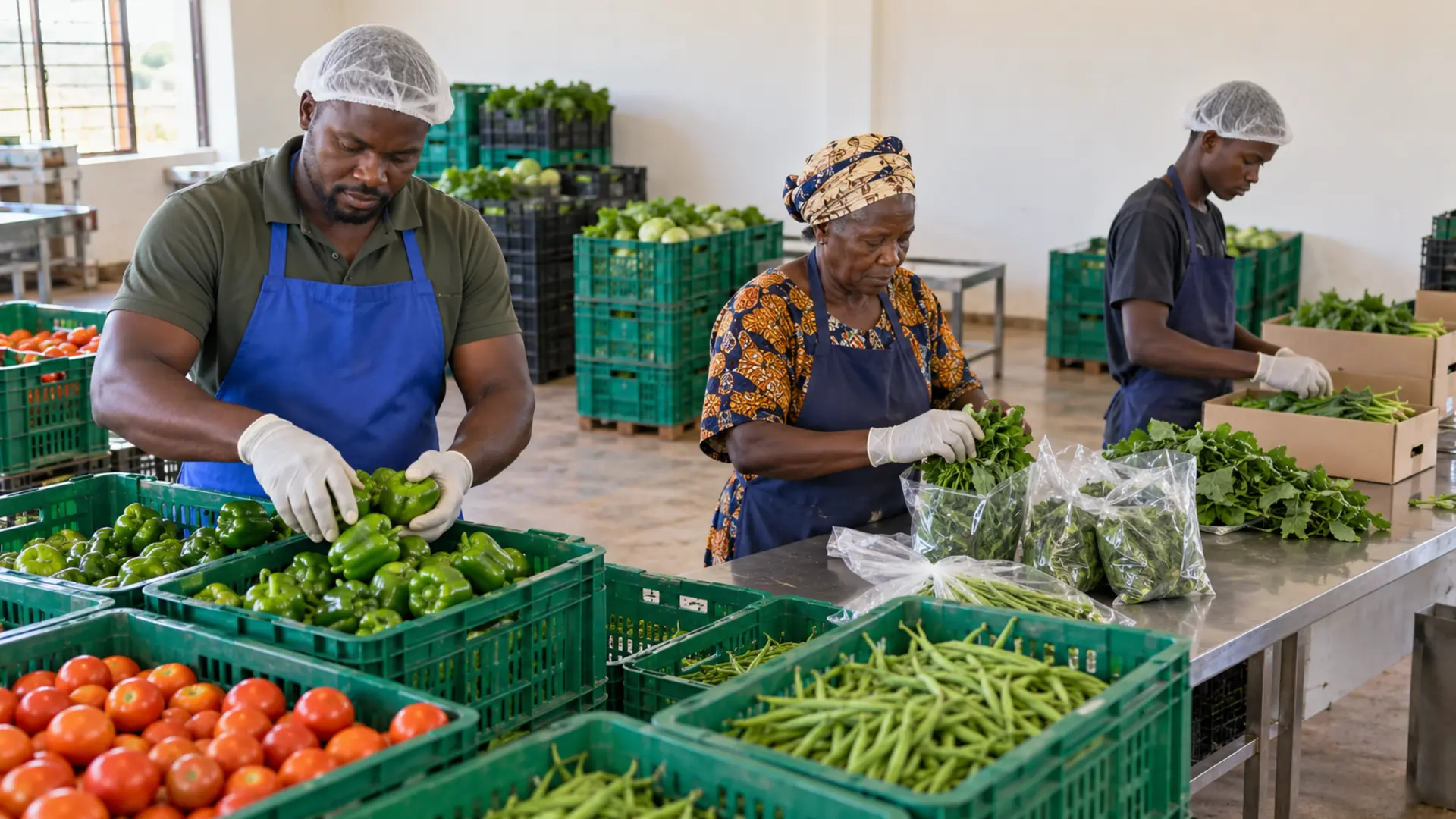
The lorry comes and everything goes on it. Big tomatoes and small ones, sound fruit and split fruit, all in one heap.
The buyer looks at the load and offers one price. It is not the price of your good produce. It is closer to the price of your worst, because that is the risk he is taking on the whole load. Your best fruit has just subsidised your worst, and neither you nor he has any way of doing it differently.
Grading is the mechanism that lets quality be rewarded. Without it, no such mechanism exists.
What this guide helps you decide
By the end you should be able to build a grading system for your own produce that you can apply the same way twice, set tolerances, lay out a small packhouse so that clean produce does not meet dirty produce, choose packaging on evidence, and open the conversation with a buyer about grades.
It does not cover drying and storage, processing, certification and labelling law, or export documentation, all of which are separate subjects.
The short answer
A grade is a set of rules specific enough that two different people applying them to the same lot reach the same answer. Build yours from three things: a size range, a maturity or colour range, and a stated allowance for blemishes. Then set a tolerance, meaning the proportion of the lot allowed to fall short without the whole lot being downgraded.
Sort in a packhouse that runs one way, from a dirty intake end to a clean dispatch end. Wash with water clean enough to be safe and finish with potable water. Pack in something that can be cleaned.
And go into the buyer conversation with the grades already made and already in separate containers, not as a proposal.
How a real grading standard is built
You do not have to invent this from nothing. Published standards show the structure, and Uganda has adopted several of them.
The East African grain standards. The East African Standard for maize grains sets three quality grades defined by numeric limits on defect categories. In the 2011 edition we read, those limits were foreign matter at 0.5, 1.0 and 1.5 per cent for grades 1, 2 and 3; broken kernels at 2, 4 and 6 per cent; and pest-damaged grain at 1, 3 and 5 per cent. Moisture was 13.0 per cent for all grades. Total aflatoxin was 10 parts per billion and aflatoxin B1 5 parts per billion across all grades, with fumonisin at 2 parts per million. A lot with an objectionable odour, off flavour or living insects is a reject regardless of grade.
The East African Standard for dry beans is built the same way: three grades on the basis of tolerable limits, with foreign matter, pest-damaged and broken or split grain each having a numeric limit per grade, moisture at 13.0 per cent, and the same aflatoxin limits.
Look at the shape of that. The grade is not a description. It is a set of numbers, one per defect, and the standard tells you which numbers put a lot in which grade.
Which edition applies matters. Uganda’s standards catalogue lists the adopted editions as US EAS 2:2017, the second edition of the maize standard, and US EAS 46:2017, the third edition of the dry beans standard. The texts we could open and read were the 2011 editions. The grade structure is very likely stable between editions, but at least one figure appears to have moved: a Uganda National Bureau of Standards article referencing the 2017 maize edition gives a moisture limit of no more than 13.5 per cent, against 13.0 in the 2011 text we read. It also gives colour purity limits, with yellow maize containing no more than 5 per cent by weight of maize of other colours and white maize no more than 2 per cent.
So: use the structure described here to understand how grading works, and obtain the current edition from the Bureau before you write a number into a contract.
The fresh produce class system. Fresh fruit and vegetables internationally use a different naming convention, with three classes. In the original definitions, Extra Class is produce of superior quality, virtually free from blemishes and particularly carefully packed. Class I is produce of good quality, commercially free from blemishes. Class II is produce which may have certain blemishes not impairing its intrinsic quality.
What a tolerance is. This is the concept most often missed, and it exists in two different forms in the two systems above.
In the fresh produce class system, a tolerance is a lot-level exception: in the original definitions, Extra Class permits a maximum of 5 per cent of the lot to fail its requirements, provided that produce still satisfies Class I, and Classes I and II each permit a maximum of 10 per cent.
In the grain standards, the numeric limits per defect category are themselves what define the grade, rather than being an exception allowance on top of it.
Both are legitimate. What matters is that yours is written down. A grade without a stated tolerance is an argument waiting to happen, because two people will always disagree about how much is too much.
Marking. Uganda’s guidelines for labelling fresh fruits and vegetables place responsibility for marking on the packer or dispatcher, require particulars to be indelibly marked, clearly visible and legible, and list the required fields as the produce name, variety, origin, class, size and weight. Note that class is on that list. The standard assumes you have graded.

Building your own grades
Take one commodity. Take a representative sample from a real harvest, not a good one.
Step one: decide what actually varies. Lay the sample out and look. For most produce it will be size, maturity or colour, and physical defects. Pick the two or three that a buyer can see and cares about.
Step two: split into three piles. Not by feel. Draw a line. This size to this size. This colour to this colour. These blemishes allowed, these not.
Step three: write the rules down. Actual numbers, actual descriptions. If you cannot write it, you cannot repeat it, and neither can whoever sorts for you next week.
Step four: set the tolerance. How much of a crate may fall outside the rule before the crate drops a grade. Ten per cent is where the international fresh produce classes sit for Class I and Class II.
Step five: name them and never change the names. Consistency across seasons is what makes a grade mean something to a buyer.
Step six: have someone else sort a crate to your written rules and compare. If they get a different answer, the rules are not specific enough yet. This is the test that matters.
There is one commercial detail worth knowing. Published guidance on grading describes rejects on aesthetic grounds as providing a second or even third quality grade, rather than as waste. The grading operation is not about discarding. It is about finding a buyer for each grade.
Where the losses actually happen
Two sets of figures, both regional rather than Ugandan, and each labelled as such.
Grain. African post-harvest loss data for maize in one Tanzanian region in 2021 records losses by chain step: harvesting and field drying 6.4 per cent, further drying 4.0 per cent, threshing and shelling 1.3 per cent, transport from field 2.4 per cent and household storage 5.3 per cent, with a cumulative loss across all steps of 18.0 per cent. We could not access the equivalent Uganda-specific dataset, which was blocked to us.
Fresh produce. A Kenyan assessment reports mango losses of 25 to 44 per cent along the entire value chain, with one study reaching 60 per cent, tomato losses of around 10 per cent, and general horticultural losses as high as 50 per cent. Across sub-Saharan Africa it gives a chain breakdown of production 39 per cent, handling and storage 37 per cent, processing 7 per cent, distribution 13 per cent and consumption 5 per cent.
Read that breakdown carefully. Handling and storage is nearly as large as production. That is the part a packhouse and better packaging touch.
The packhouse
You do not need a building. You need a flow.
The principle comes from FAO’s post-harvest training manual and it is simple: a single-level building with a receiving area at one end and a dispatching area at the other separates the reception area, which will be dirty, from the packing and dispatching activities, thus reducing the risk of contamination.
Everything else follows from that one arrangement.
- Intake at one end. Field crates arrive here. This end is dirty and stays dirty.
- A rejects bay off to the side. Rejects leave the flow immediately and do not travel back up it.
- Washing, where washing applies. With water quality addressed below.
- Draining and drying. Produce packed wet spoils.
- Sorting and grading tables. With a separate crate for each grade, physically apart.
- Packing. Clean containers only, stored on this side.
- Dispatch at the far end. Loaded straight onto the vehicle.
The rule that makes it work: produce never travels back towards the intake end. Neither do crates, hands or water. Put a handwashing point where staff cross from the dirty side to the clean side.
Water. International guidance is specific. Clean, or preferably potable, water should be used when water is applied under pressure or vacuum during washing, and the water used in the final rinsing step should be potable. Testing for indicator organisms is recommended. Recycled water may only be used if it is treated and maintained so as not to present a risk.
FAO’s field manual adds the practical version: check that the water is not polluted by sewage, factory effluent or pesticides, and avoid washing produce in recirculated or stagnant water, because it can quickly become heavily contaminated. A drum of water that has washed forty crates is not washing the forty-first.
Hygiene. The international code of hygienic practice for fresh fruits and vegetables covers general hygienic practices from primary production to consumption, and is particularly directed at produce intended to be consumed raw. Uganda has adopted it. Personnel hygiene and record keeping are part of it, not optional extras.
Packaging, and what the evidence actually shows
This is where most advice overstates, so here is what we could verify and where it comes from.
Crates against wooden crates, East Africa. A pilot in the Tanzanian tomato value chain measured weight loss from farm to retailer at 1.9 per cent in traditional wooden crates against 1.0 per cent in plastic crates, and reported that tomatoes transported in plastic crates achieved higher market value as better quality resulted in improved prices, without giving a premium figure.
Crates against bags and sacks, outside East Africa. A review of returnable plastic crate systems reports much larger effects where the comparison is against bags: tomato losses in Cape Verde falling from 30 per cent to 10 per cent, mango and avocado losses in Sri Lanka from 30 per cent to 6 per cent, and Afghan tomatoes handled in plastic bags with up to 50 per cent losses falling to under 5 per cent with crates. Those are not East African figures and should not be presented as such.
Container size. Data from Ghana found cabbage packed in 30 kilogramme sacks yielded 77 per cent sellable product against 68 per cent for 70 kilogramme sacks. Smaller units crush less.
Lining. The same Kenyan assessment found corrugated fibreboard lined crates showed markedly fewer bruises than unlined ones, and that bruised fruit loses over 60 per cent of its value.
The failure mode of traditional containers. Published guidance names it directly: natural fibre containers cannot be cleaned or disinfected and represent a source of contamination. That is the argument against reusing baskets and sacks for produce intended to be eaten raw, independent of any bruising argument.
Container types by use. Transport packs are described as fibreboard or wooden boxes weighing from 5 to 20 kilogrammes. Consumer packs are a different category.
Does grading actually earn more? The honest answer
We looked hard for a study measuring a price premium for graded against ungraded produce in East Africa, with a number attached. We did not find one.
The closest we got: a Kenyan institutional assessment states that Rwandan farmers who graded and sorted tomatoes could sell them for higher unit prices, without quantifying it. A 2024 study of sixty wheat markets in Ethiopia concluded that markets only reward quality attributes observable at no cost, which is an important and slightly uncomfortable finding, though we could only read its abstract and cannot pass on its figures.
So we are not going to tell you grading earns you a specific percentage more. What we can say is what the mechanism is. Grading makes quality observable at no cost to the buyer. The Ethiopian finding suggests that observability is precisely the condition under which markets pay. Sorting your produce into visible, consistent, named grades is what moves your quality into the category the market can reward.
Test it yourself rather than taking anyone’s number. Grade one load, sell it as three grades, sell the next load ungraded, and compare the total. Do that three times. That is your premium, on your produce, in your market.
Cost categories
No prices and no premiums, for the reasons above. Budget across:
- Crates, and enough of them for each grade to have its own
- A sorting table or clean raised surface
- A roof and open sides for the sorting area
- Clean water supply and a source of potable water for the final rinse
- Water testing, at least once
- Rejects handling, whether composting, livestock feed or a second market
- Labour for sorting, which is the largest recurring cost and the one that decides whether the practice survives
- Hairnets, aprons and soap
- Scales, so that grades are sold by weight consistently
- Crate washing and drying, recurring
- The current editions of the relevant standards from the national standards body
Common mistakes
Grading by feel. Two people will not agree, and neither will you with yourself next week.
No written tolerance. This is what turns a grading system into an argument at the roadside.
One crate for everything after sorting. Sorting into a single container undoes the sorting.
Washing in a drum that never gets changed. Recirculated and stagnant water is explicitly warned against.
Packing wet produce. It rots in transit and the buyer blames the grade.
Overfilling containers. Ghanaian data shows the difference between sack sizes in sellable product.
Reusing baskets or sacks for produce eaten raw. They cannot be cleaned or disinfected.
Treating rejects as waste. They are your second and third grades, and they have buyers.
Quoting a standard number without the edition. Editions change and figures move with them.
Warning signs and escalation points
- A buyer disputing your grade, which usually means your written rules are not specific enough rather than that he is being difficult
- Consistent complaints about the bottom of the crate, which points to crushing and container size
- Produce arriving wet or sweating, which points to inadequate draining before packing
- Rising rejection at the point of sale despite unchanged field practice, which points to handling between farm and market
- Any suggestion of contamination or illness linked to your produce, which is a food safety matter and must go to the district health and production authorities immediately, not be handled quietly
- Grain grading where aflatoxin is in question. This one is worth naming explicitly, because the Uganda National Bureau of Standards states plainly that aflatoxin cannot be detected using eyesight. You cannot grade for it by looking. Grain destined for a buyer with an aflatoxin specification needs testing, not sorting.
Where this works, and where it does not
It works for a farmer or group selling repeatedly into the same market, where the buyer has any discretion over price, and where there is enough volume that three grades each have a plausible outlet.
It works less well in three situations. Where you sell one small load a season to whoever comes, the labour of grading may exceed anything you recover. Where the market is a single buyer with no competition, grading gives you information but not necessarily leverage. And where the quality problem is happening in the field rather than after it, grading reveals the problem rather than solving it, and the answer is agronomic.
There is also a limit worth stating about the standards themselves. We could not reach the national standards body’s live catalogue or several international standard texts directly, and worked from mirrors and official catalogue listings. The structure described here is sound. Before you write any specific figure into a contract, get the current edition of the standard from the Bureau itself.
A low-risk first step
Take one crate of your next harvest and sort it into three piles on a table. Write down, in one line each, the rule you used for each pile.
Then hand your written rules and a second crate to somebody else and ask them to sort it. Compare the two results.
Where they disagree is where your rules are vague, and that is the whole exercise. It costs you one crate, twenty minutes and a piece of paper, and it produces the one thing a grading system cannot work without: rules that two people apply the same way.
What to do next
- Sort one crate three ways and write the rules, then have someone else repeat it and compare.
- Set a tolerance for each grade and write it beside the rule.
- Obtain the current edition of the relevant standard from the Uganda National Bureau of Standards before quoting any figure to a buyer.
- Lay out your sorting area so it runs one way, intake at one end and dispatch at the other, with rejects leaving sideways.
- Sort out the water: a clean supply, a potable final rinse, and no washing in standing water.
- Get enough crates for each grade to have its own, and set up a washing and drying rack for them.
- Run the grading test: sell one load graded and one ungraded, three times, and compare the totals.
- Take your written grades to your buyer and show him the three crates rather than describing them.
Related reading: the published guides to how Ugandan farm gate prices are formed and farm record keeping and gross margin analysis cover the commercial side, and food safety and residue requirements covers what buyers test for. For the stage before this one, see drying and storing grain legumes safely and the published guide to maize post-harvest handling and aflatoxin. For the stages after, see value addition and processing and certification and labelling requirements.
About the author
This guide was researched and written by the Falcon Foundation Ltd Editorial Team. Falcon Foundation Ltd is a privately owned Ugandan agricultural company producing greenhouse crops, livestock and honey. Our Knowledge Hub is written for Ugandan farmers making practical decisions with incomplete information. We do not quote a price premium we could not find a study for, and we say which edition of a standard we actually read.
