
Soybean looks like a bean, so it gets planted like a bean. Same spacing habits, same fertiliser thinking, no inoculant, and no particular expectation of anything unusual.
Then it comes up thin and pale, the pods are poor, and the grower concludes the seed was bad. Sometimes the seed was bad. More often the crop was short of nitrogen it should have been making for itself, and nobody ever looked underground to check.
What this guide helps you decide
By the end you should be able to decide whether your field needs inoculant at all; carry out the inoculation correctly; dig up a plant and read its nodules well enough to know whether the inoculation worked; and recognise soybean rust early enough to matter.
It does not cover soybean gross margins, feed formulation using soya cake, general fertiliser guidance, or the wider question of which biological products are worth buying, which has its own guide.
The short answer
If your field has not grown inoculated soybean before, inoculate. Buy the inoculant fresh, keep it cool and out of the sun, mix it into wetted seed in the shade, cover the seed the moment it is mixed, and plant the same day into moist soil.
Then check. Six weeks or so after planting, at the start of flowering, dig up a few plants and cut a nodule open. Pink or red inside means it is fixing nitrogen. White, green, brown or mushy means it is not.
Watch the undersides of the lower leaves for rust from flowering onwards. That is where it starts.
Why soybean is different from your other legumes
Legumes fix nitrogen from the air through bacteria living in nodules on their roots. But the bacteria have to be the right ones for the crop, and this is where soybean parts company from the beans and cowpeas you already grow.
N2Africa’s guidance explains the history. Commercial soybean varieties were bred largely in North America, where rhizobia compatible with soybean were absent from the soil. Those varieties therefore have a specific requirement for their own rhizobia, and they were developed alongside the practice of adding them. Cowpea and groundnut are described as promiscuous, meaning they nodulate with rhizobia already widespread in African soils and are unlikely to respond to inoculation unless a selected strain is applied at high concentration.
So the practical question is not “does soybean fix nitrogen” but “are the right bacteria already in this particular field”. If inoculated soybean has grown there before, they may well be. If it never has, they are probably not.
An honest gap: we could not confirm from any source we opened whether Uganda’s Maksoy varieties are classified as promiscuous or as specifically nodulating. That matters and it is worth asking NaCRRI or Makerere directly. Until you know, the safe assumption for a field with no soybean history is that inoculation is worth doing.
The inoculation procedure
Get the inoculant fresh, and check what you are buying. The rate is the one thing you should not take from an article, including this one, and here is why. Two N2Africa documents give different rates: a master farmer training manual specifies 10 grammes of inoculant per 1 kilogramme of seed, while N2Africa’s own inoculation page specifies 10 grammes per 10 kilogrammes of seed, with a 100 gramme packet treating 100 kilogrammes. Both were read directly. They differ by a factor of ten, almost certainly because product concentrations differ.
Use the rate printed on the packet you actually bought. A separate Ghanaian field study looking specifically at inoculant rate found an optimum of around 10 grammes per kilogramme of seed for yield stability, or 7.5 grammes per kilogramme as a more economical option, which is a useful sanity check but is Ghanaian, product-specific, and not a substitute for the label.
Make the sticker. The inoculant has to hold onto the seed. N2Africa’s training material describes either a 40 per cent gum arabic solution or a 20 per cent sugar solution. Uganda’s own soybean production guide, written at Makerere, describes the simplest version: clean water in a soda bottle with a tablespoon of sugar stirred in.
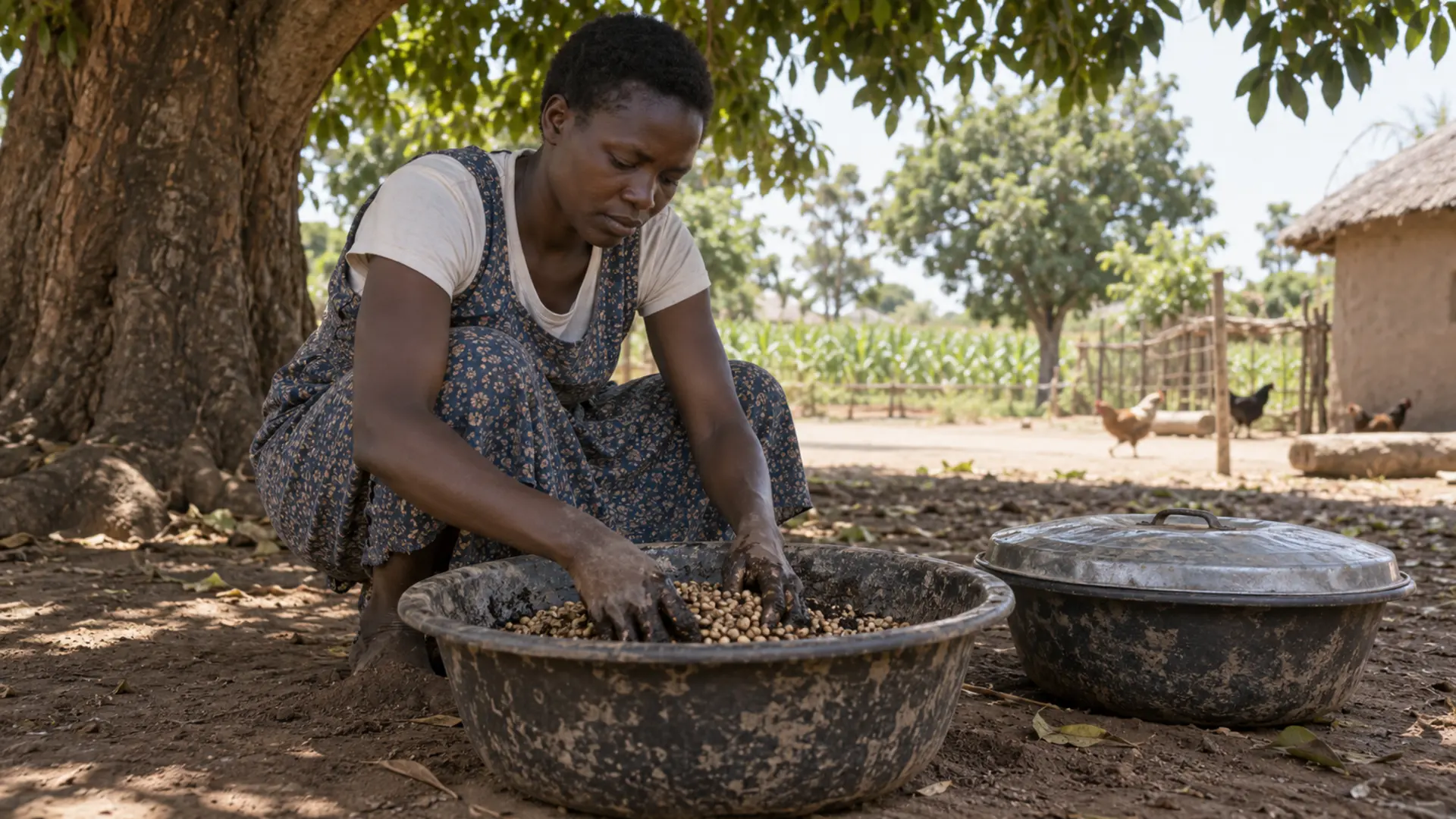
Work in the shade. This is the step most often lost and it is not a nicety. N2Africa states plainly that nodulation will fail if the inoculated seed is exposed to the sun for any length of time or is planted into dry soil. The Ugandan guide gives the same instruction: cover the inoculated seed with paper, cloth or a basket to protect it from direct sunlight, and plant immediately.
Mix, cover, plant. Wet the seed lightly with the sticker solution, turn the inoculant through until every seed is coated, cover the basin, and get it into the ground the same day. Do not inoculate on Monday for a Thursday planting.
Plant into moist soil. Dry soil kills the bacteria as effectively as sunlight does.
One thing we could not verify. Neither the Ugandan guide nor the N2Africa material we opened says whether inoculated seed can be mixed with fertiliser or with pesticide-treated seed. General practice elsewhere warns against it. We are not going to state a rule we could not source, so ask your supplier and, if in doubt, keep them apart.
Soybean in Uganda: Rhizobium Inoculation, Nodulation Checks and Rust Watch
Five-step seed inoculation sequence showing shade, sticker preparation, mixing, covering and immediate planting, with the storage rule beneath
Storage, which is the real constraint in Uganda
Inoculant is a living product. Heat kills it.
N2Africa’s guidance is that inoculant contains living organisms that must be protected from heat and sun, and that the package should be stored in a cool place away from direct sunlight, suggesting a clay pot for farmers without refrigeration. Uganda’s own guide says the same: cool, dry, dark, and avoid hot conditions or direct sunlight.
The research behind that instruction is East African and specific. A study of legume inoculant shelf life in carrier materials available in East Africa, done through the University of Nairobi, found that a bean rhizobium in a filter mud carrier achieved a shelf life of 135 days, and a soybean rhizobium held above a billion cells per gramme for 105 days. Both fell short of the six-month expiry period stated on the commercial product they were tested against. The study also found refrigerated storage at 4 degrees improved shelf life over storage at 24 degrees, and N2Africa’s summary of it concludes that inoculants should be used during the season they were produced.
The practical rules that follow:
- Buy for the season you are planting, not in advance
- Keep it in the coolest, darkest place you have, from the moment you buy it
- Do not keep a part-used packet for next season
- Treat any packet that has sat in a hot shop window or on a lorry as suspect
- Check the manufacture and expiry date, and understand that the shelf life may be shorter in practice than the label suggests
The nodule check
This is the step that turns inoculation from an act of faith into something you can verify, and almost nobody does it.
When. Extension guidance gives two timings: around five to six weeks after planting, or at the R1 stage, meaning the beginning of bloom. Either works. The plant must be flowering or close to it, because nodules take time to form and become active.
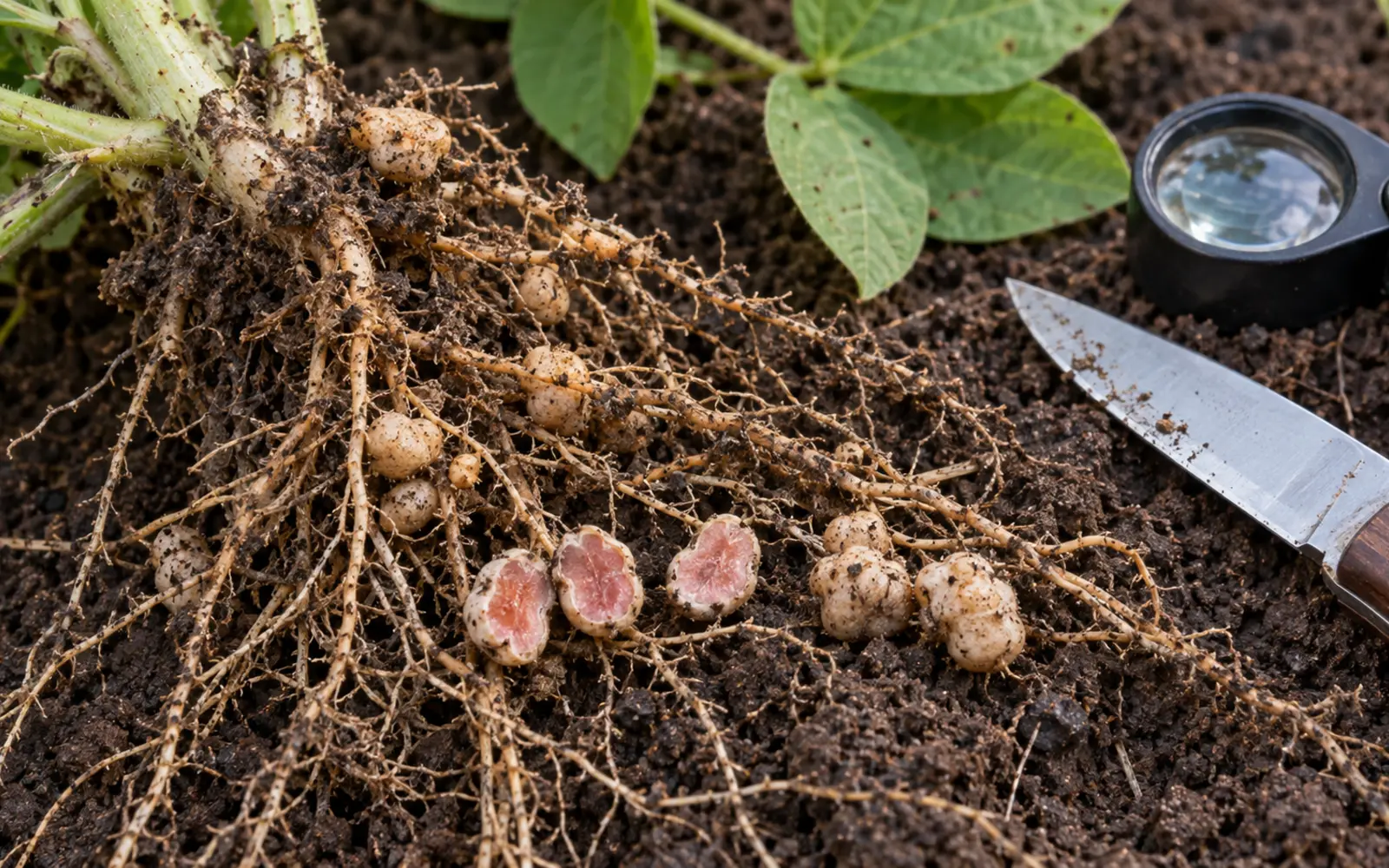
How to lift the plant. Dig, do not pull. Nodules shear off the roots and stay in the soil, and a pulled plant tells you nothing. Take a spade, lift a block of soil around the plant, and then soak the root ball in a basin of water to float the soil off rather than shaking or scrubbing it.
How many, and where. Published thresholds differ and each is worth knowing:
- Manitoba soybean guidance: at least 10 nodules per plant to reach 90 per cent of maximum yield
- Saskatchewan pulse guidance: greater than five clusters of pink pigmented nodules for effective nodulation
- Penn State: five to seven nodules on the taproot two weeks after emergence, or twelve total root nodules per inch of taproot at flowering
Where the nodules sit matters as much as how many. Penn State’s diagnostic point is that nodules on the taproot indicate the inoculant you applied succeeded, while nodules only on the lateral roots usually indicate rhizobia that were already in the soil. If you inoculated and you find nodules only on the laterals, your inoculation probably failed and the field carried its own bacteria anyway.
Cut one open. This is the actual test. An effective nodule is pink or red inside. The colour comes from leghaemoglobin, which has to be present for nitrogen fixation to be happening at all. White inside means immature and not yet fixing. Green means not fixing. Brown and mushy means finished or non-functional.
Cut several, from several plants, in more than one part of the field.
Write it down. Date, growth stage, plants checked, nodules per plant, where they sat, and the colour inside. Next season that record tells you whether to inoculate again.
Soybean in Uganda: Rhizobium Inoculation, Nodulation Checks and Rust Watch
Nodule inspection card showing where to dig, how to lift the plant, where effective nodules sit on the root, and a cut nodule colour guide
What to expect, and what not to promise
The honest position on inoculation response is that it varies a great deal and nobody can predict it well.
A study of soybean inoculation response across sub-Saharan Africa found average yields of 1,343 kilogrammes per hectare with inoculation against 1,227 without, but with substantial geographic variation without clear spatial patterns, pointing to the availability of compatible effective bacteria as the yield-limiting factor. A Ghanaian meta-synthesis found combined rhizobium and phosphorus application gave the highest soybean yield response at 92.6 per cent, against 31.0 per cent for inoculation alone and 50.9 per cent for phosphorus alone, and concluded that the success of inoculation is highly determined by the identity of the strain in the inoculant.
Read those two findings together and the message is: inoculation often helps, sometimes helps a great deal, sometimes does nothing, and phosphorus supply is part of the answer. Anyone quoting you a guaranteed percentage is selling something. All of that evidence is from outside Uganda, and we found no Ugandan quantified inoculation response study.
Two agronomic points that condition the response, both sourced from outside Uganda. Starter nitrogen suppresses nodulation, because a plant with soil nitrogen available does not invest in fixing its own. And soil acidity limits it: a Kenyan study found strongly acidic soils recorded low nitrogen fixation, that inoculation is effective in moderately acidic soils, and that lime co-applied with inoculation has potential in strongly acidic ones. If your soil report shows a low pH, deal with that alongside the inoculant. Reading that report is covered in reading a soil laboratory report - scheduled in this programme.
Rust: what to look for, and when
Soybean rust is caused by the fungus Phakopsora pachyrhizi, and it is present in Uganda. Research characterising rust pathotypes across East Africa included Ugandan field sites at Ngetta in Lira district and Mubuku in Kasese district, where susceptible check varieties consistently developed high disease severities.
How fast it moves. Within seven to nine days after penetration the fungus forms uredinia, the pustules, which erupt through the leaf surface.
What it looks like. Small pale green water-soaked spots first, developing into blister-like raised pustules on the UNDERSIDE of the leaf. The pustules are grey to tan, then reddish-brown, then dark brown. The leaf tissue around the first pustules turns from pale green to reddish-brown or purple and later to dark brown. It starts on the lower, older leaves and moves up.
Where to look. Turn the lower leaves over. Rust on the upper surface is rust you found late.
What favours it. Optimum temperature for spore germination ranges from 17 to 29 degrees Celsius, with relative humidity above 85 per cent and moisture on the leaf surface for six to twelve hours. That describes a Ugandan wet season closely.
What it costs. Severe infection has been associated with yield losses normally ranging between 18 and 55 per cent but as high as 80 per cent. Those figures come from trial conditions with susceptible checks, not from ordinary farmer fields, so treat them as a risk range rather than an expectation.
What this guide does not give you. No fungicide, no product name, no spray schedule. Some of the Ugandan sources behind this article do name chemical products. We have deliberately excluded them. If rust is established in your crop, that is a conversation with your district agricultural officer or a qualified agronomist, and the published guide to safe pesticide use covers how any such decision should be handled.
The genetic route. Makerere University’s breeding programme, under Professor Phinehas Tukamuhabwa, has released the Maksoy series: Maksoy 1N in 2004, 2N in 2008, 3N in 2010, 4N and 5N in 2013, 6N in 2017, and Maksoy 7N approved by the National Variety Release Committee on 13 February 2026 with stated strong resistance to soybean rust. Makerere reports that 93 per cent of Ugandan soybean farmers cultivate Maksoy varieties.
Where to get inoculant in Uganda
This is where we can be least helpful, and we would rather say so than guess.
What we can verify. Uganda’s Agricultural Chemicals (Control) Act defines agricultural chemicals to include biofertilisers, and requires registration before import or sale. MAAIF’s own Agricultural Chemicals Register lists a registered Bradyrhizobium japonicum product at 4 times ten to the ninth colony forming units per gramme, so at least one rhizobium inoculant is legally registered for sale in Uganda. A regional registration guideline document records that Uganda requires multi-locational trials across three agro-ecological zones for three seasons, plus a minimum viable cell count and a contamination limit, before a rhizobium product is registered. IITA’s Uganda country page lists promotion and adoption of Biofix inoculants as an active activity in Uganda. And Uganda’s own soybean production guide names an inoculant produced at Makerere, purchasable at the School of Agricultural Sciences.
What we cannot verify. We could not corroborate the Makerere product name from a second institutional source, and that guide dates from 2015. We could not find a current list of registered distributors. And one well-known regional commercial inoculant is documented as distributed in Benin, Ghana, Nigeria and Togo, with Uganda not among its markets, so do not assume a product available elsewhere in the region is available here.
What to do about it. Treat inoculant as something obtained through a research institute, a project or a registered supplier you have confirmed, rather than as a routine agro-input you can expect on any shop shelf. Ask NaCRRI, Makerere’s School of Agricultural Sciences, or your district agricultural officer, and ask when the batch was produced.
Cost categories
No prices, because we could not verify Ugandan prices for any of this.
- Certified seed of a named variety, per acre
- Inoculant, per unit of seed, at the rate on the packet
- Sugar or gum arabic for the sticker, which is trivial
- Cool storage, which for most farms means care rather than money
- Phosphorus, where a soil report indicates it, because the evidence says inoculation and phosphorus work together
- Lime, where soil acidity is the constraint
- Labour for accurate planting
- Labour for scouting, which is the cheapest insurance in this article
- A spade and a basin for the nodule check
Common mistakes
Not inoculating at all in a field with no soybean history. The most common error, and the one this whole article exists for.
Inoculating in the sun. Documented to cause nodulation failure. Work in shade and cover the seed.
Inoculating the day before planting. The organisms are alive and the coating is not a preservative.
Planting into dry soil. Named alongside sun exposure as a cause of failure.
Buying inoculant early and storing it warm. East African shelf-life research shows viability falling short of label claims even under controlled storage.
Applying starter nitrogen and expecting good nodulation. They work against each other.
Never checking. If you do not dig and cut, you never learn whether any of this worked.
Pulling the plant to check. The nodules stay in the soil and you conclude there were none.
Scouting only the top of the plant for rust. It starts on the underside of the lower leaves.
Warning signs and escalation points
- Plants pale and stunted from about four weeks, with no nodules or only white ones when you dig
- Nodules present only on lateral roots after you inoculated, indicating the inoculation did not take
- Nodules brown and mushy well before maturity
- Small raised pustules on the underside of lower leaves, especially in a wet spell
- Rapid yellowing and leaf drop from the bottom of the plant upwards
- Rust appearing before flowering, which is the worst timing
Contact your district agricultural officer or the nearest NARO institute if rust appears early and widely, or if you cannot obtain inoculant or seed of a resistant variety.
Where this works, and where it does not
It works for a grower with access to fresh inoculant, moist soil at planting, and the willingness to dig up a few plants six weeks later.
It works less well in three situations. Where inoculant cannot be obtained fresh and stored cool, the honest position is that a degraded product may do nothing, and a promiscuous-variety strategy may serve better if a suitable variety is available. Where soil pH is strongly acidic, inoculation alone is documented to underperform and the pH is the first problem. And where the field has grown well-nodulated soybean recently, inoculation may add little, which is exactly what the nodule check is for.
The market case for soybean is real and institutionally documented: MAAIF’s Vegetable Oil Development Project material records that Uganda imports 60 to 70 per cent of its edible oil needs with demand growing around 9 per cent a year, and Makerere’s own value chain material describes soybean as a key raw material for vegetable oil, feeds and food. That is a demand picture, not a promise of profit, and we give no gross margin here.
A low-risk first step
Split your first soybean field in two. Inoculate one half, plant the other half with the same seed, uninoculated, on the same day.
At flowering, dig five plants from each half, wash the roots in a basin, count the nodules and cut them open. Write down what you find.
That costs you nothing beyond an hour and a spade, and it answers the question no article can answer for your field: whether the bacteria were already there. It also gives you a comparison at harvest that means something, because everything else about the two halves was the same.
What to do next
- Find out whether this field has grown inoculated soybean before. If not, plan to inoculate.
- Source inoculant through NaCRRI, Makerere or a supplier you have confirmed, and ask when the batch was made.
- Store it cool and dark from the moment you get it.
- Read the rate printed on the packet and use that, not a figure from anywhere else.
- Split the field and leave an uninoculated strip so you can compare.
- Inoculate in shade, cover the seed, plant the same day into moist soil.
- Dig, wash and cut nodules at the start of flowering, and write down what you find.
- From flowering onwards, turn over the lower leaves twice a week and look at the undersides.
Related reading: the published guides to crop rotation and cover crops and soil testing and fertility cover the ground this crop sits in, and verifying seed and planting material quality covers checking what you have bought. Within the programme, see rhizobium inoculants and biofertilisers - scheduled in this programme for the wider evidence on biological products and how to test one on your own farm.
About the author
This guide was researched and written by the Falcon Foundation Ltd Editorial Team. Falcon Foundation Ltd is a privately owned Ugandan agricultural company producing greenhouse crops, livestock and honey. Our Knowledge Hub is written for Ugandan farmers making practical decisions with incomplete information. We name no pesticide products, we label evidence from outside Uganda as such, and where two authoritative sources disagree we show you both rather than choosing one quietly.
