The rains arrive and there are no vines. Or there are vines, but they are in a neighbour’s old field that has been standing since the last harvest, full of volunteers and weevil-damaged roots, and cutting them means bringing that field’s problem into a new one.
This is not a minor inconvenience. Sweet potato is propagated vegetatively, which means the crop cannot be stored as seed in a tin. The planting material is a living plant, and a living plant does not survive a long dry season without help. A study of Ugandan and regional sweet potato seed systems puts the biology plainly: even just a few degrees north or south of the equator, the increasing unimodality of the rains leads to long dry seasons during which sweet potato cannot survive as an actively growing plant.
The consequence is a shortage at exactly the moment the material is needed, and a temptation to take whatever is available. This guide is about not being in that position.
Why it matters in Uganda
The bottleneck is measured, not assumed.
A study of informal sweet potato seed enterprise in northern Uganda records that in Gulu a long dry season lasts from December to mid-March, that this is too long for sweet potato crops not to desiccate, and that most farmers lack vines to plant at the start of the rainy season in April.
Survey work on the Uganda sweet potato value chain found that of the farmers interviewed, 106 wanted to buy additional planting material but only 40 were able to purchase it, and that farmers reported they would have planted twice as much and about a month earlier if more planting material had been available.
In Tanzania’s Lake Zone, the same regional review found planting material shortage identified as the major constraint by 66 per cent of 77 farmers interviewed.
The second half of the problem compounds the first. The same Uganda value chain work notes that sweet potato weevils are more abundant and damaging during the dry season than during the rainy season, which is precisely when the surviving vines are sitting in old fields waiting to be cut.
What this guide helps you decide
Which dry-season conservation method suits your site, given whether you have water, a wet spot or neither. Where to put a multiplication plot and how far from your last crop. Which part of the vine to cut and why it matters for both vigour and weevils. What actually breaks the weevil cycle, and in what order. And how much help to expect from variety choice, which is less than most growers assume.
The short answer
Keep a small, clean multiplication plot alive through the dry season, sited away from any old sweet potato field. Take apical tip cuttings from it, not middle or basal sections. Remove residues and volunteers from the field you last cropped. Earth up the ridges when they crack, and harvest on time rather than leaving roots in the ground.
There is no variety that will do this for you, and there is no spray in this article.
Getting vines through the dry season
Four approaches are documented, and they need different things from your site.
Sweet Potato Vine Multiplication and Weevil Control: Getting Clean Planting Material Before the Rains
Comparison of four documented dry-season vine conservation methods showing what each needs, what it produces, where it has been documented and its main risk
An irrigated multiplication plot. The most straightforward and the most demanding of water. The CABI regional review describes irrigated gardens with raised or sunken beds in several West African countries, and the northern Uganda study describes an organisation-run multiplier with more than a hectare of dry season production and a pump for water. A Kenyan coastal evaluation compared several methods of multiplying planting material, including pits lined and unlined, open ground and sacks, and concluded that under off-season irrigation any of the methods of planting would give the same vine yield, recommending that farmers start multiplication in the off-season and continue during the long rains so as to multiply enough planting material.
Read that finding carefully, because it is liberating. If you can water the plot, the container or bed design matters much less than whether you water it.
A valley bottom or wetland edge. The method most Ugandan multipliers actually use. The northern Uganda study records that multipliers mainly used land in two swamps to the north-east of Gulu Town, planting in swamps on ridges or mounds around the start of the dry season and harvesting the vines several times. The CABI review describes seed beds located along river beds or wet spots in Tanzania’s Lake Zone.
This uses residual moisture instead of a pump. Two cautions come with it: wetland cultivation may be regulated in your district and you should check before you clear anything, and a low wet site is exactly where a crop will suffer if the rains come early.
Roots stored in sand and sprouted, known as Triple S. Developed and promoted through the International Potato Center with a Ugandan researcher named in the Center’s own reporting as its developer. Small and medium roots that are not going to be sold are selected at harvest and stored in dry sand through the dry season. Six to eight weeks before the rains are expected, the roots are planted into a seedbed and watered, and they sprout to produce vine cuttings for transplanting when the rains start.
The reported figures need care. Cutting yield per root is given as approximately 40 in several of the Center’s own materials and as 40 to 60 in the regional review; the planting window is given as six to eight weeks before the rains in most sources and five to seven weeks in the review. Report both as ranges rather than picking one. One validation study reported 81 to 95 per cent root survival during dry storage against 7 to 57 per cent for traditional approaches, with significantly higher vine growth and lower weevil and virus infection symptoms, and noted that planting at the start of the main rains and harvesting just before the dry season gives the highest number of medium-sized, weevil-free roots suitable for storage.
The great advantage of this method is that it needs no water through the dry season, only sand, shade and discipline.
A shaded or backyard plot using household water. The CIP working paper lists seven farmer practices for dry-season conservation, including wetland cultivation, waterhole irrigation, backyard plots using wastewater, root sprouting, shade cultivation and late establishment. These are what farmers already do. They are small, and their limitation is scale rather than principle.
Siting and running a multiplication plot
Distance from your last sweet potato crop is the first decision and the cheapest. A tropical sweet potato technical manual states that a nursery bed should be established far away from existing sweet potato fields, and that fields not used for sweet potato in the last two to three years are preferred.
The reason is specific and worth knowing. Regional research on integrated weevil management states that the weevil can survive up to a maximum of approximately ten months on residues and volunteer plants, and that the residual portion of previously infested sweet potato plants can easily serve as an infestation epicentre. A plot beside an old field is a plot with a supply line running into it.
We should be honest about what we could not verify. We found no Uganda-validated isolation distance in metres for a multiplication plot. What exists is general pest-management guidance recommending barrier strips of a non-host crop such as cassava, maize, banana or sorghum three to five metres wide around a plot. Treat that as an indication of the kind of measure that helps, not as a validated Ugandan figure.
Water. Keep the soil moist but not wet. We could find no Uganda-specific minimum irrigation figure for a multiplication plot, in litres or millimetres, and we are not going to invent one. What the Kenyan comparison establishes is that with adequate off-season water, plot design is a secondary question.
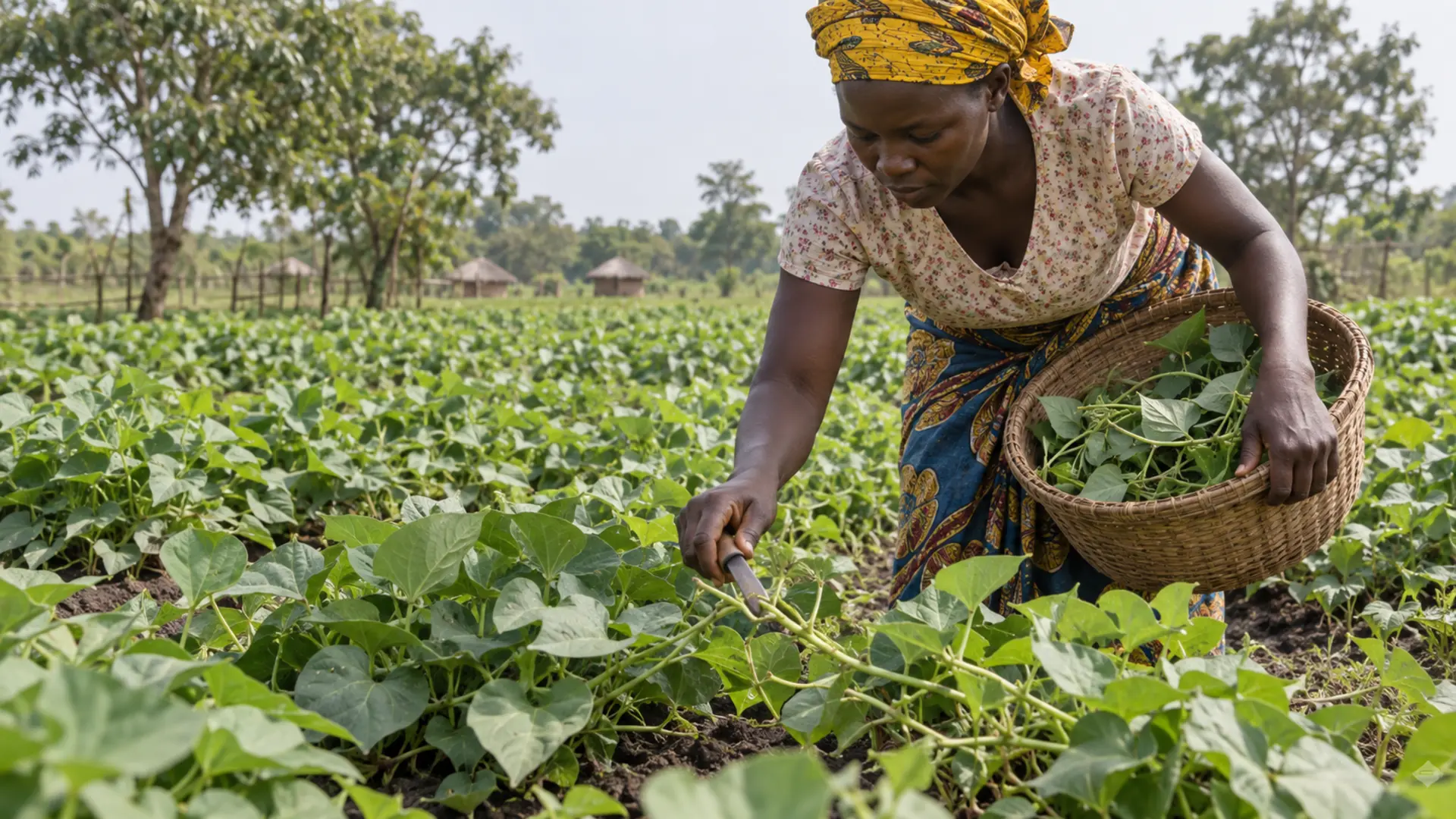
Cutting. The technical manual gives cuttings of 30 to 40 centimetres in length, taken from mature, insect-free plants. Nursery sprouts are described as reaching 40 to 50 centimetres approximately four to eight weeks after bedding.
Rogueing. Walk the plot regularly and pull out any plant showing virus symptoms, taking it out of the plot rather than dropping it. The CIP working paper is direct about the value of this: the long-term effect of rogueing may actually be the main benefit. That is a statement about the seed system rather than about a single season, and it is the reason a small plot walked weekly beats a large plot walked never.
Which part of the vine, and why it matters twice
Take the apical portion. The tip.
Three independent sources agree. A tropical technical manual states that the apical region of the plant is more likely to be free of pest infestations and that it gives better yields than cuttings from the middle or base. A companion guide states that it is recommended to plant apical cuttings, which give better growth than middle or basal portions. A regional pest information platform explains the weevil half of the reason: weevils tend to lay eggs in the older, woodier parts of the vine, so apical cuttings carry fewer eggs. The CIP working paper states the same, that apical selection gives fewer weevil eggs and higher yields.
This is the single cheapest weevil control measure available to a Ugandan grower and it costs nothing but discipline at cutting time.
The weevil
Which one. The species dominant in East Africa is Cylas puncticollis, described by a regional pest platform as one of the most important pests of sweet potato in tropical Africa, notably Uganda, Rwanda, Kenya and Cameroon. Cylas brunneus is also present in the region.
What it does. Eggs are laid singly in small cavities on the sweet potato root or at the base of the vine, and sealed with a plug of the mother’s excrement. Larvae bore into stems and roots. The European plant protection organisation’s alert entry describes larval tunnelling and secondary rots reducing the size and number of roots, and notes that infested tubers cannot be stored for long as the pest may continue its development in them. The same entry gives the temperature requirement as annual mean temperatures of 18 to 35 degrees Celsius to complete the life cycle, which is most of Uganda.
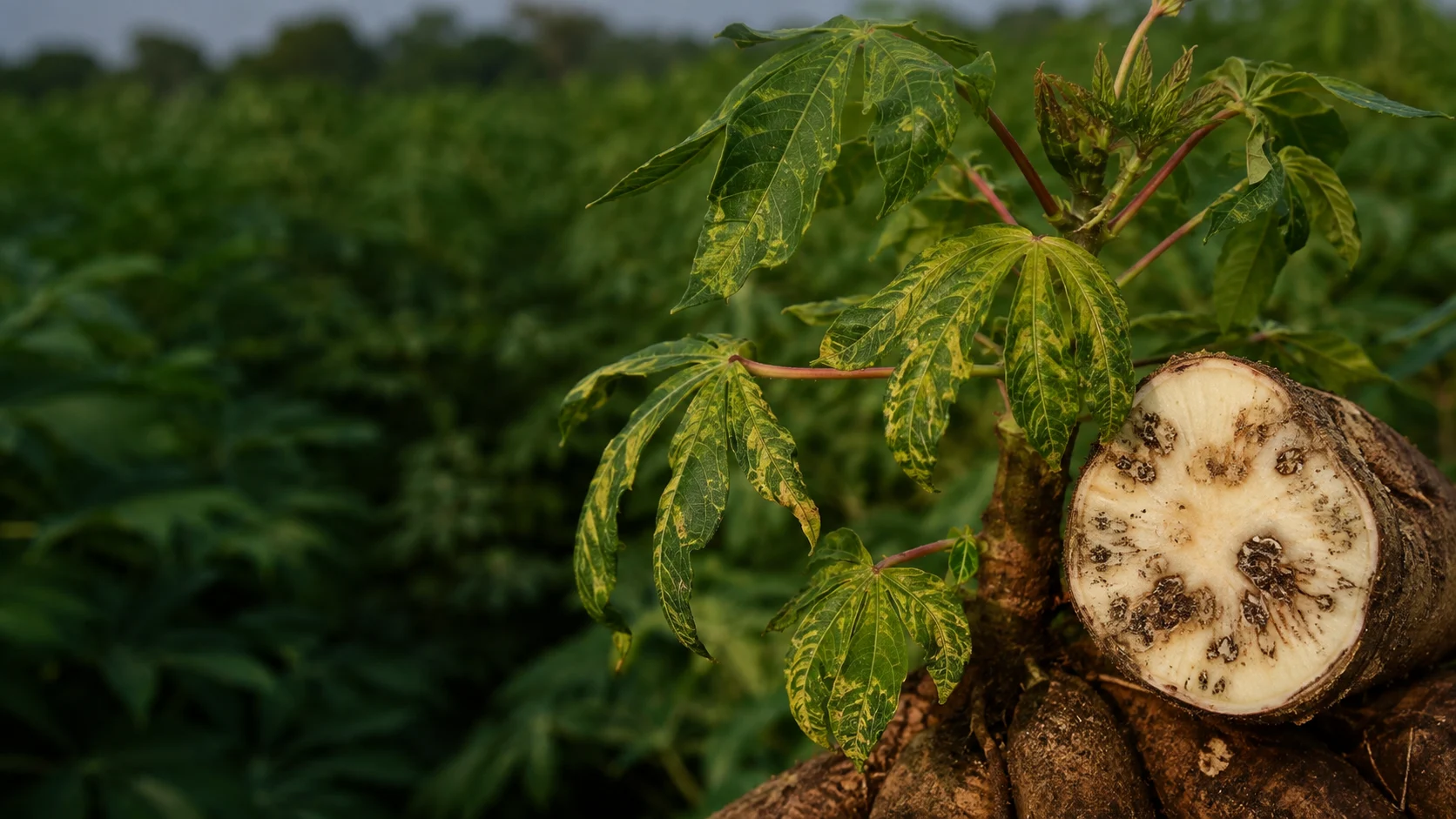
What damage looks and tastes like. Damaged roots become spongy and brownish to blackish with numerous small holes. The taste change is not incidental: a 2023 review of Ugandan weevil resistance breeding explains that larval damage triggers the plant to produce sesquiterpenes, giving damaged roots an unacceptable odour and a bitter taste. A small amount of damage can therefore spoil a root for eating and for sale.
Why the dry season is worse. Cracks. Regional research states that cracks develop as the sweet potato bulks up or as the soil dries, and that covering those cracks can prevent the weevil accessing the root to lay eggs. The pest platform is blunter: soil cracks are the major route of weevil access to roots.
Sweet Potato Vine Multiplication and Weevil Control: Getting Clean Planting Material Before the Rains
Diagram of the sweet potato weevil cycle from residue and volunteer plants through the new crop, with the four points at which a grower can break it marked
The sanitation break
Each of these is a cultural practice. None involves a chemical.
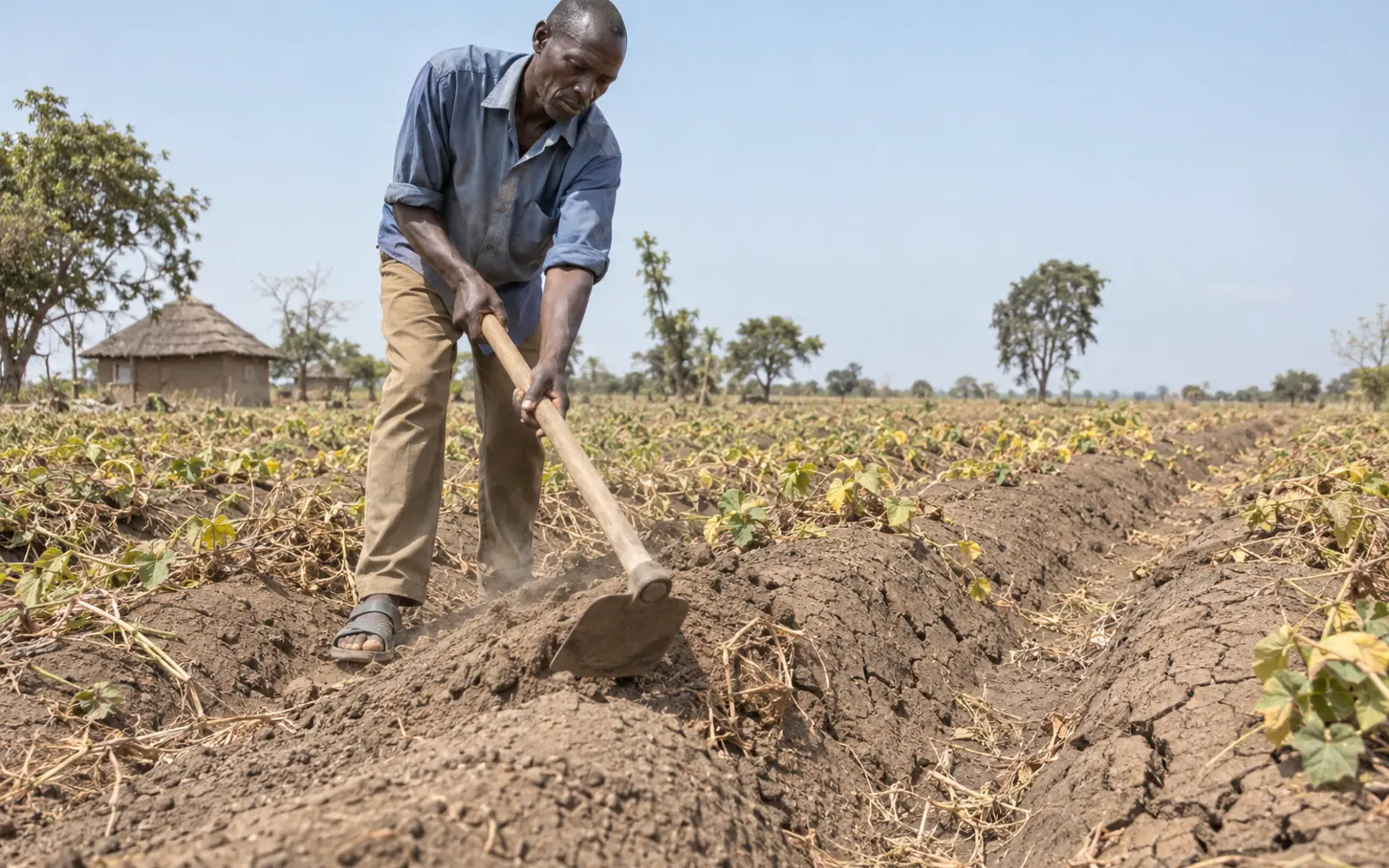
Remove residues and volunteers. This is the highest-value item, because of the ten-month survival figure above. After harvest, take out the vines and the small and damaged roots. The pest platform recommends burying infested material deeper than 15 centimetres or destroying it. Do not leave a field of volunteers standing between crops.
Rotate, and accept that the interval is uncertain. Guidance ranges from avoiding sweet potato for two to three successive seasons in one source to once every five years in another, and neither is a controlled Ugandan trial result. What is verified is the ten-month survival window on residues, which sets the logical minimum: a rotation shorter than that, with residues left in place, is not a break. Report the interval to yourself as at least a full season with the residues cleared, and longer if the infestation is heavy.
Do not move the problem. Striga and weevils both travel in material people carry. Do not take soil, unrotted residue or cuttings from an infested field to a clean one, and do not lend cuttings from a field you have not walked.
Earth up when the ridges crack. The pest platform recommends re-hilling about 30 days after planting to close soil cracks. In practice, look at the ridges rather than the calendar: when the crop is bulking and the soil is drying, cracks open, and drawing soil over them closes the door.
Harvest on time. Every additional week in the ground is another week of exposure through the cracks. The Uganda value chain work notes that in-ground storage and piecemeal harvesting contributed to weevil infestation, which is worth reading carefully because piecemeal harvesting is precisely what a household does when the field is also the store.
Use clean planting material. Regional research calls clean planting material a foundational practice. This is the whole point of the multiplication plot.
Plant deep. One pest advisory mentions deeper cutting placement and deep-rooted varieties as reducing damage. We could not corroborate this in the Uganda-specific literature and report it as a lower-confidence measure.
Sweet Potato Vine Multiplication and Weevil Control: Getting Clean Planting Material Before the Rains
Weevil sanitation checklist paired with a blank multiplication plot record sheet for site, distance from the last sweet potato field, cutting dates and rogueing
Virus, and why clean material matters twice over
Sweet potato virus disease in East Africa is caused by two viruses acting together. A plant health knowledge bank describes Sweet potato chlorotic stunt virus, a crinivirus spread by whiteflies, and Sweet potato feathery mottle virus, a potyvirus spread by aphids. The two viruses do relatively little damage on their own, but where the first suppresses the plant’s defences the second can multiply up to 600 times higher, producing the severe disease.
The critical sentence for a multiplier is this: the viruses are spread in cuttings used for planting. That is why the same guidance recommends growing cuttings in nurseries for later planting in the field, so that infected plants can be rogued out before they reach the crop.
One honest qualification. A review from the International Potato Center notes that popular East African cultivars appear to sustain their long-term survival by reverting from symptomless infection, which means field severity is sometimes less dramatic than the mechanism suggests. That is a reason to keep perspective, not a reason to plant infected material.
Varieties, and what they will and will not do for you
Orange-fleshed varieties released in Uganda, verified from primary variety release literature.
Kakamega, also designated SPK004, and Ejumula were approved for release by the Ugandan Plant Variety Release Committee in April 2004, with the National Crops Resources Research Institute at Namulonge as the research institution. Kakamega was introduced as pathogen-tested mini cuttings from the International Potato Center’s seed unit at Muguga in Kenya; Ejumula was collected from Aterai village, Wera sub-county, Katakwi District in Uganda. Kakamega has moderate field resistance to sweet potato virus disease, whereas Ejumula is described as susceptible to it. Both are susceptible to sweet potato weevils, with Kakamega less susceptible than Ejumula under field conditions.
NASPOT 12 O and NASPOT 13 O were approved for release by the same committee in November 2013, in work involving the national research organisation, the International Potato Center and partners. On-station yields were reported at 43.1 and 27.8 tonnes per hectare respectively, with on-farm yields of 14.9 and 9.7. Both have moderate levels of field resistance to sweet potato virus disease, and both are described as susceptible to weevils, with NASPOT 12 O tending to be less susceptible because of its thick canopy.
The International Potato Center’s orange-fleshed catalogue also lists NASPOT 9 O, known to farmers as Vita, as released in Uganda and Kenya, and NASPOT 10 O, known as Kabode, as released in Uganda. The catalogue does not give release years for these two and we have not supplied any.
Now the part that matters most. A 2023 review of weevil resistance breeding in Uganda states that all of the 29 sweet potato varieties released in Uganda to date are either moderately resistant or susceptible to sweet potato weevils. The best resistance source identified, the landrace New Kawogo, shows moderate resistance through hydroxycinnamic acid esters that deter the development of weevil larvae, and the review is explicit that this is a deterrent mechanism, not immunity.
There is no released Ugandan variety that will solve your weevil problem. The sanitation checklist is the lever. Variety choice adjusts the margin.
And a note on what this article does not say. Orange-fleshed sweet potato is frequently promoted with nutritional claims. This article makes no nutritional or health claim of any kind, because verifying those claims properly is a different exercise from verifying agronomy, and because a variety’s agronomic performance is what a grower is deciding on here.
Common mistakes and failure points
Waiting until the rains to think about vines. Cutting from the nearest old field. Taking middle and basal cuttings because they are longer. Siting the multiplication plot next to last season’s crop. Leaving residues and volunteers standing after harvest. Never walking the plot to rogue it. Ignoring cracks in a drying ridge. Leaving roots in the ground as a store. Carrying soil or unrotted residue from an infested field to a clean one. Choosing a variety in the belief that it will handle the weevil for you. And clearing a wetland for a multiplication plot without checking whether that is permitted in your district.
Where to get help
Contact the National Crops Resources Research Institute at Namulonge, under the National Agricultural Research Organisation, for current variety recommendations and for the source of clean planting material. Variety recommendations change and a research station’s current advice beats an article’s.
Contact your district agricultural office before establishing a plot in a wetland or valley bottom, because wetland use is regulated.
Ask a plant health officer or extension worker to look at a plot showing virus-like symptoms before you take cuttings from it, rather than after.
A practical action plan
At harvest, this season. Select and set aside small and medium roots from the healthiest, least damaged plants if you intend to use the sand storage method. Clear the residues and volunteers out of the harvested field.
Early dry season. Establish the multiplication plot at whichever site your water situation allows, as far from your last sweet potato field as you can manage. Write down where it is and how far.
Through the dry season. Water it, weed it, and walk it. Pull and remove any plant showing virus symptoms.
Six to eight weeks before the rains. If you are using stored roots, bed them out and water them.
At planting. Take apical tip cuttings only, from mature, insect-free plants, and carry them in a basket rather than dragging them.
Through the crop. Earth up when the ridges crack. Harvest on time.
Conclusion
Sweet potato is a crop whose main constraint is not agronomy but supply of its own planting material, and whose main pest is one that travels forward on that planting material and through the cracks in a drying ridge.
Both problems are answered by the same small piece of infrastructure: a clean plot, kept alive through the dry season, sited away from last year’s field, and walked often enough that you know what is in it. That plot costs a fraction of a hectare and it is the difference between planting on time with clean material and cutting whatever is standing when the rain comes.
Author: Falcon Foundation Ltd Editorial Team
The Falcon Foundation Ltd Editorial Team produces evidence-based agricultural guidance for Ugandan farmers, drawing on published research and institutional sources and translating them into practical decision support. Where evidence is unavailable or contested, we say so rather than filling the gap.