
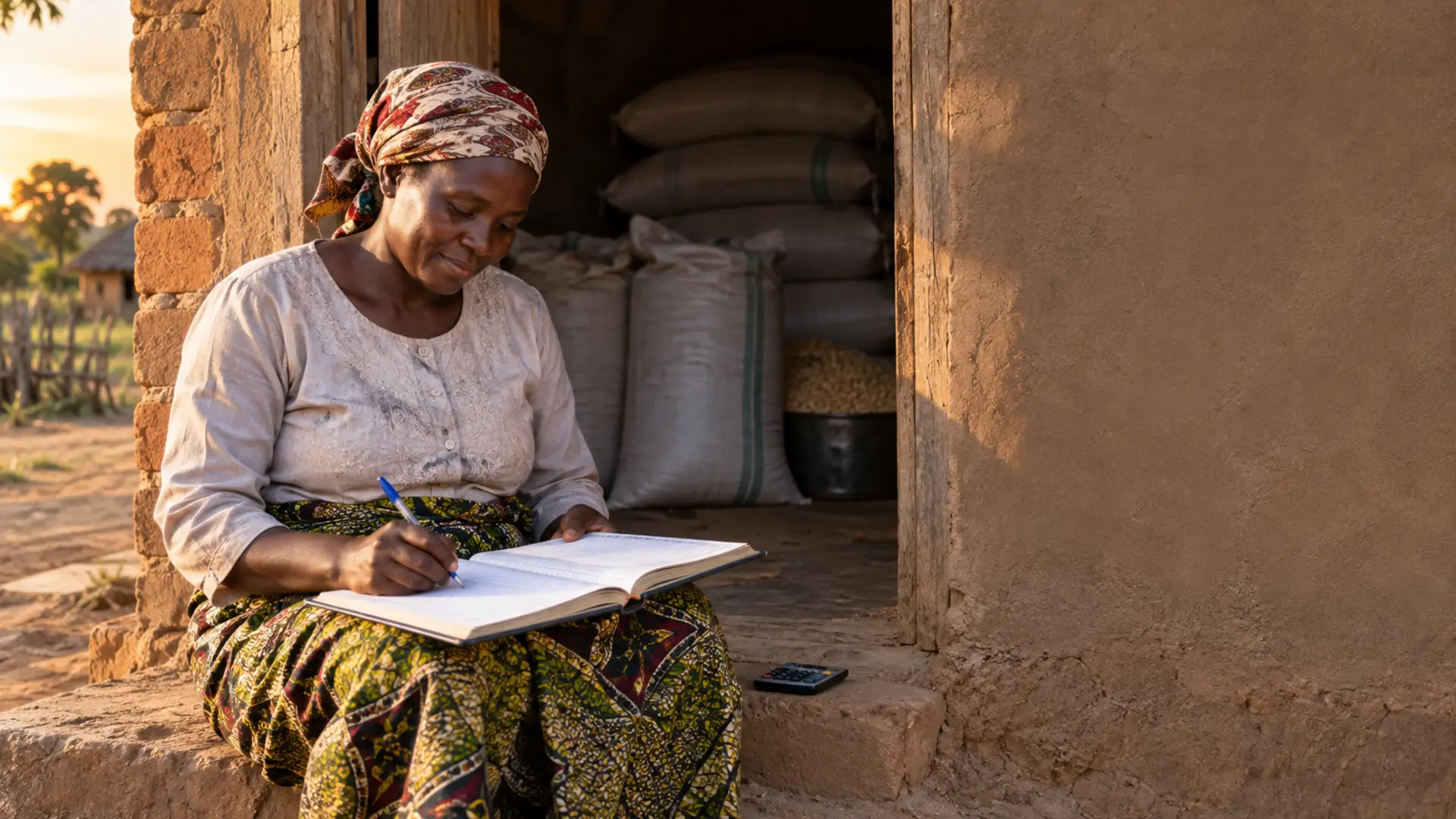
There is a story about agricultural finance in Uganda that gets repeated at every training, in every brochure and in a good deal of the press. It goes like this: deposit your grain in a licensed warehouse, receive a receipt, take the receipt to a bank, borrow against it, and sell months later when the price has recovered instead of dumping at harvest.
It is a good story. Uganda’s own Law Reform Commission has looked at whether the law actually supports it, and the answer it gives is uncomfortable.
This guide sets out what is genuinely established about agricultural credit in Uganda, what can actually be used as security, what the warehouse receipt system does and does not provide, and what a farmer should assemble before approaching anyone. It names no lender, recommends none, and states no interest rate, fee or loan ceiling, for reasons given below.
First, the size of the problem
Credit does not reach Ugandan agriculture in proportion to its weight in the economy, and the figures are worth having in front of you when a refusal starts to feel personal.
A World Bank policy note on agriculture finance in Uganda recorded that only 12.2 per cent of overall credit goes to the agricultural sector, that agriculture credit for production represented a very small share of agricultural GDP, and that total private sector credit itself was a modest share of GDP. It identified the binding constraints in plain terms: lack of acceptable collateral, with lack of physical assets for collateral described as one of the major obstacles; perceived risks and high transaction costs; exposure to systematic risks such as climatic events with inadequate mitigation mechanisms; and limited outreach by financial institutions in rural areas making transaction costs for access to finance prohibitively high.
Those figures are from 2019 and some of the underlying data is older. We could not obtain a current national figure from the central bank or the statistics bureau during the preparation of this guide, and we are not going to update an old number by assumption. Treat the figures as describing a structural situation rather than this quarter’s position.
The important point is what the constraints are. Three of the four are about the lender’s risk and cost, not about your farming. That tells you what an application has to address.
What lenders assess
We looked for a published document from the central bank or a Ugandan commercial lender setting out an itemised documentary checklist for an agricultural borrower. We did not find one, and we are not going to invent a checklist and present it as though a bank published it.
What the evidence supports is the categories a lender is working through, which follow directly from the constraints above.
Agricultural Finance in Uganda: What Lenders Actually Require and What Warehouse Receipts Change
A blank lender readiness checklist grouped into identity and registration, records, land and security, and cash flow evidence, each item with space to record whether the farmer holds it and where it is.
Does this business exist as a distinguishable thing? A farm that has never been registered, has no separate account and no records is, from the lender’s side, indistinguishable from a household. Registration is covered in registering and formalising a farm business.
Can you show what it earns? Not what you believe it earns. Records. Gross margins by enterprise, over more than one season, with the method set out in farm record keeping and gross margin analysis. This is the single most common gap and the cheapest to close, because it costs nothing but a year of discipline.
Is there transaction evidence? Bank or mobile money history, sales receipts, buyer contracts. A lender assessing repayment capacity is trying to see money actually moving.
Is there security? The subject of the next section, and the hardest part for most Ugandan farms.
Is there a plan the lender can follow? The construction of one is set out in writing a bankable farm business plan.
Security: what actually counts
This is where Ugandan agricultural lending mostly stalls, and the legal position is more varied than most farmers realise.
Agricultural Finance in Uganda: What Lenders Actually Require and What Warehouse Receipts Change
A four-column comparison of security types available in Uganda covering registered land title, certificate of customary ownership, movable and farm-product security, and warehouse receipts, against what the law provides and what the practical constraint is.
Registered land
A registered freehold, leasehold or mailo title is the security a lender is most comfortable with, and the conveyancing and verification questions are dealt with in verifying land title and tenure.
Customary land, and the certificate that changes its status
Most Ugandan farmland is held under customary tenure, and most farmers assume that makes it useless as security. The Land Act says something more specific than that.
The Act provides that any person, family or community holding land under customary tenure on former public land may acquire a certificate of customary ownership, and that applications are made to the committee of the area in which the land is situated. It provides that a certificate confers the right to undertake transactions in respect of that land, which may include leasing, mortgaging or pledging the land or part of it where the certificate does not restrict it, and selling.
And it contains a provision that deserves to be much better known: the Act states that a certificate of customary ownership shall be recognised by financial institutions as a valid certificate for purposes of evidence of title.
That does not make a certificate identical to a registered title in a lender’s risk assessment, and this guide is not going to pretend it does. But it means that customary land with a certificate sits in a different legal position from customary land without one, and obtaining a certificate is an action available to a household that may take a long time but costs far less than acquiring registered title.
One practical note on citation. The Land Act is cited in older material as Chapter 227 and in the more recent revision of the laws as Chapter 236. They are the same Act under different chapter numbering, and you may encounter either. Do not assume a document citing the older number is out of date for that reason alone.
Movable property and farm products
This is the option most under-used by Ugandan farmers and it is worth knowing about.
Uganda operates a registry for security interests in movable property, established under the Security Interest in Movable Property Act of 2019 and operated by the Uganda Registration Services Bureau. What can be registered is broader than most farmers expect. The registry’s own description of registrable collateral explicitly includes farm products including crops such as coffee, banana and tea, whether grown, growing or to be grown, as well as fish stocks, poultry and livestock, and separately covers plant and machinery, trucks, generating sets, drilling rigs, presses and forklifts, along with inventory and raw materials.
Read that list against your own farm. A dairy herd, a standing coffee crop, an irrigation pump, a milling machine: these are assets, and there is a legal mechanism for using them as security that does not depend on owning registered land.
Financial institutions, individuals and law firms can register notices and conduct searches, and the public can search. The searchability matters in both directions: it is also how a lender discovers that an asset you are offering is already encumbered.
We were not able to open a machine-readable copy of the Act itself, so this guide describes the registry from the registry’s own published description of what it does and accepts, and does not quote section numbers.
Warehouse receipts: what the law actually says
Now the part that requires the most care, because the gap between the promotional account and the legal position is wide.
What the Act establishes
Uganda’s Warehouse Receipt System Act of 2006 is real, and it does substantial things.
It defines a warehouse receipt as a receipt for goods issued by a warehouse keeper duly licensed and bonded under the Act, including both negotiable and non-negotiable receipts. It establishes the Uganda Warehouse Receipt System Authority, whose functions include licensing warehouses, licensing warehouse keepers and licensing warehouse inspectors.
On the commercial substance, it provides that a warehouse receipt creates a charge on the goods deposited at the warehouse once it is issued; that a negotiable warehouse receipt to the order of a named person is negotiated by endorsement on its delivery and registration of the negotiation by the Authority; and that a holder to whom a negotiable warehouse receipt has been duly negotiated acquires title to the goods and the obligation of the warehouse keeper to hold or deliver them. It also allows a warehouse keeper to reserve a security interest against the depositor for a maximum amount specified on the receipt.
So the instrument is a document of title. Negotiating it transfers title to the goods. That is genuinely powerful and it is the basis of the whole concept.
Agricultural Finance in Uganda: What Lenders Actually Require and What Warehouse Receipts Change
A process flow of the warehouse receipt system from deposit through grading, receipt issue and negotiation, paired with an evidence panel stating what the law does and does not provide about using a receipt as loan collateral.
What the Law Reform Commission found
Here is where an honest guide has to depart from the brochure.
Uganda’s Law Reform Commission published an issues paper reviewing this Act. Its finding on the collateral question is direct: the law is silent on the use of warehouse receipts as collateral for obtaining agricultural or any other form of credit, yet this appears to be one of the major purposes of the law in other jurisdictions.
It adds a second gap that matters enormously to any lender: the law is silent on the priority of creditors in the queue of recovery where a farmer fails to pay a lender.
And it reports a survey finding that should be read by anyone being told this is a routine route to credit: in its preliminary consultations, 66.7 per cent of respondents did not know of any financial institution that had extended credit based on a warehouse receipt as collateral.
Note what the Act’s own provisions do and do not cover. The charge the Act creates on the goods, and the security interest a warehouse keeper may reserve, protect the warehouse keeper’s claim for storage charges. They are not the same thing as a statutory framework for a third-party lender taking security over the receipt and knowing where it stands against other creditors.
Scale
The same issues paper records that total licensed storage capacity in 2014 stood at 22,000 tonnes, described as very marginal in comparison with total annual volume of grains and pulses produced in Uganda estimated at over 4.9 million tonnes.
That figure is more than a decade old and capacity may well have grown. We could not find a current figure. But the order of magnitude is the point: this was a system covering a very small fraction of national production.
We also could not find a published, browsable list of currently licensed warehouses. So if somebody tells you a particular store is licensed, that is a claim to verify with the Authority directly, not one to accept.
How to read all this
Not as a reason to dismiss the system. It exists, it is regulated, the Act gives receipts real legal effect, and the commission’s review is aimed at strengthening it rather than abolishing it.
Read it as a reason to ask a specific question before you plan around it: has this particular financial institution actually lent against a warehouse receipt before, and on what terms? The commission’s own survey suggests the honest answer will often be no. A farmer who has asked that question is in a completely different position from one who has arranged their whole season around an assumption.
Grades: the part that decides whether you can deposit at all
A warehouse cannot issue a meaningful receipt over a heap of unknown quality. The regulations under the Act require the Authority to require warehouse keepers to apply such typology and grading standards as are approved by the Uganda National Bureau of Standards to the grading of goods, and require licensed warehouses to have well maintained equipment necessary to sample and grade all inbound and outbound commodities for which the warehouse is certified.
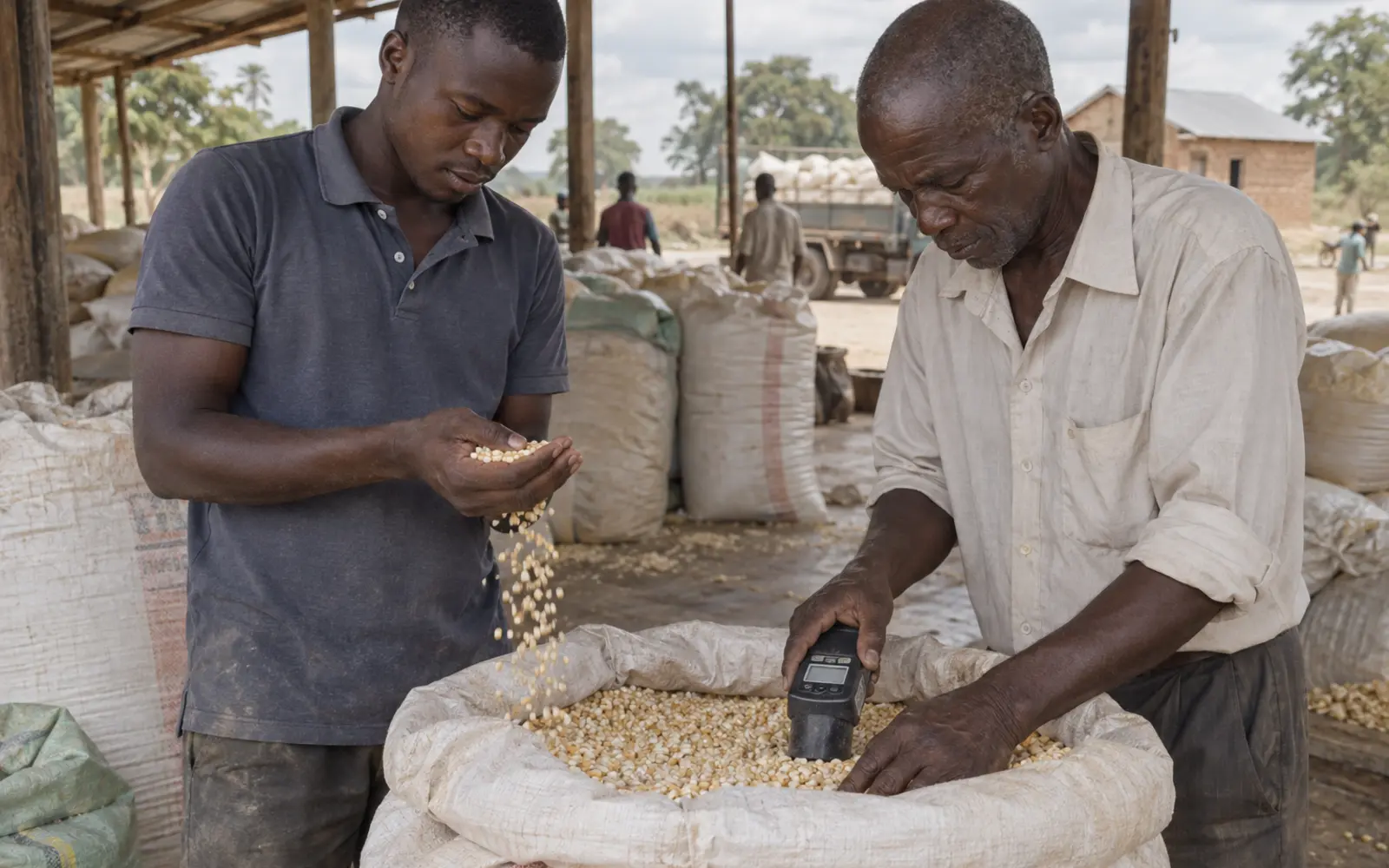
The practical consequence for the farmer is the most actionable thing in this whole guide: the quality work happens before the grain ever reaches the warehouse gate, and it is entirely within your control. Drying to the right moisture, keeping the crop clean, and storing it properly between harvest and delivery determine whether your consignment grades at all. Those operations are covered in grain and legume drying, moisture and hermetic storage and, for maize specifically, in maize post-harvest handling and aflatoxin.
A farmer who cannot meet a grade has no access to the system regardless of what the law says about receipts.
The regulations also require a warehouse bond to be filed with the Authority before a warehouse licence can be issued, and set licensing criteria covering ownership or lease status, the reputation of the keeper and directors, sufficiency of net assets, and competency. That bond is part of what is meant to stand behind your deposited goods.
Other finance routes
Commercial bank lending is not the only channel, and for many Ugandan farms it is not the most likely one. Four other routes are documented, and they differ in what they are designed to fund rather than only in what they cost.
The point of setting them out side by side is that farms routinely approach the wrong one. A request for working capital to buy inputs for one season is a different proposition from a request to buy a processing machine, and a channel built for one will decline the other regardless of how strong the applicant is.
Agricultural Finance in Uganda: What Lenders Actually Require and What Warehouse Receipts Change
A set of comparison cards covering commercial bank lending, microfinance and SACCO lending, the government-supported credit facility route, parish-level revolving funds, and buyer or input-supplier credit, each describing what it is used for and what the applicant must show.
The Agricultural Credit Facility. A facility initiated in 2009, described in a central bank paper as intended to promote commercialisation of agriculture through provision of medium and long term financing. Eligible uses described in that paper include acquisition of agricultural machinery and equipment, post-harvest handling equipment, storage facilities, agricultural inputs and irrigation facilities, and agro-processing. Excluded uses listed include land purchase, tree planting, non-grain trading and refinancing of existing facilities. Access is through participating financial institutions rather than directly, and the paper states that primary security is machinery and equipment.
Two cautions. The document we could read reflects data from some years ago, and the current terms, ceilings and list of participating institutions could not be verified from a current primary source. And the exclusion list is worth reading carefully before assuming your intended use qualifies.
Microfinance and savings and credit cooperatives. Widely used and locally variable. The questions to ask are the same ones as for any lender.
The parish-level revolving fund. The published user handbook for the Parish Development Model’s revolving fund describes a conditional grant provided per gazetted parish, to be used for the sole purpose of lending by the parish cooperative to subsistence households in the parish that have identified viable agriculture-based income generating activities, disbursed from the consolidated fund to the cooperative’s account in a supervised financial institution. Eligibility as described requires membership of a registered subsistence household, membership of an enterprise group that is a member of the parish cooperative, and a running enterprise or a viable business plan, with the loan exclusively for investment in a qualifying enterprise.
Buyer or input supplier credit. Often the most accessible and the least examined. Read what it costs in the price you receive rather than in a stated rate, and read how Ugandan farm-gate prices are formed before agreeing to it.
Insurance. Worth understanding as part of a credit application rather than as a separate product. One of the four constraints the World Bank note identified was lender exposure to systematic risks such as climatic events with inadequate mitigation mechanisms. Insurance is the mechanism that addresses that constraint directly, which is why a farm that carries cover may present differently to a lender than one that does not.
A government-supported agriculture insurance scheme exists, described in a ministry of finance page as providing insurance cover for crops and livestock for both small and large-scale farmers, with government providing premium subsidy funds, regulatory oversight by the insurance regulator and account management by the central bank. This guide gives no subsidy percentage, because the page we could open did not state one. Insurance matters to lenders because it addresses one of the four constraints identified at the top of this guide.
Why this guide gives no figures
Deliberately, and for three reasons.
Rates, fees, ceilings and terms change. An article that states them ages into misinformation. The one substantive central bank document we could open reflects data from several years ago and media reporting suggests the terms have since been revised, which is precisely the problem.
Second, quoting a rate invites comparison shopping on the wrong variable. The cost of agricultural credit is in the total package, the security demanded and the repayment schedule against your cash flow, not in a headline figure.
Third, naming institutions would amount to endorsement, and this guide has no basis for endorsing any lender.
Common mistakes
Approaching a lender before the records exist. The records take a year. Start them now, borrow later.
Assuming customary land is worthless as security without ever investigating a certificate of customary ownership.
Overlooking movable property entirely. Livestock, machinery and standing crops are registrable.
Planning a season around borrowing against a warehouse receipt without first asking whether the institution has ever done it.
Accepting that a store is licensed on the store’s own say-so.
Delivering grain that has not been dried and cleaned and discovering at the gate that it will not grade.
Reading the Act’s charge provision as a lender’s security. It protects the warehouse keeper’s claim.
Assuming an old chapter number means an out-of-date law.
Treating buyer credit as free because no rate is stated.
Budgeting from a published rate found in an article, including this one, which is why there is none here.
When to get professional advice
Talk to a lawyer, an accountant, a district commercial officer or a qualified financial adviser rather than relying on general guidance when:
- You are being asked to pledge land, of any tenure type. The consequences of a default on land security are severe and are not a place for general reading.
- You are asked to sign a personal guarantee.
- You are considering a certificate of customary ownership application, which involves a local committee process.
- You intend to register a security interest over movable property, or you are being asked to.
- You are offered credit against a warehouse receipt, in which case ask the lender directly about creditor priority, because that is the gap the law reform commission identified.
- The terms of an offer are not written down.
This guide is not legal or financial advice and cannot be. It is a description of what the published record establishes.
A practical action plan
This month: start the records if they do not exist. Nothing else in this guide substitutes for them.
This month: separate the farm’s money from the household’s. Whether that means a bank account or a disciplined mobile money line, a lender cannot assess a business whose transactions are mixed with a household’s.
This month: complete the readiness checklist honestly. The blanks are your work plan.
This quarter: establish what land documentation you actually hold, and if it is customary land without a certificate, find out what a certificate application involves in your district.
This quarter: list your movable assets and find out what registering a security interest over them involves.
Before any warehouse plan: ask two questions. Is this warehouse licensed, confirmed with the Authority rather than with the warehouse. And has this lender previously advanced credit against a receipt from it.
Before harvest: fix the quality. Drying, cleaning and storage decide whether you can deposit at all, and they are entirely yours to control.
Before signing anything: get the terms in writing and have someone who is not selling you the loan read them.
Conclusion
Agricultural credit in Uganda is constrained by things largely outside an individual farmer’s control: the share of lending that reaches the sector, the cost of serving rural borrowers, and the weather risk that sits behind every agricultural loan.
Three things are inside your control. Records, which cost a year of discipline and change what a lender can see. Security, which is broader than most farmers assume once customary certificates and movable property are considered. And quality, which decides whether the warehouse route is even open to you.
On warehouse receipts specifically, the honest position is this: the instrument is real and legally substantial, the national law reform commission has found the Act silent on exactly the use everybody describes, and two thirds of its respondents had never heard of a financial institution lending against one. That is not a reason to ignore the system. It is a reason to ask one specific question before you build a season around it.
Author: Falcon Foundation Ltd Editorial Team
The Falcon Foundation Ltd Editorial Team produces evidence-based agricultural guidance for Ugandan farmers, drawing on published research and institutional sources and translating them into practical decision support. Where evidence is unavailable or contested, we say so rather than filling the gap.