
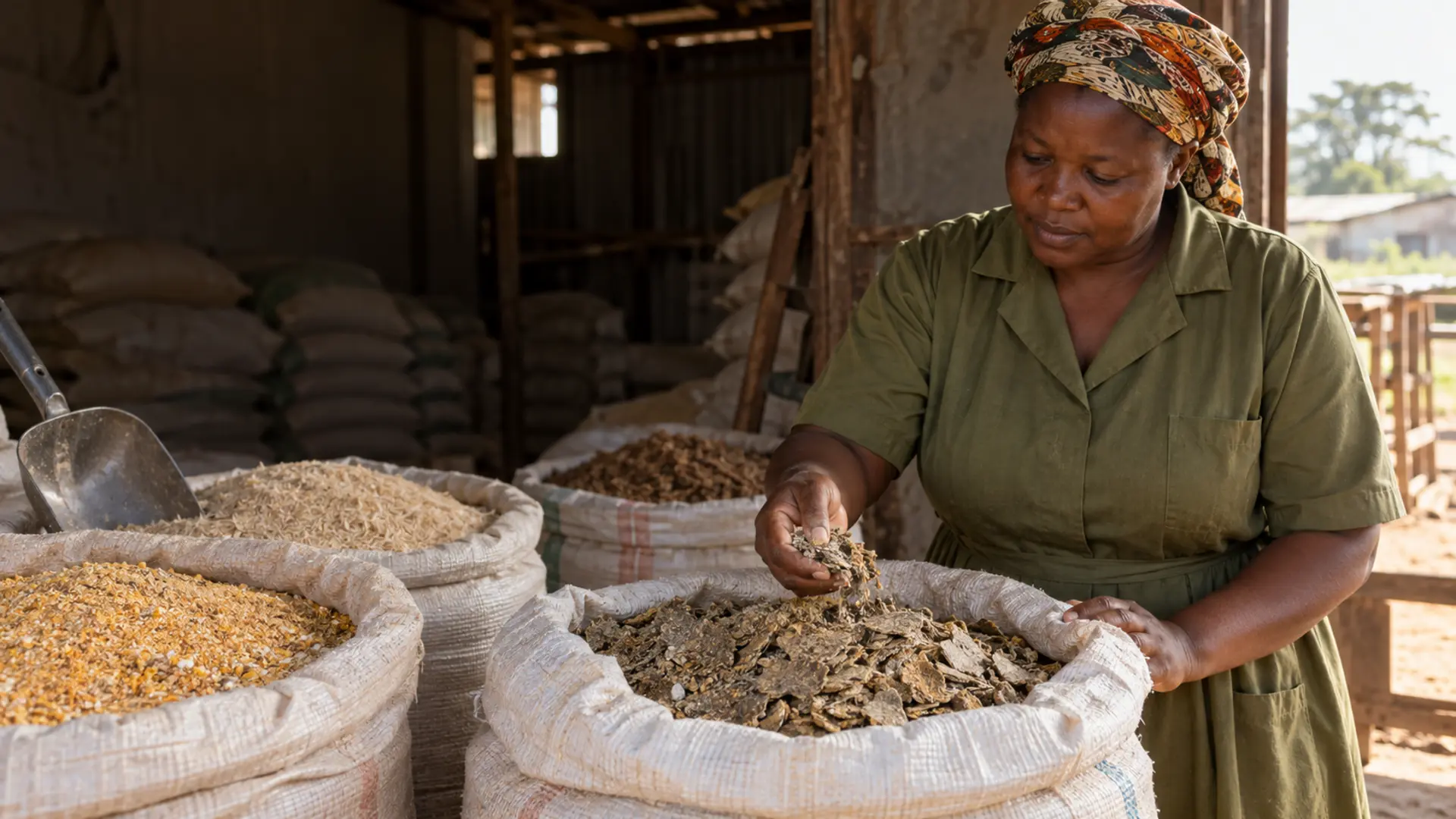
The sack looked fine. It was the right price, the colour was right, and the man selling it had a lorry and a hurry. It was only when the buyer got it home and cut it open properly that he found the middle of the sack was warm, and that a handful of it, rubbed between the palms, contained more coarse husk than the top of the sack had suggested.
Uganda mills maize and rice at scale, presses oilseed, and brews beer. The by-products of all of that are genuinely available, genuinely useful, and genuinely variable. Quality differs enormously between suppliers and, more awkwardly, between sacks from the same supplier. A short set of checks can reveal several common problems before money changes hands, although it cannot replace laboratory testing.
This guide sets out what each by-product is, what goes wrong with it, how to inspect it before money changes hands, which animals it suits, and how long you have before it spoils. It is about buying and handling. It is not about compounded feed, crop residues, or the details of toxicology, each of which is covered elsewhere.
What this guide helps you decide
Whether the sack in front of you is worth buying. Which of your animals it is safe to feed. How much of it to buy at once, given how fast it goes off. And what to do differently the next time you buy from the same supplier.
The short answer
Four checks, done at the point of sale, catch most of what can be caught by eye and hand: squeeze a fistful, smell a handful, sieve or spread a scoop to look for foreign matter, and push your arm into the middle of the sack to feel for heat. None of them detects mycotoxins, which is the limitation you must keep in mind.
One species restriction genuinely matters and it is not about the sack, it is about the animal. Cottonseed cake contains gossypol, and mature ruminants handle it in a way that young animals with an undeveloped rumen cannot.
And two of these by-products are perishable on a clock measured in days, not months. Wet brewers’ spent grain is the extreme case.
The four field checks
Do all four, in this order, before money changes hands. They are quick, require only your senses and a small sample, and together reveal several problems that can be detected without a laboratory.
Brans, Oil Cakes, Brewers' Grain and Molasses: Buying Agro-Industrial By-Products Without Getting Caught
Purchase inspection checklist card showing the four field tests, hand squeeze, smell, sieve for foreign matter and sack temperature, each with a pass or reject outcome
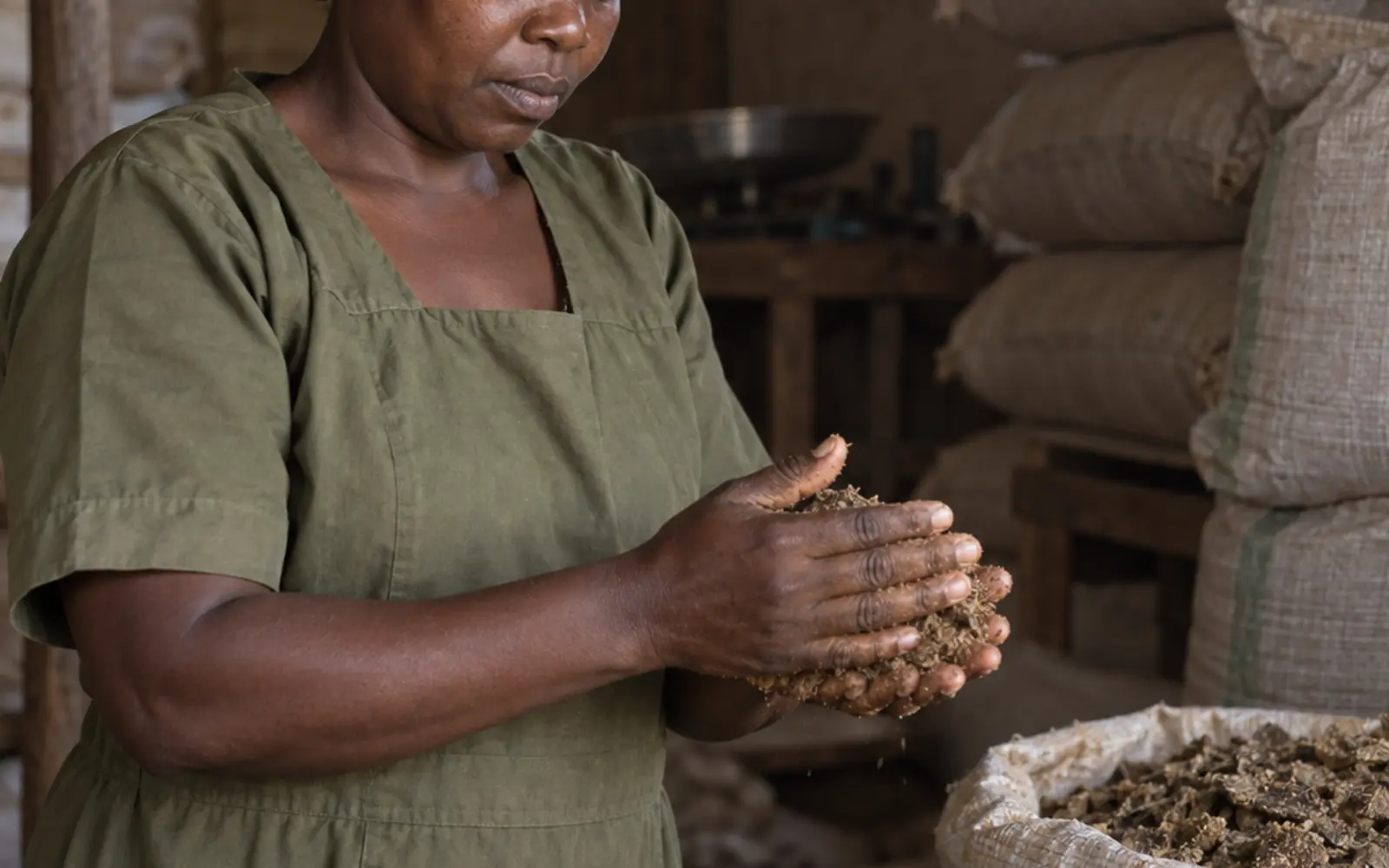
Squeeze. Take a fistful from deep in the sack, not from the top, and close your hand on it. Dry meal falls apart when you open your hand. Material that holds its shape as a moulded lump has moisture in it. This is a comparison test, not a measurement: it tells you this sack is wetter than that sack, and it will not give you a percentage.
Smell. A handful held close should smell of the grain or seed it came from. Musty, sour, sharp or fermented smells mean microbial activity has started. The extension guidance for stored grain is direct about this: a foul or musty odour is an early indicator of a problem, and you should grasp a handful from arm depth as well as from the surface and smell for musty, mouldy odours.
Look, and sieve if you can. Spread a scoop on a clean surface or shake it through a sieve. You are looking for what should not be there: sand, soil, small stones, husk fragments in something that should not contain much husk, seed hulls, string, or anything that looks like it was swept up. The standard covering maize bran as animal feed requires the product to be free from foreign particles, insects, fungal contamination and rodent and insect infestation.
Feel for heat. Push your arm into the sack, or between sacks in a stack. Grain-storage guidance describes exactly this test: thrust your arm into the material and see whether you can detect any heating. Warmth in the middle of a stack means something is respiring in there. Warmth is a reason to walk away, not a reason to negotiate.
A note on what these checks cannot do. They cannot detect aflatoxin. A sack can pass all four and still be contaminated, because the fungus that produces the toxin may have grown and died before you saw the material. This is why the storage history matters as much as the appearance, and why the aflatoxin evidence below is worth taking seriously.
By-product by by-product
Maize bran
The most widely traded by-product in Uganda and the one with the most documented problems.
Feedipedia’s entry gives typical values of around 11.9 per cent crude protein and 44.2 per cent neutral detergent fibre on a dry matter basis, with metabolisable energy around 11 megajoules per kilogramme of dry matter, and notes that maize bran may be highly contaminated with mycotoxins, particularly during the hot rainy season.
The Ugandan evidence is specific and should change how you buy. A peer-reviewed study of aflatoxins in poultry feeds and feed ingredients across Kampala, Wakiso, Jinja, Mbale and Masindi found maize bran carried the highest level of contamination of the ingredients tested, averaging 103.3 parts per billion with a standard error of 22.98, against samples ranging from 7.5 to 393.5 parts per billion from feed plants and 19.0 to 188.5 from farmer sources, and against an acceptable limit of 20 parts per billion. That is a single study in five districts, not a national statistic, but it is Ugandan, it is measured, and it concerns exactly the ingredient most farmers buy most often.
The East African standard for maize bran as livestock feed sets enforceable limits that make a useful buying specification: maximum moisture 12 per cent, minimum crude protein 6 per cent, maximum crude fibre 12 per cent, maximum free fatty acids 20 per cent, and aflatoxin not more than 10 parts per billion. Note that the version of the standard text we were able to read is dated 2001, while the schedule of compulsory Ugandan standards references a 2021 edition, so the numbers may have been revised; treat them as indicative of the kind of specification that applies rather than as the current legal limits.
Buying rule. Buy from a mill you can visit, buy smaller quantities more often in the wet season, and refuse anything warm or musty.
Rice bran
Rice bran has a problem that has nothing to do with the seller’s honesty: it starts spoiling the moment it is made.
Feedipedia explains the mechanism. The oil in full-fat rice bran becomes rancid during storage because of a lipolytic enzyme that becomes active when the bran is separated from the rice. The rate is startling: free fatty acid content of bran from parboiled rice is below 3 per cent immediately after milling but increases at the rate of about 1 per cent per hour. Stabilisation is possible, by heating with live steam at 100 degrees Celsius for four or five minutes, by dry heating spread on trays at 200 degrees for ten minutes, or by reducing moisture below 4 per cent, but none of that is likely to have been done to the sack in front of you.
Rice bran is also the by-product with the clearest adulteration test. Feedipedia states that rice bran is often adulterated with rice hulls, and that genuine bran should have a crude fibre content of 10 to 15 per cent. You cannot measure crude fibre at the roadside, but you can look and feel: hull fragments are sharp, light, and visibly different from the fine soft bran around them. Spread a handful thin on a dark surface and you will see them.
Buying rule. Buy rice bran as fresh as you can get it and use it quickly. Ask when it was milled and treat a vague answer as an answer.
Cottonseed cake
The by-product with a genuine species restriction, and the one where getting it wrong kills animals.
Feedipedia reports protein ranging from roughly 30 to 50 per cent of dry matter depending on dehulling, and free gossypol content varying enormously with the extraction method, from around 200 milligrammes per kilogramme in screw-pressed material up to 5,000 in solvent-extracted meal. It gives storage guidance of 5 to 11 per cent moisture and 5 to 25 degrees Celsius, and states that cottonseed meal can be safely included up to 15 per cent in cattle diets.
The restriction itself is explained in veterinary reference material. Adult ruminants detoxify gossypol by forming stable complexes with soluble proteins in the rumen, preventing absorption. Animals whose rumen is not yet functioning cannot do this. Extension guidance from Oklahoma State University puts it plainly: ruminants such as cattle and sheep can tolerate higher levels of free gossypol because gossypol binds to proteins in the rumen, while young calves and lambs are quite susceptible, because even though they are ruminants their rumen is not considered fully functional and is unable to bind as much free gossypol as an adult. North Carolina State extension guidance states that it is not recommended that calves be fed cottonseed before they have a well developed rumen, and that problems have been seen primarily in early weaned calves.
The same principle applies to goat kids, which are also pre-ruminant when young.
Signs of poisoning are documented. In young lambs, goats and calves, cardiomyopathy and sudden death, or in a more chronic course, depression, poor appetite and pronounced difficulty breathing. In mature dairy cattle, weakness, depression, loss of appetite, oedema of the brisket, difficulty breathing, gastroenteritis, blood in the urine and reproductive problems. Oklahoma State reports toxicity in adult cattle at levels around 800 parts per million fed over a long period, and notes that toxicity is cumulative rather than a single-dose event.
For poultry, veterinary reference material states that birds are affected by dietary gossypol concentrations above 200 parts per million, with reported green discolouration of egg yolks and decreased hatchability.
Brans, Oil Cakes, Brewers' Grain and Molasses: Buying Agro-Industrial By-Products Without Getting Caught
Species suitability table for six by-product feeds showing which classes of stock each suits and where a restriction applies
Buying rule. If you keep young calves or kids, do not let cottonseed cake into a store where it can be scooped into their feed by mistake. Physical separation is more reliable than a rule everybody has to remember. Note also that the gossypol content depends on how the seed was processed, which you usually cannot determine from the sack, so treat unknown material as the more concentrated kind.
Sunflower cake
Feedipedia reports crude protein from roughly 29 to 40 per cent of dry matter depending on dehulling and processing, and notes it is more fibrous and lower in lysine than cottonseed or soybean meal, making it a more suitable ingredient for laying hens than for birds with higher protein and energy requirements such as broilers and turkeys. Its main storage risk is mycotoxin development from poor drying before storage.
Sunflower cake carries no gossypol restriction, which makes it a simpler purchase where it is available.
Brewers’ spent grain
Genuinely valuable, and the most perishable thing you will buy.
Feedipedia reports around 25.8 per cent crude protein on a dry basis, and gives storage guidance of two to five days in warm temperature and five to seven days in cold weather for the wet material, noting it is susceptible to bacterial and fungal contamination.
A controlled study measured the deterioration directly. At 20 degrees Celsius, slight mould growth was apparent by the fourth day of storage and extensive mould growth by late on the sixth day. The authors concluded it would be safe to store and feed wet brewers’ grain to dairy cattle provided it is stored for less than six days at 15 degrees and less than two days at 20 degrees. Crude protein at 25 degrees fell from 265 grammes per kilogramme when fresh to 181 grammes per kilogramme after six days. Those day counts come from a temperature-controlled trial and should not be read as a guarantee under the conditions in an open Ugandan shed, which will often be warmer than 20 degrees.
Three preservation routes exist and you must choose one before you collect: feed it immediately, dry it to below 10 per cent moisture for long-term storage, or ensile it, which Feedipedia reports is ready within about three weeks and usable over six months.
Brans, Oil Cakes, Brewers' Grain and Molasses: Buying Agro-Industrial By-Products Without Getting Caught
Timeline showing how quickly wet brewers' spent grain deteriorates at different storage temperatures and the three preservation options
Buying rule. Do not collect more wet spent grain than your animals will eat inside the window, unless the ensiling pit is already dug and lined.
Molasses
Feedipedia reports roughly 70 to 75 per cent dry matter dominated by sugars, high in calcium and low in phosphorus, and recommends a limit of 2 to 3 kilogrammes per day for dairy cows.
Two hazards. The first is water. Australian state agriculture guidance states that molasses has a storage life of many years provided it is not contaminated with water; Feedipedia warns that caution must be taken when the rains begin, because diluted molasses will rapidly ferment into alcohol and may fatally poison cattle. Keep the drum sealed and keep rain out of it.
The second is quantity. Feedipedia states that molasses fed in large amounts is toxic to livestock, with reduced body temperatures, weakness, rapid breathing and even blindness, and that rumen parakeratosis may also occur. The Australian guidance describes the mechanism behind the neurological signs: the flow rate through the rumen becomes so slow that vitamin B is destroyed, and animals stagger around blinded. It identifies salt at about 1 per cent and adequate roughage as the practical preventive measures.
Storage on your own farm
The published moisture benchmarks for stored grain-type material give you a target: the Food and Agriculture Organization’s post-harvest loss manual gives safe moisture content as around 13 per cent for maize, wheat, millet and rice, 14 per cent for paddy and 15 per cent for beans and cowpeas, and notes that fungi start growing above 65 to 70 per cent relative humidity.
The speed matters as much as the threshold. The same manual states that storage fungi require a relative humidity of at least 65 per cent, that the minimum moisture for Aspergillus flavus is around 18 per cent, and that mycotoxins can be found in stored produce as soon as 24 hours after infestation with fungus. Separate guidance ties aflatoxin contamination directly to crops that could not be dried within 48 hours.
Practically: store off the floor on pallets or poles, keep sacks away from walls so air moves, keep the roof sound, keep the store shut against rain and open to air, and turn the stack so nothing sits at the bottom for months. Inspect by smell and by arm every time you take a sack out, not only when you buy.
What Ugandan reporting says, and how to read it
There is Ugandan material on feed adulteration and it must be handled carefully.
A 2025 peer-reviewed survey of chicken farmers and feed millers across Lira, Gulu, Iganga, Bugiri, Mbale, Mbarara, Bushenyi, Kampala, Wakiso and Mukono found that both producers and millers were aware of feed and ingredient adulteration, and reported adulterants including sand or soil, stones and maize cobs, with maize bran named among the most commonly adulterated ingredients by about a third of farmers and millers. This is what respondents believed and reported, not laboratory-confirmed prevalence, and it should be read that way.
Ugandan press reporting has also carried officials’ estimates of very high contamination rates in marketed feeds. We were unable to confirm the date of the article in question and the estimate is an official’s statement rather than a measured survey, so this guide does not repeat the figure. What the reporting does establish is that adulteration is a recognised concern named by the national standards body and the agriculture ministry, which is reason enough to do the four checks.
On the legal side, Uganda enacted an Animal Feeds Act in 2023. Secondary legal analysis of it states that contaminants are permitted only within limits recommended by the national standards body, that prohibited materials include sand, stones, wood including sawdust and wood shavings, and domestic and industrial waste water, and that producers must hold a certificate of registration of the premises. We read that analysis rather than the Act itself, so treat it as an indication of the framework rather than a statement of your legal obligations, and check the primary text before relying on it.
Cost categories
No prices. The cost lines to hold in mind are: the material itself; transport, which for wet by-products is a large share of the delivered cost; the storage you need before you can accept a bulk delivery; the preservation cost if you ensile or dry wet material; the losses you will take from spoilage, which are real and should be budgeted rather than discovered; and the value of the animals you are risking, which is the largest number on this list and the one that justifies walking away from a cheap sack.
Common mistakes
Sampling from the top of the sack. Buying on colour. Buying a lorry-load of wet spent grain with nowhere to put it. Storing cottonseed cake where it can reach young stock. Assuming that because a supplier was good last time the sack in front of you is good. Leaving the molasses drum open in the rains. Treating the smell test as optional because the seller is in a hurry. And assuming that a sack which looks and smells clean cannot carry aflatoxin.
Warning signs and escalation points
Reject on the spot: any warmth inside the sack or stack; a musty, sour or fermented smell; visible mould, caking or crusting; obvious foreign matter; sacks that have clearly been rained on.
Escalate to a veterinarian: any group of animals showing weakness, loss of appetite, difficulty breathing, swelling under the chest, staggering, or blood-coloured urine after a change of feed. Stop feeding the suspect material first, keep a sample of it, and note when the change was made.
Where it works and where it does not
By-product feeding works where you can see the source, buy small and often, store dry and off the ground, and match the material to the class of animal. It works especially well close to a mill, an oil press or a brewery, where transport is short and the material is fresh.
It does not work as a way of buying the cheapest protein in the market from whoever has a lorry. The saving on a cheap sack is small; the cost of a spoiled batch or a poisoned calf is not.
A low-risk first step
The next time you buy any by-product, do the four checks before you pay, and write down what you found: date, supplier, material, and one line each on squeeze, smell, sieve and heat.
After five purchases you will have something no advice article can give you, which is a record of which suppliers in your own area sell material that passes and which do not. That record is the actual protection.
What to do next
Read our guide to maize post-harvest handling and aflatoxin for the storage discipline behind the mycotoxin risk described here, and year-round fodder planning for goats and cattle to see where by-products fit in a whole ration. Fertiliser types and quality verification covers the same verification habit applied to a different input. Our forthcoming guides to buying compounded feed and reading a feed label - scheduled in this programme and feed toxins and anti-nutritional factors - scheduled in this programme, together with our guide to crop residues as feed, complete this cluster.
About the author
The Falcon Foundation Ltd Editorial Team produces evidence-based agricultural guidance for Ugandan farmers, drawing on published research and institutional sources and translating them into practical decision support. Where evidence is unavailable or contested, we say so rather than filling the gap.
