
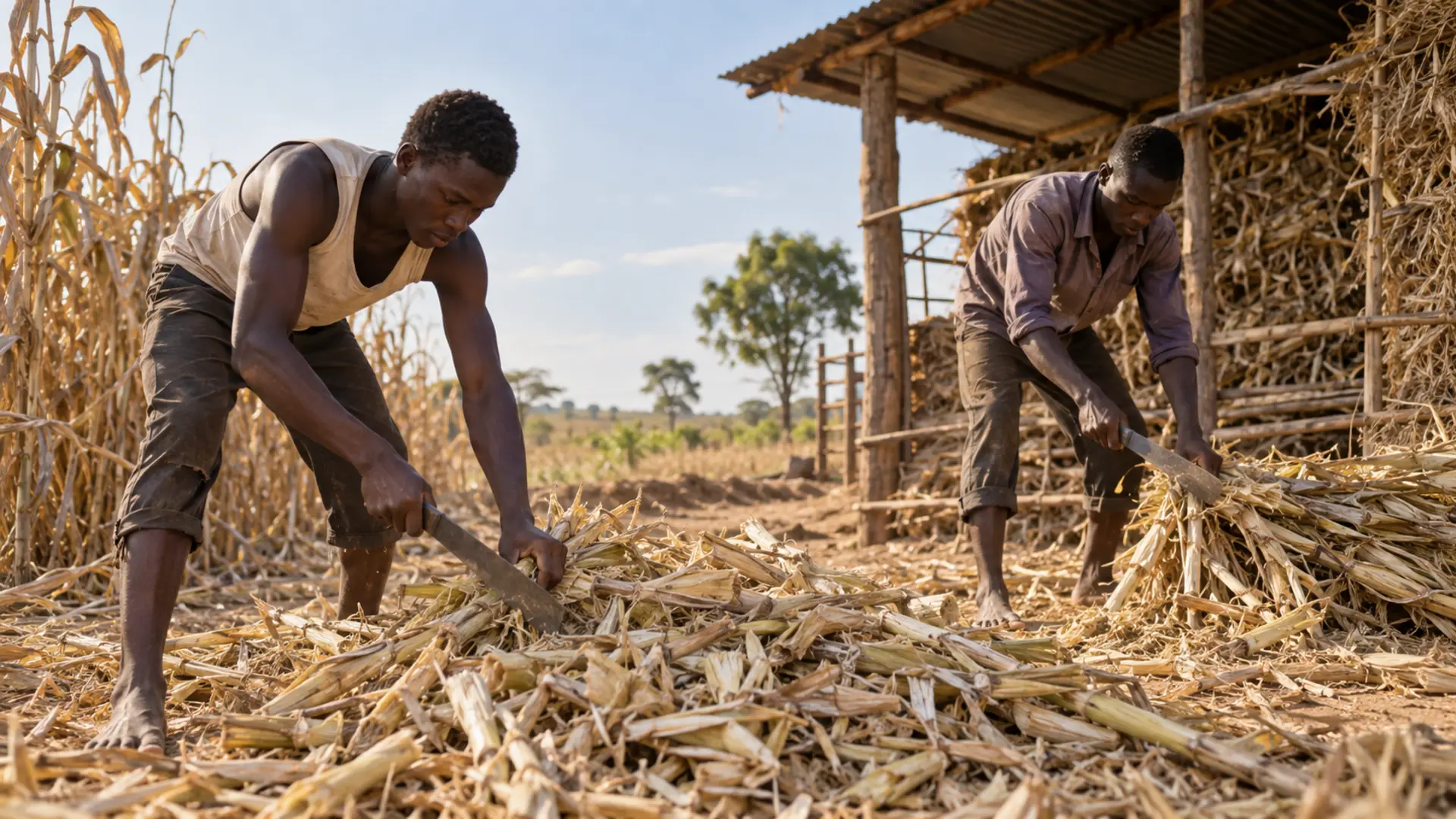
Every dry season the same thing happens. The maize is harvested, the stover is dragged to the boma, and it is thrown on the ground in a heap. The animals pick over it for a couple of hours, eat the leaves and the softest bits, and walk away. By evening what is left is a mat of trodden stems.
You did not run out of feed. You had the feed. You lost most of it between the field and the animal’s mouth.
This guide is about the handling that sits between those two points, and it applies to cattle, goats and sheep.
What this guide helps you decide
By the end you should know when to collect residues rather than leaving them standing, how to store them so they are still worth eating in three months, whether to chop and how finely, how to measure whether your chopping is actually working, and what to feed alongside the residue so the animal can use it.
It does not cover chemical or urea treatment of residues, banana or root crop by-products, silage or hay making, all of which are separate subjects with separate guides.
The short answer
Collect stover as soon after grain harvest as you can manage, because its feeding value starts falling the day the grain comes off. Store it off the ground, under cover, in a stack you can draw from. Chop it before feeding, to stop the animal sorting leaf from stem. Feed it in a trough, never on the ground. And feed something with protein alongside it, because on its own it does not carry enough nitrogen for the rumen to work properly.
Chopping is worth doing. It is also worth understanding exactly what chopping does and does not do, because the research is more mixed than the advice usually is.
Why the value falls while the stover is still standing
Feeding value is highest at grain harvest and declines from there. A Canadian trial recorded in vitro dry matter digestibility of maize stover starting at 52 per cent and falling by 1.5 percentage points every week. A United States study recorded losses of 15 to 20 percentage points of digestibility in the fibrous parts of maize stover over three months.
The mechanism is worth knowing, because it is not what most people assume. The decline does not appear to come primarily from the cell walls becoming more woody. It comes from the loss of cell solubles, the soluble contents inside the plant, which leaves the fibre making up a larger share of what remains. Rain washes them out. Sun and weathering break them down. Animals grazing the field take the best parts first.
So the material sitting in your field is getting worse every week, and the loss is largest early. No additive recovers it. Collection timing changes the feeding value of a residue more than anything you can do to it afterwards.
Ugandan practice is already partly there. A study in the Lake Victoria Crescent found 92.4 per cent of surveyed dairy households stored maize stover for later use, though 52.7 per cent used simple heaps at the homestead. Maize stover ranked as the top crop residue in that study, and the region’s two dry seasons, roughly December to February and June to August, are what makes the storage necessary.
What the residues on your farm are actually worth
These are compiled ranges from international feed databases and FAO compilations, not measurements from your farm. Variety, maturity at harvest and weathering all move them, and the ranges are wide for that reason.
- Cereal straws generally: around 4 per cent crude protein in dry matter, with organic matter digestibility in the range 42 to 54 per cent. FAO’s compilation gives a crude protein range of 3.1 to 5.5 per cent and in situ forty-eight hour digestibility of 47.6 per cent for wheat straw and 42.9 per cent for rice straw.
- Maize stover: crude protein often above 4 per cent and as high as 9 per cent, with very poor material below 4 per cent. FAO’s in situ figure is 50.6 per cent.
- Common bean straw and haulms: about 7.1 per cent crude protein, with a reported range of 4.8 to 10.7 per cent, neutral detergent fibre around 69.7 per cent and organic matter digestibility about 54.7 per cent.
- Groundnut haulms: about 11.1 per cent crude protein, with a reported range of 6.2 to 17.2 per cent, and organic matter digestibility about 59 per cent. FAO’s compilation gives peanut hay at 12.0 per cent crude protein and a strikingly higher in situ forty-eight hour digestibility of 77.2 per cent.
That last discrepancy is instructive rather than contradictory. Organic matter digestibility and in situ forty-eight hour digestibility are different measurements on different trial sets. Never average them, and never quote a single number without the method attached.
The pattern that matters for your ration is simple: legume residues carry roughly two and a half times the protein of cereal residues, about 10 per cent against about 4 per cent. Your groundnut and bean haulms are the valuable material. Treat them accordingly.
Storage that keeps the value you collected
FAO’s guidance and traditional practice across the tropics converge on the same principles.
Off the ground. Ground contact means moisture from below, termites and rot at the base of the stack.
Under cover. A stack, a thatched shelter or a tarpaulin. FAO’s manual describes exactly this practice from Southeast Asia: residues stored at harvest as a stack near the house or in a thatched hut, drawn on through the dry season.
Dry before you stack. Material stacked damp will heat and mould. Mould reduces digestibility, palatability and intake, and moulds that grow in warm humid conditions can produce toxins. That is general stored-feed guidance from extension literature rather than a Ugandan finding about residues specifically, and we could not find any Ugandan study of mycotoxins in stored stover or haulms. Treat the risk as real and unquantified.
Build it so you can draw from one face. A heap you have to climb over is a heap that gets trodden.
FAO’s compilation recommends ensiling as the best preservation method for dry residues at small scale, after moisture is restored. That is a different technique and a different guide.
Chopping: what the evidence actually shows
This is where most advice oversimplifies, so here is the whole picture.
What chopping reliably does is stop selection. In India, chopping straws and stovers reduced fodder wastage by 30 per cent because animals could not select between the leafy parts and the dry stems. That is the main mechanism and the main benefit.
Chopping and grinding can raise intake. Grinding wheat straw, even coarsely, has been reported to increase intake by 20 to 30 per cent because material passes through the rumen faster. Grinding maize stalks increased intake by 10 to 15 per cent in ewes, though the grinding cost made it uneconomic in that trial. FAO’s compilation reports that fine grinding through an 8 millimetre screen followed by pelleting increased lamb feed intake by half, from 728 to 1,098 grams of dry matter, and daily gain by 129 per cent.
But it does not make the material more digestible. FAO states plainly that grinding does not improve the metabolisable energy value of the roughage to any significant extent, and that it is uneconomic and impractical in smallholder contexts. The same compilation notes that dry matter digestibility of pelleted straws is depressed relative to long or chopped forms, primarily because of the faster passage rate. More goes in. Less of each mouthful is extracted.
And the effect differs by species. An Ethiopian trial fed sorghum stover to sheep and cattle at different offer levels. Chopping was clearly beneficial for rams and not for steers, where at high offer levels chopping reduced intake. In both species, the refused stover contained less leaf and sheath than the stover offered, confirming that both were selecting for leaf.
There is even an argument for not chopping. FAO’s guidance on feeding straw to small ruminants reports that allowing goats to reject 50 per cent of the straw offered, instead of the conventional 10 to 20 per cent refusal rate, increased straw dry matter intake by 30 to 47 per cent, because the animals selected the higher-value leaf and sheath. It notes that selective feeding is easier with long straw than with chopped. That strategy trades material for intake, and it only makes sense if you have plenty of residue and something else to do with the refusals.
What this means for you. If residue is scarce and you need every kilogramme eaten, chop. If residue is abundant and the animals are the constraint, consider offering generously and accepting high refusals, then using the refusals for bedding or compost. Do not chop finely: no source we found recommends a specific hand-chop length, and the evidence for fine grinding is about pelleted rations, not hand-cut stover.
Ugandan farmers already chop. In the Lake Victoria Crescent study, 71.2 per cent chopped maize stover and 88.3 per cent chopped sweet potato vines.
Measuring whether it is working
Do not guess. Weigh back.
For one week, weigh what you put in the trough each day and weigh what is left the next morning before you clear it. The difference is intake. The proportion left is your refusal rate.
Then change one thing, either the chop length or the way you present it, and repeat the measurement for another week. If refusals fall and intake rises, the change worked. If refusals stay the same, you have your answer without spending anything more.
Also look at what is in the refusals. If they are almost all stem and almost no leaf, the animals are still sorting and your chop is too coarse. If the refusals look like a fair sample of what you offered, sorting is not your problem and something else is limiting intake.
One thing that will undo all of this: feeding on the ground. The Lake Victoria Crescent study recorded residues being thrown into the cattle boma, causing trampling and wastage. A trough, even a rough one, is the cheapest improvement on this list.
The protein pairing, and why it is not optional
A cereal residue at around 4 per cent crude protein does not supply enough nitrogen for the rumen microbes to do their work. Intake falls, digestion slows, and the animal eats less of an already poor feed. Adding protein lifts both.
The sourced guidance is:
- Feedipedia’s straw guidance suggests supplementation with a protein concentrate at the level of 100 grams of soybean meal or 150 grams of rapeseed meal per kilogramme of straw.
- Groundnut haulms are described as able to supply supplementary nitrogen to ruminants on low-nitrogen cereal residue diets, particularly in the dry season, at cited levels of 200 to 450 grams per day.
The Ugandan evidence is direct and worth quoting properly. A trial in northern Uganda fed dairy cows a sorghum stover based dry season diet and supplemented it with Tithonia diversifolia leaf hay in different formulations. Average milk yield rose significantly from 6.49 kilogrammes per cow per day on the unsupplemented control to between 7.25 and 7.52 kilogrammes on the supplemented diets. Total intake did not differ significantly between the supplement types. That is a Ugandan trial, on Ugandan animals, in a Ugandan dry season, and it is the strongest single piece of evidence in this article.
You do not need a bought concentrate to do this. Your own legume haulms, a browse shrub, or a fodder legume grown for the purpose all serve. The published guide to year-round fodder planning for goats and cattle covers growing the protein side deliberately rather than hoping for it.
What it costs
No prices. The cost categories are:
- Labour to collect residues promptly at harvest, which competes with other harvest work and is the real constraint on most farms
- Transport from field to homestead
- A raised platform or poles for the stack base, and a cover
- A chaff cutter, hand or motorised, or the labour to chop by panga
- Blade sharpening and maintenance
- A trough, which can be built from offcuts
- A protein source, whether grown, gathered or bought
- Storage space that could otherwise hold something else
Working the chaff cutter safely
A chaff cutter is the most dangerous machine on a smallholding. It has an exposed blade, a set of feed rollers that pull material in, and a heavy flywheel that keeps turning after you stop cranking. The following are ordinary operating precautions rather than findings from a study, and we give them because the hazard is obvious and the consequences are severe.
- Never feed material with your fingers. Use a push stick, always, and keep it with the machine.
- Keep the blade guard and any gear cover fitted. A machine that has lost its guard should be repaired before it is used again.
- Never leave the machine unattended with the flywheel free. Children are drawn to a flywheel that spins.
- Do not clear a blockage while the flywheel is still turning. Wait until it has stopped completely.
- Feed steadily. Rushing a bundle in is how hands get close to the rollers.
- Keep the working area clear and keep bystanders, especially children, out of it.
Common mistakes
Leaving the stover in the field until you need it. By then the value has gone, and the loss is largest in the first weeks.
Feeding on the ground. Documented in Ugandan surveys as a direct cause of trampling and wastage, and completely avoidable.
Chopping without measuring. If you never weigh the refusals you cannot tell whether the effort is paying.
Feeding residue alone. Without protein alongside, the animal eats less of the residue, not more.
Stacking damp material. Heating and mould follow, and both cost you intake.
Treating all residues as equal. Groundnut and bean haulms are roughly two and a half times the protein of maize stover. Store and ration them separately.
Chopping too fine. No evidence supports it for hand-fed stover, and it costs labour.
Warning signs and escalation points
- Visible mould, a musty smell, or dust that makes you cough when the stack is opened. Do not feed it.
- Animals eating well but losing condition, which points to a ration low in protein rather than low in bulk.
- A sudden drop in intake after a change of batch, which usually means the new batch is spoiled or much stemmier.
- Coughing or nasal discharge in animals fed dusty residue.
- Any group of animals becoming unwell shortly after a feed change, which needs a veterinarian, not a feed adjustment.
One specific risk deserves naming. Extension guidance from the United States documents nitrate accumulating in drought-stressed cereals including maize, sorghum, sorghum-sudan hybrids, oats, barley, wheat and pearl millet, concentrated in the lower stalks rather than the leaves, and spiking for several days after the first rain that breaks a drought. That guidance recommends testing before feeding. We could not find any Ugandan or East African extension source addressing this, and we could not verify that a nitrate test is available to Ugandan smallholders. Treat drought-stressed cereal stover, especially the lower stems, with caution, introduce it gradually rather than as a sudden full ration, and raise it with your veterinarian if you have no alternative feed.
Where this works, and where it does not
It works wherever you are keeping ruminants and growing cereals or grain legumes, which is most mixed farms in Uganda. The residues are already on your land and already paid for.
It does not work as a complete ration. Residues are a bulk feed and a dry season bridge, not a production diet. It does not work for an animal in late pregnancy or peak lactation without substantial supplementation. And it does not work where the residue has already been sold, burned or grazed off before you thought about it, which is why the collection decision has to be made at harvest rather than at the start of the dry season.
There is one longer-term option worth knowing about. Research by CIMMYT and ILRI on dual-purpose maize has found that breeding for improved stover feed quality had no impact on grain yield, which matters for smallholders who cannot spare land for a dedicated fodder crop. Whether such varieties are available in Uganda is a question for NARO and your seed supplier, and not one we could answer.
A low-risk first step
Build a trough and do one week of weigh-backs.
Nothing else changes. Same feed, same animals, same routine. Weigh what goes in, weigh what is left, write both down. Look at what is in the refusals and note whether it is mostly stem.
At the end of the week you will know your actual refusal rate, which is the number every other decision in this article depends on, and you will know whether your animals are sorting. Neither costs you anything but a scale and seven pieces of paper.
What to do next
- Decide now, before the next harvest, who collects the stover and when. Put it in the harvest labour plan rather than leaving it to chance.
- Build or repair a raised, covered stack base before the residues arrive.
- Build a trough if you are feeding on the ground.
- Run one week of weigh-backs to establish your baseline refusal rate.
- Store legume haulms separately from cereal stover and ration them deliberately as the protein component.
- Plan a protein source for the dry season, whether a browse shrub, a fodder legume or a purchased concentrate.
- Check and repair the guards and push stick on your chaff cutter before the season starts.
Related reading: taking a local feed resource inventory helps you see what else is available on and around your farm, and diagnosing a high feed cost puts residue use in the context of the whole feed bill. The published guide to integrated crop and livestock farming covers the wider relationship between the cropping and the animals.
About the author
This guide was researched and written by the Falcon Foundation Ltd Editorial Team. Falcon Foundation Ltd is a privately owned Ugandan agricultural company producing greenhouse crops, livestock and honey. Our Knowledge Hub is written for Ugandan farmers making practical decisions with incomplete information, and we report ranges with their measurement method attached rather than presenting a single convenient figure.
