
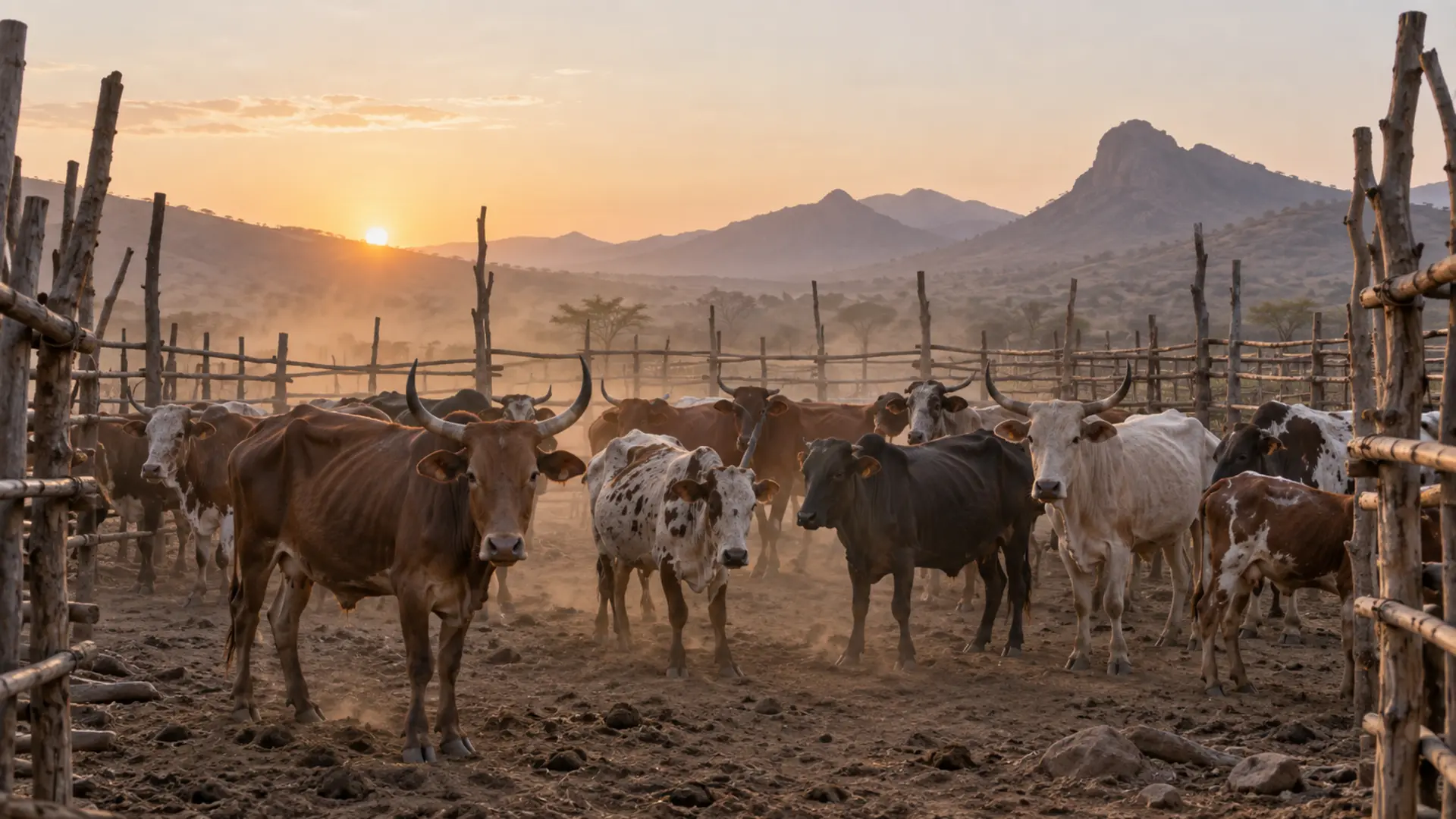
The money in fattening cattle is made on the day you buy them.
Everything afterwards is feed and time, both of which are broadly predictable. What is not predictable is whether the animal in front of you is four years old or seven, whether it is thin because it has been on poor pasture or thin because something is wrong with it, and whether its frame will carry the weight you intend to put on it.
This guide gives you a repeatable way to make those judgements. It covers ageing by teeth, the two body condition scales and why confusing them causes real problems, what compensatory growth actually delivers, the measured Ugandan growth figures, and the legal requirement that applies when you move an animal between districts.
It does not cover ration formulation, which is a separate subject, nor does it contain any price, cost or profit figure. The reason is simple: nobody can forecast Ugandan cattle prices, and an article that pretended otherwise would be selling you something.
Ageing by dentition
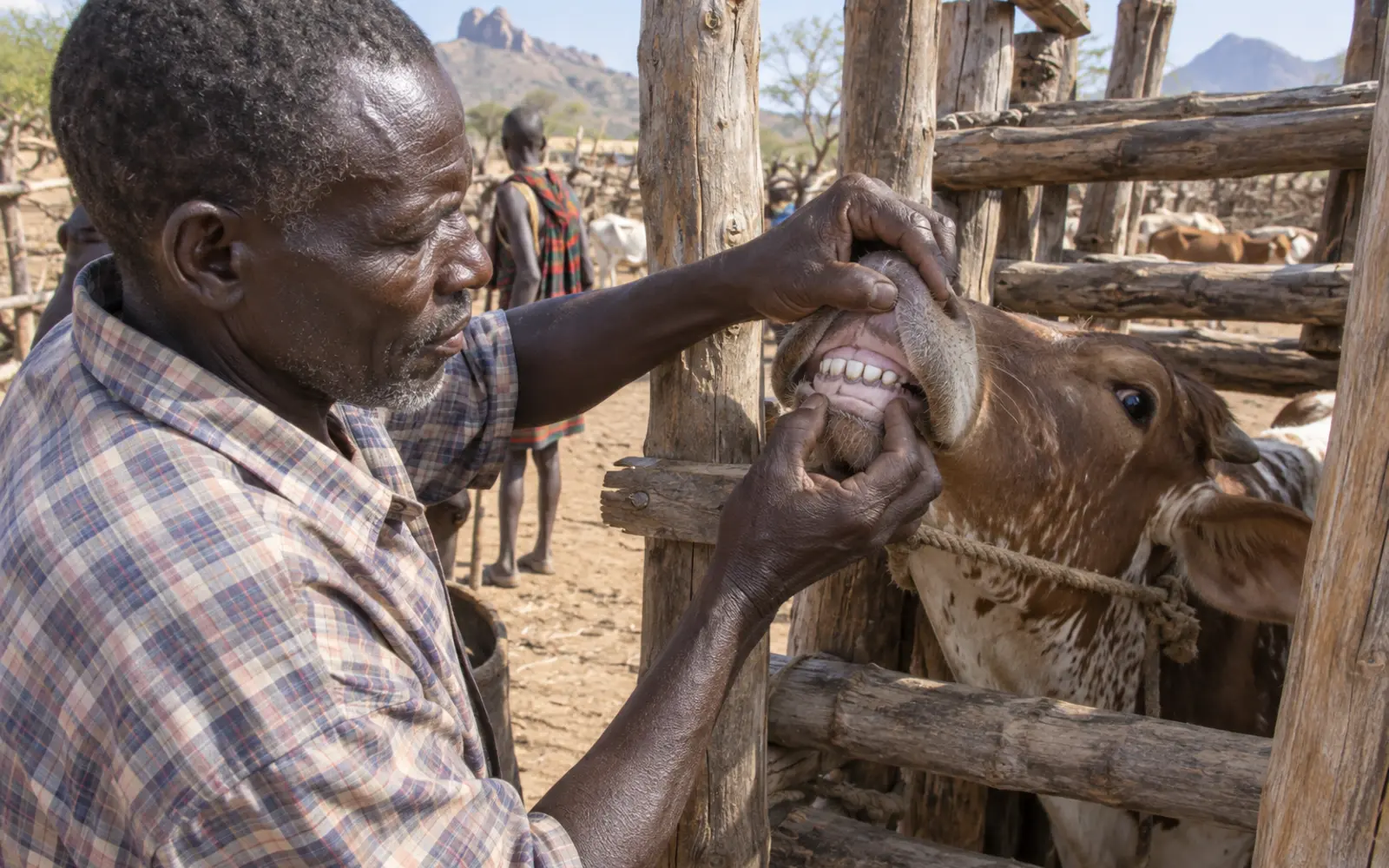
Teeth are the only part of a bovine that gives you a number rather than an impression.
Buying Cattle to Fatten in Uganda: Selection, Condition Scoring and the Finishing Decision
A schematic front view of a bovine lower incisor row with pairs numbered outward from the centre, alongside a table of the documented eruption ages for the first three pairs.
A standard veterinary reference is explicit about why: “Eruption times of incisors are the most reliable feature for age determination in cattle.”
The documented eruption ages for the first three pairs of permanent incisors are: first pair at two years, second pair at two and a half years, third pair at three and a half years.
Cattle have no upper front teeth. They have eight lower incisors, arranged as four pairs about the centre line, and they are replaced from the centre outward. A calf has eight small temporary teeth. As the animal matures, the central pair is replaced by two visibly larger, broader permanent teeth, then the next pair out, and so on.
So counting permanent pairs from the centre outward gives you an age bracket directly. Two large central teeth and six small ones is an animal around two years old. Four large and four small is around two and a half. Six large and two small is around three and a half.
Three cautions, and they matter more in Uganda than in the country the reference was written for.
Do not age by wear. The same source states that “eruption dates are more reliable for estimation of age than clinical signs of wear… because rate of wear is largely influenced by nutrition.” On animals that have grazed short, gritty, dry-season pasture, wear runs ahead of age. A trader who ages cattle by how worn the teeth look will consistently overestimate.
Breed changes the timing. The reference describes variation as breed-related. Indigenous Ugandan types are not the breeds these figures were established on, and the ages should be treated as indicative brackets rather than precise.
The fourth pair. We searched for a documented eruption age for the corner incisors and did not find one in a source we could open. This guide therefore gives no figure for it. An animal with a full mouth of eight permanent incisors is older than three and a half years, and how much older is a question this article cannot answer for you.
What does this give you practically? A method for the specific commercial question in fattening, which is whether an animal still has growth ahead of it. A young animal with two or four permanent pairs has frame to fill. A full-mouthed animal is being bought for condition alone.
Condition scoring, and the scale confusion
Body condition scoring is a way of turning “that one looks thin” into a number that two people can agree on and that you can write down and compare next month.
There are two scales in common use, they are not interchangeable, and a great deal of confusion comes from people quoting a number without saying which one it came from.
Buying Cattle to Fatten in Uganda: Selection, Condition Scoring and the Finishing Decision
A two-column panel comparing the one to nine and one to five body condition scales, their landmarks and their documented end points, with a warning that they are not interchangeable.
The one to nine scale
United States beef extension guidance states that “Body condition scores in beef cattle range from 1 (extremely emaciated) to 9 (very obese).”
The landmarks it assesses are “fat cover over the tailhead, ribs, and shoulder, and in the brisket,” and the skeletal points of “ribs, backbone, spinous processes, transverse processes, hooks (hips), and pins.”
The two end points are described precisely. A score of 1 is one where “No palpable fat is detectable over the spinous processes, transverse processes, ribs, or hooks.” A score of 9 describes an animal that is “blocky, with extremely wasty and patchy fat cover. The tailhead and hooks are buried in fatty tissue.”
Note the word palpable. This is a scale you apply with a hand on the animal, not by looking at it from a distance. That is the whole point of it.
The one to five scale
A United Kingdom institutional source documents a scale running from 0 to 5 in quarter-point increments, assessing the sacral ligament, the tailhead ligament, the pins, the thurl, the short ribs and the hooks.
An honest limitation. The source we were able to open frames that scale around dairy lactation, describing it as “a practical means of assessing the impact of negative energy balance in early lactation.” We were unable to open a beef-specific document for the one to five scale. So this guide confirms the scale exists and describes its landmarks, and does not independently confirm its beef application from a source we read.
What this means on a Ugandan farm
Three rules.
Pick one scale and use only that one. A herd scored on two scales at different times has no usable record.
Write the scale name next to every score. A note saying “BCS 3” means an emaciated animal on one scale and a moderate one on the other. That is not a small difference.
Score by hand, at the same points, every time. The landmarks lists above are the value of the method. Scoring by eye from the far side of a pen reintroduces exactly the subjectivity the scale exists to remove.
Compensatory growth: what it actually delivers
The entire logic of buying a thin animal to fatten rests on compensatory growth. It is worth knowing what the evidence says, because the effect is real and considerably more modest than the strategy assumes.
Buying Cattle to Fatten in Uganda: Selection, Condition Scoring and the Finishing Decision
A panel setting out the documented conditions, magnitude and retention of compensatory growth, with the reported range from nil to partial compensation shown explicitly.
An Australian extension source defines it: “if growth is less than normal for some months due to under-nutrition, then later when good nutrition is available the liveweight gain of the cattle will be greater than would otherwise be the case.”
The documented conditions are three. It follows “reduced growth during the dry season.” It requires “adequate availability of good quality pasture during the recovery phase.” And the recovery phase must last “at least some months,” with the animals achieving “higher intakes of pasture” of “15-30%” above normal.
The documented magnitude is where expectations meet evidence. The additional gain is described as “usually only modest (e.g. 0.1 to 0.3kg/day).”
And the documented retention is the figure that most changes the calculation: “on average only about 65% of the liveweight advantage… will be retained by the end of the following wet season.”
The reliability is documented as a wide range, from “nil compensation” in some trials to “60% compensation” in others.
Four conclusions follow, and all four should sit in a buying decision.
The effect is documented, so the strategy is not wrong. Buying an animal in low condition and feeding it well is a real mechanism, not a folk belief.
The gain is modest. One or two hundred grammes a day above normal, not a transformation.
Roughly a third of the advantage is documented as lost again. That has to be in the plan.
It requires good feed, for months. Compensatory growth on poor feed is not compensatory growth. It is an animal staying thin.
That last point is the one that determines whether fattening is a viable enterprise on a particular farm at all, and it is a feed question before it is a cattle question. The starting point is knowing what feed you actually have, which is dealt with in the farm feed resource inventory and year-round fodder planning.
A limitation to state plainly. The compensatory growth evidence above comes from northern Australia. We searched for a Ugandan or East African compensatory growth study and found none. The mechanism is physiological and should transfer; the specific figures were measured in a different system on different cattle.
What Ugandan cattle actually do in a feedlot
There is one published Ugandan finishing trial that we were able to read, and its results are the most directly useful figures in this guide.
Buying Cattle to Fatten in Uganda: Selection, Condition Scoring and the Finishing Decision
A panel of measured Ugandan feedlot growth and carcass figures by genotype and by feeding system, alongside the national cattle population and breed composition figures.
The trial, published in the South African Journal of Animal Science in 2009, compared genotypes and feeding systems.
By genotype. The crossbred group achieved an average daily gain of 620 grammes per day, against 560 grammes per day for pure Ankole and 500 grammes per day for the other cross tested.
By feeding system. The three treatments gave 850, 550 and 270 grammes per day.
Look at those two sets together, because the comparison is the finding. The spread between genotypes was 120 grammes per day. The spread between feeding systems was 580 grammes per day.
In other words, how you feed the animal mattered roughly five times as much as which type of animal it was. For a Ugandan farmer choosing between paying a premium for a particular type and investing the same money in feed, that is the single most relevant published number available.
Carcass results. The trial reports hot carcass weight and dressing percentage descending across the three treatments as 145, 132 and 110 kilogrammes, and 52, 51 and 50 per cent respectively.
The authors’ own conclusion. That “the indigenous Ankole cattle have a great potential for beef production when finished in a feedlot even without crossbreeding.”
A limitation. We could not extract a stated finishing period length from the trial report. The daily gain and carcass figures are verified; how many days the animals were on feed is not, and this guide therefore gives no finishing period figure.
Frame, type and the breed figures that exist
Frame matters because it sets the ceiling. An animal cannot finish heavier than its skeleton will carry.
The documented Ugandan figures are thin, and worth stating for what they are.
A Food and Agriculture Organization animal genetic resources bulletin reports Ankole cattle in Mbarara district with “Mean body weight was 292 and 341 kg for first and second or higher parities” from data collected in 1997. It notes that Ankole “were generally heavier than Zebu, but similar to the Sanga breeds,” and rates the breed “only 40/100 for meat production.”
Two cautions on that. Those are cow weights by parity, not bull or steer weights, and should not be presented as a general mature weight. And the 40 out of 100 meat rating reflects a dual-purpose, milk-leaning breed assessment, which sits interestingly against the Ugandan trial conclusion above that Ankole have great potential when finished properly. Both statements are from credible sources, and the reader is entitled to see both.
For comparison, a systematic review reports that “mature bulls of the Improved Boran in Kenya were reported to weigh 550-850 kg and those for cows were 400-550 kg,” and that “the F1 Angus/Boran steer weighed 426 kg when sold at 13 months with a daily gain of 1.36 kg.” Those are Kenyan and Ethiopian figures for an improved breed, not Ugandan figures.
What we could not find. No live weight figures in kilogrammes for the East African Shorthorn Zebu were obtainable from any accessible non-banned source. The one relevant paper we could open gave body measurements such as heart girth and height but no weights. That is a genuine gap for the most numerous type of cattle in the region, and it is reported rather than filled.
The national context, for scale: the Ministry’s statistical abstract records a cattle population of 14,662,705 for 2024 and beef production of 276,892 tonnes for the same year. The National Livestock Census 2021 recorded 14.5 million cattle, of which “Seventy-seven (77) percent of the cattle population is of Indigenous breed” against 23 per cent exotic or cross, with the Ankole sub-region holding 1.8 million cattle, 12.4 per cent of the national herd.
A second gap. We searched for an official Ugandan cattle offtake or slaughter rate expressed as a percentage and did not find one in an accessible source. Anyone quoting you a national offtake rate should be asked which document it is in.
Temperament, and why it belongs on the checklist
Temperament is the item buyers most often skip and most often regret, and it is worth a short section because none of the sources above address it directly.
What can be said honestly is this. The measurements in this guide, dentition and condition scoring, both require a hand on the animal. An animal that cannot be handled cannot be assessed by either method, which means a buyer either accepts it unassessed or walks away. That is a practical reason to weigh temperament, quite apart from the handling it will need over the whole finishing period.
Three observations are worth recording on the checklist, and all three can be made in a market without equipment.
Behaviour on approach. Where the animal places itself relative to you as you walk toward the group, and whether it moves before or after its neighbours.
Behaviour under restraint. Whether it settles or continues to struggle once held. This is the observation that predicts whether routine handling will be a two-person job for the next several months.
Behaviour when separated. An animal that becomes severely agitated when taken out of a group will be agitated every time it is weighed, moved or inspected.
We give no scoring system for this, because no source we opened provided one that we could verify. What the checklist asks for is a written note rather than a number, and a written note made at purchase is still better than a recollection formed after the animal has been difficult for a month.
Health signs you can check without a laboratory
Everything above establishes what the animal is. This section establishes whether it is well, using observations that can be made in a market in a minute with no equipment at all.
Buying Cattle to Fatten in Uganda: Selection, Condition Scoring and the Finishing Decision
A blank purchase selection checklist covering age by dentition, frame, condition score, temperament, visible health signs, origin and documents, with ruled space for each animal.
The purchase checklist includes eight visible health observations. They come from veterinary examination guidance, and the point of listing them is that they can all be done in a market, in a minute, without equipment.
Eyes. Assess position, symmetry and vision. Discharge, asymmetry or a failure to track movement are all findings.
Nose and breath. Check the nostrils for patency and discharge, and smell the breath.
Breathing. Measure respiratory rate and rhythm by watching the chest. One sign here is worth memorising, from a veterinary clinical textbook: “Mouth breathing is abnormal in cattle and is usually an indication of very poor lung function or a failing circulation.” An animal breathing through its mouth is not an animal to buy.
Mucous membranes. The same textbook states that “The ocular and other visible mucosae should be salmon pink in colour. Pallor of the mucous membranes may indicate anaemia.” Pull down the lower eyelid and look.
Coat. The textbook describes “A dull, dry, thin and brittle coat” as a sign of poor nutrition or systemic illness. On a thin animal, the coat distinguishes underfeeding from something worse.
Gait. Examination guidance describes lifting each foot and examining the claws and sole. In a market that may not be possible, in which case watch the animal walk, on a hard surface if there is one.
Lymph nodes. Palpate the prefemoral and prescapular nodes. Enlargement is a finding worth taking seriously.
Alertness. Not a technical measure, but an animal that does not respond to its surroundings the way its neighbours do is telling you something.
A limitation. We searched for documented faecal consistency criteria as a purchase check and did not find them in either veterinary source we opened. Consistency is a widely used field sign; it is not one this article can source, so we do not give criteria for it.
And a boundary. Every observation above is a reason to reject an animal or to ask for a qualified inspection. None of them is a diagnosis, and this guide contains no treatment of any kind.
Origin, documents and disease risk
This is the section that protects the animals you already own.
A Ugandan network study published in 2023 states the position directly: “cattle trade can result in local and long-distance disease spread in Uganda,” and that “livestock markets and nearby areas should be prioritised due to their importance as transmission hotspots” for transboundary and public health relevant diseases.
The same study gives the scale of movement. In 2019 there were “5,114 between-district batch movements” for breeding, fattening and restocking, against “16,910 between-district batch movements” for slaughter, with “234,229 animals” moved in total and 87.65 per cent of those for slaughter.
The legal framework is older than most people assume. The Animal Diseases Act, Cap 38, provides in section 18(1) that “no stock or carcass shall be moved in or from any such area without the written permission of the commissioner.” Section 8 provides that “Any veterinary officer may at any time require any animal to be examined, inoculated, sprayed, dipped, washed or otherwise disinfected or to undergo a period of quarantine.” Section 10 empowers the commissioner to “prohibit in any place the holding of any exhibition of stock, or the sale of stock in open markets or in private sale yards.”
The practical procedure is set out in Ministry guidelines. A buyer is to “Obtain a veterinary health certificate/an animal movement permit from the DVO of the district of origin.” The permit must include “animal identification…, health status…, details of disinfection carried out and fitness of animals to travel, destination and the stock route to be used.” The guidelines also state: “Never start from, transit through and end the journey in disease infected districts,” and that “contact at resting points between animals from different sources shall be avoided.”
Three practical implications for somebody buying cattle to fatten.
The permit comes from the district of origin, not your own. That is the seller’s district, and obtaining it is part of the transaction, not something to sort out afterwards.
The permit records health status. It is therefore a document worth reading rather than filing. What it says about the animal’s health status is information you paid for.
A purchased animal entering an existing herd is the highest-risk event in a farm’s year. That is a biosecurity question, and the full approach is in whole farm biosecurity.
The purchase decision, in short
Age with the teeth, not with the eye. Count permanent pairs from the centre. Two pairs at around two years, three at around two and a half, six at around three and a half. Ignore wear.
Score condition by hand, on one named scale, and write the scale down.
Expect compensatory growth to be modest and partly lost. One to three hundred grammes a day above normal, with roughly two thirds of the advantage retained, and only where good feed is available for months.
Put your money into feed before you put it into genetics. The Ugandan trial found feeding system moved daily gain about five times as much as genotype did.
Check the eight visible health signs and reject on any of them. Mouth breathing and pale mucous membranes in particular.
Get the movement permit from the district of origin, and read what it says.
And record what you bought, what it scored, what it ate and what it weighed at sale. The Ugandan evidence base on fattening is one trial from 2009. Your own records are the only figures that will ever be specific to your farm, and building them is dealt with in farm record keeping and gross margin analysis.
Author: Falcon Foundation Ltd Editorial Team
The Falcon Foundation Ltd Editorial Team produces evidence-based agricultural guidance for Ugandan farmers, drawing on published research and institutional sources and translating them into practical decision support. Where evidence is unavailable or contested, we say so rather than filling the gap.
