
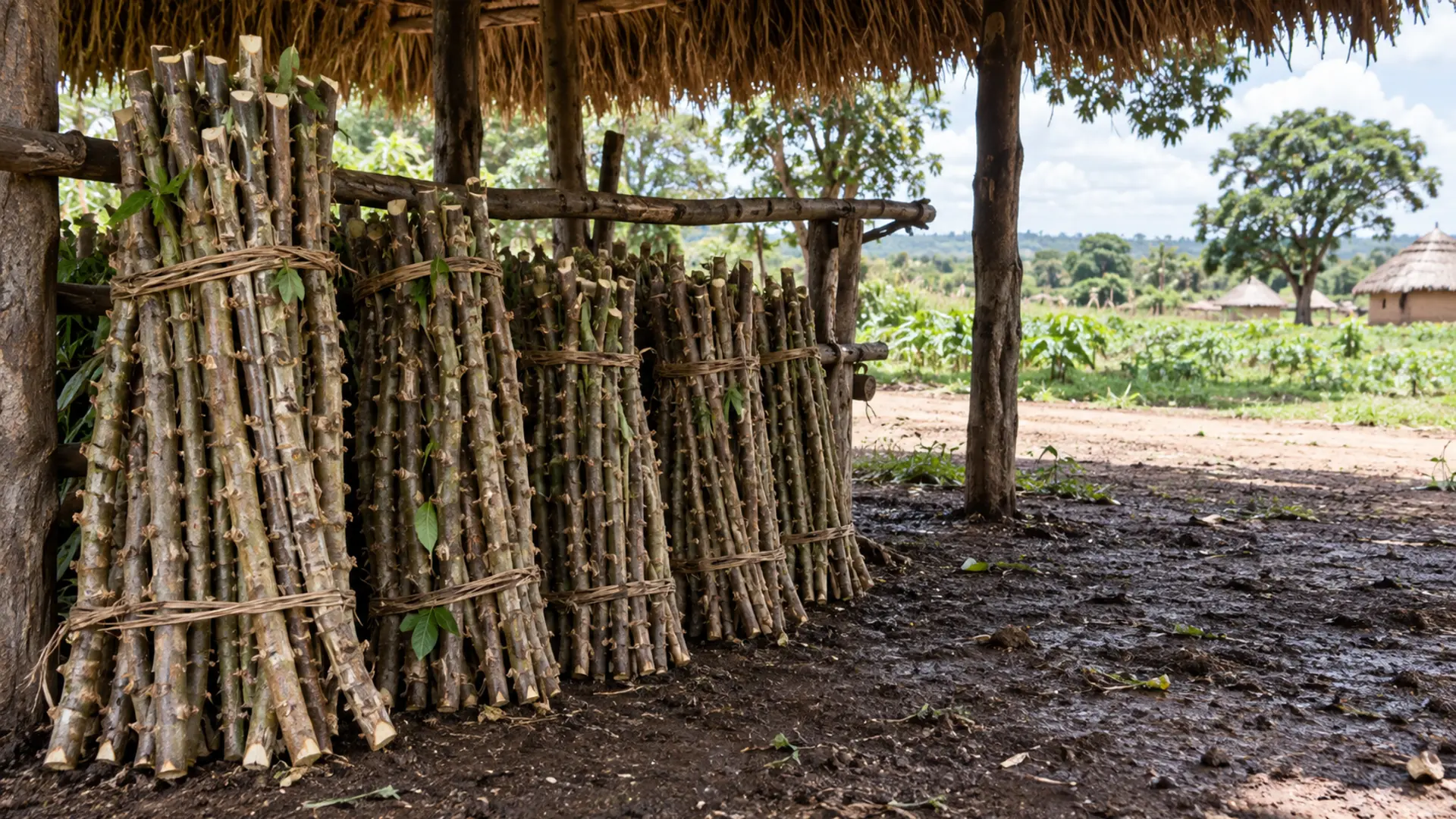
Most Ugandan cassava is planted from stems whose history nobody knows. They come from a neighbour, from a trader at a market, or from a field the buyer has never walked. The variety is what the seller says it is. The health of the parent crop is a matter of trust.
That is the single largest avoidable cost in Ugandan cassava production, and it is avoidable in two ways: by learning to inspect a stem source properly, and by growing your own.
This guide deals only with the material. Cassava disease management is a separate subject and is covered in cassava mosaic and brown streak disease management. What follows is about sourcing, inspecting, cutting, handling and multiplying.
It begins with something most cassava growers in Uganda have never seen: a statutory instrument that sets exact numbers for what a cassava cutting has to be.
What the law actually specifies
The governing framework is the Seeds and Plant Act, 2006, which established the National Seed Certification Service and defined the seed classes. The Act defines breeders seed as “seed of a particular variety, produced by the breeder (owner) of the variety,” basic seed as “seed produced from breeders seed,” certified seed as “a class of seed produced under a certification programme from basic seed” which “can be of two generations,” and standard seed as “any seed which is not grown under a certification program.” Section 8(1) places responsibility for “all matters related to seeds” with the National Seed Certification Service, which sits in the department responsible for crop inspection and certification within the Ministry.
The detail that matters to a cassava grower is in the Seeds and Plant Regulations, 2016. That instrument adds Quality Declared Seed as a class, defined as “a class of certified seed derived from any other certification seed class,” and sets cassava-specific field standards.
Cassava Clean Planting Material in Uganda: Inspecting a Stem Source and Multiplying Your Own
A schematic diagram of a cassava stem divided into basal, middle and top portions alongside a table of the four measurable legal requirements for basic and certified classes.
Those standards, for the basic and certified classes, are four measurable numbers and three nil tolerances.
Minimum cutting length: 30 centimetres.
Minimum number of live nodes: 5.
Minimum diameter: 3 centimetres.
Skin injury, scar or damage: 15 per cent.
And the disease tolerances are stated as nil. Cassava mosaic disease carries a tolerance of “Nil during any inspection.” Cassava bacterial blight and cassava brown streak virus disease each carry a tolerance of nil at any inspection.
Three things to understand about these figures before you use them.
They apply to formally certified classes. A grower buying stems informally from a neighbour is not buying certified material, and that material is not legally required to meet these standards. The figures are still the most useful benchmark available, because they are what the Ugandan regulator considers acceptable.
Nil tolerance means nil. For the three named diseases, the standard is not a low percentage. It is none, at any inspection. That tells you something about how seriously the regulator treats disease transmission through planting material, and it is the reason the inspection checklist below spends as much time on the standing crop as on the cut stems.
The diameter figure is a minimum, and there is a trial finding that complicates it. More on that below.
The wider practice of verifying any planting material before purchase is set out in verifying seed and planting material quality.
Why this matters so much in Uganda specifically
The scale of the informal system is worth stating, because it explains why the problem persists.
Uganda’s National Seed Strategy records cassava seed requirement at 2,115,148 tonnes annually as at 2014, with formal system production at zero and reliance on the informal system at 100 per cent. Its target for 2020 was 317,272 tonnes through Quality Declared Seed producers, representing 15 per cent, with the remaining 1,797,876 tonnes, or 85 per cent, still informal.
Set against production: the Ministry’s own statistical abstract records cassava production of 7,419 thousand tonnes in 2024, on an area recorded at 740 thousand hectares in 2020.
So this is a crop of national significance whose planting material has been, as a matter of official record, entirely outside the formal certification system. That is not a criticism of anybody. It is the context in which a farmer’s own inspection skill is the only quality control that exists.
A peer-reviewed account of the Quality Declared Seed system published in 2021 describes how it works in practice: “The starting material for producing QDS is basic seed, which is generally produced by NARO,” while “Seed sampling for purposes of laboratory testing remained the responsibility of the NSCS seed samplers.” Roots and tubers, including cassava, qualify for the class.
Inspecting a stem source
An inspection that happens after the money has changed hands is not an inspection. This checklist is built to be completed standing in front of the seller, in about ten minutes.
Cassava Clean Planting Material in Uganda: Inspecting a Stem Source and Multiplying Your Own
A blank stem source inspection checklist with sections for the standing crop, the individual stems, the legal cutting standards and a decision box, with ruled space for recording each observation.
The checklist above has four sections, and the order is deliberate.
Look at the standing crop first, if you possibly can. This is the section that separates a serious buyer from a hopeful one. Stems cut and stacked at a roadside tell you almost nothing. A standing crop tells you whether the field was uniform, whether plants have been removed, what the leaves looked like, and what other cassava is growing next to it.
If the seller will not show you the field, that is an answer.
Then the individual stems. Four visible faults disqualify material, and one of them is specific enough to be worth setting out.
Cassava scale insects leave a distinctive sign. An East African technical resource describes it plainly: the scale “may cover the stem with conspicuous white secretions, and eventually the leaves,” it “sucks from the stem and dehydrates it,” and, critically, “Stem cuttings derived from infested stem portions normally do not sprout.” The recommended practice is stated equally plainly: “Selection of clean (scale free) planting material.”
White waxy coating on the bark is therefore not cosmetic. It predicts failure to sprout. Reject it.
The other three field signs to check are shrivelling or dehydration of the stem, bore holes or tunnelling indicating stem borers, and bark lesions or scarring beyond the tolerated 15 per cent.
Then measure against the standard. Take a measuring stick to a stem source. Measure length, count nodes, measure diameter. A seller who objects to being measured has told you what you needed to know.
Then decide, and write the decision down. Including the conditions if you are buying conditionally.
Selecting and cutting
The documented criteria are specific, and they come from international institute guidance rather than from Ugandan trials.
Mother plant age. Guidance from the international institute states: “Stems for planting should be obtained from plants 10-12 months old.” A second document from the same institute repeats it: “Obtain stems from plants that are 10-12 months old.”
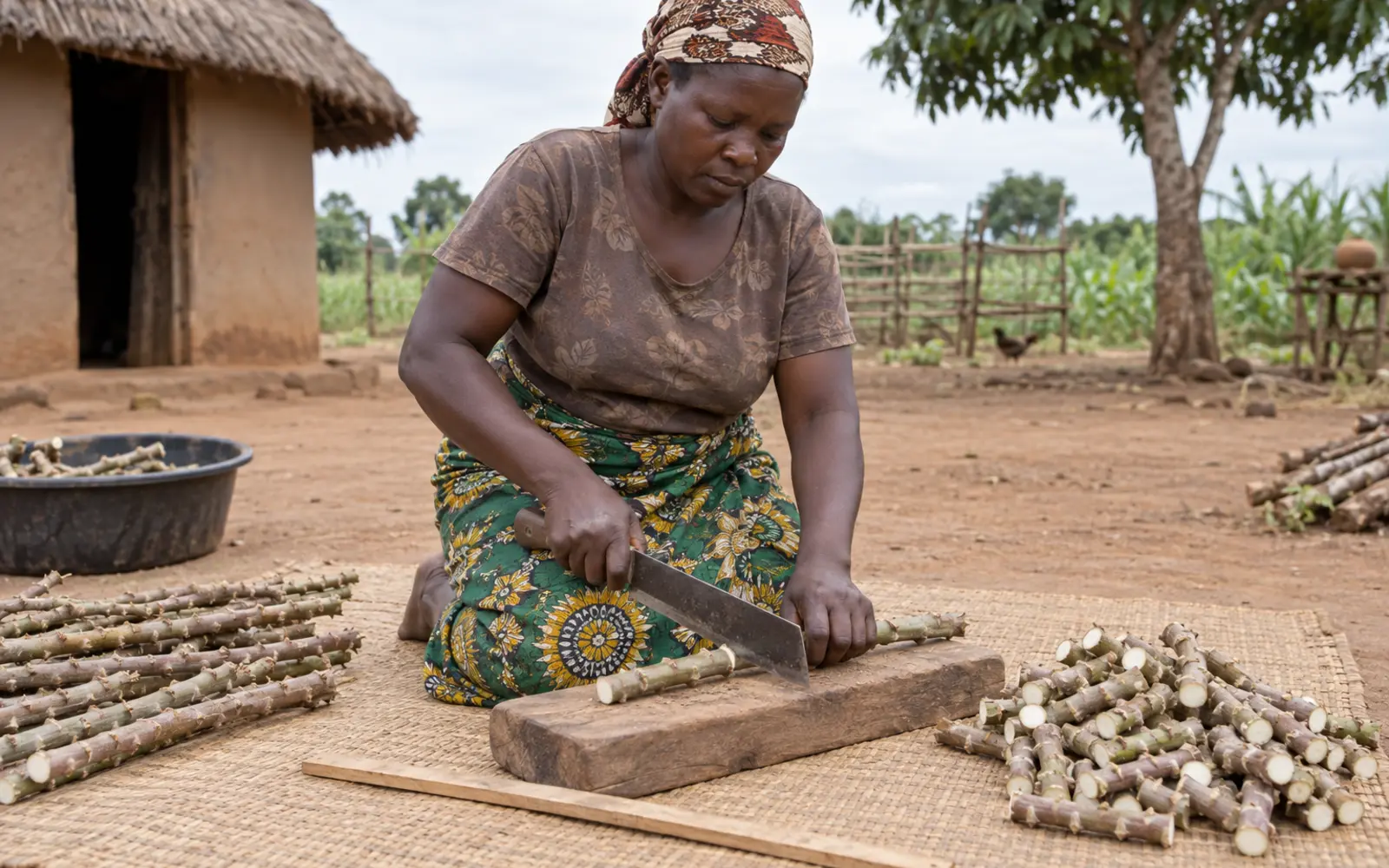
Which part of the stem. The same guidance instructs to “Cut the middle stems into 25cm lengths with 5-7 nodes; middle portions establish better than the tips and basal parts.”
Note the tension between that 25 centimetre figure and the 30 centimetre minimum in the Ugandan instrument. They are not contradictory in a legal sense, because the regulation sets a minimum for certified classes and the institute guidance describes a general practice. But a grower cutting to 25 centimetres is producing material that falls below the Ugandan certified standard, and if you intend to sell stems, that matters. Cut to 30 and you satisfy both.
Node count. Five to seven nodes in the institute guidance; a minimum of five live nodes in the Ugandan instrument. These agree.
Handling and storage
This is where a good stem source is routinely destroyed between purchase and planting.
Cassava Clean Planting Material in Uganda: Inspecting a Stem Source and Multiplying Your Own
A horizontal timeline from stem harvest to planting showing the documented storage window, the documented absolute limit, the storage arrangement and the handling rules.
The documented window is short. The institute guidance states that “Cassava stems should be stored under the shade for 2-5 days (never more than 2 weeks) before being cut and planted.”
Read both halves of that. Two to five days is the working window. Two weeks is stated as an absolute outer limit, not a target.
The documented arrangement is specific: “Cassava stems can be stored vertically on the soil under shade. The distal end of the stems should touch the soil, and moistened regularly.”
And the handling instruction is short and often ignored: “Handle the stems carefully to avoid bruising or damaging the nodes and to improve sprouting.”
Every sprout comes from a node. Stems thrown into a lorry, dragged across ground, or stacked with weight on them arrive with damaged nodes, and the grower blames the variety.
What we could not find. We searched for a documented curve showing how cassava stem viability declines over storage time, and found none in any source we could open. This guide therefore gives you a window and a limit, not a percentage loss per day. Anyone offering you such a figure should be asked for the study.
Multiplying your own
The reason to multiply your own material is straightforward: it is the only way to know the history of what you plant.
Cassava Clean Planting Material in Uganda: Inspecting a Stem Source and Multiplying Your Own
A blank multiplication ratio calculator worksheet with numbered lines for working from a target planting area back to the number of mother plants and seasons required.
The worksheet above works backwards from the area you intend to plant. The number that drives everything is the multiplication ratio, and there is a published East African figure for it.
A trial reported in Frontiers in Plant Science, conducted at a research centre in the Tabora Region of Tanzania, states that “a mature cassava plant at 8 months after planting (MAP) can yield 5 to 10 cuttings, resulting in a ratio of 1:10.”
That is the figure to start with, with two qualifications. It is Tanzanian, not Ugandan. And it spans a factor of two, from five cuttings to ten, which on a multiplication plan compounds into a very large difference by the third season.
Which is why line nine of the worksheet exists: after one season, replace the published figure with your own counted result.
Rapid multiplication from short setts
The institute guidance describes the technique that raises the ratio substantially. “Cut selected cassava stems into 2-node pieces using a secateur, sharp knife/matchete or stake cutting machine for pre-sprouting in transparent polybags,” then “Store the transparent polybags under a shady tree or under the cassava canopy or in a farm shed for 7 to 10 days to sprout.” Three-node pieces are described as an alternative.
The logic is simple. A stem that yields five to ten 30 centimetre cuttings yields far more two-node pieces. The cost is that each piece is smaller, weaker, and needs the pre-sprouting and nursery stage before it goes to the field.
What we could not verify. We searched specifically for quantified multiplication ratios and cycle times for semi-autotrophic hydroponics and tissue culture in cassava. Multiple sources describe these methods as improving on conventional multiplication. None that we could open gave a number. This guide therefore describes those methods as existing and does not attach a ratio to them.
Siting and running the multiplication plot
A multiplication plot is not an ordinary cassava field. Its product is stems, and that changes how it should be sited and managed.
Put it where you walk past it. The plot needs inspecting far more often than a production field, because its whole value is that you know its history. A block at the far end of the farm gets inspected twice a season, which is not enough.
Separate it from older cassava. The Ugandan instrument sets a nil tolerance for three diseases at any inspection, and the practical route to meeting that standard is not treatment but distance from sources of infection. Siting a multiplication block immediately downwind of an old, failing cassava field undoes the purpose of having one.
Rogue it, and rogue it early. Removing an off-type or symptomatic plant in the first two months costs almost nothing. Leaving it until the stems are cut means it has been in the block for a full season. A multiplication plot that is never rogued is simply a cassava field with ambitions.
Keep one page of records. Where each planting came from, the date, the variety as stated, and what was removed and when. That page is what lets you tell a buyer, two seasons later, exactly what they are getting, and it is the thing that makes your stems worth more than the ones at the roadside. The general discipline is set out in farm record keeping and gross margin analysis.
Do not harvest it for roots at the wrong time. This is the commonest way a multiplication plot is lost. The documented mother plant age for stems is ten to twelve months. A grower who lifts the roots at eight months because the price is good has harvested the crop and destroyed the stem supply in the same operation. Decide at planting which the block is for.
Planting orientation: where the sources disagree
This is the section where honest reporting is more useful than a rule.
Cassava Clean Planting Material in Uganda: Inspecting a Stem Source and Multiplying Your Own
A panel setting the general institutional guidance on planting orientation against the trial results that contradict it, with both positions stated and neither reconciled.
The institute guidance describes the methods. Cuttings “can be planted in a slanting or angular position” and “buried in the soil with one-third above the soil surface.” Alternatively they “can also be planted in a horizontal position” and “completely buried” to “a depth of 5 cm.” And it gives a rule: “In areas of high rainfall or on very heavy soils, vertical or angular planting should be practiced while horizontal planting is better in dry areas.”
A six-trial study conducted in south-western Nigeria between 2016 and 2020 found something different. It reported that “vertically planted stakes produced the highest root yields in 4 of 6 trials” and that “slanted stake insertion produced root yields similar to vertical planting in 5 of 6 trials.” But the season mattered more than anything else. In the first season, horizontal produced 16.73, slanted 17.89 and vertical 17.40 tonnes per hectare. In the second season the ranking reversed: “Horizontal stake orientation had an advantage when planting in the second season (20.68 Mg ha-1) over slanted (18.01) and vertical (16.86).”
The same trial produced two further findings that bear directly on how a grower selects material. First: “high diameter stakes produced lower root yields than low diameter stakes.” Second: “the provenance within the mother plant stem, i.e., the age of the planting stakes did not affect the root yield.”
Take these carefully.
The orientation rule and the trial do not agree. The guidance keys the decision to rainfall and soil. The trial found season to be the determining factor. We are not reconciling them, and no reader should treat either as settled.
The diameter finding sits awkwardly against the standard. The Ugandan instrument sets a minimum diameter of three centimetres, and the Nigerian trial found higher-diameter stakes yielding less. These are not directly contradictory, because a minimum is not a recommendation to maximise, but a grower selecting the thickest stems available on the assumption that thicker is better is not supported by this trial.
The provenance finding contradicts the general guidance. The institute guidance says middle portions establish better than tips and basal parts. The Nigerian trial found the position within the mother plant did not affect root yield. Establishment and final root yield are different measurements, which may explain the difference, and this guide reports both without claiming to resolve it.
What should a Ugandan grower do with that? Test it. Plant a block of each orientation in the same field in the same season, and count the yield. Two seasons of that on your own land is worth more than either source, and the approach to doing it properly is in reading agricultural research for a Ugandan farm.
What exists in Uganda, and what does not
A Ugandan programme to commercialise cassava planting material has operated, described as running research to generate pre-basic seed and methods of seed production, regulation and certification for quality assurance, production of seed as a direct consumable input, and commercialisation of quality cassava planting material, with cassava seed entrepreneurs sourcing clean seed from the national research institute.
The qualitative outcome reported is that “Smallholder farmers are now willing to pay for certified cassava planting materials as compared to receiving free planting materials.”
We report that and we report its limit honestly: the source we could open contains no quantitative outcome figures at all. No hectares, no farmer numbers, no multiplication ratios achieved. Anyone citing Ugandan cassava seed entrepreneur figures should be asked which document they come from.
There is a second reason to be careful with programme figures in this area. Cassava seed system projects are typically funded for three to five years, and the outcome reported at the end of a project is not the same as the outcome that persists afterwards. A grower deciding whether to become a stem supplier should ask not what a project achieved during its funding period, but what the stem market in their own district looks like now, who is buying, and at what price relative to root sales. That is a local commercial question, and the framework for answering it is in how Ugandan farm gate prices are formed.
One correction worth making, because it circulates. The BASICS and BASICS-II cassava seed system programmes, which are frequently cited in discussions of cassava seed entrepreneurs, operate in Nigeria and Tanzania. Their own project description states that they develop “Decentralized, commercially viable seed enterprises [cassava seed entrepreneurs (CSEs)] in Nigeria and Tanzania.” Uganda is not covered. Figures from those programmes should not be attributed to Uganda.
Putting it together
The practical sequence for a Ugandan grower who wants to stop buying uncertain stems is four steps over about two years.
This season, inspect properly. Use the checklist. Walk the field. Measure against the four figures. Reject anything with white waxy coating on the bark.
This season, set aside a multiplication block. It does not need to be large. Work backwards from the worksheet: the area you want to plant in two years determines the number of mother plants you need now.
Handle what you have properly. Two to five days under shade, upright, base on damp soil, handled without bruising the nodes. Nothing in this guide costs less or is skipped more often.
Next season, count your own ratio. Take one mature plant, cut it properly to the standard, and count the cuttings you actually get. Put that number on the worksheet in place of the published one.
At the end of that, you have material whose parent crop you walked, whose cutting dimensions you measured, whose handling you controlled, and whose multiplication rate you know from your own field. That is a different position from the one most Ugandan cassava growers start the season in, and none of it required buying anything you could not already reach.
Author: Falcon Foundation Ltd Editorial Team
The Falcon Foundation Ltd Editorial Team produces evidence-based agricultural guidance for Ugandan farmers, drawing on published research and institutional sources and translating them into practical decision support. Where evidence is unavailable or contested, we say so rather than filling the gap.
