
A heifer that calves at three years old has eaten for a year longer than she needed to and produced nothing in that time. A heifer that calves too small has a hard first calving and never quite reaches the milk she should.
Both outcomes are usually decided in the first eight weeks of her life, long before anyone is thinking about breeding her.
This guide is about the checkpoints between birth and first service, and how to tell at each one whether you are on track.
What this guide helps you decide
By the end you should know what to feed in the first hours and how much, how to judge colostrum quality, when a calf is actually ready to wean and what criterion to use, how to monitor growth without a weighbridge, and what target to aim at for first service.
It does not cover heat detection or the breeding decision, which come after this. It does not cover milking hygiene. And it gives no disease treatment guidance of any kind, no medicine names and no doses. Sick calves are a matter for a qualified veterinarian.
The short answer
Get colostrum into the calf within the first two hours, at around a tenth of her body weight, and give a second feed by twelve hours. That single window matters more than anything else you will do for her.
Offer starter from the first week and wean on intake, not on the calendar: a sustained daily intake of solid feed over consecutive days, with the calf healthy, and not before six weeks of age.
Aim to serve her at around 55 per cent of mature body weight, and to calve her by around 22 to 24 months at 85 to 90 per cent of mature body weight. Measure the weight with a heart girth tape, using an equation developed on the kind of cattle you actually keep.
Colostrum: the two hour window
The calf is born with almost no immune protection of her own. She gets it from colostrum, and she can only absorb it for a short time.
How soon. Feed within the first two hours after birth. Every hour of delay costs absorption.
How much. Guidance converges on a first feed of around 10 per cent of body weight, or expressed as a volume for a typical dairy calf, roughly 3 to 4 litres. A second feed of about 2 litres by twelve hours is recommended.
What quality. Colostrum quality is measured with a Brix refractometer, a small handheld instrument you look through. Different extension programmes use slightly different cut-points: one uses above 22 per cent Brix as good, another uses above 25 per cent as good and 30 per cent as excellent. Treat the range 22 to 25 per cent as the practical threshold rather than fixing on one number. Where immunoglobulin concentration is measured directly, above 75 grammes per litre is classed as good, 50 to 74.9 as fair and 25 to 49.9 as poor.
Why the window closes. The calf’s gut absorbs whole immunoglobulin molecules for a limited period after birth, and that ability declines steeply. Extension guidance summarising the classic absorption research reports efficiency of about 66 per cent at six hours, about 47 per cent at twelve hours, about 12 per cent at twenty-four hours and under 7 per cent beyond thirty-six. We should note that we could not open the original peer-reviewed paper behind those figures and are citing an extension synthesis of it. The shape of the curve is not in dispute; treat the individual percentages as indicative.
What happens if you miss it. Failure of passive transfer is defined in United States national survey work as serum immunoglobulin below 10 grammes per litre at one to seven days of age, and it was found in 12.0 per cent of a national sample of 1,623 Holstein heifer calves. The consequences documented there go well beyond the calf stage: more illness, more deaths, lower daily gain, decreased first and second lactation milk production, and higher culling in the first lactation. A calf that missed her colostrum is a cow that gives less milk two years later.
That is the argument for the two hour rule, and it is the strongest single argument in this article.
Weaning: on intake, not on the calendar
The most common weaning error is weaning by age. The calf’s rumen has to develop before she can live on solid feed, and rumen development is driven by what she eats, not by how old she is.
Start solid feed early. Extension guidance describes an early developmental threshold of about half a pound of grain a day sustained for twenty-one to twenty-eight days as what is needed for the rumen papillae to develop. That is a different criterion from the weaning trigger; it is what makes weaning possible later.
The weaning criterion. Published criteria differ, and they are measuring slightly different things:
- A United States Department of Agriculture calf feeding guide gives at least 1.4 kilogrammes, about 3 pounds, of starter a day for three consecutive days, together with good health.
- Current nutrient requirement guidance via a university extension summary gives a minimum of about 2.75 pounds of starter a day before weaning, and at least 4.0 pounds a day where high growth rates are the target.
Take whichever you use and apply it consistently. The principle is the same in both: a sustained daily intake, measured over consecutive days, not a single good day.
Minimum age. Not before six weeks, because the rumen is not mature enough. Most farms in practice wean at eight to nine weeks, and one national survey found 31.1 per cent of farms weaning at nine weeks or later.
Step down rather than stopping. Reducing milk gradually over at least seven days pushes the calf onto solid feed while she still has support. Research cited in extension guidance found that a step-down beginning around four weeks outperformed later gradual weaning.
The Ugandan warning on late weaning. A study of 252 dairy households in Kampala and Gulu recorded weaning at two to three months, four months, and five months or more, and found that late weaning at five months or more was associated with significantly higher abortion rates in the herd. That is an association in a survey rather than a controlled trial, but it is Ugandan and it points the same way as the international guidance: weaning late is not the safe option it feels like.
Housing, which is where Ugandan research is clearest
The strongest Ugandan evidence on calf rearing is about housing.
A study of 336 dairy farmers across four regions of Uganda found that 70.8 per cent provide calf housing, of which 59.2 per cent was permanent and 40.8 per cent temporary, but that 54.6 per cent of farmers were dissatisfied with its adequacy. Adoption was more likely among farmers with more education, those using artificial insemination, and those in the northern region, and less likely on farms with large herds, on farms that tether animals, and where land tenure was insecure. Poor housing was linked to pneumonia, with an associated reduction in growth rate of around 18 per cent, and to other health problems and calf deaths.
What good housing does is simple: it keeps the calf dry, out of wind and rain, off wet ground, and away from adult stock. Bedding needs to be dry, which means it needs replacing rather than topping up. Ventilation matters more than warmth in Ugandan conditions, so an open side is an advantage rather than a fault.
Two figures are worth putting alongside that. A study across Ugandan districts recorded East Coast fever causing 28.2 per cent calf mortality in Soroti against 7.7 per cent in Kayunga and Kiruhura, and helminthosis causing 7.9 per cent calf mortality in Soroti, with disease ranked the top constraint by 74 to 87 per cent of farmers. Those are disease-specific, district-specific figures from that study and not a national all-cause calf mortality rate, which we could not find published for Uganda at all. They do make the point that the disease burden on Ugandan calves is heavy and varies enormously by place, and that your local picture is a question for your veterinarian rather than for an article.
Weighing her without a weighbridge
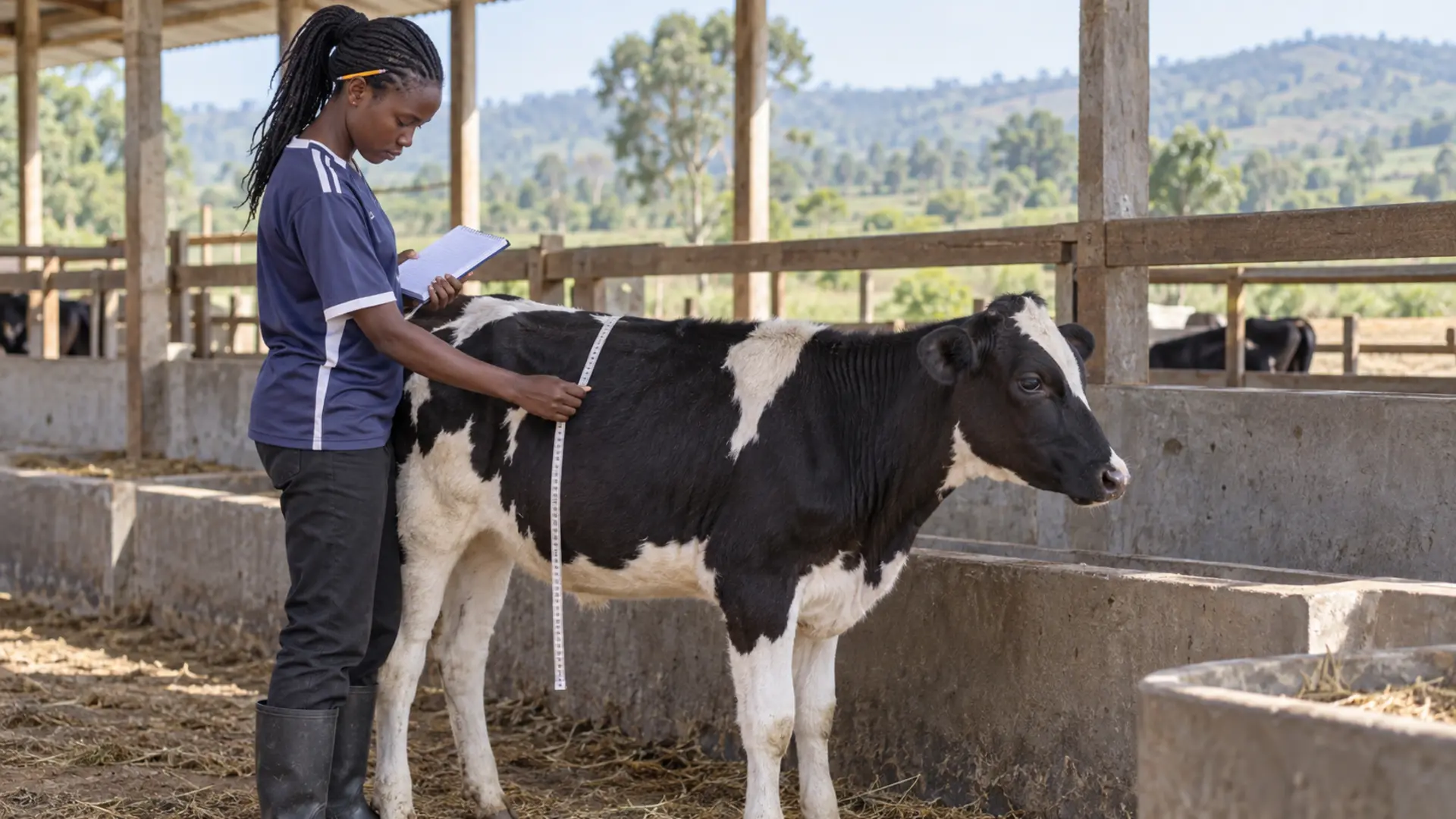
You cannot manage growth you do not measure, and almost nobody has a weighbridge. A heart girth tape is the practical answer.
How to take the measurement. Stand the animal square on level ground. Pass the tape around the chest immediately behind the front legs, so it sits just behind the elbow and crosses over the withers. Read at the end of an exhalation, snug but not tight. Measure at the same time of day each time, because gut fill changes through the day.
The equation matters more than the tape. Commercial weight tapes are calibrated on Holstein cattle. Extension guidance puts their accuracy at within 3 to 5 per cent for animals above about 330 pounds and 5 to 8 per cent for smaller calves, but that is accuracy on the cattle they were built for. Uganda’s dairy animals are largely crossbreds and zebu types, and an equation developed on a Holstein does not transfer.
Four published equations developed on African cattle, with the animals each was built on:
- Tanzania Shorthorn Zebu, from 300 animals: weight in kilogrammes equals 4.55 times heart girth in centimetres minus 409, with a coefficient of determination of 0.88.
- Boran and Small East African Zebu crosses, northern Kenya, from 160 females aged one to three years: liveweight equals minus 265 plus 3.37 times heart girth, with a coefficient of determination of 0.90 and a prediction error of 12.8 kilogrammes, about 7.3 per cent of mean liveweight.
- Crossbred dairy cattle, smallholder Kenya, from 452 animals across three districts: liveweight equals 4.277 times heart girth minus 393.13, with an adjusted coefficient of determination of 0.705 and an error of about 26 kilogrammes, roughly 11 per cent, valid over a 100 to 450 kilogramme range.
- East African Shorthorn Zebu, from 703 animals: weight to the power 0.262 equals 0.95 plus 0.022 times girth, with a coefficient of determination of 0.98 and a 95 per cent prediction interval within about 20 per cent of body weight.
Pick the one closest to your animals, use it consistently, and understand that you are estimating rather than weighing. The value of the measurement is in the trend from month to month, not in any single figure.

The first service target
Age. A systematic review drawing on seventeen papers and 2.4 million cow records puts the target age at first calving at 22 to 25 months, and found that deviation in either direction lowers first-lactation and lifetime milk yield, lowers fertility and lowers the odds of reaching a second lactation. Veterinary guidance and university extension both give 22 to 24 months as the target.
Size. Two independent international sources agree: about 55 per cent of mature body weight at first service, at around 13 to 15 months of age, and 85 to 90 per cent of mature body weight at first calving.
Use the percentage, not the kilogrammes. This is important enough to state on its own. Those sources also quote absolute weights, and those weights are for Holstein cattle. A Ugandan crossbred or zebu-cross heifer has a substantially lower mature weight, so the pound figures do not apply. The 55 per cent and 85 to 90 per cent proportions do. To use them you need to know the mature weight of the cows in your own herd, which you can estimate with the same girth tape on your adult animals.
The pre-weaning link. Extension research reports that calves gaining faster in the first eight weeks consumed more protein and energy and produced slightly more milk in the first lactation than slower-growing calves. The early feeding and the eventual milk yield are connected.
An honest gap: we searched Ugandan reproductive and dairy studies for a published age at first calving figure for Ugandan herds and found none. Three separate Ugandan studies we examined did not measure it. So we cannot tell you what the Ugandan average is, only what the target should be and why.
Cost categories
No prices. Budget across:
- Colostrum management: a Brix refractometer, a clean feeding bucket or bottle, and the labour to be present at calving
- Colostrum storage, if you bank surplus from good cows
- Milk or milk replacer through the pre-weaning period, which is the largest single cost
- Calf starter, from the first week
- Housing: materials for an individual pen, a roof, and bedding that is replaced rather than topped up
- Bedding, recurring
- A heart girth tape and a record book
- Veterinary attention, routine and unplanned
- The opportunity cost of milk fed to the calf rather than sold, which is the cost farmers feel most and account for least
Common mistakes
Leaving the calf to suckle and assuming she got enough. A calf that suckles may or may not have taken sufficient colostrum in the window. If you did not feed it, you do not know.
Feeding colostrum late because calving happened at night. The two hour rule does not adjust for convenience, and this is the single most consequential error in this guide.
Weaning by age. A calf weaned at eight weeks who is not eating enough starter goes backwards.
Weaning abruptly. Step down over at least a week.
Weaning very late. Ugandan survey data associates weaning at five months or more with significantly higher abortion rates in the herd.
Using a Holstein weight tape on a zebu cross. It will read wrong, consistently, in the same direction, and you will not know by how much.
Using Holstein target weights in kilogrammes. Use the percentage of your own herd’s mature weight.
Wet bedding. The most common practical failing in calf housing, and the one linked to pneumonia in the Ugandan study.
Keeping no growth record. Without one you find out the heifer is behind at the point you wanted to serve her, which is a year too late to fix.
Warning signs and escalation points
Call a qualified veterinarian for any of these. Nothing in this article is a substitute.
- A calf that will not stand or suckle within the first hours
- Scouring, particularly with dullness or sunken eyes
- Coughing, laboured breathing or nasal discharge
- A calf that is not gaining between monthly girth measurements
- Any calf that is dull, off feed or separate from the group
- A cluster of illnesses among calves of similar age, which points to a management or housing problem rather than an individual one
- A heifer tracking well below the growth line as first service approaches, which is a culling and management conversation, not a feeding tweak
Where this works, and where it does not
It works on a farm that is raising its own replacements, where somebody is present at or near calving, and where there is enough milk or milk replacer to feed a calf properly through the pre-weaning period.
It works less well in three situations. Where calvings happen unattended in a grazing herd, the two hour colostrum window is missed as a matter of routine and the whole plan starts from a weaker position. Where every litre of milk is sold and the calf gets what is left, the pre-weaning growth that drives everything downstream will not happen. And where the disease burden is very high, as the Ugandan district mortality figures show it can be, calf survival is a veterinary and biosecurity question before it is a nutrition one.
One regulatory note. Uganda’s Parliament approved the merger of the Dairy Development Authority, the Cotton Development Organisation and the National Agricultural Advisory Services into the Ministry of Agriculture, Animal Industry and Fisheries, in a plenary sitting reported by Parliament on 22 October 2024, and the Dairy Industry (Amendment) Act was subsequently signed into law. The Authority is no longer a standing agency, and material describing it as one is out of date.
A low-risk first step
Buy or borrow a heart girth tape and measure every heifer on the farm once, today. Write the girth and the date against each name.
Then do it again in a month, at the same time of day. That is all.
Two measurements a month apart tell you something you almost certainly do not know: whether your heifers are growing, and roughly how fast. From there, the 55 per cent target becomes a plan rather than a hope, and you find out about a heifer who is behind while there is still time to do something about it.
What to do next
- Get a heart girth tape and start monthly measurements on every heifer, recorded by name and date.
- Measure your mature cows too, so you know the mature weight the 55 and 85 to 90 per cent targets are a proportion of.
- Put a colostrum plan in place: who is on call at calving, where the clean bucket is kept, and where the refractometer lives.
- Set your weaning criterion in writing as a starter intake over consecutive days, and weigh the starter rather than estimating it.
- Check the calf pens for dry bedding and open-sided ventilation, and fix the bedding routine if it is top-up rather than replace.
- Mark on the record the age and girth at which each heifer should reach first service, and check monthly against it.
- Discuss your local calf disease picture and a preventive plan with your veterinarian, especially if you are in a district with heavy tick-borne disease pressure.
Related reading: milking hygiene and mastitis prevention covers the parlour side, choosing a dairy cow covers the animals you are breeding from, and heat detection and the breeding decision covers what happens once the heifer reaches target. The published guides to year-round fodder planning for goats and cattle and whole-farm biosecurity cover feeding the growing animal and keeping disease out.
About the author
This guide was researched and written by the Falcon Foundation Ltd Editorial Team. Falcon Foundation Ltd is a privately owned Ugandan agricultural company producing greenhouse crops, livestock and honey. Our Knowledge Hub is written for Ugandan farmers making practical decisions with incomplete information. We give no disease treatment guidance, and where a figure was derived on temperate Holstein cattle we say so rather than passing it on as though it applied here.
