
You notice mastitis when the udder is hot, the quarter is hard, and the milk comes out in clots. By then you are managing a loss, not preventing one.
The cases you never notice are the expensive ones. They do not swell. The milk looks normal in the bucket. The cow keeps producing, just less than she should, month after month, and one day the quarter simply stops giving what it used to. Nothing you buy will bring it back.
This guide is about the twenty minutes twice a day that decide whether that happens on your farm.
What this guide helps you decide
By the end you should be able to build a milking routine you can actually follow, in the order that matters; work out which of your cows to milk first and which last; and use two simple tests to find infected quarters before they announce themselves.
This guide does not cover treatment. Treatment is a veterinary matter, and there is a reason for that beyond caution, which the section on antimicrobial resistance explains. We name no medicines and give no doses anywhere in this article. If you have a cow with clinical mastitis today, call a qualified veterinarian.
The short answer
Wash your hands. Strip the first few squirts from each teat onto a dark surface and look at them. Prepare and dry each teat with its own towel, never a shared one. Start milking within a minute or two of first touching the udder. Milk the cow out completely. Disinfect the whole of every teat the moment you finish. Milk your clean, young cows first and your known problem cows last, every single time. Keep the cow on her feet for about half an hour afterwards.
That is the whole routine. The rest of this article explains why each step is there, and how to find the cows you cannot see are sick.
Why so much of the loss is invisible
Subclinical mastitis is inflammation of the udder without visible signs. The cow looks well. The milk looks normal. The infection is real.
Ugandan studies have measured how common it is, and the figures are high wherever anybody has looked, though they differ a great deal by district, herd and test method. A study of eighteen smallholder farms within twenty kilometres of Kampala tested 195 cows and 760 quarters and found subclinical mastitis in 86.2 per cent of cows and 55.4 per cent of quarters. A separate study across sixty farms in Jinja tested 172 cows and 688 quarters and found 61.3 per cent of cows positive on the California Mastitis Test, of which 60.7 per cent were subclinical. That same Jinja study recorded two things that explain the first: hygiene levels on most farms were very low, and farmers had no knowledge of subclinical mastitis at all.
There is no single national figure, and anyone quoting one should be asked which study, which districts and which test. What the studies agree on is direction, not magnitude.
The regional picture is similar. Work in Mvomero and Njombe in Tanzania found 51.6 per cent of animals subclinically affected. Work in Thika in Kenya found 64 per cent of cows positive on CMT, with poor udder hygiene and muddy floors associated with higher prevalence. Work around Kigali in Rwanda found 76.2 per cent of cows and 43.1 per cent of quarters affected.
Why treatment does not fix what prevention would have
When an udder is infected, the immune response damages the milk-producing tissue itself. The peer-reviewed literature on mammary gland health describes what follows plainly: secretory cells are destroyed and replaced by connective tissue, and chronically infected quarters become progressively less productive as scar tissue replaces secretory tissue.
Scar tissue does not make milk. Clearing the bacteria does not rebuild the cells. A quarter that has been quietly inflamed for a year does not come back to what it was, whatever you give it.
The same literature is direct about the strategic conclusion: mastitis cannot be completely eliminated from a herd, only kept at the lowest possible incidence. That is not a counsel of despair. It is the reason the routine matters more than the medicine cabinet.
There is a second reason to keep treatment with a veterinarian. Ugandan work on mastitis pathogens has documented substantial resistance. The Jinja study found more than half of isolates resistant to commonly used antibiotics. A study of 97 clinical mastitis samples from cows and of samples from the people milking them, across Kampala, Wakiso, Mukono, Mpigi, Luwero, Kamuli, Kayunga and Mityana, grew bacteria from 82 of the samples and found methicillin-resistant coagulase-negative staphylococci in 57 per cent of the cow isolates tested, along with multidrug-resistant Gram-negative organisms. It also found genetically similar organisms circulating between the cows and the milkers. Casual treatment makes that picture worse, and it is a picture that reaches the household as well as the herd.
The routine, step by step
The sequence below is drawn from the National Mastitis Council’s recommended milking procedures, FAO’s guide to good dairy farming practice, and university extension guidance, cross-checked against Uganda’s own code of hygienic practice for milk and milk products, US 163:2000.
Before you start. Wash your hands with soap and water. A survey of 757 smallholder dairy farmers in central Uganda found 75.8 per cent do this, so a quarter do not.
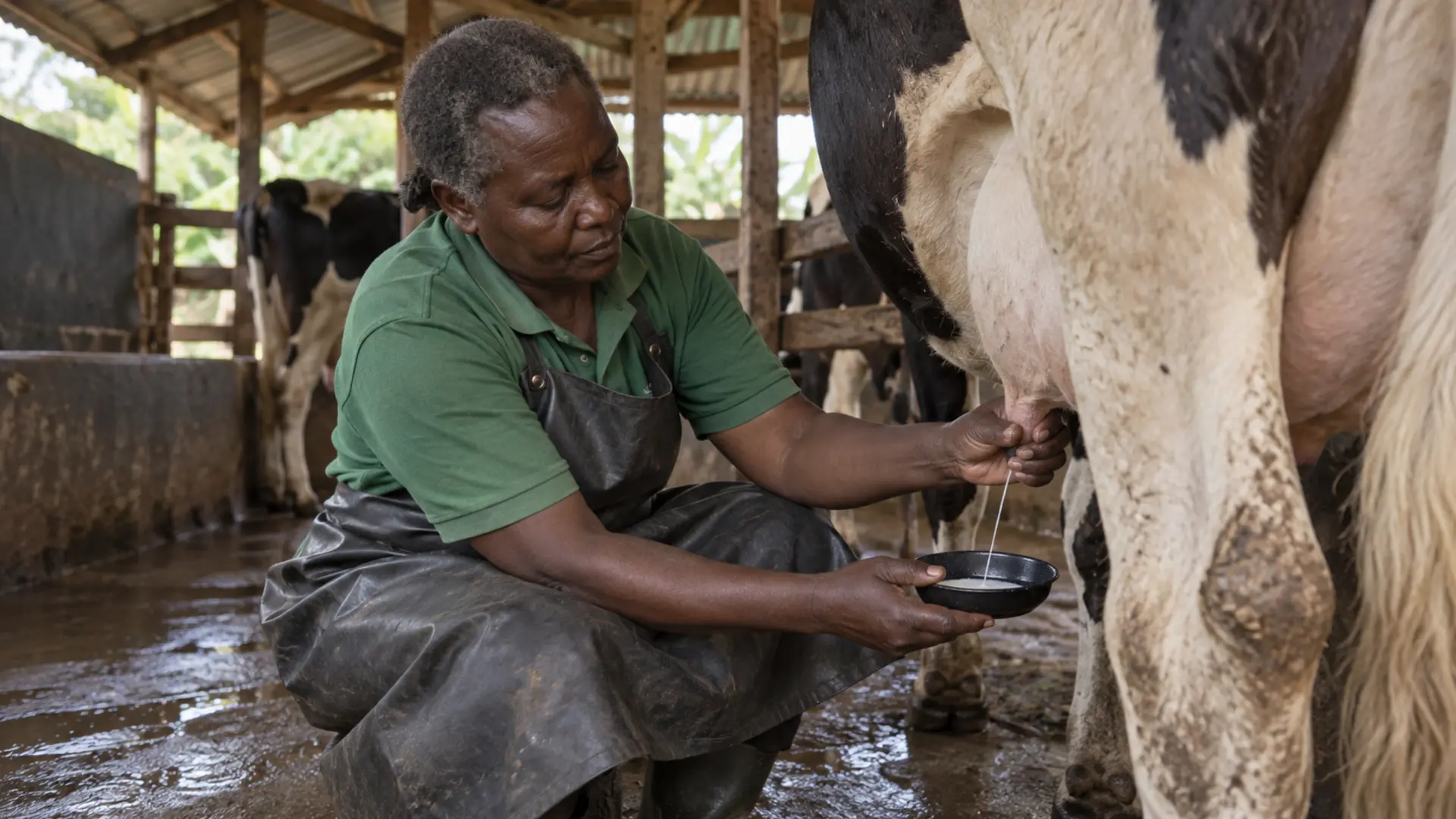
Step one: fore-strip. Draw three to four streams of milk from each teat onto a dark surface or into a strip cup. This does two things at once. It removes the milk sitting in the teat canal, which carries the highest bacterial load. And it lets you see clots or flakes before they go into the bucket. Uganda’s own standard requires it: the milkers shall test each milking teat for mastitis before milking.
Step two: prepare the teats. Uganda’s standard says the udder and teats shall be effectively washed and cleaned, and dried with a clean dry towel. FAO’s guidance is to wash and dry dirty teats and only milk animals with clean, dry teats. If you use a teat preparation product, the National Mastitis Council specifies thirty seconds of contact time before wiping. Thirty seconds is longer than it feels. Count it.
Step three: dry each teat with its own towel. This is the step most often skipped and the one that most directly spreads infection between cows. The National Mastitis Council specifies single-service paper or individual cloth towels. Not one cloth for the row. In the central Uganda survey, only 19.6 per cent of farmers sanitised udders before milking at all.
Step four: start milking inside the window. The udder releases milk in response to stimulation, and the release does not last indefinitely. The National Mastitis Council recommends milking begin within sixty to one hundred and twenty seconds from the start of cow preparation. University extension guidance gives the same window and a minimum of one minute between first stimulation and starting.
Step five: milk out completely. Milk left in the udder is milk left for bacteria.
Step six: disinfect every teat immediately. The entire teat must be covered, immediately after milking. This single step has the clearest evidence behind it of anything in the routine: the National Mastitis Council states the rate of new intramammary infection can be 50 per cent lower where teats are disinfected compared with no disinfection.
Step seven: keep her standing. The teat sphincter takes about thirty minutes to close after milking, and teat disinfectant takes about thirty minutes to dry. A cow that lies down in a dirty stall before then is presenting an open teat canal to whatever is on the floor. Feed her after milking rather than before, so she stays on her feet.
The order of cows, and why it is not optional
Milk your cows in a fixed order: freshly calved heifers and young clean cows first, the main herd next, known infected or high-cell-count cows last.
Uganda’s own hygiene standard is explicit that milk from mastitis-affected teats shall be milked last and discarded in a manner that avoids contaminating other milk. FAO’s guidance says animals whose milk is unfit for human consumption should be milked last or with a separate bucket. The National Mastitis Council’s reasoning is contagion control: cows infected with the organisms that spread cow to cow should be identified and milked last, or milked with separate equipment, because your hands, your cloth and your bucket are the vehicle.
There is good evidence that this is a habit farms can actually adopt. A Ugandan intervention study in an intensive dairy production area trained farms on hygiene and measured what changed. The proportion of farms milking mastitic cows last rose from 13.3 per cent to 87 per cent. The proportion using one towel per cow rose from 3.3 per cent to 63 per cent. Subclinical mastitis prevalence in that cohort fell from 72.3 per cent to 25.8 per cent.
That study also found something worth knowing if your milk is being rejected. Bulk milk hygiene at the collection centres did not improve, averaging 6.50 log10 colony forming units per millilitre at the centre against 3.79 at the farm. If your milk leaves your farm clean and fails at the centre, the problem may not be yours, and it is worth establishing where the failure happens before you rebuild a parlour.
Finding the quarters you cannot see
Two tools, one you already own and one you may not be able to buy.
The strip cup. A dark plate or a fine mesh over a dark surface. Fore-strip onto it and look. You are checking for clots, flakes and coagulation. A cow whose milk shows flakes at one quarter and not the others has told you which quarter to watch, without any test at all. Do this at every milking, on every cow. It costs nothing and takes seconds.
The California Mastitis Test. A paddle with four wells, one per quarter. Draw a small equal quantity of milk into each well, add an equal quantity of the reagent, swirl the paddle gently for under ten seconds and read within about fifteen seconds. The reagent breaks open the somatic cells present, and their contents form a gel. More cells, more gel. The reaction is scored from negative through trace, weak positive and distinct positive to strong positive, by how thick the gel becomes and whether it adheres to the paddle when you tip it.
An important honesty note. We could not verify that commercial CMT reagent is reliably obtainable in Uganda from any named, checkable, non-promotional source. Retailers appear in the region, but we found none we could confirm supplies Uganda. There is Ugandan research testing locally available detergents as substitutes for the commercial reagent, which itself suggests access is constrained, but we could not open the full text and so cannot tell you what it concluded. Ask your veterinarian or your district production office before you plan a testing programme around a product you cannot get.
What a positive CMT result means is worth stating clearly. It means the quarter is inflamed. It does not tell you which organism, and it does not tell you what to do next. It tells you which quarter and which cow to put at the end of the milking order, and which cow to discuss with your veterinarian.
Equipment, water and the bucket
FAO’s guidance is that milk containers should be non-corrosive and easy to clean and disinfect. A galvanised or stainless bucket kept for milk and nothing else. Not a jerrycan you cannot get your hand inside.
FAO’s milking hygiene guidance sets out the cleaning sequence: rinse in clean water, scrub in a hot detergent or disinfectant solution at or above 45 degrees Celsius, and finally rinse in chlorinated water at 50 parts per million. Rinsing first in clean water matters, because starting with hot water bakes milk protein onto the surface. Cooling water should be clean and below 15 degrees Celsius.
Store the bucket upside down where it can drain and dry. A wet bucket left standing is a culture vessel.
What this costs
There are no invented figures here, because the honest answer is that most of this routine costs habit rather than money. What it does cost falls into these categories, and you should price each locally before you decide anything.
- Individual cloth towels, enough for every cow at every milking, plus soap and the labour to wash and dry them
- A dark strip cup plate, which can be improvised
- Teat disinfectant, an ongoing consumable, the one item on this list that is genuinely recurrent and genuinely worth it
- A CMT paddle and reagent, if you can source them
- Detergent and a chlorine source for equipment cleaning
- Hot water, which on most farms means firewood or charcoal
- A record sheet and a pencil
Set against that: the milk from a quarter that never scars over, in a cow that will be in your herd for years.
Common mistakes
Washing the whole udder with a hose and not drying it. Water running down a wet udder into the bucket is worse than not washing at all. The drying step is the hygiene step.
One cloth for the whole herd. This does not clean cows. It moves infection along the row in the order you milk.
Preparing all the cows first, then coming back to milk. The one to two minute window is per cow, not per session.
Treating without a diagnosis. Beyond the resistance problem described above, it hides the pattern. A cow treated three times for the same quarter is telling you something the treatment is not fixing.
Letting cows lie down immediately after milking. Feed after milking, not before.
Keeping no record. Without a quarter record you cannot see that the same cow, same quarter, has flared four times this year. That cow is your reservoir.
Warning signs and escalation points
Call a qualified veterinarian, do not manage it yourself, if any of these occur.
- A hot, hard, painful or swollen quarter
- Blood, pus or watery milk
- A cow that is off feed, dull or has a fever alongside udder signs
- Several cows developing clinical mastitis within a short period
- A quarter that has flared repeatedly despite treatment
- Milk rejected at the collection centre when your own bucket looks clean, which needs the collection centre investigated as well as the farm
Nothing in this article replaces that call.
Where this routine works, and where it does not
It works in hand-milked smallholder systems, which is most of Uganda’s dairy, and it works whether you have two cows or twenty. Every step in it can be done with a bucket, a cloth, soap and water.
It works less well in three situations. Where cows are milked in mud with no clean standing area, the routine is fighting a losing battle against the floor, and the housing has to be fixed first. Where the milker changes daily and nobody owns the routine, it decays within a fortnight. And where the herd already carries a heavy burden of chronic infection, prevention protects the cows you have not yet lost but will not restore the ones you have, so it needs to run alongside a culling decision taken with your veterinarian.
There is also a regulatory change worth knowing. Uganda’s Parliament approved the merger of the Dairy Development Authority, the Cotton Development Organisation and the National Agricultural Advisory Services into the Ministry of Agriculture, Animal Industry and Fisheries, in a plenary sitting reported by Parliament on 22 October 2024, and the Dairy Industry (Amendment) Act was subsequently signed into law. The Dairy Development Authority is therefore no longer a standing semi-autonomous agency, and its quality assurance functions sit with the ministry. Older material describing it as an operating authority, including material still on its own former website, is out of date. If you need a regulator, the ministry is the current route.
A low-risk first step
Do not rebuild anything. For the next two weeks, do one thing: fore-strip every cow onto a dark surface before you milk her, and write down what you see.
A ruled sheet, cow names down the side, four boxes across for the four quarters. A tick for clean, a cross for flakes or clots. Nothing else changes.
At the end of a fortnight you will know something you do not know now: which of your cows and which specific quarters are the problem. That is the information every other decision depends on, and it costs you two minutes a day and a sheet of paper.
What to do next
- Start the fore-strip record this week and run it for fourteen days.
- Rank your cows from the record and fix a milking order: clean and young first, marked cows last. Write the order on the shed wall.
- Count how many individual towels you need for one milking, and get that many.
- Price teat disinfectant locally and budget it as a recurring cost, not a one-off purchase.
- Ask your veterinarian or district production office whether CMT paddles and reagent can be obtained where you are.
- Move feeding to after milking so cows stay standing.
- Take the record sheet to your veterinarian and discuss the cows that appear repeatedly.
Related reading: the published guide to food safety and residue requirements covers what the buyer is testing for, and whole-farm biosecurity sets the milking parlour in the context of the rest of the holding. On the animals themselves, see choosing a dairy cow and rearing the replacement heifer.
About the author
This guide was researched and written by the Falcon Foundation Ltd Editorial Team. Falcon Foundation Ltd is a privately owned Ugandan agricultural company producing greenhouse crops, livestock and honey. Our Knowledge Hub is written for Ugandan farmers making practical decisions with incomplete information. We name no medicines and give no doses, and we say plainly when the evidence does not exist rather than filling the gap with a plausible number.
