
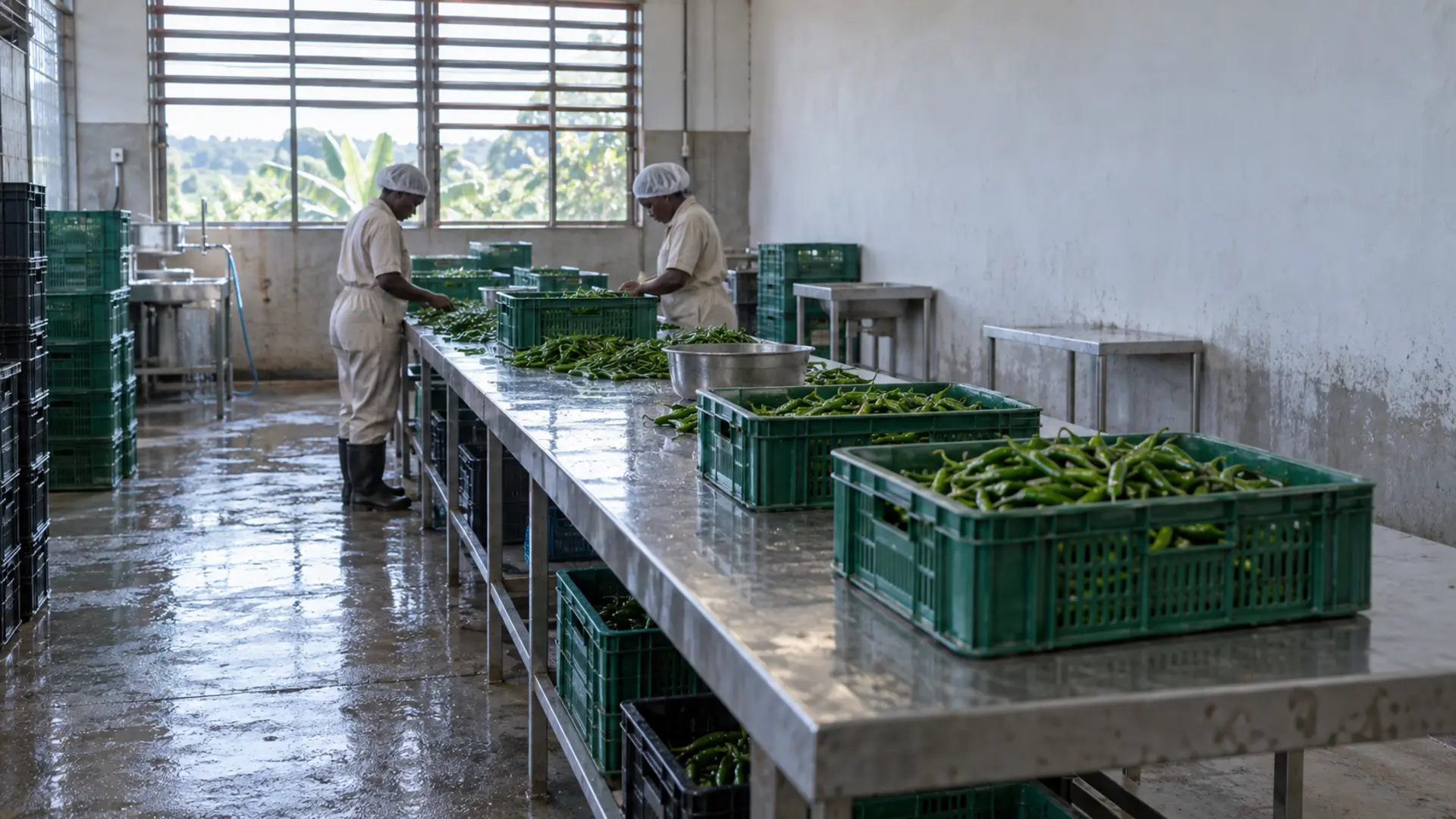
A grower with good chillies and a buyer in Europe has, in their own mind, an export business. What they actually have is a consignment that will be stopped.
The gap between the two is a registration route with nine stages, a pack house that must exist before anyone will audit it, and a certificate that is issued only after an inspector has examined the goods.
Nobody explains this in order. The result is that first consignments are assembled first and compliance is attempted afterwards, which is the most expensive possible sequence.
What this guide covers and what it excludes
It covers the compliance pathway: who registers, with whom, in what order, and which document each step produces; what the pack house and farm verification examines; how the phytosanitary certificate is obtained and what the law says about it; and the documented record of why Ugandan consignments have been stopped.
It excludes grading and packing practice, which is a separate operational subject; product certification for the domestic market; tax and customs procedure; freight and logistics pricing; and market-specific tariff advice. It names no buyer, no freight agent and no consolidator.
It is not legal advice. It is a reading of published instruments and published ministry process, with each named so you can read it yourself. On a question that ends in a seized consignment, the Department of Crop Inspection and Certification is the office whose answer counts.
The Ugandan context, in figures
Two numbers frame this whole subject.
The Standards and Trade Development Facility records that “In 2014, the EU intercepted more than 80% of fresh fruit and vegetable exports from Uganda because they contained harmful organisms, including false codling moth and fruit flies, in capsicum and bitter gourd.”
The same source records what happened afterwards: “Capsicum interceptions decreased by more than 90%, from 72 in 2018 to three in 2022.”
Read those together and the encouraging conclusion is available: this is a solvable problem, and Uganda has substantially solved a large part of it. The less encouraging conclusion is also available: it was solved by compliance systems that an individual first-time exporter now has to enter, and those systems are what the rest of this guide describes.
For scale, the Ministry’s own statistical abstract records that “Fruits and Vegetables exports in the FY 2024/25 stood at 191,508 MT, valued at USD 102.56 million.”
The operating principle, in plain language
Every importing country protects itself against pests and diseases arriving on plants. The international mechanism for that protection is a certificate issued by the exporting country’s own plant health authority, stating that the consignment has been inspected and meets the importing country’s requirements.
That is what a phytosanitary certificate is. It is not a quality certificate, not a grade, and not a statement that the produce will sell. It is a plant health statement made by one government to another.
Three consequences follow, and they explain most of what first-time exporters find surprising.
The certificate is issued after inspection, not before. You cannot hold a stock of them.
The requirements are the importing country’s, not Uganda’s. The Act says so in terms: the obligation arises where the destination country requires such a certificate, and the examination is done “in accordance with the requirements of the country of destination.”
The whole system depends on traceability. If a pest is found at destination, the importing country wants to know which field it came from. That is why the registration route below is built around farms, pack houses and records rather than around consignments.
What the law actually says
The governing instrument is the Plant Protection and Health Act, 2015.
Section 22(1) creates the obligation: “A person intending to export a consignment of plants or plant products to another country which requires such plants or plant materials to be accompanied by a phytosanitary certificate on importation shall submit the consignment for examination by an Inspector.”
Section 22(2) sets the timing and the two possible outcomes. Material is examined “within fourteen days of the date of export or in accordance with the requirements of the country of destination.” If the inspector is satisfied, he or she “shall recommend for the issuance of phytosanitary certificate.” If the material “presents any risk for the exportation and spread of plant pests, or does not otherwise satisfy the provisions of this Act it shall, at the expense of the exporter, be subject to appropriate treatment in order to remove the risk or otherwise be denied a phytosanitary certificate.”
Note the phrase “at the expense of the exporter.” A failed inspection is not neutral. It produces a treatment bill or a refusal.
Section 23(1) gives inspectors broad powers, including to “hold, open, inspect, sample, submit for examination, direct removal to a quarantine station, remove for treatment and treat” plants and plant products, and to “inspect any-land, store, warehouse, go-down or other premises used for handling or storing plants or plant products.”
Section 21 allows the Minister by statutory instrument to declare that specified material carrying a harmful organism above a stated amount “shall not be exported from Uganda.” That is the legal basis on which an export restriction can be imposed.
Section 28(2) sets penalties: for a body corporate, “a fine not exceeding two hundred fifty currency points”; for an individual, “a fine not exceeding twenty four currency points, or imprisonment not exceeding one year or both.” The Act defines a currency point as “equivalent to twenty thousand shillings.” On a second or subsequent conviction the court may additionally order “the withdrawal of any license, certificate, prescribed permit, registration, or any other right held by the offender under this Act.”
That last sentence is the one that matters commercially. The real penalty for a repeat offender is not the fine. It is losing the registration.
One honest note. We read the Act and found no section creating a registration scheme for exporters or premises. The registration route described below comes from published ministry process rather than from the Act’s own text, and this guide says so rather than implying a statutory basis it could not find.
The registration route
There are nine stages and they are strictly sequential, because each one requires evidence produced by the one before it. A first-time applicant who works them out of order loses weeks.
Process diagram with document register
Show the export registration route as a fixed sequence in which each step produces a specific document, so that an applicant can see what they must already hold before the next step will accept them.
The Ministry publishes the route for fruit and vegetable exporters, and the order matters because each stage requires evidence produced by the one before it.
Stage one. “Register with the Uganda Registration Services Bureau.” This is company registration and it is the foundation of everything else. The general approach to formalising a farm business is in registering and formalising a farm business.
Stage two. “Receive a recommendation for registration from The Commissioner External Trade, Ministry of Trade Industry and Cooperatives.”
Stage three. “Undergo orientation, SPS export readiness (pre-assessment of your production (out growers/farms) and packhouse facilities) by the Apex Association (HortiFresh).” Note what this is: a pre-assessment of your farms and your pack house, before the ministry ever sees them.
Stage four. “Obtain a recommendation letter from Hortifresh to the Commissioner for Crop Inspection and Certification.”
Stage five. Apply on company letterhead to the Commissioner for Crop Inspection and Certification, attaching proof of apex association membership, proof of the pack house and supplier audit, and proof of the orientation.
Stage six. “Applicants for registration for export are required to prove ownership of a hired, rented, or shared pack house before the commencement of the MAAIF audit.”
Stage seven. “Applicants for registration for export are also required to show proof of either owned nucleus farm or and have contracted farmers.”
Stage eight. Supply “a TIN Number from the Uganda Revenue Authority (URA), REX numbers for EU Exporters.”
Stage nine. “Submit the documents to the Department of Crop Inspection and Certification for approval to be an exporter.”
And a requirement that sits across the whole route: “No company will be registered for purposes of exporting without a physical address and an approved producer traceability system.”
The Ministry’s online certification page adds two operational details. The process runs through the Phytosanitary and Quarantine Inspection Services Division of the Department, and “Upon receipt of the application, a system audit shall be conducted within 10 working days.” It also states that “ALL exporters and importers shall undergo electronic registration and certification of their consignments via the MAAIF Portal.”
Four documents people confuse
Most first-time exporters believe they have the paperwork when they hold one of these. They are issued by four different bodies and only one of them travels with the goods.
Comparison table
Separate the four documents a first-time exporter must not confuse, because each is issued by a different body for a different purpose and holding one does not substitute for another.
A first-time exporter typically believes they have “the papers” when they hold one of these. They are not interchangeable.
Company registration proves the business exists. It proves nothing about the produce.
The tax identification number proves the business is registered with the revenue authority. The export promotion board’s documentation guide notes that “Exports are tax exempt,” but the registration is still required.
Export registration approval from the Department of Crop Inspection and Certification proves that your farms, pack house and traceability system have been audited and accepted. It is held by the business, not by a consignment.
The phytosanitary certificate is the only one of the four that travels with the goods. The export promotion board’s guide describes it as a “MANDATORY international requirement for trade in plant and plant products such as coffee, tea, fruits, vegetables, spices and grains,” issued by the “Crop Inspection and Certification Department,” and states a fee of “UGX. 5,000 per consignment.”
The same guide notes a certificate of origin as a separate document, “General” or “Preferential” depending on the destination market.
On fees. The figure above is quoted from the published guide. Fees change and are set administratively. Confirm the current figure before budgeting rather than relying on a figure in an article.
The electronic certificate
Uganda issues phytosanitary certificates electronically. The International Plant Protection Convention recorded in November 2020 that “Uganda are the latest country to go live on the the IPPC ePhyto Solution using the Generic System (GeNS) and from 30th November they will use the GeNS to issue phytosanitary certificates for a number of commodities.”
The Ministry’s own page describes the certificate in the same terms a buyer would: “A phytosanitary certificate is an official document issued to exporters of plants and or plant products whose products meet standard requirements of the target market.” It confirms that “The National Plant Protection Organization is the Department of Crop Inspection and Certification under the Ministry of Agriculture, Animal Industry and Fisheries,” and that farmers and traders “can conduct self-audits using provided checklists before formal inspection.”
That last sentence is an invitation worth accepting, and the next section is built on it.
The pack house and farm verification
The ministry’s own guidance invites applicants to conduct self-audits using checklists before formal inspection. This is that self-audit, and completing it honestly is considerably cheaper than failing one.
Checklist
Give the applicant a blank self-audit sheet to complete before the ministry audit, because the published process invites self-audit using checklists and an applicant who fails an audit loses a season.
The checklist above is a self-audit sheet. Complete it yourself, honestly, before anyone else does.
Two principles govern what an audit is actually looking for, and understanding them is more useful than memorising a list.
Can you trace a crate back to a field? Traceability is named explicitly as a registration condition. An audit will test it by picking something and asking where it came from. If the answer involves recollection rather than a record, the system does not exist.
Can contamination move backwards? Pack house layout is assessed for whether incoming unwashed produce, waste and outgoing packed produce share space or cross paths. This is not fussiness. It is the mechanism by which a single infested crate contaminates a consignment.
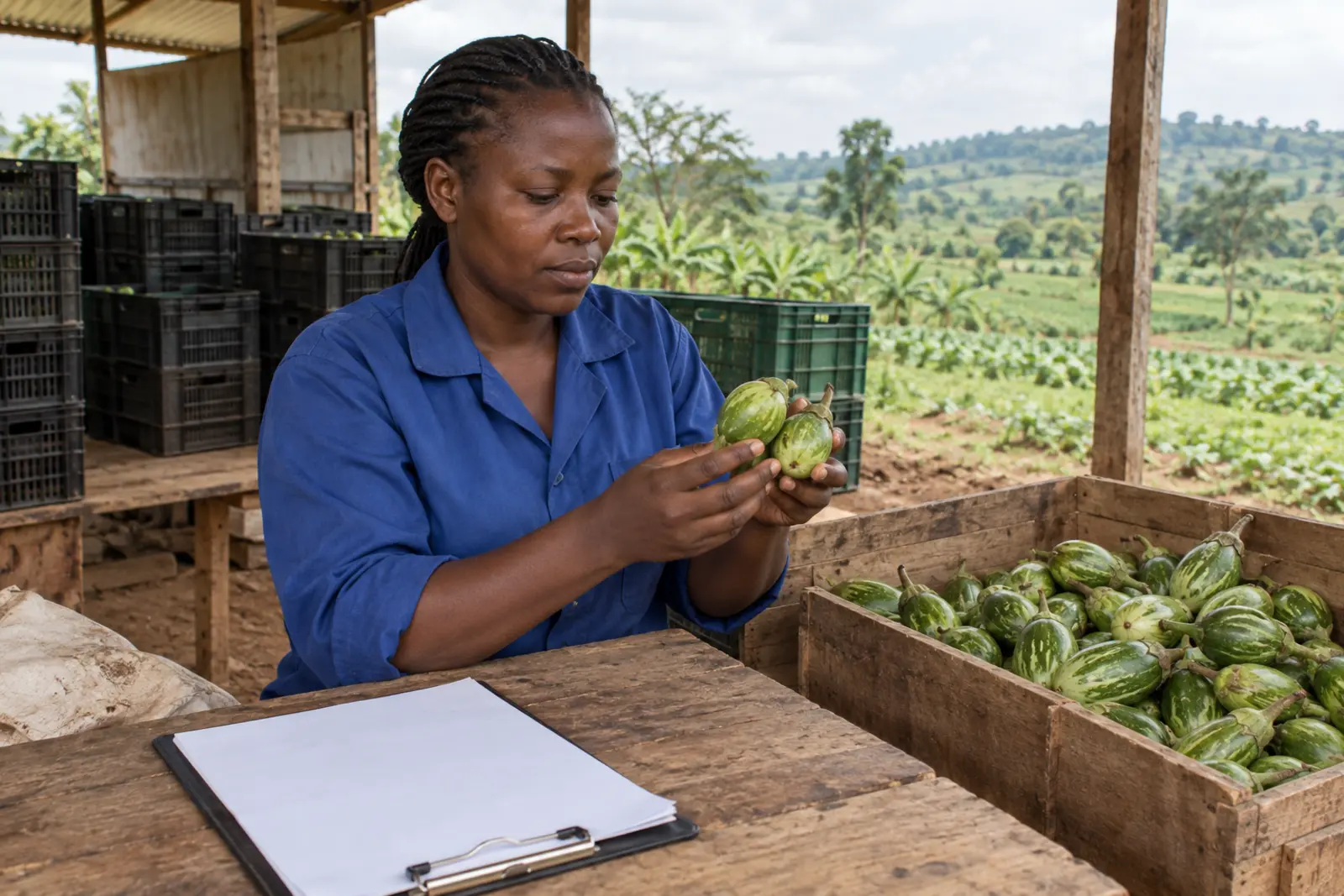
Three practical points about the farm side.
Contracted farmers are part of your system. The published requirement accepts an owned nucleus farm or contracted farmers. If you use contracted farmers, their fields are inside your audit boundary, and their records are your records.
Field pest management is where interceptions are prevented. Every documented Ugandan interception in the record below is a live organism, which means it was on the plant before the crate was packed. The scouting discipline that catches that is in integrated pest management scouting and thresholds.
What was applied, and when, is a record you will be asked for. The wider framework for handling agricultural chemicals is in safe pesticide use, selection, mixing and application.
What has actually stopped Ugandan consignments
General warnings about compliance are easy to write and useless to act on. Here instead is the documented record of what has genuinely stopped Ugandan produce, year by year.
Risk framework
Show the documented interception record rather than a general warning, so that a first-time exporter directs effort at the failure mode that has actually stopped Ugandan consignments.
This is where an honest article separates itself from a general warning. Here is the documented record.
2014. More than 80 per cent of fresh fruit and vegetable exports intercepted, for harmful organisms, specifically “false codling moth and fruit flies, in capsicum and bitter gourd.”
2018. False codling moth was designated a quarantine pest by the destination market with effect from 1 January 2018, which raised the consequence of every interception.
February 2019. Contemporaneous reporting of an official letter recorded that “As of 1st February 2019, the number of interceptions was 55 (40 in Capsicum, 9 in Rosa, 6 in Annona muricata),” described as the highest among that market’s trading partners, with a warning that a decision on a ban on peppers might follow.
April 2019. Uganda announced a self-imposed restriction. Reporting quoted the head of the European Union delegation welcoming Uganda’s “self-imposed ban on the export of chillies and substandard vegetables to Europe,” and saying “good government has halted the exports before the EU stepped in.”
2022. Capsicum interceptions recorded as three, against 72 in 2018.
Three things follow from this record, and all three are practical.
Every documented interception is a pest. We searched specifically for documented rejections of Ugandan produce on pesticide residue grounds and found none we could verify. That is a clean negative finding and it is reported as one. It does not mean residues do not matter; the residue framework is covered in food safety and residue requirements. It does mean that a Ugandan exporter allocating effort should put it into field pest management and pack house inspection first, because that is where the documented failures are.
The restriction was Uganda’s own. This is frequently misremembered as a ban imposed on Uganda. The reporting we could verify describes a Ugandan self-imposed suspension, announced before an external decision was taken. The distinction matters because it tells you how the system actually responds: the national authority will suspend a product category to protect the market, and an individual exporter’s non-compliance can therefore cost every other exporter of that product.
Interceptions concentrated in specific products. Capsicum, chillies, bitter gourd, roses, soursop. A new exporter entering one of these categories is entering a scrutinised one.
Common mistakes and why they fail
Assembling the consignment first. The commonest and most expensive. Registration takes weeks, the audit has a ten working day clock that only starts when the application is complete, and the certificate is issued after inspection of goods. A grower who harvests and then begins compliance has perishable produce and no route.
Treating the pack house as a building rather than a system. Proof of control of a pack house is stage six. A clean shed with no separation of incoming and outgoing produce and no records is not a pack house for audit purposes.
No traceability until asked for it. Traceability cannot be constructed retrospectively. It is a record made at harvest.
Believing the certificate can be bought without inspection. Section 22 makes the examination the precondition. An offer to supply a certificate without one should be treated as what it is.
Assuming the requirements are Ugandan. The Act refers the examination to the requirements of the destination country. Two consignments of the same produce to two markets can face different requirements.
Reading a fee or a form as permanent. Fees, forms and portal arrangements change. Confirm before you budget.
Concluding from one buyer’s interest that a market exists. How prices are actually formed, and what a first order does and does not prove, is dealt with in how Ugandan farm gate prices are formed and in a bankable farm business plan.
Cautions and escalation points
Legal. The penalty provisions apply to individuals and to companies, and a second conviction can cost the registration. Do not attempt to move produce across a border without the certificate the destination requires.
Financial. A denied certificate leaves you with treatment costs at your own expense under section 22(2)(b), or with produce you cannot ship. Neither outcome is covered by anything except your own working capital.
Reputational and collective. The 2019 record shows a national response to concentrated interceptions. Your non-compliance is capable of affecting other exporters.
Escalate to the Department of Crop Inspection and Certification for anything concerning registration, audit, inspection or certification. This is the National Plant Protection Organization and it is the only body whose answer on these questions is authoritative.
Escalate to a qualified customs or trade adviser for anything concerning tariffs, customs procedure or the documentation the destination market requires beyond the phytosanitary certificate. This guide deliberately does not cover that ground.
Escalate to the apex association for the pre-assessment and orientation stages, because they are stages three and four of the published route and cannot be skipped.
Where to start
A grower with no pack house and a grower whose consignment was just rejected need entirely different advice. The tree below routes you by where you actually stand.
Decision tree
Route a grower to the correct first action depending on where they currently stand, because a grower with no pack house and a grower with a registration number but a rejected consignment need entirely different advice.
The decision tree routes you by where you actually stand rather than where you intend to be.
Most first-time exporters discover they are at the first end point: the production base and the pack house have to exist before the registration route can begin. That is not a setback. It is the correct order, and discovering it before a harvest is considerably cheaper than discovering it after one.
Practical action plan
This month. Complete the self-audit checklist for your farm and your pack house, honestly. Establish a traceability record at harvest, even if you are not yet exporting, because a record cannot be created retrospectively and a season of records is what an audit will ask to see.
Next. Register the company if it is not registered. Obtain the tax identification number. These two have no seasonal dependency and no reason to wait.
Then. Approach the apex association for orientation and the sanitary and phytosanitary pre-assessment. This is stage three, it assesses your farms and pack house, and it produces the recommendation letter that stage four requires.
Then. Assemble the application: letterhead request, apex membership proof, audit proof, orientation proof, pack house control evidence, farm or contract evidence, tax identification number, and the registered exporter number if your destination requires one. Submit to the Department of Crop Inspection and Certification and expect the system audit within ten working days of a complete application.
For each consignment thereafter. Apply through the electronic system, submit the consignment for examination, and plan the timetable around an inspection that precedes shipment rather than following it.
Throughout. Manage field pests as though every consignment will be inspected, because in the documented record that is where Ugandan consignments have failed.
Conclusion
Uganda’s export compliance system is more navigable than its reputation suggests, and the documented improvement in capsicum interceptions between 2018 and 2022 is evidence that it works when it is used.
What defeats first-time exporters is not the difficulty of any single step. It is doing the steps in the wrong order, and specifically assembling a consignment before the registration, the audit and the traceability record exist to support it.
Build the system first. The consignment is the last part, not the first.
Author
This guide was produced by the Falcon Foundation Ltd Editorial Team. We research agricultural questions against published government instruments, institutional guidance and peer-reviewed evidence, and we translate them into decisions a Ugandan farmer or agribusiness can act on. Where a figure, a legal duty or an institutional position could not be verified from a document we were able to open and read, we say so in the article rather than filling the gap. This article is not legal advice and Falcon Foundation Ltd is not a law firm or a licensed customs agent.
