
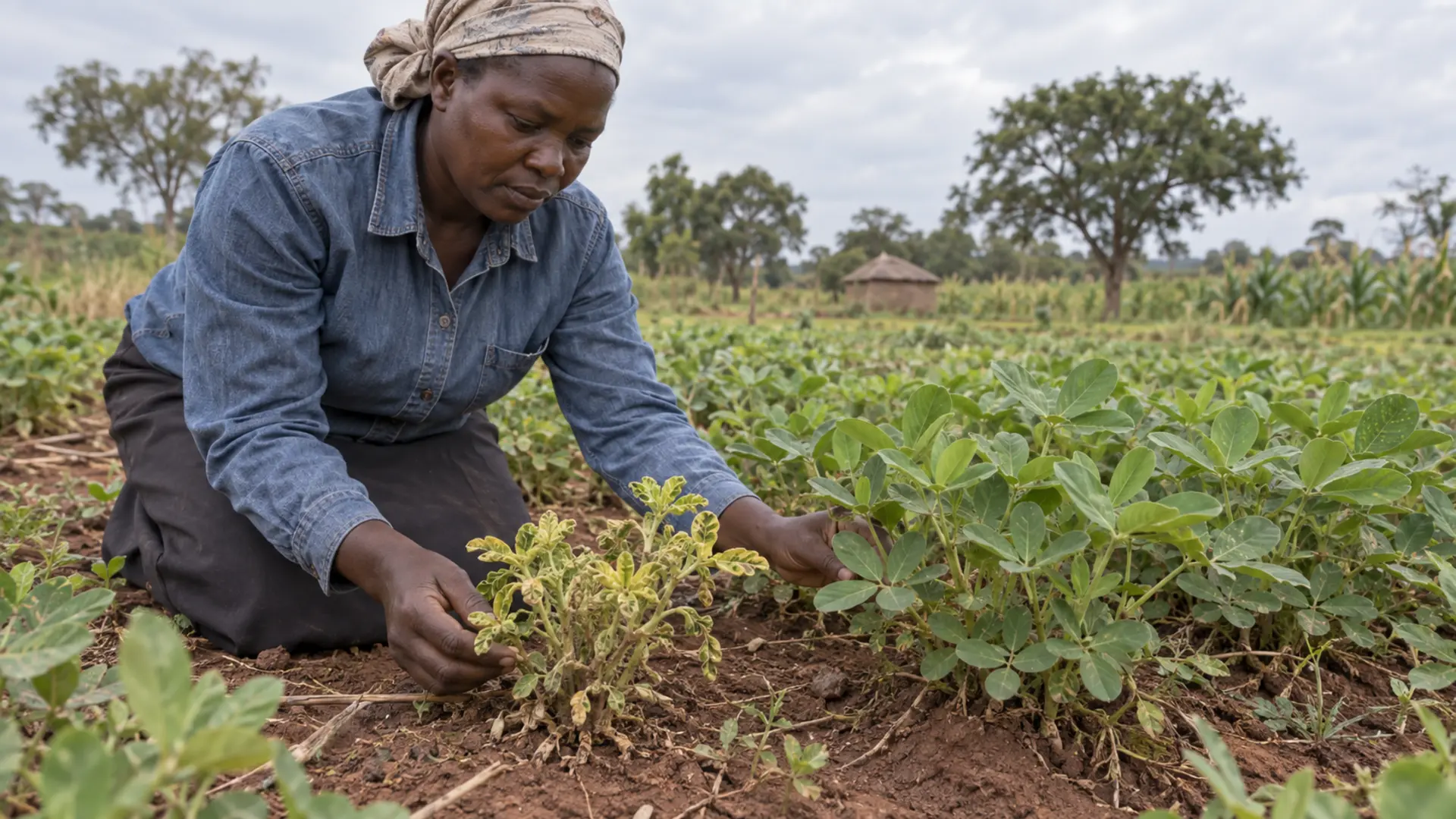
The plants come up well. Three or four weeks later a few of them look wrong: short, bunched, the leaves too small and the colour off. You pull one and the root is fine. Nothing is eating it.
A month after that, patches of the field look the same, and by then it is too late to do anything about it. Rosette is not a disease you treat. It is a disease you plan around, and the planning happens before you plant.
What this guide helps you decide
By the end you should be able to recognise the two forms of rosette in the field and distinguish them from other causes of stunting; understand when the aphid that carries it arrives on your crop and why; and make the two changes that the research shows reduce it, which are when you plant and how closely you space.
It does not cover aflatoxin, which is a separate problem handled after harvest, and it names no pesticide products of any kind.
The short answer
Plant as early in the season as the rains allow, and plant close. Both of those reduce the number of virus-carrying aphids that land on and move through your crop, and both are free.
Scout the undersides of young leaves from emergence, because the aphid population builds on the crop rapidly around the second month. Pull out and destroy plants showing symptoms as soon as you see them, and clear volunteer groundnut plants left from last season before you plant. Where you can obtain seed of a variety documented as rosette resistant, use it.
There is no spray in this guide, and no treatment. Once a plant is infected, it stays infected.
What is actually causing it
Rosette is not one virus. It is three agents working together, and understanding the arrangement explains why the control measures are what they are.
Groundnut rosette virus is an umbravirus. It does not encode a coat protein of its own, so it cannot form the protective particle a virus needs to survive outside a plant, and it cannot be picked up by an aphid on its own.
Groundnut rosette assistor virus is a luteovirus. It supplies the coat protein. On its own it produces no symptoms at all. Its role is to make aphid transmission possible.
A satellite RNA depends on the rosette virus to replicate, and it is the satellite that determines the symptoms you see. Which variant is present decides whether the plant shows chlorotic rosette or green rosette.
The practical consequence is that all three must be present in a plant for that plant to become a source of infection for the rest of your field. Research has documented that short aphid probes can transmit the rosette virus and the satellite without the assistor virus, producing plants that show symptoms but cannot pass the disease on. Those are dead-end sources. Most infected plants are not.
The aphid, and its timetable
The vector is Aphis craccivora, the small dark aphid you find on the growing points and the undersides of young leaves of groundnut, cowpea and other legumes.
Transmission is persistent and circulative. That means the aphid has to feed for a substantial period to acquire the virus, then wait through a latent period before it can pass it on, and then it stays infective for a long time. Published virus descriptions record that most aphids need to feed for longer than 24 hours to acquire, with many needing two to three days, and that once infective they retain the ability to transmit for at least fifteen days and possibly for life. Detailed work gives acquisition access feeding of about four hours for the chlorotic form and about eight hours for the green form, with latent periods of roughly 26 and 39 hours respectively.
That timetable matters for a reason people usually miss. This is not an insect you can knock back once and have solved. An aphid that acquired the virus in a neighbour’s field a week ago carries it into yours already infective.
The Ugandan work on the aphid itself is old but directly relevant. A study at Serere Research Station between 1964 and 1968 found that aphid numbers increased rapidly on the groundnut crop 31 to 45 days from emergence, that the vector survived the dry seasons on weeds including Euphorbia hirta and Euphorbia prostrata, and that low-density plantings supported substantially higher aphid numbers than dense ones. Those three findings are the backbone of everything recommended below.
Telling the two forms apart, and telling rosette from everything else
Chlorotic rosette. Young leaves show faint mottling that develops into bright yellow leaflets with green veins and sometimes green islands. The leaf lamina curls. Internodes shorten severely, so the plant becomes a tight bunch close to the ground.
Green rosette. Young leaflets show mottling with some curling. The plant is severely stunted, but it stays dark green rather than turning yellow. This is the form that predominates in Uganda. A nationwide survey covering 23 districts in 2012 and 2013 concluded that the green rosette type predominates, making Uganda a green rosette belt.
What both share. Severe stunting, dramatically shortened internodes, a bunched or rosette habit, and leaflets smaller than they should be. The plant looks compressed.
What rosette is not. A plant stunted by waterlogging or compaction has a poor root system when you pull it. A plant short of nitrogen is pale overall and evenly so, without the bunching and without the mottling on young leaves. A plant damaged by insects has visible feeding damage. Pull three suspect plants and three healthy ones and look at the roots and the internodes side by side. If the roots are sound and the internodes are compressed, you are looking at rosette.
Timing of infection matters enormously. Research is consistent that early infection, before flowering, can cause total loss on the affected plant, while late infection has comparatively minor effect. A plant that shows symptoms at pod fill has already made most of its yield. A plant that showed them at four weeks has not.
The two changes that work
Plant early
The controlled evidence comes from a field trial in Malawi that compared planting around the first of December with planting around the first of January, at three spacings. Numbers of incoming winged aphids were significantly greater on late-planted than on early-planted groundnuts, and the rate of secondary spread within the crop followed the same pattern.
The mechanism given in the wider literature is that early planting at optimum density lets the crop reach ground cover before the aphids’ main flight period. A bare-looking field with soil showing between plants is visually attractive to a landing aphid. A closed canopy is not.
Ugandan practitioner guidance says the same thing. The groundnut manual for Uganda prepared under a Department for International Development crop protection project states that late planted crops and wide spacing can increase the incidence of rosette disease and should be avoided, and gives an early planting window of 15 February to 15 April.
The rule for you: plant as soon as the rains are reliably established, not two or three weeks later when other work is finished. Late planting is the single most common cause of a heavy rosette year.
Plant close
The same Malawi trial compared within-row spacings of 30, 7.5 and 2.5 centimetres in 90 centimetre rows. Both aphid landing and secondary spread ranked in the order 30 centimetres worse than 7.5, worse than 2.5. Closer spacing gave less disease. The Ugandan aphid ecology study reached the same conclusion from the insect side: low-density plantings supported substantially higher aphid numbers.
The Ugandan spacings published in the NaSARRI and ICRISAT production guide for Uganda are:
- Erect and bunchy types: 45 centimetres between rows and 10 to 15 centimetres between plants
- Spreading types: 45 centimetres between rows and 7.5 to 10 centimetres between plants
Note the difference is driven by the growth habit of the variety, so you need to know which type you are planting. The same guide states that early planting and close spacing of rows reduce disease, and that intercropping with beans or sorghum is effective in reducing incidence.
Two practical points. First, measure your spacing rather than pacing it, at least for the first few rows, until your eye is calibrated. Most fields that look closely planted are not. Second, fill or re-plant gaps promptly. A gappy field is an open field.
Roguing and the volunteer problem
Two sources of infection sit on your own land between seasons.
Infected plants in the standing crop. Published guidance is consistent that roguing infected plants prevents both primary and secondary spread. Pull them, do not just cut them. Remove them from the field. Guidance from a regional plant health factsheet specifies destroying them by burning or deep burying rather than leaving them on the headland.
Volunteer groundnuts. Plants that come up on their own from last season’s missed pods carry the virus through the gap between crops. The same factsheet is explicit: eliminate volunteer groundnuts from fields, as they serve as disease sources for subsequent seasons.
Add to this the weed hosts. The Serere work found the aphid surviving the dry season on Euphorbia hirta and Euphorbia prostrata. Clearing those from field margins removes the aphid’s bridge as well as the virus’s.
Do the volunteer and weed clearance before you plant, not after. Once your crop is up, the volunteers are hidden in it.
Varieties, and what we can and cannot confirm
NARO’s National Semi Arid Resources Research Institute at Serere runs Uganda’s groundnut breeding programme and has released a Serenut series. Its own institutional material describes work on rosette resistant lines.
What we can confirm from documents we opened: Serenut 2 and Igola 1 are named as resistant in multiple Ugandan guidance documents. The broader phrase “Serenut 2 to 14 series” is used generically as resistant in the NaSARRI and ICRISAT production guide.
What we cannot confirm: the individual rosette resistance rating of most numbered Serenut releases. The formal variety registration papers were not accessible to us. A 2019 field trial in Kitgum, Omoro, Amuru and Nwoya evaluated Serenut 5R, 8R, 9T and 14R, all released in 2010 and 2011, and recorded rosette severity scores between 1.5 and 3.5 with no statistically significant difference between the four varieties. That same trial found dry pod yield significantly negatively correlated with rosette severity, at a correlation of minus 0.437, which is a direct measure of what the disease costs in the field.
We also could not verify current seed availability for any named variety. Ask NaSARRI or your district agricultural officer rather than a general supplier, and ask specifically whether the seed is certified and which variety it actually is. The published guide to verifying seed and planting material quality covers how to check.
What it costs
No prices, because groundnut seed and labour rates vary and we will not invent them. The cost categories a rosette strategy involves are:
- Seed, and more of it than a wide-spaced crop, because closer spacing means a higher seed rate
- Certified or quality-declared seed of a resistant variety, if you can obtain it, which usually costs more than saved seed
- Labour for accurate spacing at planting, which is slower than broadcasting or pacing
- Labour for scouting, roughly twice a week from emergence
- Labour for roguing and for clearing volunteers and weed hosts before planting
- Nothing at all for the two most effective measures, which are planting earlier and planting closer
Common mistakes
Waiting to see how bad it gets. Every week you wait, infected plants are feeding the aphids that infect the rest.
Planting late because other work came first. The evidence on planting date is among the clearest in this subject, and late planting is a choice made in February that shows up in April.
Pacing the spacing. Almost everyone paces wider than they think. Measure the first rows.
Cutting rogued plants instead of pulling them. A cut plant regrows and stays a source.
Leaving volunteers standing. They carry the virus across the dry season on your own land.
Assuming a resistant variety removes the need for the rest. The 2019 northern Uganda trial found rosette severity in all four improved varieties tested. Resistance reduces the problem. It does not remove it.
Applying a yield loss figure from elsewhere to your field. We give none for Uganda, because none exists that we could verify.
Warning signs and escalation points
- Stunted, bunched plants appearing before flowering, which is when the yield consequence is greatest
- Colonies of small dark aphids on the growing points and the undersides of young leaves
- Symptomatic plants appearing in a spreading patch rather than scattered singly, which indicates secondary spread within your field
- Symptoms appearing in a field where you also grow cowpea or other legumes, which share the vector
- Rosette appearing in a neighbouring field, which is a reason to scout yours immediately
Contact your district agricultural officer or the nearest NARO institute if rosette appears widely and early across your area, or if you cannot obtain seed of a resistant variety. District-level outbreaks are worth reporting rather than absorbing quietly.
Where this approach works, and where it does not
It works in the groundnut systems of eastern and northern Uganda where the disease is documented, and it works for a farmer with land, seed and control over their own planting date.
It works less well in three situations. Where the rains are unreliable and planting early risks losing the crop to a false start, the planting date advice conflicts with a real agronomic risk and you have to weigh them. Where seed is scarce, closer spacing may not be affordable in the season you most need it. And where the surrounding fields are all planted late, your crop sits in a landscape producing aphids regardless of what you do on your own plot, which is an argument for talking to neighbours rather than acting alone.
An honest note on the evidence. The two controlled trials behind the planting date and spacing recommendations were done in Malawi in 1976 and in Uganda between 1964 and 1968. They are sound peer-reviewed work and the mechanism is well understood, but they are not recent Ugandan field data. We could not retrieve a numeric incidence or severity percentage for Uganda from the national survey, and we found no Uganda-specific yield loss figure at all. The continental figures that exist, of over 150 million United States dollars a year in annual losses across sub-Saharan Africa, are regional and should not be presented as Ugandan.
A low-risk first step
Walk the field you intend to plant, before you plant it, and pull every volunteer groundnut plant you find. Clear the Euphorbia and other weeds from the margins while you are there.
It takes an afternoon, costs nothing, and removes the reservoir that carries both the virus and its vector across the gap between your seasons. It is also the only rosette measure that has to be done before planting and cannot be caught up later.
What to do next
- Clear volunteer groundnuts and weed hosts from the field and its margins before land preparation.
- Decide your planting date now and protect it. Plan the labour so groundnuts are not the last crop planted.
- Find out the growth habit of the variety you will plant and set the correct spacing for it.
- Measure the first few rows at planting with a marked stick rather than pacing.
- Ask NaSARRI or your district agricultural officer about seed of a documented rosette resistant variety, and ask what is actually available.
- Scout twice weekly from emergence, turning young leaves over, and rogue symptomatic plants the same day you find them.
- Consider intercropping with beans or sorghum, which Ugandan guidance describes as effective in reducing incidence.
Related reading: the published guides to integrated pest management scouting and thresholds and the evidence limits of biological control and biopesticides cover the wider approach. After harvest, drying and storing grain legumes safely handles the aflatoxin problem that groundnuts carry separately from rosette.
About the author
This guide was researched and written by the Falcon Foundation Ltd Editorial Team. Falcon Foundation Ltd is a privately owned Ugandan agricultural company producing greenhouse crops, livestock and honey. Our Knowledge Hub is written for Ugandan farmers making practical decisions with incomplete information. We name no pesticide products, and we say plainly when a figure for Uganda does not exist.
