
Honey that ferments in the bucket was not spoiled in the bucket. It was harvested wet.
That is the whole subject in one sentence, and almost everything else in this guide follows from it. Fermentation is a water problem, water gets in at three specific points, and two of those three are entirely under the beekeeper’s control.
What this guide covers and what it excludes
It covers how to judge ripeness at the hive without an instrument, why moisture causes fermentation and at what documented level, the extraction and straining sequence with the documented limit at each step, container and storage rules, and the full list of parameters a buyer or a laboratory can test you against.
It excludes hive inspection and colony management, wax and other bee products, and export documentation, which is a separate compliance subject covered in exporting produce from Uganda. Pesticide exposure and apiary siting are dealt with in protecting bees from pesticide exposure.
One thing this guide will not do is give you a standard number for a Ugandan honey composition specification. We searched for one and could not open a document establishing that it exists. What Uganda has, and what we read in full, is a national code of practice covering apiary management, handling and processing. That code is quoted extensively below. It sets procedures. It sets no numbers for moisture, acidity or any other composition parameter, and this guide says so rather than attaching a number to a standard we could not verify.
The Ugandan context
The Ministry’s statistical abstract records national honey production rising across five financial years, from 15,600 tonnes to 21,505 tonnes, with the most recent year described as an increase “by 3% from 20,875MT in 2022/23 to 21,505 MT in 2023/24.”
The same abstract records exports in terms that need reporting carefully: “The quantity of Honey exported increased from 10,400MT to 44,849MT fetching the revenue of US$42 and US$59 [million] from FY 2022/23 to FY 2023/24 respectively.”
Set those two figures side by side and the export quantity for 2023/24 exceeds the recorded national production for the same year by more than double. We report that discrepancy rather than resolving it, because the document does not explain it and we are not going to invent an explanation. What it tells a beekeeper is that published national honey figures should be handled with care, and that any market claim built on them deserves a question.
The same document contains no figure for the number of Ugandan beekeepers, which we also report rather than estimating.
Why honey ferments
Fermentation is not a mystery and it is not bad luck. It is a chain with four links, and a beekeeper controls two of them completely.
Risk framework
Explain fermentation as a water problem with a documented threshold, so that a beekeeper understands why the capping rule exists rather than treating it as an arbitrary instruction.
Honey resists spoilage because it is a concentrated sugar solution. Most micro-organisms cannot grow in it because the sugar draws water out of them.
But not all. International guidance is precise about this: “Only osmophilic yeasts can grow in the high sugar concentrations, but their presence is ubiquitous in honey, nectar, hive interiors, dust and soils.” Ubiquitous means everywhere. You are not going to keep them out.
What you can control is whether they can multiply, and that is a water question. The same guidance states: “Their rate of multiplication increases proportionally with increasing water content, up to a certain point.”
And it gives the threshold: “Below 18% moisture content there is little probability of fermentation, but even at concentrations below 17.1% the risk of fermentation cannot be completely excluded.”
Read both halves of that sentence. Eighteen per cent is the practical line. And even below it, the risk is reduced rather than abolished.
Three routes by which water gets into honey.
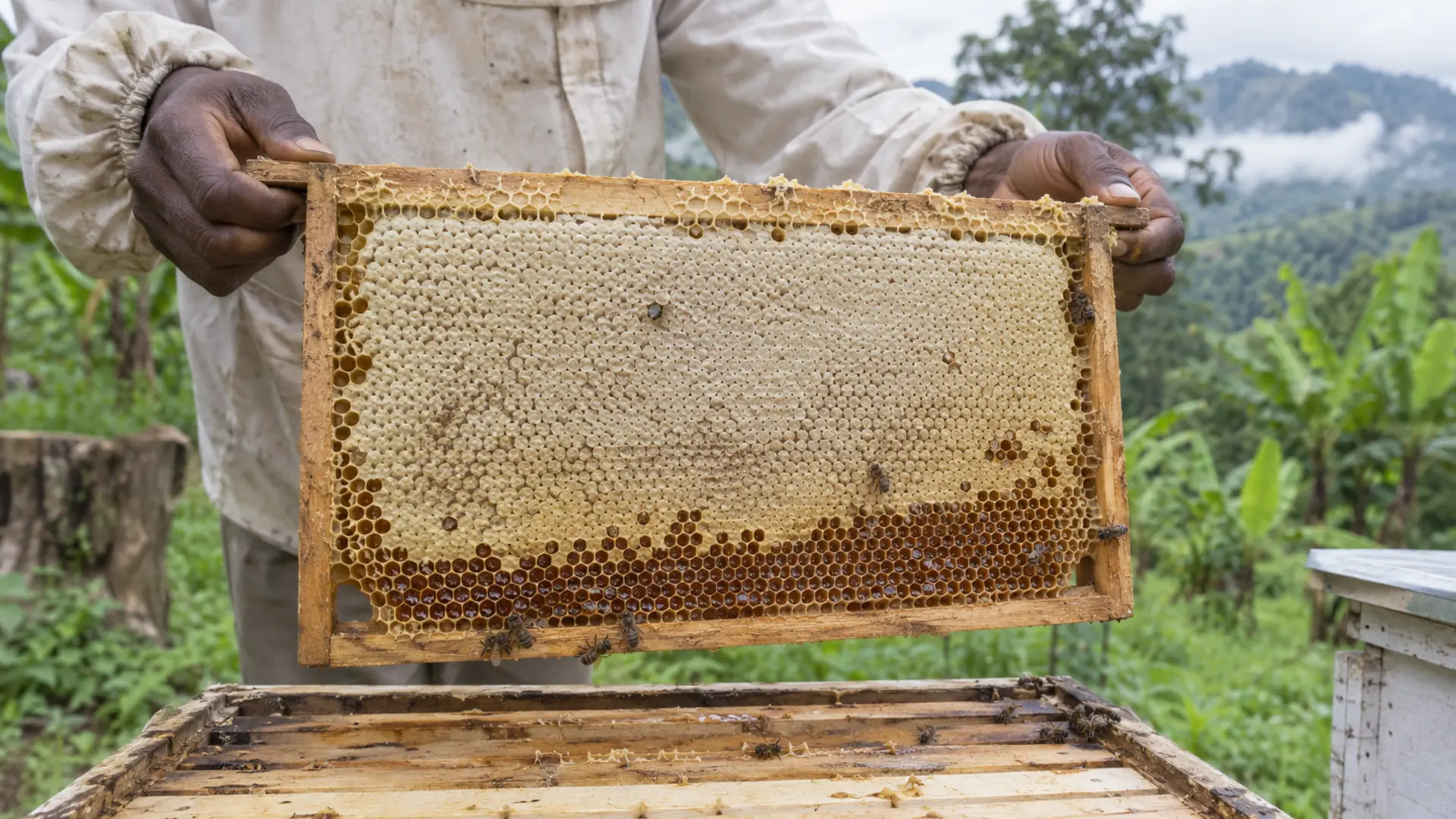
The bees had not finished. Bees ripen honey by evaporating water from it and then sealing the cell. An unsealed cell contains honey the bees have judged not yet ready. Harvesting it is harvesting water.
It absorbed moisture from the air. The Ugandan code of practice states it directly: “Harvested honey, honey in combs or extracted has a potential to absorb moisture under given conditions.” It goes further, describing the mechanism: “For each honey a relative humidity exists at which no gain or loss of moisture takes place”, and warns that where honey takes up water “There may be a relatively rapid dilution at the surface and fermentation starts.”
Note the phrase at the surface. A honey that ferments often ferments from the top down, because that is where the humid air met it. An airtight container is not a refinement.
It was added during handling. Wet buckets, wet cloths, wet knives. Every piece of equipment that goes into honey wet puts water into honey.
The first route is prevented by the capping rule. The second and third are prevented by containers and hygiene. That is the entire structure of the next three sections.
Ripeness
This is the single decision that determines whether a batch keeps or ferments, and it is made at the hive with your eyes rather than with an instrument.
Diagnostic panel
Give the beekeeper a way to judge ripeness at the hive without a refractometer, since the national code and international guidance both key ripeness to capping and most Ugandan beekeepers have no instrument.
Two documented rules exist and a Ugandan beekeeper should know both.
The Ugandan code of practice is categorical. Clause 6.1: “During harvesting only sealed/capped combs shall be harvested.” Clause 6.4.3 adds a selection rule: “Select only combs that are either full or three quarters full of ripe honey.” And clause 6.2.3 identifies capping as the inspection indicator: “During inspection, the honey cells are found to be capped.”
International guidance gives a proportion. “only completely ripe honey should be harvested, i.e. combs with more than 75% of the honey cells sealed.”
These agree in substance. The national code requires sealed combs and combs full or three quarters full; the international guidance puts the sealing threshold at more than 75 per cent of cells. A beekeeper applying either will harvest ripe honey. A beekeeper applying both will harvest ripe honey and be able to say which rule they followed if a buyer asks.
On the shake test. It is widely described: tilt or shake the comb and see whether honey runs out of the unsealed cells. We searched for an institutional or peer-reviewed source documenting it as a method and found none we could open. This guide therefore gives you no shake test procedure. That is a gap and it is reported as one. What we can tell you is that the capping rule is documented twice, in a Ugandan instrument and in international guidance, and it is enough on its own.
On refractometers. A honey refractometer measures moisture directly and removes the guesswork entirely. We could not open an institutional source documenting its scale and operation, so this guide describes no reading procedure for one. If you have access to one, a laboratory or an experienced buyer can show you how to use it in five minutes, and the number it gives you is the one that matters against the 18 per cent threshold above.
From hive to container
Seven stages separate a sealed comb from a sealed container, and each one carries a documented limit that is easy to breach without noticing.
Process diagram
Set out the harvest to container sequence as a fixed order with the documented limit attached to each step, because the commonest quality failures happen between the hive and the bucket.
The sequence has seven stages and each carries a documented limit.
Opening the hive. The Ugandan code: “Before opening the hive, a minimum amount of smoke shall be puffed into the hive.” Minimum is the operative word. Heavy smoking drives bees into the honey and leaves smoke taint in the product.
Selecting combs. The capping rules above.
Cutting or uncapping. The Ugandan code discourages one specific practice directly. Where fire is used for smoothening, it “leads to formation of off-flavours” and “is therefore not encouraged.”
Extraction. International guidance sets a temperature ceiling: “extraction temperatures should not exceed 30°C.” This matters commercially, and the reason is in the parameter table below. Heat drives up hydroxymethylfurfural, which is one of the things a buyer tests. Warming honey to make it flow is the fastest way to fail a test you did not know existed.
Straining. Here the two sources give different figures and we report both.
The Ugandan code, clause 7.2.1, specifies “straining using a clean cloth of mesh 500 microns or 200 microns.”
International guidance states that “The finest mesh size used commonly has holes of 0.1-0.2 mm diameter”, which is 100 to 200 microns.
The fine end of both ranges agrees at 200 microns. The Ugandan code additionally permits a coarser 500 micron cloth, and the international guidance describes finer mesh down to 100 microns as commonly used. A beekeeper straining through 200 microns satisfies both. A beekeeper straining through a kitchen cloth of unknown mesh satisfies neither and cannot say what they did.
Settling. International guidance: “At temperatures of 25-30°C settling is generally rather quick and can be completed in a few days.” Settling lets fine wax and air bubbles rise so they can be skimmed. The Ugandan code sets no settling time, which we note rather than filling.
Container and storage. The Ugandan code, clause 6.4.1: “Honey containers may be made of earthenware, stainless steel, or airtight buckets, but shall always be rustproof.” Clause 7.3: “After processing, the product shall be kept in airtight containers.”
International guidance is stricter on materials, and the two do not agree. It states: “No copper, iron, steel or zinc should be used as they dissolve into the honey and may affect colour and flavour, and might reach toxic levels.” It recommends instead that “stainless steel, glass and food grade plastic can be recommended”, and permits galvanised steel only “for surfaces which come into contact with honey only for short periods, such as in extractors.”
How to use that disagreement. They agree on stainless steel. They agree on avoiding rust. The international guidance additionally excludes plain iron, steel, copper and zinc by name, and gives a toxicity reason. Where two credible sources differ and one gives a safety reason, follow the stricter one. Stainless steel, glass or food-grade plastic, airtight, and nothing else.
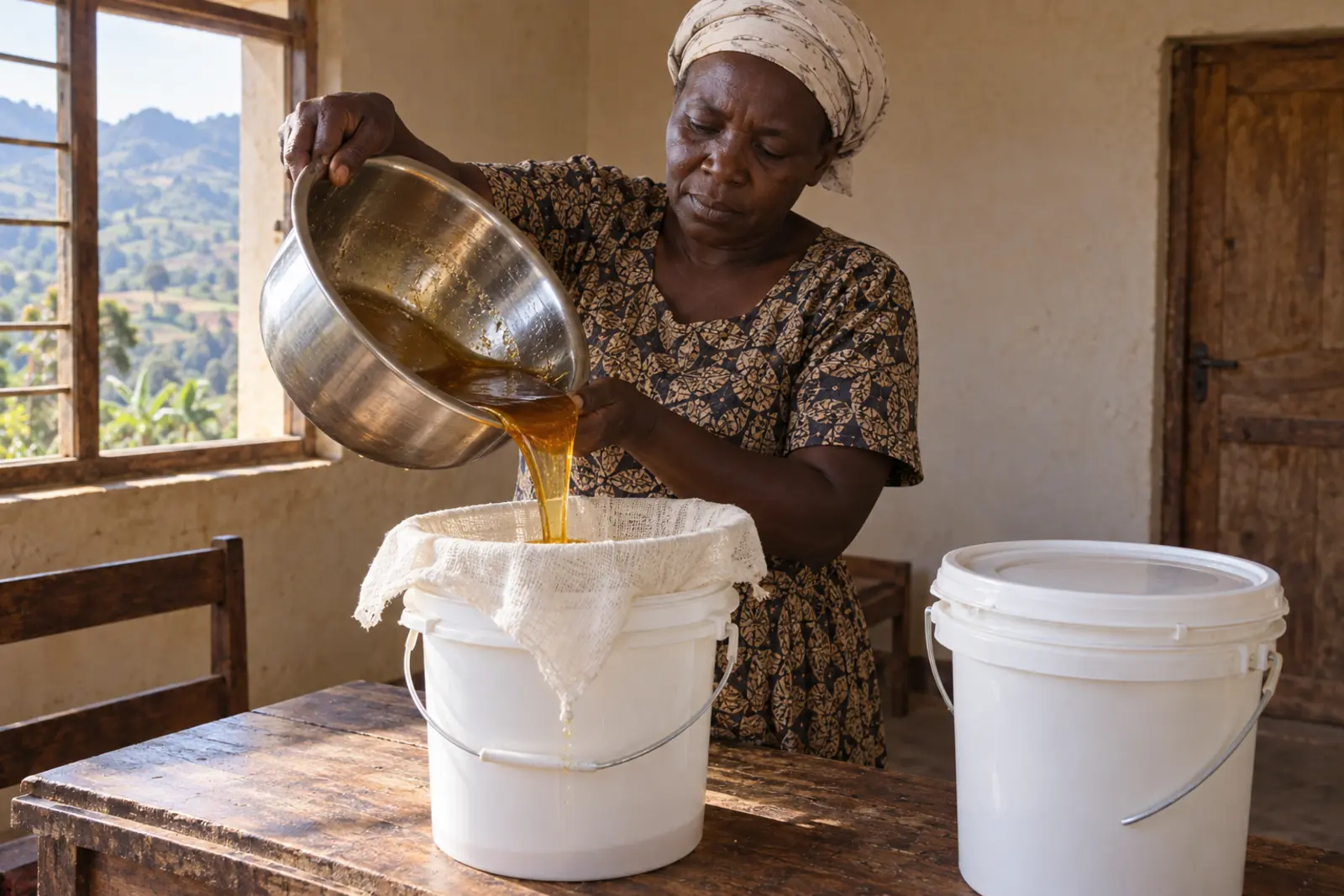
Hygiene across all of it. The Ugandan code, clause 6.3.2: “equipment such as airtight buckets, knives, etc that may come into direct contact with the product shall be washed with potable water and properly dried.” Properly dried is the phrase that matters. A washed bucket that is still wet is a water addition.
And clause 10.2.2.1 covers the person: “everyone entering the production area present himself or herself in a clean and tidy manner.”
What buyers actually test
A serious buyer is applying a specification whether or not anyone explains it to you. Here is the full list, with the documented figure for each.
Comparison table
Show the full set of parameters a buyer or laboratory can test honey against, with the documented figure for each, so a beekeeper knows in advance what they are being judged on.
The international food standard for honey sets the parameters. A Ugandan beekeeper selling to a serious buyer will be judged against these whether or not anyone explains them first.
Moisture. “Honeys not listed below - not more than 20%”, with a separate figure of “not more than 23%” for one named heather honey.
Note the gap between this and the fermentation threshold. The standard permits up to 20 per cent. International guidance puts the fermentation risk line at 18 per cent. A honey at 19.5 per cent moisture complies with the standard and is at real risk of fermenting in a warm store. Selling to a standard is not the same as selling something that will keep.
Sugars. Fructose and glucose combined, “not less than 60 g/100g” for most honeys and “not less than 45 g/100g” for honeydew honey and blends. Sucrose “not more than 5 g/100g” generally, with higher figures of 10 and 15 grammes per 100 grammes permitted for named floral sources.
Sucrose is the number that catches adulteration with cane sugar, which is why it is low.
Water-insoluble solids. “Honeys other than pressed honey - not more than 0.1 g/100g” and “Pressed honey - not more than 0.5 g/100g.” This is what straining controls. Wax, bee parts and dirt.
Free acidity. “The free acidity of honey may be not more than 50 milliequivalents acid per 1000g.” Rising acidity is one of the signatures of fermentation.
Diastase. “In general not less than 8 Schade units and in the case of honeys with a low natural enzyme content not less than 3 Schade Units.” Diastase is a natural enzyme that is destroyed by heat and by long storage. A low reading suggests the honey was overheated or is old.
Hydroxymethylfurfural. “Shall not be more than 40 mg/kg”, with an important exception: “in the case of honey of declared origin from countries or regions with tropical ambient temperatures, and blends of these honeys, the HMF content shall not be more than 80 mg/kg.”
That exception matters directly to Uganda. It exists because honey stored in tropical ambient temperatures naturally develops more of this compound. A Ugandan beekeeper whose honey is tested against the 40 milligramme figure rather than the 80 milligramme tropical figure is being held to the wrong line, and that is worth knowing before a negotiation.
What the standard says about additions. “Honey sold as such shall not have added to it any food ingredient, including food additives, nor shall any other additions be made other than honey.” And on removals: “No pollen or constituent particular to honey may be removed except where this is unavoidable in the removal of foreign inorganic or organic matter.”
Authenticity testing. The standard names the methods used to detect added sugar: a sugar profile method and a stable carbon isotope ratio analysis method. A beekeeper should understand that adulteration is detectable by laboratory analysis, not just by taste.
And the column that matters most. For every parameter above, the Ugandan code of practice sets no figure. We read it in full. It governs procedure and hygiene, not composition. Any Ugandan buyer quoting you a moisture specification is applying an international standard or a private buyer specification, and you are entitled to ask which.
Common mistakes and why they fail
Harvesting unsealed combs because the season is ending. The single largest cause of fermenting honey. The bees have not finished removing the water and nothing you do afterwards puts it back.
Warming honey to make it pour. Fails the hydroxymethylfurfural and diastase tests at once, and the beekeeper never finds out why the buyer paid less.
Straining through whatever cloth is available. The documented figures are 200 to 500 microns in the national code and 100 to 200 microns in international guidance. An unknown cloth gives an unknown result on the water-insoluble solids test.
Reusing a container that held something else. The code requires rustproof containers and washed, properly dried equipment. A drum that held fuel or chemicals is not made acceptable by rinsing.
Leaving a large air gap in the container. Honey absorbs moisture from the air above it, and the code describes rapid dilution at the surface starting fermentation. Fill the container.
Storing in the sun or in a hot roof space. Drives the hydroxymethylfurfural up and the diastase down, which are two of the tests.
Wet equipment. Washed is not the same as dried.
Assuming crystallised honey has gone bad. It has not. We could not open an institutional source documenting the crystallisation mechanism, so this guide explains no mechanism, but nothing in the international standard treats crystallisation as a defect, and the standard expressly prohibits chemical or biochemical treatments to influence it.
Blending a fermenting batch into a good one. Turns one loss into a larger one.
Cautions and escalation points
Food safety. Honey is a food, and everything in the hygiene clauses of the national code exists because of that. The wider Ugandan food safety and residue framework is in food safety and residue requirements.
Do not treat a fermenting batch and sell it. The national code prohibits nothing specific here, but the international standard prohibits additions of any kind and prohibits treatments to influence crystallisation. A fermenting batch is a batch to separate and account for, not to rescue chemically.
Escalate to a laboratory before a first large sale, so that you know your own moisture and hydroxymethylfurfural figures rather than discovering them through a rejection.
Escalate to the national standards body for the current status of any Ugandan honey standard, since we could not verify a composition specification and one may exist or may have been issued since.
Escalate to a buyer, in writing, for their specification before you agree a price. Which parameters, tested by whom, against which standard, and which hydroxymethylfurfural figure. A buyer unwilling to state this is not a buyer to build a season around, and the general framework for judging a market is in how Ugandan farm gate prices are formed.
Before you sell
Part A of this sheet costs nothing and prevents most rejections. Part B is what a laboratory sees and your eyes cannot.
Checklist
Give the beekeeper a pre-sale self-check covering the things a buyer can observe or test, so that a rejection is discovered before delivery rather than at it.
Part A of the checklist costs you nothing and prevents most rejections. Part B is what a laboratory sees and you cannot.
Keep the completed sheets. A beekeeper who can show a buyer a harvest record, a straining specification and a storage description is negotiating from a different position than one who cannot, and the record keeping discipline behind that is in farm record keeping and gross margin analysis.
Practical action plan
Before the next harvest. Assemble the equipment: stainless steel, glass or food-grade plastic only, airtight containers with lids, straining cloth of a known mesh at 200 microns or finer, and a clean dry place to work. Wash everything and dry it properly.
At the hive. Minimum smoke. Select only sealed combs, or combs at least three quarters full and sealed. Leave the rest. A comb left for two more weeks is worth more than a comb harvested wet.
At extraction. Keep it below 30 degrees Celsius. Do not warm honey to make it flow.
At straining. Known mesh, clean cloth, dry equipment.
At settling. A few days at ambient, then skim the surface.
At containering. Fill the container. Close it airtight. Store dry, cool and out of sunlight.
Before selling. Complete the checklist. Ask the buyer for their written specification. If you can, have one batch tested for moisture and hydroxymethylfurfural so you know your own numbers.
Across seasons. Record which apiaries and which months produce honey that keeps and which do not. That record is the only source of information specific to your own bees and your own climate, and nothing in any standard replaces it.
Conclusion
Uganda has a national code of practice for honey that is clearer and more usable than most beekeepers realise. It tells you to harvest only capped combs, to strain through a specified mesh, to use rustproof airtight containers and to keep equipment washed and dried.
What it does not do is give you a number for moisture. The number comes from international guidance, it is 18 per cent for fermentation risk and 20 per cent for the international standard, and the difference between those two is the gap where a lot of Ugandan honey ferments in storage while technically complying.
Harvest capped. Keep water out. Keep heat out. Everything else is detail.
Author
This guide was produced by the Falcon Foundation Ltd Editorial Team. We research agricultural questions against published government instruments, national standards, institutional guidance and peer-reviewed evidence, and we translate them into decisions a Ugandan farmer or beekeeper can act on. Where a standard, a figure or a method could not be verified from a document we were able to open and read, we say so in the article rather than filling the gap. This article states no standard number that we did not read and gives no procedure for which we could not find a documented source.
