
A planted fodder plot is the most reliable feed investment a Ugandan livestock keeper can make, and it is also the one most commonly ruined by three avoidable mistakes: cutting it too low, never feeding it, and tolerating a diseased stool in the row until it has infected the plot.
This guide covers establishment and cutting for the two species most Ugandan keepers will actually plant, the two diseases that destroy Napier stands, and one documented livestock caution about Brachiaria that regional promotion of the species tends to leave out.
It does not cover hay or silage making, nor the fodder calendar that decides how much you need in the first place. If you have not built that calendar, start with the twelve-month fodder calendar, because a fodder plot planted without knowing the size of the gap is a guess.
Napier: establishment
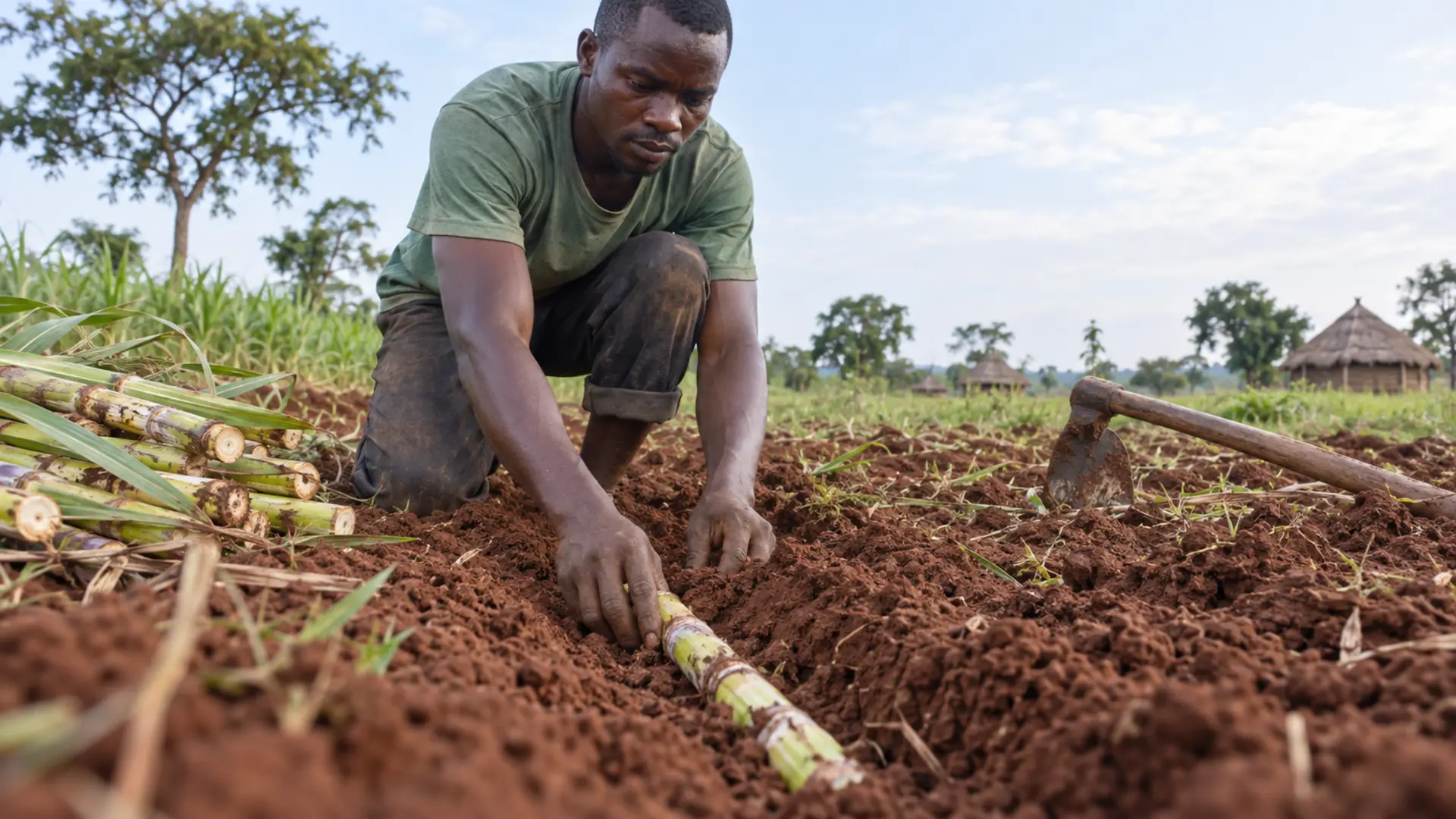
Napier is planted vegetatively, from pieces of cane or from rooted splits, because it produces very few viable seeds.
Where the material comes from. This is the step most often done carelessly. Published guidance is that setts are taken from the basal two thirds of moderately mature stems. The thin upper part of the cane is not planting material, however convenient it is to cut.
Node count. Both the general tropical forage reference and the East African extension factsheet agree: a sett should contain at least three nodes. The factsheet adds the placement rule, two nodes in the soil and one above.
Planted Fodder Grasses: Establishing Napier and Brachiaria and Managing What Attacks Them
An annotated planting diagram for Napier showing where on the cane setts are taken from, the number of nodes, the two planting orientations with their depths, and the row and plant spacings.
Orientation and depth. Two documented methods. Setts pushed into the soil at an angle of about 45 degrees, basal end down, with two nodes buried. Or setts laid horizontally into a furrow at a depth in the range of 5 to 10 centimetres. Either works; what does not work is a sett pushed in upside down or laid so shallow that it dries out.
Spacing. Here the published figures genuinely differ, and it is worth knowing why. The general tropical reference gives rows 0.5 to 2 metres apart and 0.3 to 1 metre within rows, depending on rainfall and cutting management. The East African extension factsheet, produced with Uganda’s national livestock research institute, is much more specific: 50 centimetres apart and 50 centimetres between plants, planted in holes of about 15 centimetres diameter and up to 30 centimetres deep.
For a cut-and-carry plot in Uganda, the factsheet figure is the one to start from. The wider spacings in the general reference reflect drier conditions and grazed rather than cut management.
Timing. The factsheet states it plainly: the best time to plant Napier grass is at the beginning of the rainy season. A sett is a cutting with no roots. It needs moisture while it makes them.
Scale. A Ugandan forage seed market study records the planting material requirement as 1,800 to 2,000 cuttings per acre, which is a useful figure when working out how much cane you need to source or cut from an existing stand.
Napier: cutting height and interval
This is where most established plots are lost, slowly, over two or three years, in a way that gets blamed on the soil.
The general tropical forage reference states that Napier is normally cut at 15 to 30 centimetres above ground, and then gives the warning that matters: regular cutting at ground level to 10 centimetres leads to declining yields and ultimate plant death.
The East African factsheet gives a lower stubble, 5 to 10 centimetres, and sets harvest at 60 to 90 centimetres of growth, described as waist height. A Ugandan farmer survey by the national research organisation recorded farmers harvesting at 75 to 150 centimetres plant height or 30 to 80 days of regrowth. Guidance drawn on Kenyan practice gives a first harvest when the crop reaches about 1 to 1.2 metres, usually three to four months after planting, with subsequent cutting at intervals of six to eight weeks and a stubble of 10 to 15 centimetres.
Planted Fodder Grasses: Establishing Napier and Brachiaria and Managing What Attacks Them
A diagram showing a Napier stool in cross-section with the stubble height band marked, the harvest height band marked above it, and a panel setting out the published figures from each source with their origin.
Those figures do not agree, and this guide is not going to average them into a single false number. What they agree on is the two principles underneath:
Leave stubble. The stubble is where the plant’s reserves for regrowth sit. Cutting to ground level repeatedly is, in the reference’s own words, how you eventually kill the stand.
Do not let it get too tall before cutting. The reference notes that more frequent cuts give less dry matter but better leaf production than infrequent cuts. A tall stand weighs more and feeds worse, because the proportion of stem to leaf has gone the wrong way.
The practical resolution for a Ugandan plot: cut when the stand reaches roughly waist height, leave a hand’s breadth of stubble, and stop cutting lower when the stand starts thinning. A plot that is declining is usually being cut too low, not starved of rain.
With adequate rainfall, the East African factsheet reports that a plot can be harvested six to eight times in a year.
Napier: the two diseases
A Napier plot can be established perfectly and still be destroyed. Two diseases are responsible, and their evidence positions in Uganda are different.
Planted Fodder Grasses: Establishing Napier and Brachiaria and Managing What Attacks Them
A two-column identification card contrasting Napier stunt disease and head smut, each with what you see, how it spreads, the evidence status in Uganda, and the management response.
Napier stunt disease
This is the serious one, and it is documented in Uganda.
What it is. A phytoplasma disease. The general reference describes it as by far the most devastating disease of Napier grass, causing foliar yellowing, small leaves, proliferation of tillers and shortening of internodes. A genome paper on the pathogen records that the disease severely impairs the growth of Napier grass, with losses of up to 70 per cent biomass in infected plants, causing serious economic losses in the smallholder dairy industry.
What you see. A stool that is short and bunched with many thin tillers, yellowing leaves, and leaves smaller than those on neighbouring healthy stools. A farmer survey across East Africa recorded the symptoms farmers themselves reported: foliar yellowing of the leaves, stunted plants with little leaves and a bushy appearance, and necrosis of leaves or plant death.
How it spreads. The same survey identifies transmission by a leafhopper. Work in Ethiopia identified further potential insect vectors and, importantly, alternative plant hosts including alfalfa and one common grass species, noting that these may have epidemiological implications in spreading the disease. That matters for plot hygiene: the reservoir is not only in your Napier.
Uganda evidence. The survey records that the disease was first reported in Kenya in 1997 and in Uganda in 2001, and reports survey prevalence ranging from 33 per cent in Uganda to 95.7 per cent in Kenya.
Thirty-three per cent is not a small number. If you keep Napier in Uganda, this is a disease to be actively looking for rather than one to read about.
Napier head smut
What it is. A fungal disease. The general reference describes head smut as the most damaging, causing major productivity losses, and notes that it is currently restricted to the African continent.
Evidence position. A Kenyan study surveying 204 households across three districts found that about 63 per cent of interviewed households reported experiencing this disease, making it the most serious challenge to Napier production in that survey, with uprooting of affected tillers and stools as the coping strategy used.
For Uganda specifically, we have to be honest about the difference. We found no Ugandan prevalence survey for head smut comparable to the stunt disease data. What we did find is that the East African extension factsheet produced with Uganda’s own livestock research institute recommends smut-tolerant cultivars, which implies local relevance. So: present in the region, addressed by Ugandan extension guidance, not quantified for Uganda in anything we could open.
The response to both: roguing, done properly
Neither disease is managed with a product in this guide, and the practical response to both is the same.
The East African farmer survey records that roguing was used by 32.3 per cent of respondents and explains the mechanism: roguing helps to lower the infection pressure by providing fewer inoculum sources for vectors to feed on.
The procedure, following published roguing guidance, is more thorough than most farmers do:
- Walk the plot deliberately, looking for the symptoms above, rather than noticing them during cutting.
- Take the whole stool, not the affected tillers. Uproot it.
- Put the removed material straight into a container or bag rather than dropping it in the row.
- Take it off the plot and destroy it. Published roguing guidance is explicit that all affected plant material must be taken out of the field and burnt.
- Do not use material from an affected plot as planting material anywhere.
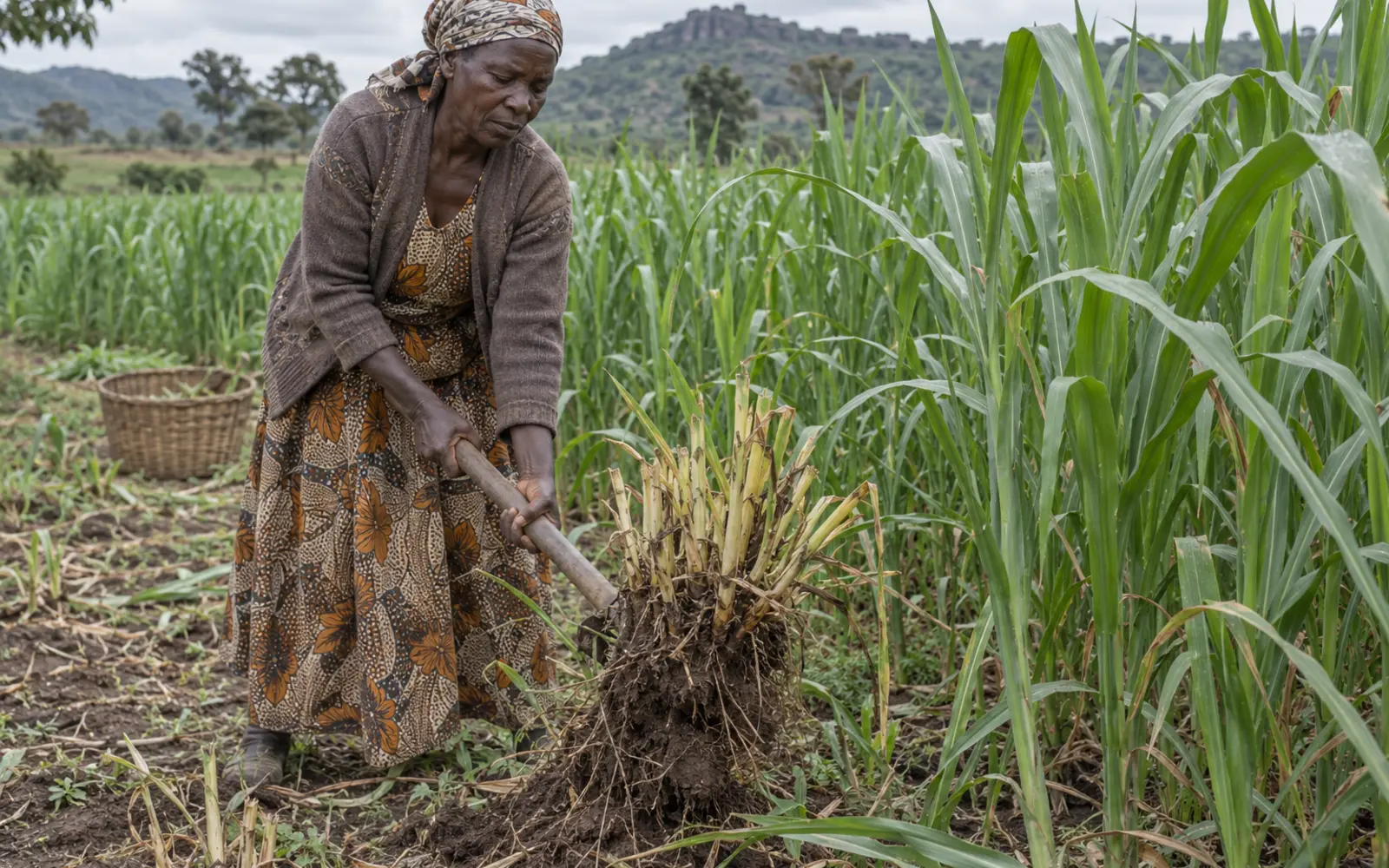
The half-measure, cutting around a diseased stool and leaving it standing, is the commonest error and it leaves the inoculum source in place for the vector.
Tolerant cultivars. The East African factsheet names tolerant cultivars for each disease: for stunt it names Ouma and South Africa types; for smut it names Kakamega types. Ask what is available locally by name, and ask specifically whether it is a tolerant line. Tolerance is not immunity, and a tolerant cultivar in a plot that is never rogued will still decline.
Brachiaria: the alternative, with one real caution
Brachiaria, now often classified as Urochloa, is promoted heavily across East Africa as a drought-tolerant alternative to Napier. Much of that promotion is justified. One part of the picture is routinely omitted.
Establishment
Unlike Napier, the hybrids are established from seed, which changes the economics and the logistics completely.
An East African extension factsheet for one hybrid gives a seed rate of 8 kilograms per hectare planted in lines or 10 kilograms per hectare broadcast, rows 40 to 50 centimetres apart with 30 centimetres between plants in the rows, a sowing depth of 1 to 2 centimetres, germination in 7 to 21 days, and first harvest at 80 to 100 days after germination. It gives a cutting rotation of 25 to 45 days in the wet season and 60 to 70 days in the dry season, a minimum water requirement of 450 millimetres a year, and soil pH tolerance from 4.5 to 8.
The breeding institute’s release document for a widely promoted hybrid gives a seed rate of 5 to 6 kilograms per hectare at a stated minimum cultural value with drilled rows 0.5 to 0.7 metres apart, and pastures ready for grazing between 90 and 120 days after planting with over 80 per cent cover. A general reference gives a seed rate range of 4 to 6 and up to 10 kilograms per hectare, and adds an important practical note: freshly harvested seed remains dormant for several months and must be stored for at least that period or treated before planting. Buying seed straight from a fresh harvest and planting it immediately is a documented way to get poor germination.
A Ugandan forage seed market study confirms that the hybrid cultivars and several non-hybrid cultivars are actually present in the Ugandan commercial seed trade, which matters because a species is only an option if you can buy it here.
The claimed advantages
The release document for the main hybrid supports the drought and soil claims directly: tolerance to prolonged periods of drought of up to six months, good adaptation to poor acid soils with high aluminium content, and tolerance of moderate but not permanent waterlogging. It also reports antibiotic resistance to several spittlebug species, and notes moderate susceptibility to one soil-borne fungal pathogen. Reported crude protein and digestibility ranges are given in the same document.
The disease comparison, honestly
Brachiaria is often presented as the answer to Napier’s disease problems. We looked for the evidence.
What exists is a field-day account from Kenya in which the framing is that Napier grass is affected by head smut disease which reduces forage yields, with one farmer reporting an increase in milk production after adopting Brachiaria.
That is two farmer testimonials and a programme narrative. It is not a controlled comparison of disease incidence or milk yield, and we found no Ugandan version of it. Treat “Brachiaria has fewer diseases than Napier” as a plausible extension claim that has not been demonstrated in a trial we could open.
Planted Fodder Grasses: Establishing Napier and Brachiaria and Managing What Attacks Them
A four-column comparison of Napier against Brachiaria covering planting material and cost, rainfall requirement, soil tolerance, disease status and the documented livestock caution.
The caution that is usually left out
This is the part of the guide that matters most for a small ruminant keeper.
Several Brachiaria species contain steroidal saponins that can cause hepatogenous photosensitisation, a liver-mediated condition in which the animal becomes sensitive to sunlight.
The technical reference for one widely grown species states that hepatogenous photosensitisation syndrome has been reported in cattle, sheep, goats and buffalo, across Africa, South East Asia and South America. It states that sheep are more susceptible than other species, and lambs are more susceptible than adults. It describes the mechanism as crystals of insoluble salts originating from steroidal saponins accumulating in the bile ducts and liver, gives the clinical signs as skin lesions, facial oedema, liver damage and rumen stasis with severe drops in weight gain, and reports mortality in a proportion of cases. Critically, it identifies the conditions under which outbreaks occur: frequently in pastures left ungrazed for more than 30 days, or at the onset of the rainy season.
A 2024 meta-study confirms documented cases in sheep, cattle, goats and buffalo, identifies the responsible saponin, describes the mechanism as secondary hepatogenous photosensitisation in which liver damage blocks excretion of a photodynamic compound, and records that the species implicated include several Brachiaria and Urochloa species rather than one isolated cultivar.
Now the honest qualification. Every case report we could verify is from Brazil or Latin America. We found no East African or Ugandan case report of Brachiaria-induced photosensitisation.
That is a genuine gap and it should be read carefully in both directions. It is not evidence that the risk does not exist here: the responsible plant chemistry travels with the plant, and the species involved are the ones being promoted here. Nor is it evidence of a problem in Uganda: nobody has reported one that we could find.
The practical position for a Ugandan keeper. If you are feeding Brachiaria to sheep, and particularly to lambs, know that this is documented, know that lush regrowth after a long rest or at the onset of rains is the described trigger condition, and watch for skin lesions and facial swelling on unpigmented or lightly haired areas. If they appear, that is a veterinarian’s call, not a management adjustment. This guide names no treatment.
Fertility: the part everyone skips
A cut-and-carry plot is an export operation, and this is the mechanism that explains why fodder plots run down faster than pastures.
Planted Fodder Grasses: Establishing Napier and Brachiaria and Managing What Attacks Them
A diagram contrasting a grazed pasture where dung and urine return nutrients on site with a cut-and-carry plot where all above-ground material leaves the field, showing why replacement is required.
On a grazed pasture, a large share of the nutrients in the forage returns to the same ground as dung and urine. On a cut-and-carry plot, every harvest removes all of the above-ground material from the field and takes it to the animals somewhere else. With a well-managed Napier plot harvested six to eight times a year, that is a great deal of nitrogen, phosphorus and potassium leaving the plot annually and nothing coming back unless you carry it back.
The East African factsheet gives practical direction: apply phosphorus fertiliser or manure at planting, and subsequently make furrows between the Napier rows and bury manure, with topdressing to support fast regrowth. The general reference adds the necessary qualification, that Napier is highly responsive to nitrogen, water and other nutrients but that the response depends on soil type and climate, and that fertiliser recommendations should be based on soil analysis, expected yield and local guidance.
This guide therefore gives no rate. Get the soil tested, using the framework in soil testing and fertility, and take the recommendation from that rather than from an article. What this guide does say is that a plot receiving nothing will decline, and that the manure from the animals eating the fodder is the obvious and cheapest return flow. Composting it properly is covered in composting and organic matter, and the wider logic of closing that loop is in integrated crop and livestock farming.
Common mistakes
Taking setts from the thin upper part of the cane.
Planting fewer than three nodes, or burying only one.
Planting outside the start of the rains.
Cutting to ground level. The published warning is explicit that this eventually kills the stand.
Letting the stand get very tall before cutting and losing leaf quality for bulk.
Cutting around a diseased stool instead of uprooting it.
Dropping rogued material in the row instead of removing it from the plot.
Taking planting material from a plot that has stunt disease.
Treating a tolerant cultivar as immune.
Planting freshly harvested Brachiaria seed without the storage or treatment its dormancy requires.
Feeding lush Brachiaria regrowth to lambs after a long rest period without knowing the documented caution.
Never returning anything to a plot you harvest six to eight times a year.
When to involve a professional
Contact a district production or veterinary officer, an extension officer, or a national research institute rather than acting alone when:
- Stools in your plot show the stunting, bunching and yellowing described above, particularly if they are spreading between seasons. Confirming which disease you have determines whether tolerant cultivars will help.
- A disease appears in your plot that does not match either description.
- Animals fed on Brachiaria develop skin lesions, facial swelling, or signs of liver disturbance. This is a veterinary matter and this guide names no treatment.
- You want a fertiliser recommendation, which should come from a soil analysis rather than a general figure.
- You want to know which tolerant cultivars are currently available in Uganda by name. The Ugandan seed system operates through the national seed certification service with the national research organisation conducting variety evaluation, and locally available material changes.
A practical action plan
Before you plant: decide which species, and why. If your plot is for sheep and will be Brachiaria, read the caution section again first. If your rainfall is marginal, the stated minimum water requirement for the Brachiaria hybrid is a real number to check against your own records.
Before you plant: source material properly. For Napier, cane from the basal two thirds of mature stems, taken from a plot you have inspected for disease. For Brachiaria, seed that has been stored or treated to break dormancy.
Planting: at the start of the rains, three-node setts, two nodes buried, at the closer spacing for a cut-and-carry plot. Put manure or phosphorus in at planting.
First harvest: wait. The commonest establishment failure is cutting a young stand before it has built a root system.
Every harvest: cut at the right height and leave stubble. Mark a stick to the stubble height you intend and use it until your eye is trained.
Every month: walk the plot looking for disease, not during cutting but as a separate deliberate pass with a bag for anything you remove.
Between harvests: return something. Manure buried in furrows between rows, at a rate set from soil analysis.
Each year: record harvests, dates and rough weights. Two years of that record will tell you whether the plot is improving or declining long before it is visibly failing, and it feeds directly into the farm feed resource inventory.
Conclusion
A fodder plot is the only part of a Ugandan livestock system that you can genuinely expand by decision rather than by luck, and both of the species here will do the job if established and cut properly.
The things that actually determine the outcome are unglamorous. Three nodes from the right part of the cane. Planting when the rains start. Leaving stubble. Walking the plot with a bag once a month. Putting something back into ground you harvest eight times a year.
And one thing that is not unglamorous at all: if you are planting Brachiaria for sheep, the photosensitisation literature is real, it names lambs as the most susceptible class, and it describes exactly the grazing situation, lush regrowth after a long rest, in which outbreaks occur. Nobody has reported a case in East Africa that we could find. That is worth knowing, and it is not the same as being told it cannot happen.
Author: Falcon Foundation Ltd Editorial Team
The Falcon Foundation Ltd Editorial Team produces evidence-based agricultural guidance for Ugandan farmers, drawing on published research and institutional sources and translating them into practical decision support. Where evidence is unavailable or contested, we say so rather than filling the gap.
