
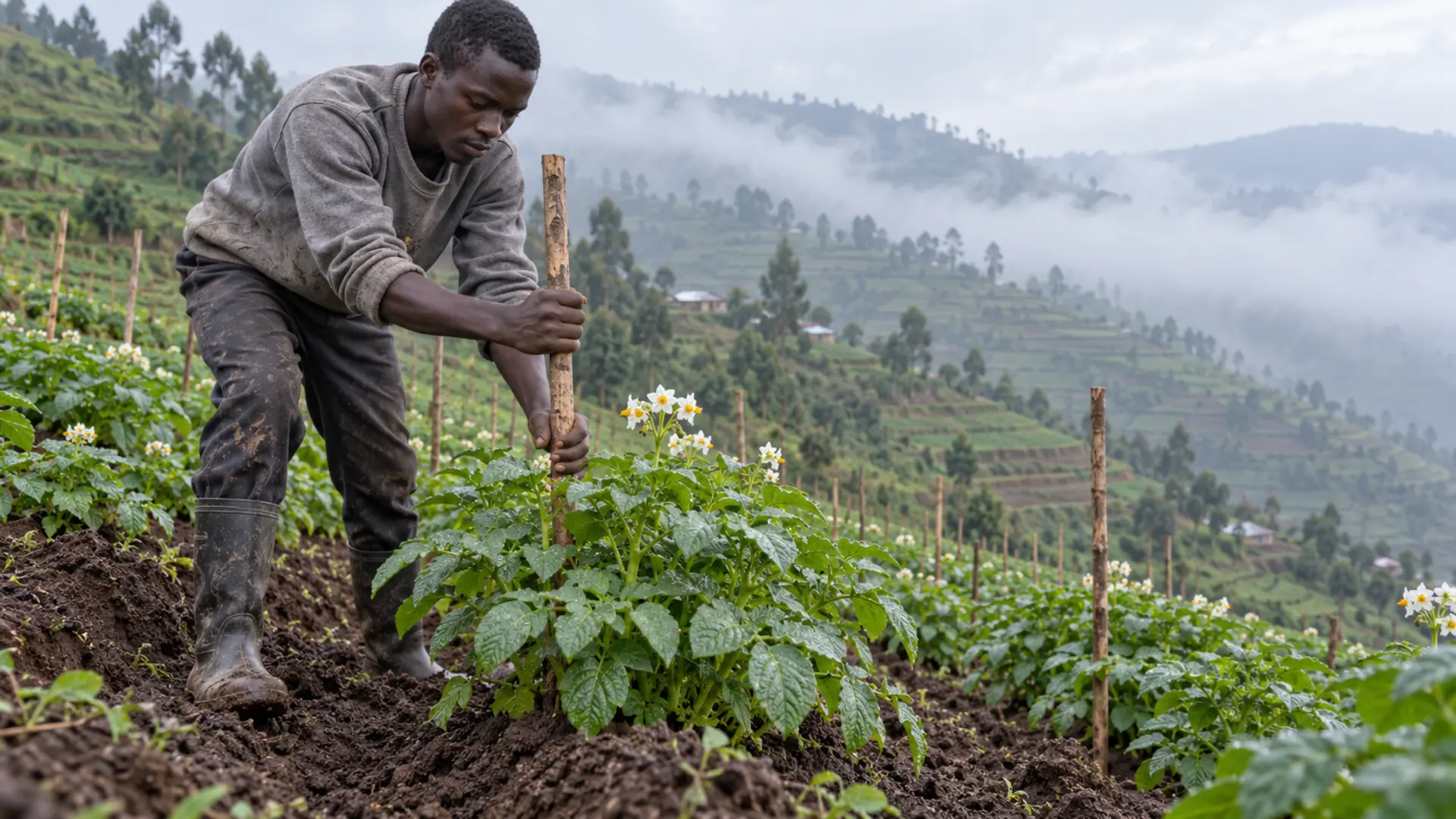
In Kigezi and on Elgon, the same conversation happens every season. Yields are down again. The variety has “gone tired”. Somebody suggests that the soil is finished, or that the rain came wrong, or that the seed needs changing but good seed cannot be found.
Two of those explanations are usually wrong and one is usually right, and the right one is the least dramatic. The seed is carrying more disease than it did last year, because it carried more than the year before, because that is what saved seed potato does.
This guide explains the mechanism, sets out what each sourcing route actually costs you in risk, and gives a field procedure you can run this season with nothing but pegs and attention. It names no fungicide and recommends no chemical programme.
The word for what is happening
The technical term is degeneration, and a study conducted in the south-western Ugandan highlands defines it precisely: degeneration of seed potatoes can be defined as a decline in seed potato quality by a build-up of pathogens and pests over subsequent generations.
That definition contains the whole problem. Potato is propagated vegetatively. Every tuber you plant carries whatever was inside the plant it came from. There is no seed-set stage to reset the load, as there is in a true-seed crop. So each generation starts where the last one finished, and adds to it.
A regional study of seed systems in Kenya, Uganda and Ethiopia puts the consequence plainly, attributing yield loss over seasons of seed recycling to the accumulation of seed-borne diseases.
We looked for a Ugandan figure for how many seasons this typically takes. We did not find one, and we are not going to supply a number that sounds authoritative and is not. What the sources support is the direction and the mechanism, not a season count.
The two that matter most, and why they are invisible
Many things accumulate in saved seed. Two deserve separate treatment because they behave in ways that defeat ordinary visual selection.
Bacterial wilt
This is the one that should change how you think about saved seed.
The authoritative guidance on its control states that infected seed tubers are the main means of dissemination of the causal bacterium. It also states that the organism can survive in soil, mostly on plant debris, and in the rooting system and rhizosphere of many hosts. And, critically for highland Uganda, it records that in cool conditions such as tropical elevations above 2,500 metres, infected but symptomless plants may harbour the bacterium and transmit it to progeny tubers as latent infection.
Read that last sentence again with your own altitude in mind. In exactly the conditions where Ugandan potato is grown best, the disease can be present and produce no symptom you can see, and still be passed into the tubers you save.
A Ugandan molecular study of the pathogen’s epidemiology found that particular strain types play an important epidemiological role in bacterial wilt of potato in Uganda, being disseminated via latently infected seed, and reported bacterial wilt prevalence in potato farms at 81.4 per cent with incidence at 1.7 per cent.
Those two numbers are easy to misread, so hold them apart. Prevalence here is the proportion of farms where it was found. Incidence is the proportion of plants affected. A very high proportion of farms, a low proportion of plants on them. That is the profile of something widespread and mostly latent, which is exactly the profile that makes seed selection by eye unreliable.
Seed Potato Quality in the Highlands: Why Your Ware Potato Should Not Be Your Seed
A warning panel on bacterial wilt showing that infection can be latent in symptomless tubers, that the pathogen persists in soil, and the field disqualification period stated in the national certification protocol.
The national seed potato certification protocol gives the clearest available statement of how seriously the authorities treat soil persistence. It provides that a confirmed diagnosis of bacterial wilt disqualifies a field from seed certification, and that all such fields will be disqualified from seed potato production for a period of six years.
Six years. That is the official answer to anyone who believes a season or two of rotation solves it. Rotation matters, and it is covered in crop rotation and cover crops, but rotation on a smallholding is not doing what a six-year disqualification does.
Late blight
Late blight is the disease Ugandan highland growers already respect, but its seed dimension is often overlooked.
Research covering south-western Uganda states that blighted potato tubers provide a mechanism for survival between cropping seasons as well as long distance spread of the pathogen, and attributes the establishment of a particular pathogen lineage across the studied countries to the movement of potato tubers.
So the tuber is not only the victim. It is the vehicle, and it is how the pathogen crosses the dry gap between seasons and how it crosses districts.
A Ugandan variety-response study records that potato late blight is one of the major diseases limiting production, with potential yield losses over 70 per cent, and reported the highest disease severity at one of its highland sites. The national certification protocol applies a zero tolerance for late blight in tubers presented for certification.
The sourcing decision
Given all that, the practical question is where next season’s seed comes from. There are four honest answers and they carry different risks.
Seed Potato Quality in the Highlands: Why Your Ware Potato Should Not Be Your Seed
A four-column seed sourcing decision table comparing certified seed, early generation seed from a research institute, positively selected own seed, and market ware potato, against what each is inspected for, the risk carried, and what the grower must do.
Certified seed. Uganda operates a formal potato certification system. The protocol sets out the classes: breeder or stock seed, then pre-basic, then basic, then certified in generations. Certification is conducted under the authority of the Ministry of Agriculture, Animal Industry and Fisheries through the Department of Crop Inspection and Certification, and the underlying legal framework is the Seeds and Plant Act, under which the national seed certification service is responsible for matters related to seeds.
Certified seed is the lowest-risk route. It is also, for most highland smallholders, the least available one, and it is important to say that plainly rather than recommend something that cannot be obtained. A Ugandan study of screen-house multiplication recorded that disease-free seed potato accounts for less than five per cent of the whole potato seed market demand in Uganda, leaving 95 per cent as a seed availability gap.
Early generation seed from a research institute or licensed multiplier. The national research organisation’s Kachwekano institute in Rubanda District hosts the national potato hub and, according to its own reporting, has capacity to produce up to one million plantlets annually. A private company has been licensed to produce tissue culture plantlets and commercialise early generation seed for a list of named varieties. This route is expanding, and it is worth asking about locally even if it was not available two seasons ago.
Your own seed, improved by positive selection. The subject of the next section. Lower risk than unselected saved seed, and available to everyone, this season, at no cash cost.
Market ware potato. The highest-risk route, and unfortunately the default when nothing else is available. Ware potato in a market has been selected for eating: size, appearance, absence of obvious rot. None of that selects against latent bacterial wilt or against symptomless virus, and the tubers have been aggregated from unknown fields. If you must do it, understand that you are importing whatever was in those fields into yours, and that the six-year disqualification period above tells you how long that decision can last.
Positive selection: the method you can run this season
If you cannot buy clean seed, this is the most useful thing in this guide.
The method is called positive selection, and a trainers’ manual produced for East African conditions describes it in one sentence: selecting the best looking plants in a potato field as source of seed for the next season.
That sounds obvious, and it is emphatically not what most farmers do. Most farmers select seed at harvest, from the heap, by looking at tubers. Positive selection selects in the field, before flowering finishes, by looking at plants. The difference is the entire method, because a tuber cannot show you that its mother plant was stunted, mottled or yellowing, and a plant can.
Seed Potato Quality in the Highlands: Why Your Ware Potato Should Not Be Your Seed
A five-stage annotated field procedure for positive selection, showing when to walk the crop, what a plant must look like to be pegged, the re-check two weeks later, individual harvest of pegged plants, and the rejection step at harvest.
The procedure
Timing. The manual is specific: it is important to do positive selection just before flowering, or when the very first flowers are appearing. A Ugandan study of the method describes selecting the healthiest looking plants 65 to 73 days after planting, just before full flowering. Too early and differences have not expressed. Too late and the canopy has started to senesce, which hides everything.
Selection. Walk the crop and look for plants that are big, that have many and thick stems, that have dark green leaves without malformations, and that do not show obvious disease symptoms. The manual also asks that selected plants have many, large and well-shaped tubers, which is confirmed at harvest rather than in the field.
Marking. Peg them. The manual says to let farmers use pegs to mark a number of healthy plants, and offers alternatives: tying strings around the plant, or using maize stalks as pegs. Anything that survives to harvest and cannot be confused with a weed.
The re-check. This step is skipped most often and matters most. The manual specifies a follow-up at full flowering, before senescence starts, approximately two to three weeks after the first pass. Remove the peg from any plant that has since developed symptoms. A plant that looked healthy in week ten and does not in week twelve was never a candidate; it was simply not yet showing.
Harvest. Pegged plants are harvested one by one and individually evaluated, and plants with few, small or misshapen tubers are rejected even though they were pegged. The plant earned the peg; the tubers have to earn the store.
What it does, and what it does not do
Here is where the guide has to be careful, because positive selection is frequently oversold and then abandoned.
Seed Potato Quality in the Highlands: Why Your Ware Potato Should Not Be Your Seed
A two-column evidence panel setting out what positive selection is documented to improve and what it is documented not to improve, with the Ugandan study finding on symptomless viruses and on one specific cultivar.
What it does. Farmer-managed trials in Kenya reported yields improving by an average of 30 per cent in a single season using this method of seed selection compared with common practice. A peer-reviewed Kenyan study reported positive selection at 14.2 tonnes per hectare against 11.8 for farmer selection in one season, and 13.1 against 8.6 in another, describing an average yield increase in farmer-managed trials of 34 per cent, achieved at an additional production cost the authors put at a small fraction of the resulting profit increase.
What it does not do. The Ugandan study of the method is the most important source here precisely because it is the least flattering. It found lower incidences of two symptom-expressing viruses in lots from positive selection compared with lots from farmers’ selection, but little improvement for two viruses that produce no visible symptom, and it found that one widely grown cultivar carried persistently high infection regardless of treatment.
That is the honest picture. Positive selection removes plants that show you something. It cannot remove what does not show. And it does nothing at all about a soil-borne pathogen already present in your field, which is a separate problem requiring separate thinking.
So the correct framing is this: positive selection slows degeneration. It does not reverse it. Run it every season, and still plan to introduce clean seed from outside your own multiplication cycle periodically, because otherwise you are managing a decline rather than stopping one.
Storing what you selected
Having selected better seed, the next way to lose it is to store it as if it were ware potato.
The relevant technology is the diffused light store, described as a low-cost seed potato storage technology made from locally available materials, storing seed in a natural, diffused light structure with good ventilation rather than in a dark place. The same brief reports that such stores reduce rotting and weight loss of tubers during the storage period by 30 to 50 per cent compared with storage in dark places.
Two qualifications. That figure is from Kenya, not Uganda. And the Ugandan evidence we could find is that the practice is already relatively common here: the regional seed systems study recorded 46 per cent of farmers in Uganda storing seed potatoes under diffuse light, compared with 15 per cent in Kenya and 23 per cent in Ethiopia. A cooperative account from Kisoro District describes the change in plain terms, a member stating that before the store they continued to have poor seeds due to unconducive storage.
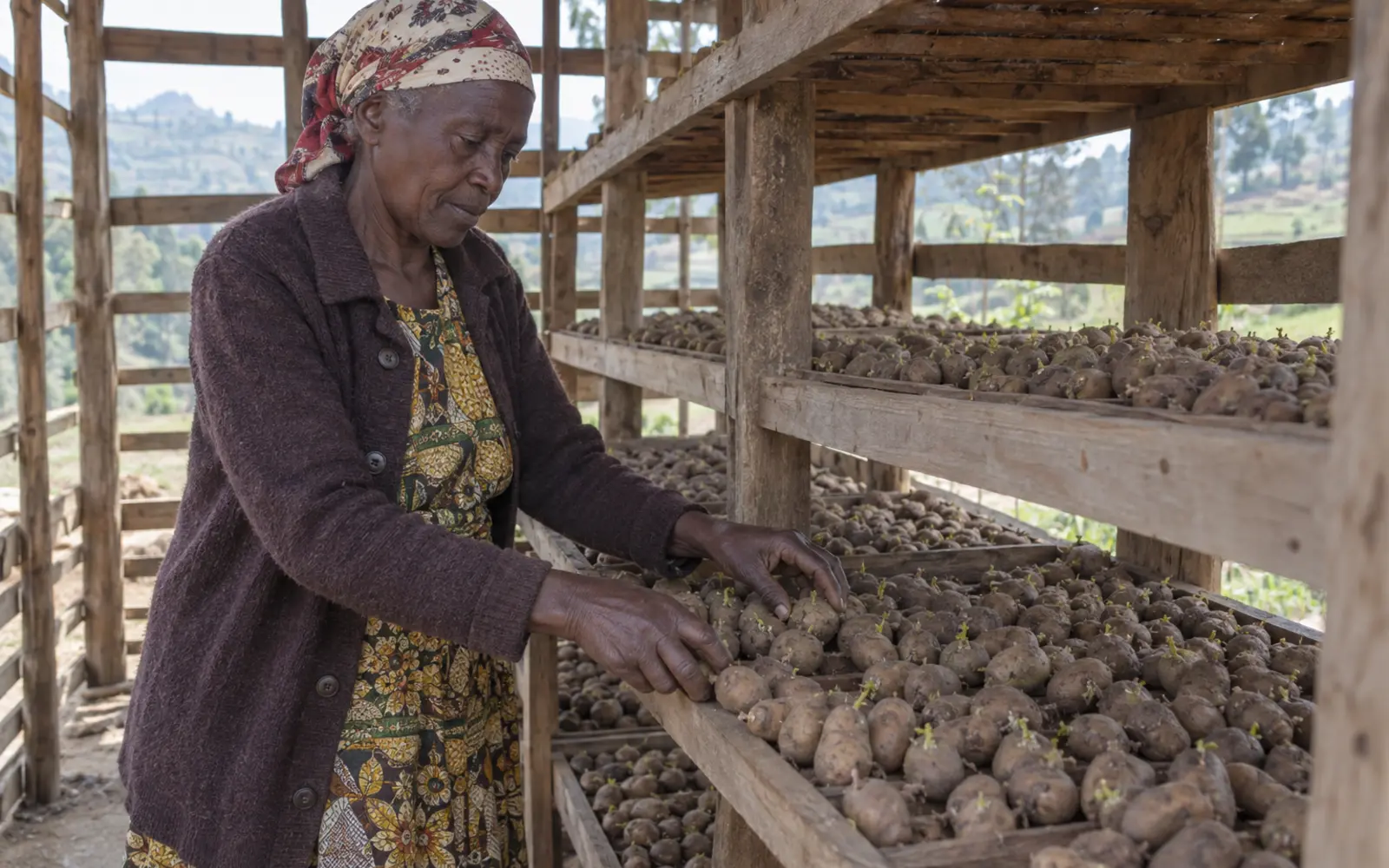
The principle is not complicated. Indirect light keeps sprouts short, green and sturdy rather than long, white and fragile. Ventilation removes the moisture that drives rot. A dark sealed sack does the opposite of both.
Keeping the selected seed separate
Selection is wasted if the selected tubers rejoin the general harvest, and on a busy harvest day that is exactly what happens unless it has been planned for.
Three practical separations are needed, and none of them costs anything.
Separate at lifting. The pegged plants are lifted on their own, before or after the main harvest but not during it. Mixing them into the general lifting means you can no longer tell which tubers came from which plant, which destroys the individual evaluation step.
Separate in transport. A distinct container, marked, carried separately. A basket of seed tipped into the main heap at the edge of the field cannot be recovered.
Separate in store. Seed goes to the diffused light store; ware goes wherever ware goes. If the two are in the same building, they should be on different shelves with a written label, because a tuber has no visible mark that tells anyone it was selected.
Add one more habit: write the season, the field and the plant count on the label. Two seasons of that record turns a vague sense that the seed is improving or declining into something you can actually read.
Common mistakes
Selecting seed from the harvest heap. The heap cannot tell you which plant a tuber came from.
Doing the field walk after the canopy has begun to senesce. Everything looks the same by then.
Skipping the two-week re-check. This is where late-expressing plants are caught.
Pegging plants and then harvesting the whole field together. The individual lift is what makes the selection real.
Keeping pegged plants whose tubers are poor. The peg is a hypothesis, not a verdict.
Believing positive selection cleans seed. It slows degeneration. The Ugandan evidence is explicit about what it misses.
Buying market ware potato as seed without understanding the six-year consequence if bacterial wilt comes with it.
Assuming a symptomless plant on highland ground is a healthy plant. Latent infection in cool highland conditions is documented.
Storing selected seed in dark sacks and undoing the selection.
Treating declining yield as a soil problem without ever examining the seed.
When to involve a professional
Contact a district agricultural officer, the crop inspection and certification department, or a plant health laboratory rather than acting alone when:
- Plants wilt rapidly without yellowing first, particularly in patches, and particularly when the weather is warm. Wilting of that kind needs identification, not guesswork.
- You are considering bringing seed onto the farm from a source you cannot inspect.
- You want to know whether a field with a wilt history can be used for seed production, which is exactly the question the certification protocol’s disqualification period addresses.
- You intend to multiply and sell seed to others, at which point you are inside a regulated system and need to know its requirements rather than infer them.
- You need current variety information. Variety names and their responsible institutions change as new material is released, and a list in an article ages badly.
Whole-farm movement control, which is what stops a problem in one field becoming a problem in all of them, is covered in whole-farm biosecurity. The general question of how to verify any planting material before it enters your farm is covered in verifying seed and planting material quality.
A practical action plan
This season, before flowering: walk the crop with pegs. This is the action with the highest return in the guide and it costs nothing.
Two weeks later: walk it again and pull pegs from anything now showing symptoms.
At harvest: lift the pegged plants individually and separately. Reject any whose tubers disappoint. Keep the rest apart from the ware crop from the moment they leave the ground.
Immediately after harvest: store the selected seed in indirect light and moving air, not in a dark sack. If you do not have a diffused light store, a slatted shelf under a shaded roof is the direction to move in.
Before next planting: ask locally what early generation or certified seed is actually available, and at what scale. This answer is changing, and it is worth re-asking each season rather than assuming last season’s answer.
Before next planting: decide your introduction interval. How often will you bring in seed from outside your own cycle? Write the answer down. A grower who has never decided this is, in practice, deciding never.
Keep a field record. Which field, which seed source, which season, and what the yield was. Two seasons of that record will tell you more about your own seed than any general guide can, and the framework is in farm record keeping and gross margin analysis.
Conclusion
The potato in the store and the potato in the ground are the same object being asked to do two different jobs, and the market has taught every grower to judge it by the first job.
Seed potato is not judged by how it looks. It is judged by what is inside it and by what was standing above it in the field last season. Bacterial wilt in cool highland conditions can be present with nothing to see, and the national protocol’s six-year field disqualification is the strongest available statement of how long that decision echoes.
Positive selection will not solve that. It will slow it, measurably, for the cost of two walks through your own crop and a handful of pegs, and the Ugandan evidence is honest about which part of the problem it reaches and which part it does not.
That is a better position than most growers are in. It is not the same as clean seed, and the guide would be doing you no favours by pretending otherwise.
Author: Falcon Foundation Ltd Editorial Team
The Falcon Foundation Ltd Editorial Team produces evidence-based agricultural guidance for Ugandan farmers, drawing on published research and institutional sources and translating them into practical decision support. Where evidence is unavailable or contested, we say so rather than filling the gap.
