
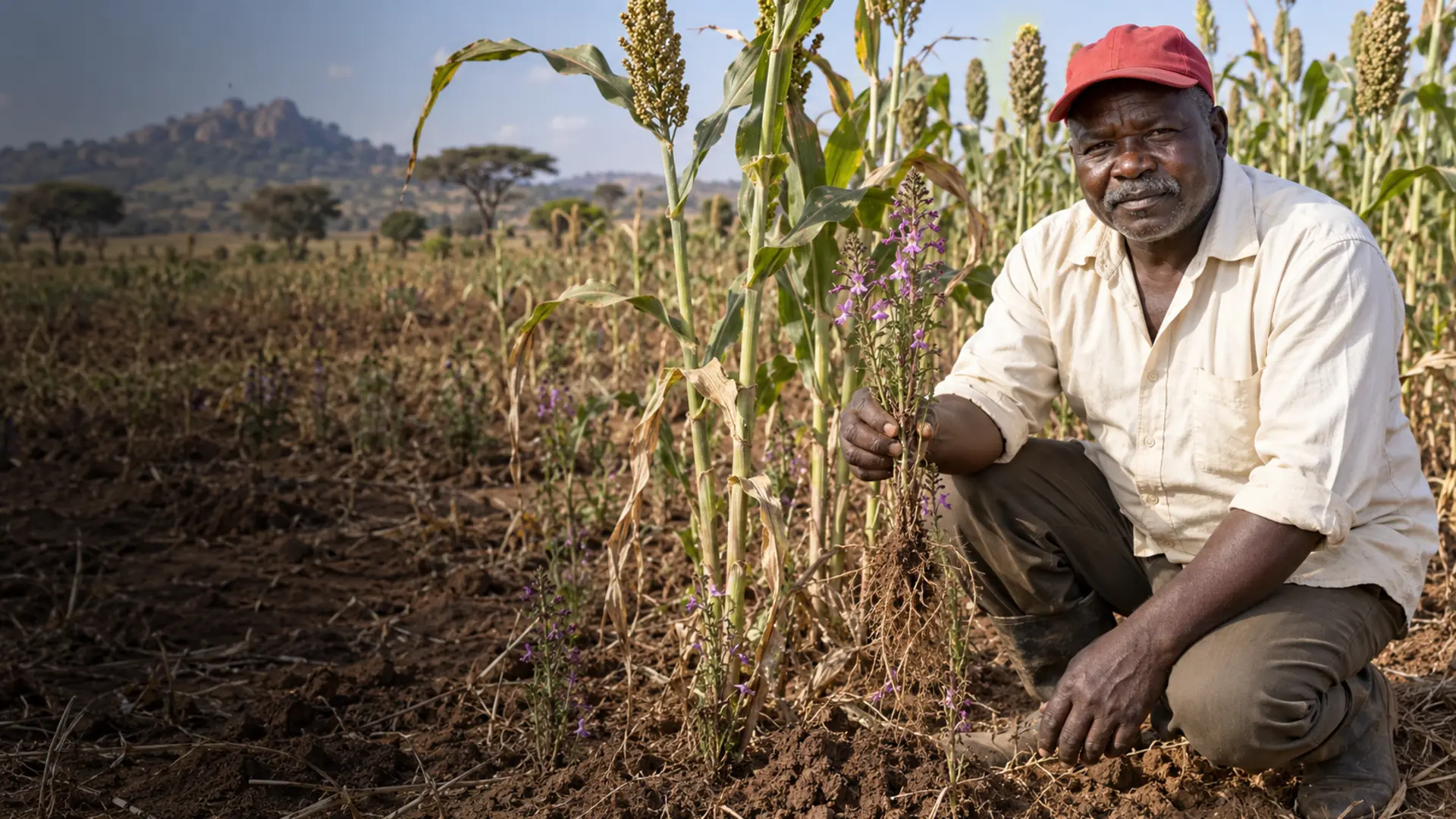
The purple flowers are the last thing that happens, not the first.
That single sentence is the whole argument of this article. A farmer who walks a sorghum field, sees Striga in flower and pulls it out has done something useful, but not for this year’s crop. By the time the parasite is visible, it has been attached to the crop’s roots for weeks, drawing water and nutrients out of the plant, and the yield loss on that plant has already happened.
This is why Striga is not a weeding problem. It is a soil problem with a weed on top of it, and the strategy has to run across seasons rather than across a field.
What this guide helps you decide
Whether what you have is Striga, and which species. Why the crop is failing before you see anything. What to plant in the seasons ahead, and what removing the visible plants actually achieves. How to score your own field so you can tell in three years whether anything is working.
It names no herbicides, no active ingredients and no seed-coating products, anywhere.
The short answer
Striga seeds germinate only when they detect a chemical signal from a host root, attach to that root, and steal from it. Published research states that symptoms are seen in infected plants even before the parasite emerges from soil, and that this effect occurs very soon after infection, as early as one week after infection.
The seed bank is the enemy. A single Striga plant produces 50,000 to 500,000 seeds, and Striga seeds can remain dormant in soil for up to 10 years. One paper on soil organic matter and the cereal-Striga interaction gives a figure of up to 200,000 mature seeds per reproductive plant. Whichever figure you take, the arithmetic is the same: one plant allowed to set seed replaces everything you removed and more.
So the plan has three parts. Stop the seed bank growing, by removing plants before they set seed. Shrink the seed bank, by triggering germination when there is no host to attach to. And reduce the damage from what remains, through soil fertility and variety.
What it is, and which one you have
The parasitic Striga species that attack cereals in East Africa are Striga hermonthica and Striga asiatica. A diagnostic protocol published under the international plant protection framework records that these species infest maize, pearl millet, finger millet and sorghum, while Striga gesnerioides usually infests legumes, especially cowpea.
Flower colour helps but does not settle it. The same protocol describes the corolla of S. hermonthica as pink or light purple, rarely white; S. asiatica as usually red, rarely yellow or white; and S. gesnerioides as usually purple, rarely pink or yellow. Because purple appears in two of those descriptions, the more reliable field diagnostic is the host: Striga in your sorghum or millet is one of the cereal parasites, not the cowpea one.
What is happening underground
This is the section worth reading twice.
Germination is triggered by the crop itself. Striga seeds do not germinate on contact with water alone. They germinate in response to chemical signals, strigolactones, exuded by the roots of a host plant. This is why the parasite appears where the crop is and not in a fallow.
Attachment is a plumbing connection. Published research describes the haustorium penetrating the host until it encounters the endodermis, where haustorial cells elongate and divide to establish vascular connections with the host, and states that once the vascular systems of the host and parasite are connected, Striga uses this connection to siphon out nutrients. A genome study describes the process in finer detail: on contact with the host root, Striga epidermal cells differentiate to form elongated intrusive cells which intrude between the host cell walls, and at two days after inoculation of the host root, haustoria were attached and intrusive cells had penetrated into the host root cortex.
The damage starts immediately. As quoted above, symptoms appear as early as one week after infection, well before emergence.
Then, and only then, does it appear. The thesis cited above gives the timing: after emergence, Striga can flower two to three weeks later, with the whole cycle from underground establishment to flowering taking roughly four to six weeks.
Striga in Sorghum and Millet: Why Pulling It Up Is Not Enough
Underground process illustration showing Striga seed germination triggered by host root exudate, attachment by haustorium, and host damage occurring before the parasite emerges
Put those together and the practical conclusion is unavoidable. Emergence is a report on damage already done. Removal after emergence protects future seasons, not this one.
What hand removal actually achieves
It is worth being precise, because hand pulling is what most farmers already do and this article is not telling them to stop.
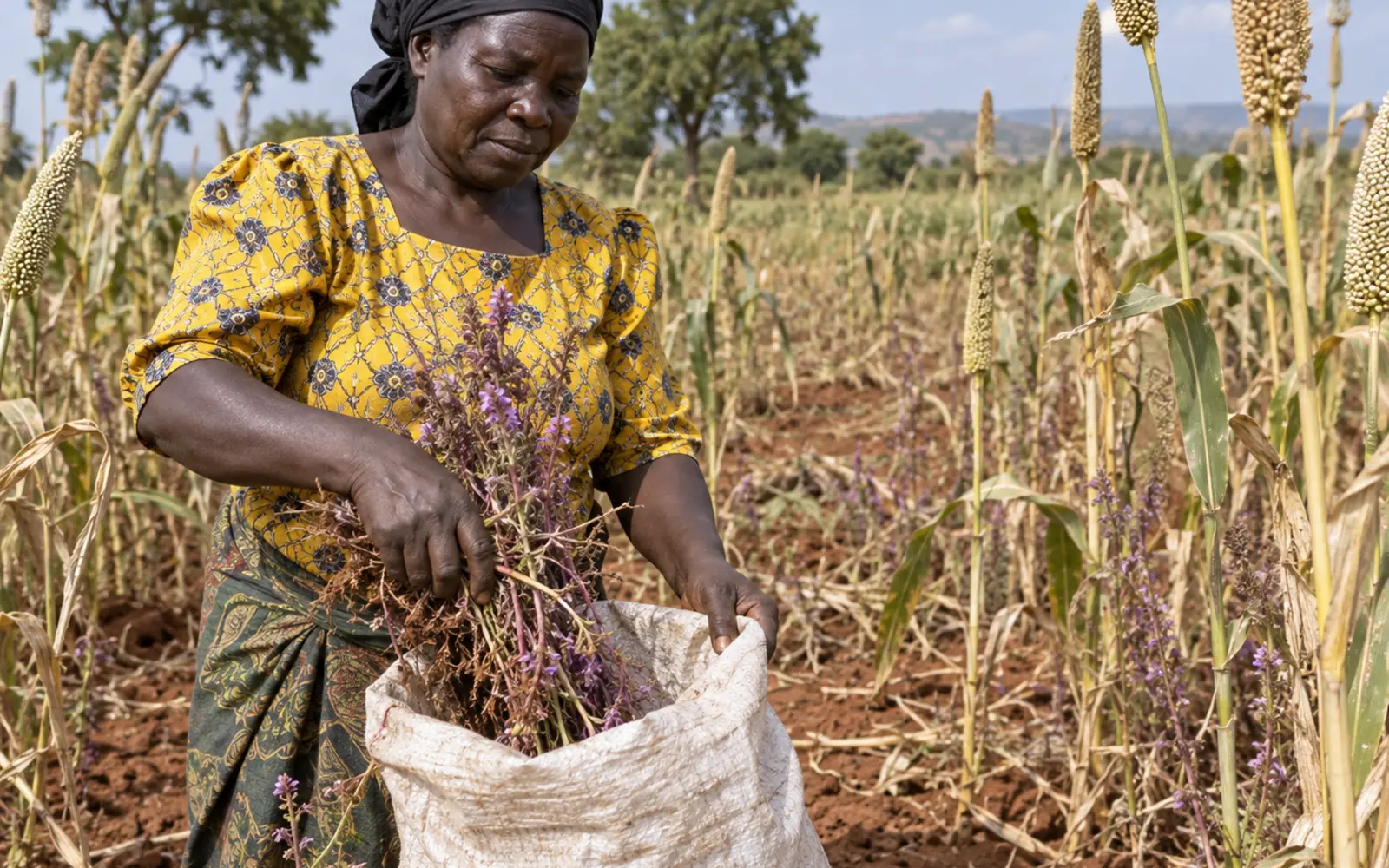
Hand pulling does one thing well: it prevents seed set. The thesis quoted above states that the brief period between emergence and seed set provides the time window for direct Striga management through hand pulling, which should be completed before seed set.
It does not recover this season’s yield, because that loss occurred underground weeks earlier.
So the rules are: pull before flowering wherever possible, and certainly before seed capsules form; do not drop the pulled plants in the field, because a plant that has begun to set seed can continue to mature after uprooting; carry them out in a sack or basket and destroy them away from the field; and go through the field more than once, because Striga emerges over an extended period rather than all at once.
If you have only enough labour for one pass, do it early, when the plants are flowering rather than seeding.
Shrinking the seed bank: trap and catch crops
The most elegant idea in Striga management is suicidal germination. Some non-host plants exude the same kind of signal that triggers Striga germination, but because they are not hosts, the germinated seedling finds nothing to attach to and dies. Every seed that germinates this way is a seed permanently removed from the bank.
The evidence is specific about which crops do this well, and the differences are large.
A field trial in Burkina Faso at Kamboinsé in 2006 and 2007 tested root exudates from cotton, cowpea and groundnut genotypes against Striga hermonthica. It found that root exudates of all nine cotton genotypes induced Striga seed germination percentages of at least 75 per cent, with the highest at 90.2 per cent. Cowpea genotypes ranged from 14.5 to 19.6 per cent, with one at zero. Groundnut genotypes were weakest, mostly below 1 per cent.
The same paper cites an earlier Mali field study reporting that intercropping of pearl millet or sorghum with groundnut led to a reduction of 50 to 60 per cent in the number of emerged Striga plants. That figure is a citation within a citation; we read it in the Burkina Faso paper rather than in the original, and it should be treated accordingly.
Two honest qualifications belong here. First, soybean, sunflower and sesame are commonly named as trap crops in general advice, and we could not find a source we could open that tested them; this article therefore does not list them. Second, the Burkina Faso trial measured germination stimulation, which is the mechanism, and the Mali study measured emerged plants, which is the outcome. They are related but not the same thing.
Push-pull: what it is and where it has been proven
Push-pull is a cropping system in which a cereal is intercropped with a legume, usually a Desmodium species, and bordered by a fodder grass. The organisation that developed it describes the Striga mechanism directly: Desmodium covers the ground between the rows, putting out a chemical that stops Striga from growing on the cereal, by stopping root attachment of Striga and initiating a suicidal germination of Striga.
Now the attribution, which matters more than the mechanism.
The best-quantified recent trial we could verify was conducted in western Kenya, in Busia, Homa Bay and Kisii, during the 2025 long rains, on maize, and reported that push-pull reduced Striga infestation by 45 to 56 per cent against untreated monocrop in the first year.
The much-quoted maize yield figures, in which about 75 per cent of farmers in a 2009 impact assessment reported a threefold to fourfold increase in maize yield, are also maize figures, from that assessment.
For Uganda specifically, what we could verify is farmer adoption rather than trial results. The developing organisation’s own material carries a photograph captioned as a mature push-pull farm in Tororo, Uganda, and refers to farmers who had adopted the technology in drier areas of Kenya, Uganda and Tanzania. The same material states that the organisation is extending the technology to crops grown in dry areas like sorghum and millet, using a green-leaf Desmodium and a Brachiaria cultivar.
We looked for a quantified push-pull trial on sorghum or finger millet in eastern Uganda and did not find one we could open. So the honest statement is this: push-pull is a real system with strong Striga evidence on maize in western Kenya, it has been adopted by farmers in eastern Uganda, and its extension to sorghum and millet is under way rather than demonstrated. Do not let anyone quote you the maize yield figures as though they applied to your sorghum.
Soil fertility, which is the most under-used lever
The link between poor soil and severe Striga is not folklore.
A doctoral thesis on soil organic matter and the cereal-Striga interaction states it plainly: a well-nourished sorghum plant induces fewer Striga seeds to germinate than a nitrogen-starved plant treated with water only. In other words, a hungry crop calls more loudly.
The same thesis reports a classic finding from earlier work that Striga reduced host shoot yields by about 70 per cent at low nutrient level and by about 45 per cent at the highest nutrient level. We read that figure quoted in the thesis rather than in the original 1971 paper, and it comes from a different growing context, so treat it as an indication of direction and magnitude rather than as a number for your field.
The thesis also names crop rotation and intercropping with selected non-host leguminous crops as essential ingredients of integrated soil fertility management in this context, which is a useful confirmation that the fertility lever and the trap crop lever are the same lever used twice.
Practically, this is the most accessible action for most farmers, because it requires no new seed and no new system: manure, compost, residue return, and rotation with legumes. It will not clear the field. It will make the crop that is there better able to withstand what remains.
Varieties, and what can honestly be said
Uganda’s National Semi-Arid Resources Research Institute at Serere is the relevant national institution. Its published programme description states that its dry-land cereals research focuses on improving drought resistance and resistance to invasive weeds such as Striga, and improving yield potential in sorghum, and lists released sorghum varieties including the NAROSORG and SESO series, with finger millet releases in the NAROMIL and SEREMI lines and a pearl millet variety.
That is a statement of breeding objective, not a resistance rating. The institutional page gives no mechanism, no trial year and no measure of resistance for any named variety, and this article will not supply one.
A separate international breeding project running from 2008 to 2012, led from Purdue University, listed the national research organisation at Serere and Kampala among its research sites alongside Kenyan and Tanzanian centres, with the objectives of characterising mechanisms of Striga resistance introgressed into improved germplasm and combining Striga resistance with drought tolerance in selected sorghum varieties. Its published outcomes section was not available, so we cannot report results from it.
On mechanism, the genome study cited earlier describes one form of post-attachment resistance observed in a rice cultivar, in which a common resistance phenotype is the inability to form a xylem bridge with the host. That illustrates what post-attachment resistance means, in rice rather than in sorghum, and is offered here as an explanation of the concept rather than as evidence about any sorghum variety.
What to do with this. Ask your district extension office or the research station directly which currently released sorghum or finger millet varieties are recommended for Striga-infested fields in your area, and ask when that recommendation was last reviewed. Do not buy a variety on the strength of a seller’s claim about Striga resistance, and be aware that this article deliberately names no variety as resistant.
The three-season plan
Nothing above works on its own. Here is how the pieces fit together across three seasons. The individual measures are sourced above; the sequencing is our arrangement of them.
Season one: stop the bleeding and start the record. Score the field before you do anything, using the sheet described below. Plant the cereal, but plan for a modest expectation. Apply whatever organic matter you have, concentrating it rather than spreading it thinly. Go through the field at least twice removing Striga before seed set, carrying it out in a sack. Do not save seed from a heavily infested field, and do not move soil or unrotted manure from that field to a clean one, because the diagnostic protocol notes that Striga seeds are minute and nearly dust-like and can be carried by contaminated soil, tools, vehicles and equipment.
Season two: break the cycle. Take the cereal out of the worst sections. Plant a trap crop instead, choosing from those with published evidence: cotton on the strength of the Burkina Faso germination data, or a legume such as cowpea or groundnut, remembering that the groundnut evidence is for reduced emergence in an intercrop rather than for strong germination stimulation. Keep applying organic matter. Continue removing any Striga that appears.
Season three: return, and compare. Bring the cereal back, using the best variety you can get current advice on. Score the same sections at the same growth stage as in season one. The comparison is the point of the whole exercise.
Striga in Sorghum and Millet: Why Pulling It Up Is Not Enough
Three-season Striga reduction plan showing the actions in each season and a seed bank depletion curve running beneath
Do not expect a clean field at the end of season three. With published seed longevity of up to ten years, the realistic goal across three seasons is a substantially reduced infestation and a crop that performs noticeably better, not eradication.
Scoring your own field
Without a record you cannot tell improvement from a good rainy season.
Divide the field into a small number of fixed sections, sketched on paper so you use the same ones each year. For each section record: the date Striga was first seen; the crop growth stage at that first sighting, which is more informative than the calendar date; a count of Striga plants in a fixed pacing quadrat, walked the same way each time; a simple appearance score for the crop in that section; the date removal was completed; and a note on the previous crop and any manure applied.
Count at the same crop stage every season. The absolute numbers do not matter much; the comparison between seasons is everything.
Striga in Sorghum and Millet: Why Pulling It Up Is Not Enough
Field infestation scoring sheet for recording Striga counts by section of the field across seasons
What is documented for Uganda
The Ugandan evidence base on Striga in sorghum and millet is thinner than the topic deserves, and it is better to say so than to inflate it.
A study concerning traditional sorghum varieties in Agago District, in northern Uganda, records that climate change endangers sorghum production by exacerbating the parasitic Striga weed, and that late-maturing sorghums need to be planted on time in order for the crop to escape the severe effects of the Striga weed.
Beyond that, what we could verify is institutional: the national research institute at Serere works on Striga resistance in sorghum, it has been a site in international Striga breeding work, and push-pull has been adopted by farmers in Tororo.
What we could not find is a Uganda-specific or eastern-Uganda-specific crop loss percentage for Striga in sorghum or finger millet. We are not going to borrow one from another country and attach Uganda’s name to it.
Cost categories
No prices. The lines are: trap crop seed for season two, which is the main new cost and is partly offset by whatever that crop yields; labour for two or more removal passes per season, which is the largest recurring cost and the one most often underestimated; sacks or baskets for carrying removed plants out; organic matter, whether that is the cost of moving manure or the opportunity cost of returning residues rather than feeding them; certified cereal seed; and the value of the reduced yield you should expect in season two on the sections taken out of cereal.
Common mistakes
Treating Striga as a weeding problem and judging success by how clean the field looks. Pulling after the capsules have formed. Dropping pulled plants in the field. Doing one removal pass when emergence continues for weeks. Moving soil, tools or unrotted manure from an infested field to a clean one. Saving seed from a heavily infested crop. Expecting one season of trap cropping to clear a ten-year seed bank. Buying a variety on a seller’s resistance claim. Applying a thin dressing of manure across a whole farm rather than concentrating it where it will change an outcome. And giving up in season two, when the numbers have not yet moved.
Warning signs and escalation points
In the crop: stunting, yellowing and poor tillering in patches, before any Striga is visible. That pattern, in a field with a Striga history, is the parasite working underground, and it is the point at which this season’s yield is being decided.
In the field over time: Striga appearing earlier in the crop’s growth each season; the infested area spreading along the direction of cultivation, which points to soil or implement movement; new patches appearing at the field edge nearest a track or a manure heap.
Seek advice from your district extension office or the national research institute if: the infestation is spreading despite three seasons of the plan above; you need current variety advice, which changes and cannot be answered by an article; or you are unsure whether the parasite in your field is one of the cereal species.
Where it works and where it does not
The plan works where you can take a cereal out of at least part of the field for one season, where you have some organic matter to apply, and where you can commit the labour for repeated removal passes.
It works poorly where every square metre must grow the staple every season, which is the situation of many households and is not a criticism of them. In that case the achievable version is narrower: concentrate organic matter, intercrop with a legume rather than replacing the cereal entirely, and remove before seed set. That is slower and it is still worth doing, because the seed bank only ever grows when a plant is allowed to seed.
A low-risk first step
Before the next season, do the scoring, and do it properly.
Sketch the field, mark the sections, and walk them at a growth stage you can repeat. Write down what you find. Then pick the single worst section and plan to take the cereal out of that section only next season and put a trap crop in it.
One section is a manageable experiment. It costs you a fraction of the field’s output for one season, it gives you a comparison you can see with your own eyes, and it will tell you more about whether this works on your soil than any figure in this article.
What to do next
Read weed management: cultural, mechanical and chemical for general weed control, which is a different discipline from parasitic weed management, and crop rotation and cover crops for the rotation the season-two plan depends on. Composting and organic matter and soil testing and fertility cover the fertility lever, and verifying seed and planting material quality matters because contaminated seed is one documented route by which Striga moves. Reading agricultural research for a Ugandan farm will help you judge the trial figures you are quoted. Our forthcoming guide to compounded feed and fodder systems - scheduled in this programme touches on the fodder grasses used in push-pull.
About the author
The Falcon Foundation Ltd Editorial Team produces evidence-based agricultural guidance for Ugandan farmers, drawing on published research and institutional sources and translating them into practical decision support. Where evidence is unavailable or contested, we say so rather than filling the gap.
