
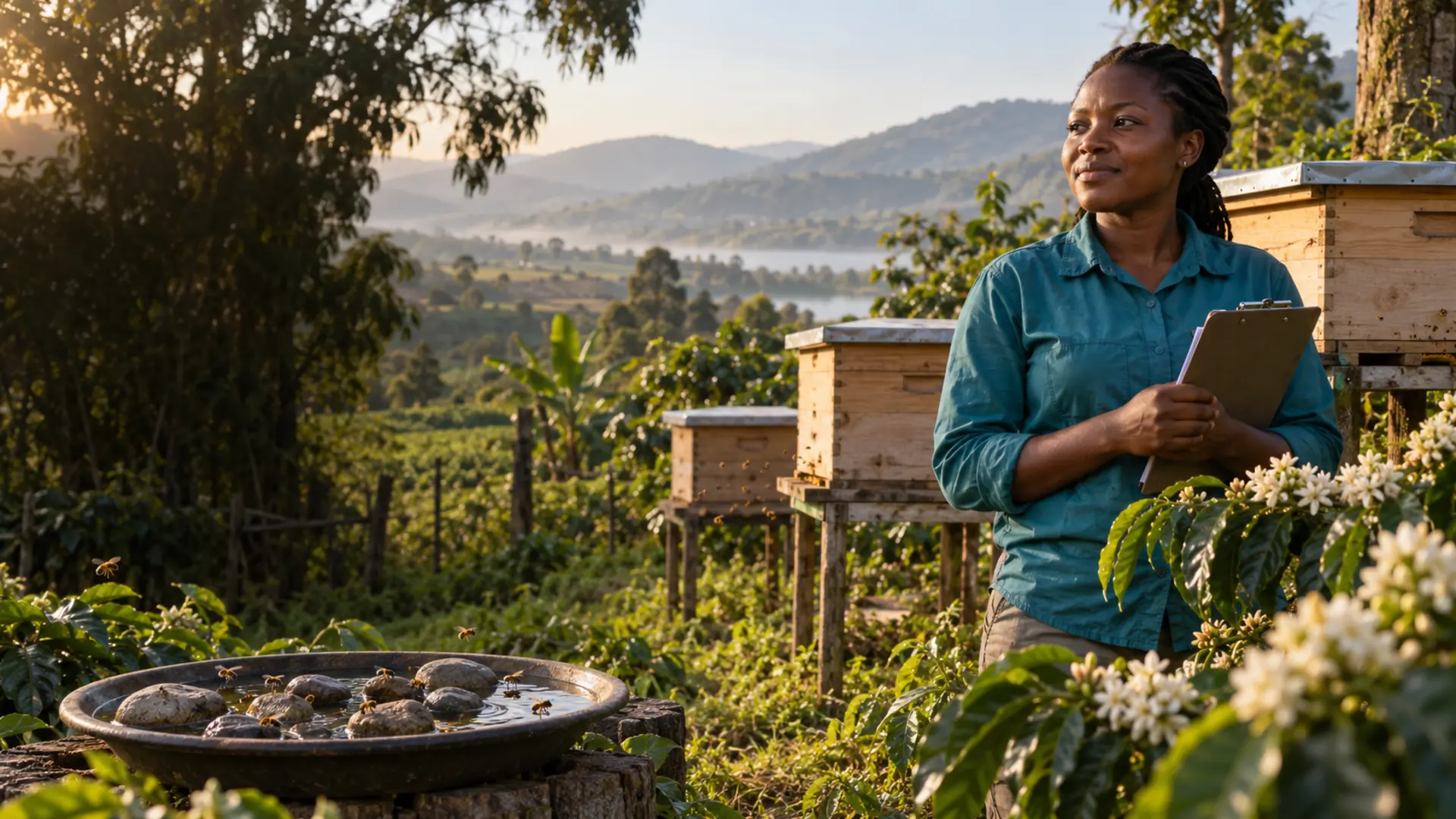
Many beekeepers observe two contrasting periods. In one, colonies build and supers fill. In another, colonies consume stored food, contract and may abscond. The difficult period can still arrive as a surprise when the beekeeper has not recorded what flowers, and when, within flight range of the hives.
You cannot look this up. That is the first and most important thing this article has to tell you, and we want to be direct about it rather than pretending otherwise.
The gap this article is honest about
We searched for a published Uganda-wide bee forage or flowering calendar and did not find one.
What exists is this. The Food and Agriculture Organization’s Beekeeping in Africa carries an appendix listing over a hundred honeybee forage plants of the tropics and sub-tropics, with no geographic limitation and no country attribution; it is a plant list, not a Ugandan calendar. A 2023 review of the state of beekeeping in Uganda names plants that beekeepers commonly report using, including coffee, mango, acacia and calliandra, but these are named by surveyed beekeepers rather than confirmed by botanical or pollen analysis, and they carry no dates. A Uganda-specific field study of bee foraging ecology exists in an institutional repository, based on fieldwork in Bwindi Impenetrable National Park, but we could not open its full text and therefore cannot report its plant list.
That is the whole of it. There is no month-by-month, nationally applicable Ugandan flowering calendar in the accessible literature.
This is not a failure of Ugandan science so much as a reflection of how variable the country is. Uganda spans rainfall regimes that differ fundamentally: seasonal calendars distinguish unimodal rainfall areas from bimodal ones, and the national meteorological authority’s own seasonal forecasting describes June to August as generally a continuation of a rainfall season for much of northern Uganda while being part of a dry season over most of the south-west, central region and Lake Victoria basin. A calendar that was right for Rubirizi would be wrong for Kitgum.
So the honest deliverable is not a calendar. It is a method for building your own.
What this guide helps you decide
Where your bees are actually foraging, and how far out you need to look. What is flowering there, month by month, at your site. When your dearth periods fall and what to do about them before they arrive. And how to give your bees water in a way that keeps them off the neighbour’s water source.
The short answer
Survey what is flowering within a couple of kilometres of your apiary, all year, and write it down. Watch which of those plants your bees actually work, because flowering and foraging are not the same thing. Use the pattern you record to predict your dearth periods. And put a reliable water source next to the hives before the bees find one somewhere less convenient.
How far do they actually go
You need to know the radius before you can survey it, and the answer depends on the bee and on how much forage is close by.
For African honey bees, a study of spatial foraging patterns in Apis mellifera scutellata found colonies concentrating the majority of recruitment within one kilometre of the hives, with median foraging distances for the two colonies studied of 295 and 563 metres, over a total recruitment area of 55 to 80 square kilometres. Compared with temperate-climate colonies, the African colonies had smaller recruitment areas, smaller mean recruitment distances and a greater emphasis on pollen foraging.
For European honey bees, a study of long-range foraging recorded a mean foraging distance of about one kilometre in May under one forage condition, but a median of 6.1 kilometres and a mean of 5.5 kilometres in August when the attractive forage was distant, with 50 per cent of foragers going more than 6 kilometres and 10 per cent more than 9.5 kilometres. The authors’ conclusion is the useful part: the exact distance foraged seems to depend on the abundance of profitable forage.
Water is different again. The Food and Agriculture Organization’s African beekeeping manual states that in savannah conditions bees will travel three kilometres to find water.
What to do with this. Survey the first kilometre thoroughly, because that is where most of the foraging happens when forage is adequate. Then walk out to two or three kilometres and note the major features, because that is where your bees will go in a dearth. Do not treat any single distance figure as the answer; the two studies above measured different subspecies in different landscapes and both are correct about what they measured.
Bee Forage and Water: Mapping the Nectar Year Around Your Apiary
Blank twelve-month forage calendar grid with rows for plants and columns for months, alongside a flight-range circle drawn over a simple landscape sketch
The survey method
A published method exists and it is straightforward. The Food and Agriculture Organization’s beekeeping manual for Asia sets out the construction of a floral calendar, defined as a timetable that indicates to the beekeeper the approximate date and duration of the blossoming periods of the important honey and pollen plants in his area. Note that this is the Asia volume; the method is generic and sound, but it was not developed for Africa and we present it as a method rather than as African evidence.
The steps, adapted for a Ugandan smallholder apiary:
Walk and list. Survey the areas in the vicinity of the apiary and within flight range of the bees, and record the species of plants that the bees visit. Use local names where that is what you know; add botanical names later if you can.
Monitor a hive. The source describes weighing the hive as one of the most accurate ways of assessing the suitability and supporting capacity of an area. A spring balance and a fixed weighing day is enough. If you cannot weigh, note super filling and comb building instead, on a fixed day.
Watch what they work. Flowering is not foraging. Stand at a plant in bloom and see whether bees are on it, and at what time of day.
Note pollen or nectar. Examine the pollen loads coming in at the entrance and their colours. A colony bringing lots of pollen and little nectar is telling you something different from one doing the reverse.
Compare bloom against stores. This is the step that turns a plant list into a calendar you can act on.
Record start and end dates. Write the dates down every year. The value compounds: one year gives you a picture, three years give you a prediction.
Two more techniques exist in the literature if you want to go further. Pollen trapping at the hive entrance, sampled at regular intervals, was used in a Kenyan study in Machakos County that recorded how dominant pollen families shifted between landscapes and across months. And melissopalynology, the analysis of pollen in honey, was used in an Ethiopian study across five districts to identify 53 bee plants and to show different dominant species in highland, midland and lowland agroecologies.
Bee Forage and Water: Mapping the Nectar Year Around Your Apiary
Six-step forage survey method diagram showing what to record within flight range across a full year
What East African studies show, and why they do not substitute for your own
Two neighbouring studies are worth knowing about precisely because of what they demonstrate about variability.
The Kenyan pollen-trap study in Machakos County found that dominant pollen families differed between landscape types, with grasses, daisies and one tree family dominating in one landscape class and daisies, mallows and grasses in another, and that the diversity of pollen types varied both between those landscape classes and across months.
The Ethiopian melissopalynology study found that 93.06 per cent of honey samples were multifloral, with Eucalyptus camaldulensis the predominant pollen type overall at 52.02 per cent, but with different dominant species in each agroecology: one species in the highland, another in the midland and a third in the lowland.
The lesson from both is the same. Within a single country, forage composition changes by landscape, by altitude and by month. Neither of these is Ugandan data, and neither should be presented as such. What they establish is that a national calendar would not be useful even if one existed.
Dearth, and why African bees leave
Dearth is not just a lean period. In African bees it is the trigger for a behaviour that European beekeeping literature barely prepares you for.
A study of seasonal absconding in Apis mellifera scutellata found that migration frequently occurs during periods in which the abundance of blooming plants declines, and that unlike many temperate-climate species that migrate in response to seasonally predictable cues, scutellata colonies may base their migration decisions on a more direct assessment of resource availability. It notes that temperate races experience a brief, predictable foraging season while African subspecies do not experience a winter and may forage virtually all year round. Colonies preparing to migrate showed foraging distances that became increasingly large and variable, and one food-depleted colony that did not migrate died of starvation.
A beekeeping development organisation’s resource on absconding distinguishes two kinds. Resource-induced absconding follows scarcity of nectar, pollen or water, with queens reducing egg-laying up to a month in advance. Disturbance-induced absconding follows predation or pest invasion alongside poor conditions such as flooding or excessive heat. It reports annual absconding rates of 15 to 30 per cent, sometimes reaching 100 per cent, and notes that absconded colonies can move up to 160 kilometres before starting a new nest site. It explains the difference from temperate bees plainly: a temperate colony that absconded would be unlikely to collect enough stores to survive the long dearth ahead, whereas tropical, African and Africanised bees show high levels of absconding. A standard reference on African honeybees attributes these traits to a more propitious climate that is perennially conducive to some flowering and to predation pressure selecting for greater colony mobility.
Read the queen’s egg-laying reduction as your warning signal. It happens up to a month before the colony leaves, which means a beekeeper who inspects and records has a month’s notice.
A dearth response plan
Once your calendar shows you where the gaps are, the plan writes itself. The elements are these.
Anticipate rather than react. The dearth is on your calendar. Everything below has to be in place before it starts, not after.
Do not over-expand into a dearth. Splitting or adding colonies just before a lean period puts more mouths on the same shrinking forage.
Keep the water going. This becomes more important in dearth, not less, and it is covered below.
Reduce the entrance. Robbing pressure rises in dearth, and a weak colony with a wide entrance is a target.
Watch the queen. A reduction in laying that you cannot explain by season is the absconding signal.
Consider whether the apiary is in the wrong place. If your calendar shows a three-month gap every year and there is no fixing it, the honest conclusion may be about siting rather than management.
The Ugandan context makes this more urgent, not less. The 2023 review of Ugandan beekeeping reports that only about 21 per cent of beekeepers provide supplementary feeds during the dearth period, with colonies depending entirely on natural food in 79 per cent of cases. It also reports that beekeepers observed no bloom and flower synchrony, with some plants emerging earlier than the normal time, attributed to changes in air and temperature, more frequent and intense droughts. That last observation is worth taking seriously as a reason to keep your own records: if flowering timing is shifting, last decade’s knowledge is less reliable than this year’s notebook.
Water: why it matters and how to provide it
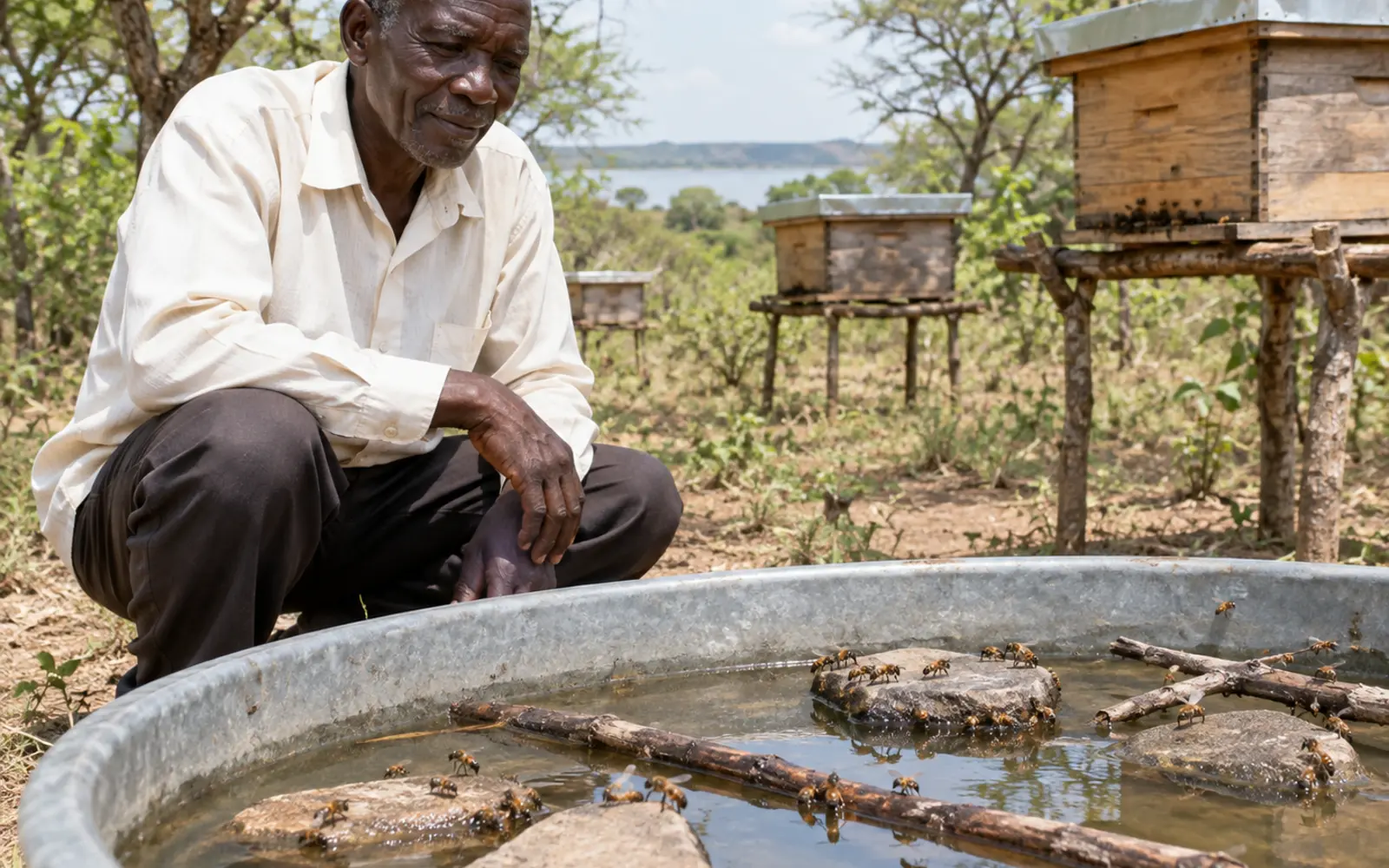
Water is not a minor comfort for a colony. A study of the behavioural regulation of thirst and water collection in honey bee colonies states that colonies use water to maintain body fluid balance in adult bees, to produce glandular secretions and dilute honey for feeding the brood, and to cool the nest on hot days. The same study measured how sharply demand can rise: water collection in heat-stressed colonies jumped from 6.0 grammes per thirty minutes to 21.5, and in a second colony from 3.2 to 22.8, once collection was permitted after deprivation. It describes water collectors becoming active when they are intensely begged for fluid but have none to share.
Combine that with the three-kilometre figure from the African manual and the conclusion is obvious: if you do not provide water, they will find it, and where they find it is not your decision.
The design. Bees are poor swimmers and drown easily in open water. The recognised solution is to break the surface: half-submerged rocks, floating corks, sticks or wood chips, or a rough sloping edge they can stand on. The container should be shallow. Site it close to the hives and, where you can, between the hives and whatever water source you are trying to keep them away from.
Keep it full. This is where most water provision fails. Practical guidance is direct: keep the waterer full or your bees may fly elsewhere, and it can be difficult to convince them to change sources once they are on one. An intermittently filled container is worse than none, because it teaches the colony to look elsewhere.
Establish it first. This is the single most important point in the section. Extension advice on bees at swimming pools notes that there is no reliable way to deter water-seeking bees once they are established at a source, and recommends providing more attractive water sources closer to the hive. Practical beekeeping guidance puts the same point as a rule of neighbourliness: set up nearby water sources before your bees arrive.
If your neighbours have livestock troughs, a laundry area, a rainwater tank or a pool, the water source goes in before the hives do. Afterwards is too late, and the conflict that follows is very hard to undo.
Bee Forage and Water: Mapping the Nectar Year Around Your Apiary
Water provision design showing a shallow container with floats and a rough landing surface, its siting relative to the hives, and the sequence for establishing it before the bees find an alternative
On monofloral honey
You will hear claims that a particular Ugandan honey comes from a single plant. Treat them as unverified unless someone can show you pollen analysis.
The only accessible East African melissopalynological study we could read found 93.06 per cent of samples multifloral, in Ethiopia. That is not evidence about Ugandan honey, but it is a useful prior: tropical honeys in mixed landscapes are usually blends. If you want to make a monofloral claim about your own honey, the route is pollen analysis of your honey, not inference from what you can see flowering.
What to actually write in the notebook
A survey that produces vague notes produces a vague calendar. Six fields are enough, and they should be the same six every month.
The plant, by whatever name you use. A local name recorded consistently is worth more than a botanical name recorded wrongly. If you can photograph a flowering branch and a leaf, do; identification can come later and the record cannot.
Where it is, and how far. Pace it out or estimate honestly in hundreds of metres. A plant at 200 metres and a plant at 2 kilometres are not the same resource.
How much of it there is. One tree, a hedgerow, a whole hillside. Abundance matters more than presence: a single flowering tree is a curiosity, a valley of the same species is a flow.
When it started and when it stopped. Two dates. These are the columns of your calendar and the reason the whole exercise works.
Whether bees were on it, and how many. Ranked simply: none, a few, many. This is the field that separates a botanical list from a forage calendar.
What they were taking. Pollen loads visible on the legs, or bees working deep into the flower for nectar, or both. Note the colour of the pollen if you can see it at the hive entrance; distinct colours arriving tell you a new plant has come into bloom somewhere you may not have walked.
Add one line at the bottom of each monthly page for the colony itself: hive weight if you weigh, or a sentence on how the combs looked. The plant record and the colony record on the same page is what turns observation into prediction.
Reading a calendar once you have one
After a year the page starts telling you things. Three patterns are worth naming, because they call for different responses.
A single dominant flow with a long gap after it. The classic hazard. The colonies build fast, you take a good harvest, and then they starve. The response is restraint at harvest and preparation before the gap, not a bigger apiary.
Two or three moderate flows. The most comfortable pattern and the one mixed landscapes tend to produce. Here the calendar mainly helps you time inspections and splits.
A shallow, continuous trickle with no strong flow. Colonies survive but the surplus is small. This is a siting question rather than a management one, and the answer is often to keep fewer colonies at that site and move some elsewhere for the season.
Whatever the pattern, the gap on the page is the thing to plan around. It will not move much from year to year, and knowing roughly when it starts is worth more than any intervention you can make once it has already begun.
Cost categories
No prices. The lines are: a hardback notebook and pencil, which is the main tool this article asks for; a spring balance if you choose to weigh; water containers and whatever you use to break the surface; the labour of filling them, which is small but must be daily in hot weather; the labour of the survey itself, which is a walk once a month; and, if the calendar shows an unfixable gap, the cost of moving or splitting the apiary between sites.
Common mistakes
Assuming a published forage list from anywhere applies to your site. Surveying once, in a good month. Recording what is flowering without checking whether bees are on it. Expanding the apiary just before the dearth. Providing water only in the dry season. Letting the water container run dry. Putting the water in after the bees have already found the neighbour’s trough. Reading a colony’s decline as a disease problem when it is a forage problem. And treating absconding as bad luck rather than as a documented response to resource scarcity that gives about a month’s warning.
Warning signs and escalation points
In the colony: a reduction in egg-laying that the season does not explain; foragers ranging further and returning with less; increased robbing at the entrance; a sudden drop in hive weight; bees clustering outside in a way that is not simply heat.
In the landscape: a major flowering tree felled within flight range; a change of land use that removes a bloom you had recorded; the start of a dearth arriving earlier than your records predict.
With neighbours: any report of bees at a trough, a tap, a pool or a laundry area is a signal to fix your own water provision immediately, and to talk to the neighbour before it becomes a dispute.
Where it works and where it does not
Building your own calendar works everywhere, and works best where the landscape is mixed, so that different plants flower at different times and the gaps are shallower.
It works least well where the landscape has become uniform. An apiary surrounded by a single crop has a spectacular flow and a long famine, and no amount of recording changes that. In that case the calendar’s value is that it tells you honestly to move some colonies, or to accept a smaller apiary at that site.
A low-risk first step
Take a notebook and walk a circle of about one kilometre around your hives this month. Write down every plant you find in flower, using whatever name you know it by, and mark whether you saw bees on it.
Do it again next month, on a day you fix now. Twelve of those walks and you will have something no published source in the country can give you, which is a forage calendar that is actually about your bees.
What to do next
Read rainfall records and seasonal forecasts for farm planning alongside this, because your forage calendar and your rainfall record are two halves of the same picture, and agroforestry for soil and water conservation if you are considering planting to fill a gap. On-farm water sources covers the supply side of the water provision this article requires. Our guides to apiary siting and colonisation and colony inspection, together with our forthcoming guide to protecting bees from pesticide exposure - scheduled in this programme, complete this cluster.
About the author
The Falcon Foundation Ltd Editorial Team produces evidence-based agricultural guidance for Ugandan farmers, drawing on published research and institutional sources and translating them into practical decision support. Where evidence is unavailable or contested, we say so rather than filling the gap.
