
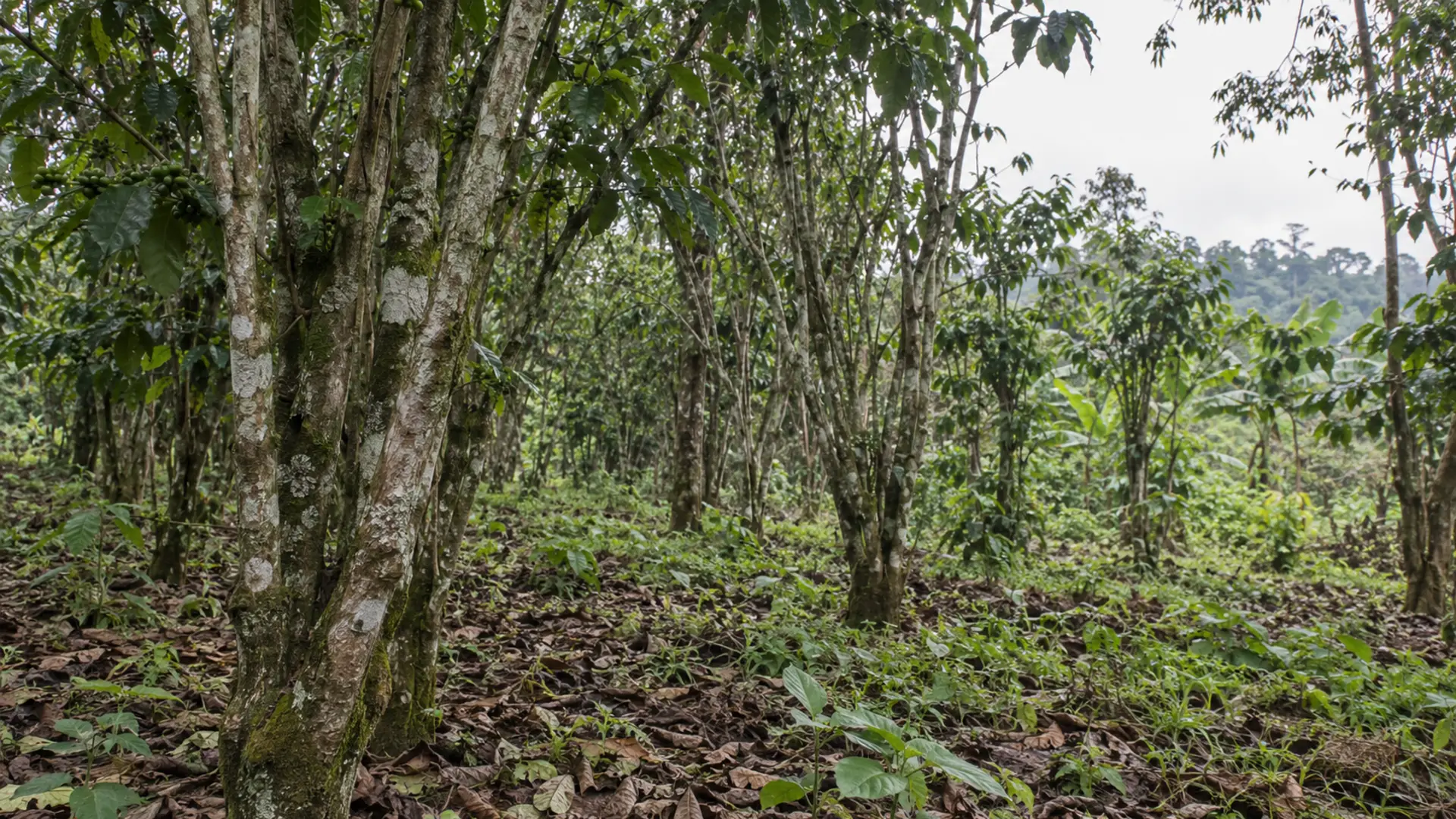
The garden is tall. You harvest from a ladder or by pulling branches down. The bearing wood is all at the top and the bottom two metres of every stem is bare. Yield falls a little every season and you cannot point to a reason.
Every neighbour has an opinion. Cut it all back. Leave it, it will recover. Pull it out and start again.
Those three opinions are the three real options, and which one is right depends on things you can count in an afternoon.
What this guide covers and what it excludes
It covers an assessment that outputs one of three decisions, the documented stumping technique as Uganda’s own coffee handbook specifies it, a phased schedule that keeps a garden earning through rejuvenation, and an honest account of a disagreement between institutional sources about how long a coffee tree actually lasts.
It excludes coffee wilt and black twig borer identification, which is a separate diagnostic subject covered in coffee wilt and black twig borer management; harvesting and drying, covered in coffee harvesting, drying and quality control; and the raising of clonal nursery material beyond a reference to the certification requirement.
It contains no price or income projection of any kind. Coffee prices move and nobody can forecast what a rejuvenated block will earn. What this guide gives you instead is the timing, so that you can put your own numbers against it.
The Ugandan context
Uganda’s coffee production stood at 8.2 million 60-kilogramme bags in the 2023/24 financial year, according to the Ministry’s statistical abstract. The same document records the national annual robusta yield at 0.6 tonnes per hectare, from 2020 data.
What nobody publishes. We searched the Ministry abstract, an international organisation’s Uganda coffee value chain mapping and the coffee authority’s own material for a figure describing the age profile of Uganda’s robusta stock. There is none that we could find. Statements that Uganda’s coffee trees are largely old are widely made and, as far as we could establish, not supported by a published national figure.
That matters for this article, because a farmer cannot benchmark their garden against a national picture that does not exist. The assessment below is therefore built on what you can measure in your own garden rather than on where you sit relative to a national average.
And one relevant observation from the value chain mapping: “replanting is not commonly practised on Uganda smallholder coffee farms.”
How long does a coffee tree actually last
This is the question everything else depends on, and two credible Ugandan institutional sources give two different answers.
Risk framework
Show the reader that two credible Ugandan institutional sources disagree about the productive life of a coffee tree, because the disagreement directly changes whether rejuvenation or replacement is the right answer.
This is where two credible Ugandan institutional sources disagree, and the disagreement is not academic. It changes the decision.
The national coffee authority’s robusta handbook states: “Current Robusta varieties can sustain good yields up to 40-50 years during which productivity is sustained by renewing cropping cycles through stumping.”
Forty to fifty years, conditional on renewal.
An international organisation’s Uganda coffee value chain mapping states: “Over time, the production capability of coffee trees declines. They continue to yield beans for several decades, with peak production occurring around five to 15 years after planting, declining thereafter.”
Peak at five to fifteen years, declining after that.
We are not going to reconcile these. They come from different kinds of document. The handbook is national technical guidance specific to Ugandan robusta management and it describes what is achievable with renewal. The value chain mapping is institutional analysis making a general statement about coffee biology. Neither is a trial.
What a farmer should take from the pair is this: peak yield and useful working life are different things. A tree past peak is not a tree to remove. A garden that has never been renewed and is decades old is a different proposition from one on a seven-year cycle.
Two further pieces of evidence, both labelled carefully because neither is Ugandan robusta.
A Ugandan news report on the Bugisu sub-region states that “Yield and production capacity begins dropping consistently from around 30 years of age” and that “by 50 years… many trees barely fruit”, with most trees there over 70 years old. Bugisu is Uganda’s Arabica belt and the same report describes the region’s Arabica production, so these figures concern Arabica, not robusta. We report them and we do not transfer them.
An international organisation feature on Ethiopian coffee stumping reports a “2- to 3-fold increase in yields” and describes farmers taking “1-3 years for their stumped trees to regenerate”. That is Ethiopian, it is a project feature rather than a controlled trial, and the same source makes an income claim which this guide does not repeat because it is not transferable to Uganda.
What is not known, stated plainly. We found no Ugandan robusta stumping yield trial reporting before and after figures. We found no robusta-specific decline onset age. We found no national age profile. Anyone quoting you a Ugandan figure for what stumping returns should be asked which document it is in.
Three options, not one
The decision is not whether to stump. It is which of three responses the garden actually needs, and they are not interchangeable.
Comparison matrix
Set the three options against each other on the factors that actually decide between them, so a farmer chooses on the state of their garden rather than on which option they have heard of.
Stumping cuts the existing stems back to the stool and grows a new cropping cycle from the same root system. The root system is the asset you keep, and it is substantial.
Gap-filling plants new material into the spaces where stools have died, leaving the rest of the garden as it is.
Replanting removes the garden and starts again.
The comparison matrix sets them against each other. The row that decides most cases is the last one: what each option does not fix.
Stumping does not fix spacing. If a garden has lost a third of its stools, stumping the remaining two thirds gives you a rejuvenated but gappy garden. The gaps stay gaps.
Stumping does not fix a dead root system. The whole method depends on the stool being alive and vigorous enough to push new shoots.
Gap-filling does not fix the old plants. A young plant establishing under the canopy of tall old trees is competing for light with plants that are already losing.
Replanting does not fix the soil or the site. If the garden is declining because of soil condition, slope, drainage or shade, a new planting will decline the same way. The soil question comes first and is covered in soil testing and fertility.
The assessment
This is the sheet that converts a vague sense of decline into a decision. It takes an afternoon, a tape measure and a notebook.
Checklist
Give the farmer a scoring sheet that turns a vague impression of a declining garden into one of three defined outcomes, so the decision is made from observations rather than from frustration.
Complete the sheet in the garden, with a tape measure and a notebook. It takes an afternoon and it replaces a year of indecision.
Part one, age and history. When was it planted. Has it ever been stumped, and when. What has it yielded in each of the last three seasons. A garden that has never been stumped and is decades old is the clearest case for rejuvenation there is.
Part two, stem condition. Count stems on ten stools. Measure the height of the bearing wood. Estimate what proportion of each stem is bare woody stem with nothing on it. If the bearing wood is above your head and the bottom two metres is bare, the plant is spending its resources maintaining stem that produces nothing.
Part three, canopy. How much sky do you see through it. A thin canopy that lets a lot of light to the ground is a plant with too little leaf to support a crop.
Part four, root and stool condition. Push each stool. Does it rock? Is the bark at the collar sound? Are any stools dead? This part decides whether stumping is even available to you, because stumping depends on the stool.
Part five, spacing and gaps. This is the part that decides more cases than any other. Measure the actual spacing. The national handbook records that “The recommended spacing of Robusta Coffee by NaCORI is 10ft x10 ft. (3mx3m). This should result in about 450 plants per acre.” Then count missing stools in a measured area.
A garden at close to the recommended population with living stools is a stumping candidate. A garden that has lost a large share of its stools is a gap-fill or replant question, and no amount of cutting changes that.
Part six, soil and site. Slope, erosion, drainage, and whether a soil analysis has ever been done. If the answer to the last is no, do that before committing to a replant.
How stumping is actually done
Uganda’s coffee handbook specifies this operation precisely, and four of its details are the ones most commonly got wrong in practice.
Step sequence
Set out the documented stumping operation precisely, because the cut height, the cut angle, the retained stem and the sucker selection are all specified in the national handbook and all four are commonly got wrong.
Uganda’s coffee handbook specifies the operation precisely, and four details are commonly got wrong.
The height and the angle. “The stems should be cut at a height of 6 inches (0.5ft) from the ground, at 45 degrees slanting slope to allow water to run off.”
Six inches. Not knee height, which is what most people do. And the angled cut has a stated reason: water runs off rather than sitting on the cut surface, which is how a stump rots.
The breather stem. “Cut down other stems and retain one single stem breather.” The handbook explains why: “The stem left works as breather and continues feeding the stump until dormant buds open up.”
This is the step most often skipped, and skipping it is why some stumped gardens fail to shoot. The retained stem keeps the root system supplied while the stump has no leaves of its own. Cutting everything at once removes the plant’s ability to feed itself at the exact moment it needs to push new growth.
Sucker selection, and when. “When suckers are approximately 20cm (8inches), select 3 or at most 4 healthiest stems and groom them for the next cropping cycle.”
Twenty centimetres is the stage. Selecting too early means judging shoots before their vigour is apparent. Selecting too late means the stump has spent resources on shoots you are about to remove. Three, or at most four.
The cycle. “After initial stumping, the subsequent production cycles should be renewed (converted) after every 7 years.”
Seven years. That is the interval that produces the forty to fifty year working life the handbook describes, and a farmer who stumps once and then leaves the garden for twenty years is not following the system that claim depends on.
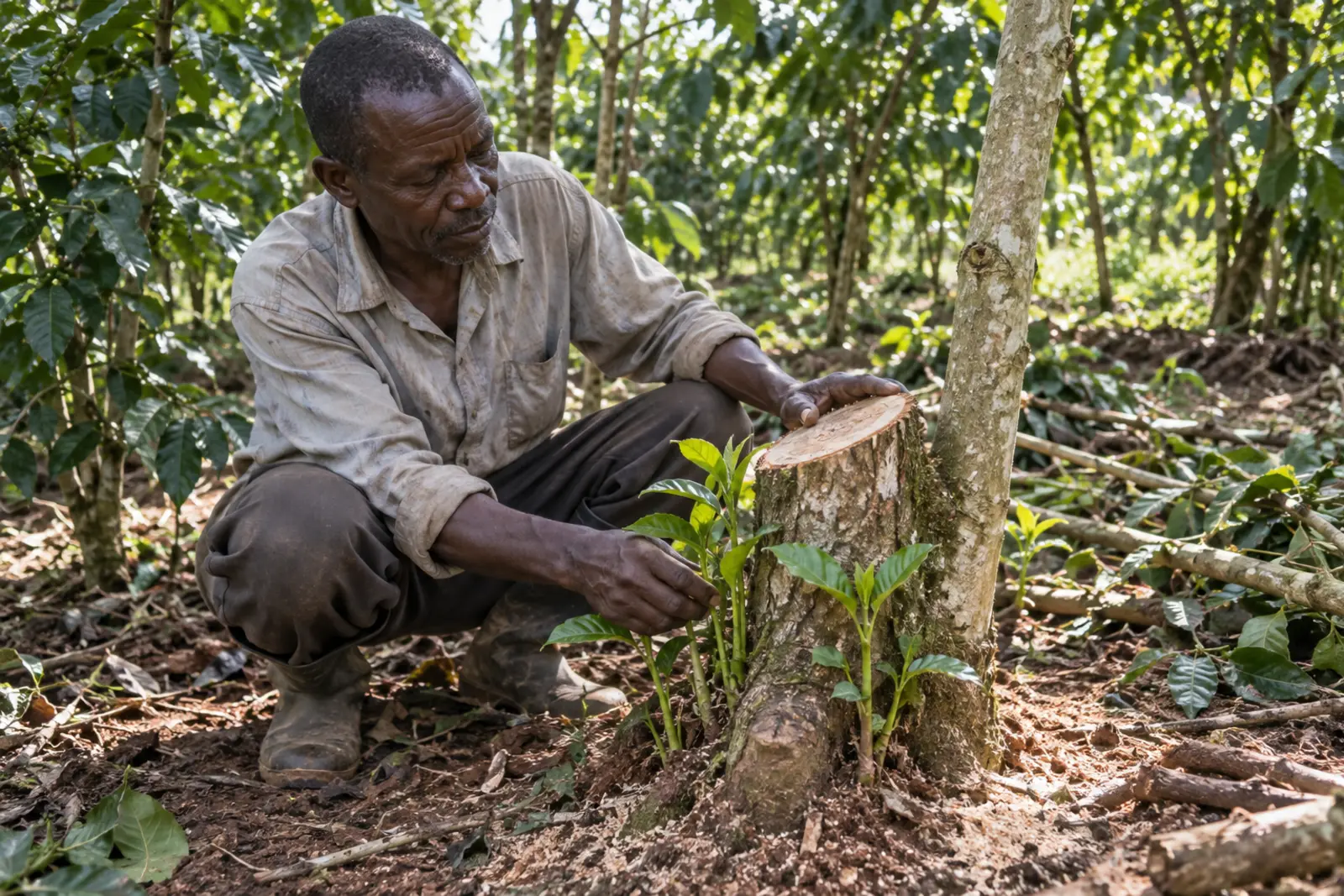
What the handbook does not specify, and we will not invent. It gives no month or season for the operation. It gives no guidance on adjusting existing shade over a garden being stumped, only on establishing shade a year before new planting. Both are reported as gaps.
Phasing it so the garden keeps earning
This is the practical heart of the decision for a smallholder, and the handbook addresses it directly rather than leaving it to be worked out.
Seasonal calendar
Show the phased three-block schedule that keeps a garden earning while it is being rejuvenated, because stumping a whole garden at once removes the entire income of the holding.
Here is the practical heart of the decision, and the handbook addresses it directly: “The farmer stumps the entire garden if it is due. However, he/she may divide the garden into parts and sequence the stumping at different periods.”
The reason is cash flow. A smallholder who stumps everything has no coffee income until the new cycle bears. That is a gap measured in years, not months, and it is the reason most farmers who know they should stump do not.
The three-block schedule. Divide the garden into three roughly equal blocks. Stump one. Leave the other two bearing. When the first block is established and approaching bearing, stump the second. Then the third.
At no point is more than a third of the garden out of production.
A qualification you must apply yourself. The schedule needs a recovery period, and Uganda does not publish one for robusta stumping. The nearest documented figure is the Ethiopian one to three years for regeneration, from a different country and a project feature rather than a trial.
So build the schedule on that figure provisionally, and replace it with your own observed recovery period after the first block. Your own first block is the only Ugandan trial that will ever be specific to your garden, and recording it properly is the point of farm record keeping and gross margin analysis.
Two further advantages of phasing that are not about cash flow. You learn the technique on a third of the garden before applying it to the rest. And if something goes wrong, it goes wrong on a third.
If the answer is replant
The handbook specifies the replanting preparation.
Holes. “Digging circular holes of 60cm (2ft) deep and 60cm (2ft) in diameter at the marked points. This should be done atleast 3 months before planting.”
Three months before planting. That is a timetable, not a suggestion, and it means the decision to replant is taken a season before the planting.
Refilling. “Refill the holes with well manured soil about a month before planting. Where possible, mix the topsoil with a 20-litre basin of well-decomposed manure.”
Shade. “Farmers should establish shade trees atleast one year before coffee is planted out”, at spacing “approximately 20-40m apart depending on the tree species and expected canopy profile.”
A year before. If shade is part of your plan, the shade trees go in before the coffee does, which extends the timetable further. The broader case for trees in a cropping system is in agroforestry for soil and water conservation.
Planting material. The national clonal nursery manual states that certification of a nursery “is obtained after assessment and recommendation of technical inspectors from the Uganda Coffee Development Authority (UCDA) and National Coffee Research Institute (NaCORI)”, and that “One of the key requirements for certification is for the mother garden having well labelled and identifiable clonal Coffee lines as released by NaCORI.”
It records that “Currently, 10 CWD-r lines are available for multiplication through both tissue culture and nodal cuttings (vegetative propagation)”, identified as KR1 to KR10, with the first seven released in 2009 and the remaining three in 2017, and yields stated in the manual as 2,200 to 4,900 kilogrammes per hectare per cropping cycle year.
Two practical points. The certification requirement means you can ask a nursery whether it is certified and who inspected it. And the yield figures above are the manual’s own statement for the released lines; they are not a projection for your garden, and this guide does not present them as one. The general discipline for checking planting material before you buy is in verifying seed and planting material quality.
A gap worth knowing. The handbook gives no fallow interval between removing old coffee and replanting the same site. We searched for one and found none in any Ugandan source we could open. If you are replanting where coffee stood, particularly where disease was present, that is a question for the coffee authority or a qualified adviser rather than something this guide can answer.
Common mistakes and why they fail
Cutting at knee height. The documented height is six inches. A high stump carries old wood into the new cycle and produces shoots from the wrong place.
A flat cut. The documented angle is 45 degrees with a stated reason. Water sitting on a flat cut surface rots the stump.
Cutting every stem at once. Removes the breather. The handbook is explicit about what the retained stem does.
Leaving all the suckers. A stump carrying eight shoots produces eight weak stems. Three, or at most four.
Selecting suckers too early or too late. The documented stage is twenty centimetres.
Stumping the whole garden at once on a smallholding. The handbook offers phasing specifically because of this, and a farmer with no other income should take it.
Stumping a gappy garden. Rejuvenates the survivors and leaves the gaps.
Stumping a garden with dying stools. The method depends on the stool being alive.
Stumping once and then forgetting. The documented cycle is seven years, and the forty to fifty year claim depends on the cycle rather than on a single operation.
Replanting without preparing holes three months ahead. The timetable is in the handbook.
Replanting into the same declining soil. Stumping and replanting both fail on a site problem.
Cautions and escalation points
Financial. Stumping removes income from the stumped area for a period this guide cannot state for Uganda, because no Ugandan figure exists. A farmer with no other income should phase, and should plan the cash flow before cutting anything. The framework is in a bankable farm business plan.
Do not stump a diseased garden without a diagnosis. Wilting and dieback have causes other than age, and cutting back a diseased garden spreads the problem on the blade. That is a separate subject with its own triage.
Tool hygiene applies. Any cutting operation in a coffee garden moves material on the blade.
Escalate to the coffee authority or a coffee extension officer for: the season in which to stump in your area; whether your garden is a stumping candidate; the fallow interval if you are replanting after old coffee; and where certified clonal material is available.
Escalate to a soil laboratory before a replant decision. Replanting into the cause of the decline repeats it.
Be careful with yield claims. Uganda publishes no robusta stumping trial. Any figure quoted to you for what stumping will return in Uganda is, as far as we could establish, not backed by a published Ugandan trial. What prices and yields actually do in Ugandan markets is dealt with in how Ugandan farm gate prices are formed.
Practical action plan
This month. Complete the assessment sheet. Ten stools, measured spacing, counted gaps, pushed stools. Write the three seasons of yield you can remember or find.
From the assessment. If the stools are alive and the spacing is close to recommended, you are a stumping case. If a large share of stools are missing, you are a gap-fill or replant case. If the soil or site is the problem, neither cutting nor replanting is the answer yet.
If stumping. Divide into three blocks now, on paper. Choose which block goes first, preferring the block you can most afford to lose. Confirm the season locally with an extension officer.
At the operation. Six inches. Forty five degrees. One breather stem retained. Then wait.
At twenty centimetres of sucker growth. Select three, or at most four. Remove the rest. Remove the breather when the new stems are established.
Record everything. The date of cutting, the date suckers reached selection stage, the date of first flowering and the first harvest weight from the block. That record gives you a Ugandan recovery period for your own garden, which is a figure that does not currently exist anywhere.
Seven years later. Renew the cycle. That is the system the forty to fifty year figure depends on.
Conclusion
Stumping is not a rescue operation for a failing garden. It is a maintenance cycle that Uganda’s own coffee handbook puts at seven years, and the long productive life it describes is conditional on running that cycle rather than on performing the operation once.
The assessment decides between the three options, and the single most useful thing in it is counting the gaps. A full garden of living stools can be rejuvenated. A garden that has lost its stools cannot be cut back into productivity.
And phase it. The handbook offers phasing for a reason, and on a smallholding with no other income that reason is the difference between a rejuvenated garden and an abandoned plan.
Author
This guide was produced by the Falcon Foundation Ltd Editorial Team. We research agricultural questions against published national technical guidance, government instruments, institutional analysis and peer-reviewed evidence, and we translate them into decisions a Ugandan farmer can act on. Where two credible sources disagree, we report both rather than choosing between them, and where no evidence exists we say so. This article contains no price or income projection, and the yield figures it quotes are stated as the figures their sources give rather than as expectations for any particular garden.
