
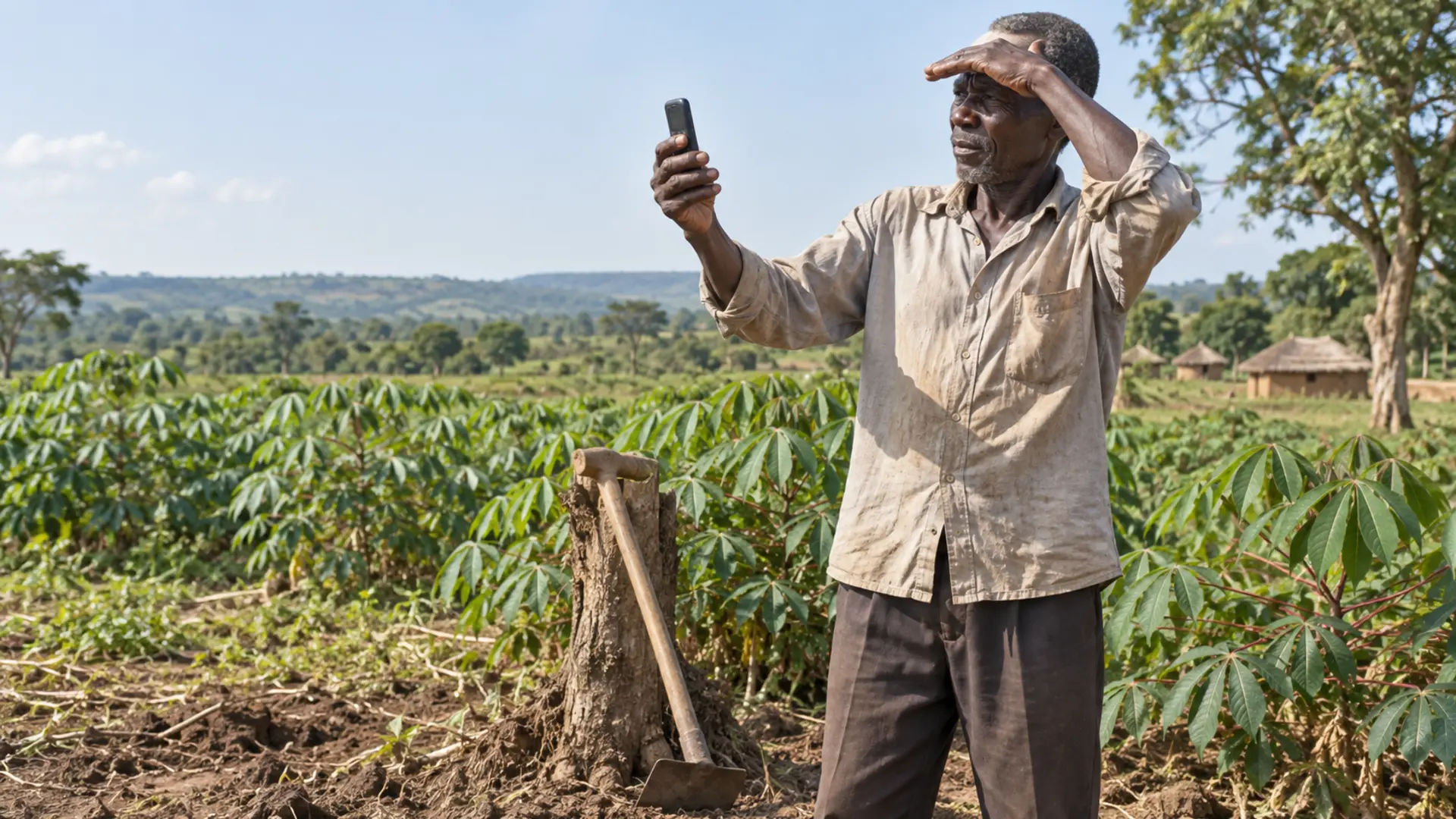
Every season, a Ugandan farmer is offered something digital. A subscription that will send crop advice by text. An app that will diagnose a disease from a photograph. A number to call for guidance. Sometimes a registration form at a meeting, in exchange for future advice.
Some of these are serious and useful. Some were serious and have closed. Some are marketing. And it is close to impossible, from the pitch alone, to tell which is which.
This guide does not tell you which service to use. It deliberately names no service as recommended, and the reason is in the evidence below: this sector has a documented history of prominent closures, and anything named in an article can be gone before the article is a year old.
What it gives you instead is a checklist you can apply to any service, an honest account of what the impact research actually found, the access figures that determine whether a service can reach you at all, and a summary of what Ugandan law says about your data.
Start here: the evaluation checklist
Rather than open with an assessment of the sector, this guide opens with the tool, because the tool is what survives contact with a service that did not exist when this was written.
The checklist below is deliberately short and deliberately awkward. Every question on it is one a legitimate service can answer in a sentence, and one that a service without institutional backing will struggle with.
Digital Extension in Uganda: Which SMS Services, Apps and Advisory Lines Are Real and Worth Using
A blank seven-question service evaluation checklist with columns for the answer given, the source of the answer and the date, applicable to any app, SMS service or advisory line.
Seven questions. Ask them before you register, subscribe or pay.
Who runs this? Can you identify the organisation, and can you contact it independently of the person pitching to you?
Who actually answers? When you ask a question, does a qualified person respond, does an automated system respond, or does another farmer respond? All three exist and they are not equivalent.
Is the advice traceable to an institution? This is the most important question in the list. Advice you can attribute to a named research body, ministry or university can be checked and can be corrected. Anonymous advice can be neither. The general framework for judging any agricultural information source is in reliable sources of farming advice.
What does it cost you? Not the subscription alone. Message costs, data costs, and whether a free trial converts to a charge.
What does it actually cover? Which crops, which livestock, which districts. A service built around maize in one region may have nothing useful for your enterprise.
What language? In practice this determines whether a service is usable at all for many farmers.
What happens to your information? See the section on data below, because Ugandan law has something specific to say about this.
A service that cannot answer the first three questions is not necessarily fraudulent. It is, however, not accountable, and you should weigh its advice accordingly.
What the evidence actually shows
This is where the guide departs from most writing on the subject, because the research is considerably more sober than the promotion.
Digital Extension in Uganda: Which SMS Services, Apps and Advisory Lines Are Real and Worth Using
A panel comparing measured effects of video, interactive voice and SMS delivery from a Ugandan randomised trial, alongside the cross-country average effect of digital advisory and a fall armyworm campaign result.
The Ugandan trial that compared channels
The most directly relevant study is a randomised trial among maize farmers in eastern Uganda that tested three delivery channels: video, interactive voice response, and text message.
The finding: video alone raised knowledge, practice adoption and yields by around 10 per cent, but the incremental effects of the voice and text technologies were found to be limited.
Read that carefully, because it is the single most useful result in this whole field for a Ugandan reader. In a controlled test, on Ugandan farms, the video screening carried the effect and adding SMS on top of it added little.
The fall armyworm campaign
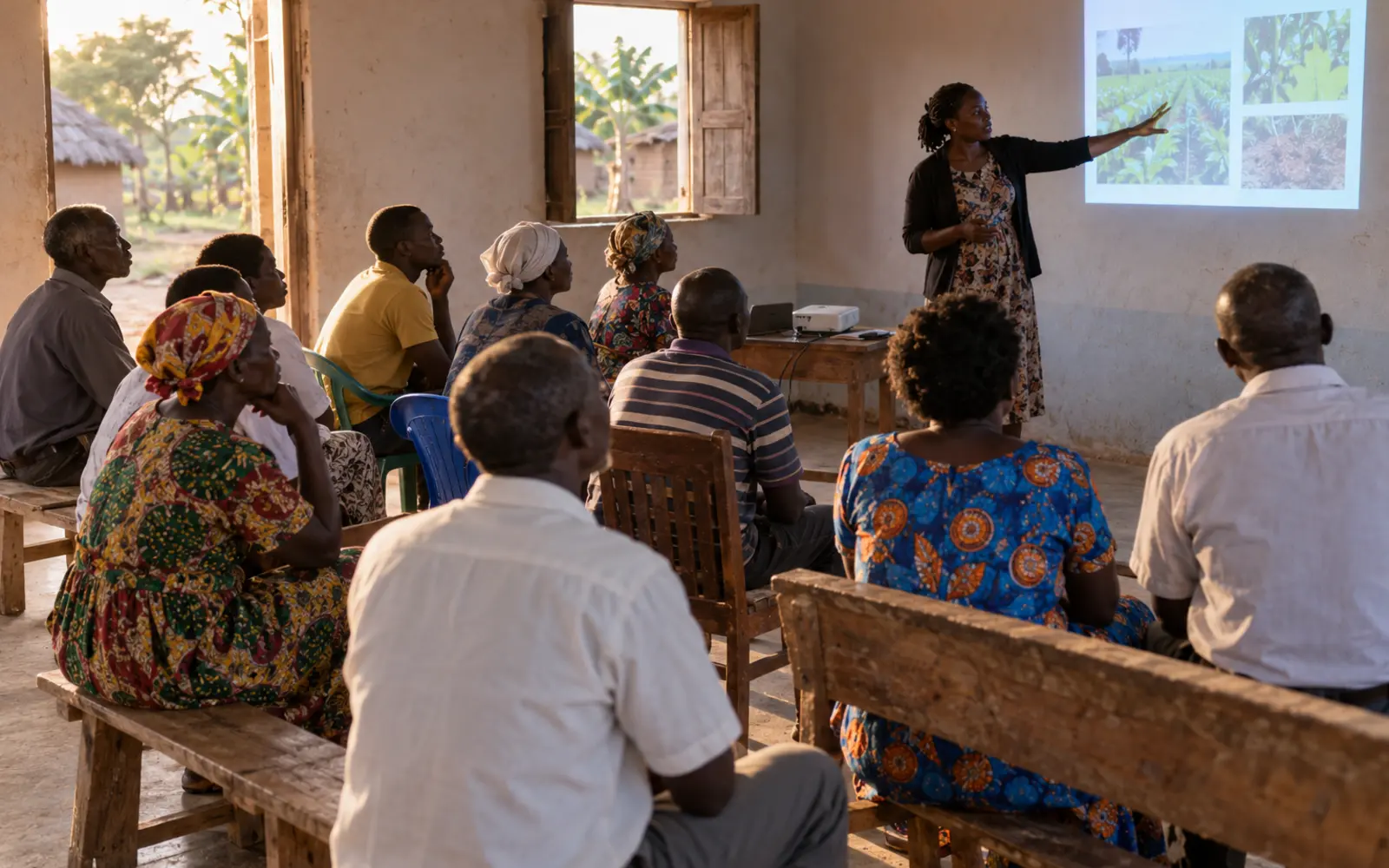
A second Ugandan study evaluated an information campaign in western Uganda that combined radio, village video screenings and a series of local-language text messages.
Knowledge rose by around 20 per cent among participants and practice adoption rose. But the text message component reached only 8 per cent of the sample and showed no robust significant effects compared with radio. The authors’ own conclusion is worth quoting in substance: in a low-literacy population, applications that allow both verbal and visual communication, such as village-based video screenings, should be prioritised, and text-based messaging is also limited in the amount and type of content that can be delivered.
The cross-country picture
A synthesis published in a major journal found that digitally delivered agricultural advice raises yields by around 4 per cent on average across the studies reviewed.
Four per cent is a real effect and it is not nothing, particularly at the cost of a text message. It is also nowhere near the transformation that marketing language implies. The same synthesis flags an equity problem directly: subscription-based models reach only a small fraction of farmers and tend to skew toward men, and toward richer, younger and more educated farmers with better digital access.
The marketplace trial
A Ugandan digital marketplace platform, built by university computer scientists and evaluated in a randomised trial, produced genuine market-level effects: price gaps between nearby markets narrowed and trader margins fell.
But only about 2 per cent of farmers with access actually completed a trade on the platform, compared with a much higher share of traders who engaged. And the evaluation noted that the research did not identify a sustainable monetisation model for operating the platform long-term.
Two lessons there. Farmer-level uptake of even a well-built, well-funded, academically evaluated platform was very low. And a service without a business model may not survive regardless of how well it works.
What exists, and what has closed
Here the guide reports what we could verify, without recommending anything.
Government services
We checked the ministry, the national advisory services body, the national research organisation and the communications regulator.
The ministry operates an electronic extension portal offering agricultural training videos in local languages, stakeholder profile information, weather advisory and information on crises and outbreaks. What we could not find on it was any short code, hotline number, USSD code, cost information or indication of when it was last updated. It reads as a content portal rather than an interactive advisory line.
The national research organisation maintains a page headed for its apps. Its entire content, when we opened it, was the words “Content coming soon!”
We found no document from any of those bodies describing an operating government toll-free farmer advisory phone line.
A commentary published in the Ugandan press in 2025 argued that Uganda urgently needs a comprehensive national digital agriculture strategy and observed that many farmers and even some extension workers lack the skills needed to effectively use digital tools. That is an opinion piece rather than a government document, and we cite it only as an indication that no such national strategy was in place.
Services that have operated
One Ugandan platform, run by a private company, was described in 2017 as allowing farmers to ask questions in languages they understand and receive feedback from extension officers by text message, with a reported registered farmer base at that time. A 2025 institutional item confirms the platform still operating, accessible by USSD for those with feature phones or without internet as well as through applications, offering farmer profiling, agricultural insurance access, inputs, market information, weather forecasts and advisories, with a training programme running in named districts. Its own site advertises a one-month free trial for weather and market information, which implies a charge thereafter, but no price is stated.
Another Ugandan platform was described in a 2024 institutional publication as offering farm management, an input shop, a financing product, training and market linkages.
We are naming neither, because inclusion in an article reads as endorsement and we have no basis for endorsing either. We are describing what a verifiable document said about each so that you know such services exist and what to ask about them.
And one that closed
A prominent peer-to-peer SMS advice network that operated across Kenya, Uganda and Tanzania, once reaching over a million farmers, went out of business in 2022.
That is the fact that should govern how you read any list of digital services, including this one. Assume nothing is still running until you have confirmed it yourself. If a service was recommended to you from a training manual, a news article or a guide written more than a year ago, check before relying on it.
The access reality
A service can only help you if you can actually use it, and the national figures set real limits.
Digital Extension in Uganda: Which SMS Services, Apps and Advisory Lines Are Real and Worth Using
A panel of Ugandan connectivity and access figures covering active SIMs, telephone penetration, mobile internet subscriptions, the split between smartphones and feature phones, network coverage by land area and population, and the gender gap.
The communications regulator’s most recent annual sector report gives a total mobile subscription base of 41.6 million ninety-day active SIMs at the end of 2024, with a telephone penetration rate of 91 per cent. Active mobile internet subscriptions stood at 15.7 million, up from 13 million the previous year, though the report notes that the measurement threshold changed during the year, so that comparison is not a direct one.
The handset figure is the one that matters most for service design. Smartphones numbered 18.3 million devices, 39 per cent of handsets, having grown substantially year on year. Feature phones remained the majority at 26.7 million, 56 per cent.
More than half of Ugandan handsets are feature phones. Any service that requires an app has, by that fact alone, excluded the majority of phone owners in the country.
Coverage is similarly uneven depending on how you measure it. The newer network generation covers 58 per cent of land area but 82 per cent of population; the older generations cover 75 per cent of land area but 98 per cent of population. The report notes that rural areas still lack consistent access to reliable voice and internet services.
The gender gap
The regulator’s report contains no gender breakdown, which is itself worth noting.
A separate study of gender and digital technologies in Uganda reports that 63 per cent of the male population has access to mobile services against 56 per cent of the female population, and that rural women’s internet access stands at 6 per cent against urban women’s 29 per cent.
An older Ugandan network report, citing a regulator survey from 2015, recorded that only 44 per cent of women owned and could use a phone at any time compared with 62 per cent of men, and that 15 per cent of women had used a computer or the internet in the previous three months compared with 21 per cent of men. Those figures are now old and are cited as historical.
The practical implication for anyone designing or promoting a service: a digital channel reaches men more reliably than women, and rural women least of all. A household where the phone belongs to one person is a household where digital advice reaches one person.
Your data
This is the part of the checklist that most farmers skip and it has real legal content behind it.
Digital Extension in Uganda: Which SMS Services, Apps and Advisory Lines Are Real and Worth Using
A panel summarising the consent requirement and four data subject rights under Ugandan data protection law, with the responsible office named and a note on what to ask a service before registering.
Uganda’s Data Protection and Privacy Act of 2019 establishes the framework. Its central provision is direct: section 7(1) provides that a person shall not collect or process personal data without the prior consent of the data subject. The Act also sets out exceptions to that requirement, which are not reproduced here.
The Act gives you specific rights. Section 24 provides a right of access, to confirmation of what data is held, a description of it, and the identity of third parties with access. Section 25 provides a right to require a controller to stop processing that causes or is likely to cause unwarranted substantial damage or distress. Section 27 provides a right against decisions based solely on processing by automatic means. Section 28 provides a right to have inaccurate data rectified, updated, blocked, erased or destroyed.
The Act establishes a personal data protection office under the national information technology authority, headed by a director.
What to do with this. When a service asks you to register, you are consenting to something. Ask what. Ask who else receives the information. Ask whether registration is a condition of receiving advice, and whether there is a way to stop. These are not awkward questions; they are the questions the Act is built around.
What a good service looks like in practice
Nothing above says digital extension cannot work. It says that the effect is modest on average and that the channel matters. So what does a service worth your time look like?
It names its institution and the qualifications of whoever answers. It states its coverage honestly, including where it does not cover. It works on a feature phone, because that is what the majority of Ugandan handsets are. It operates in a language its users actually think in. It asks for consent to hold your information and tells you what it does with it. And it can tell you when its advice was last reviewed and by whom.
A service meeting those six conditions is doing something genuinely useful even if its measured effect is the 4 per cent the cross-country synthesis reports, because 4 per cent on a season’s yield for the cost of a few messages is a reasonable return. The problem is not that digital extension is worthless. It is that the distance between a service meeting those conditions and one meeting none of them is invisible from the pitch.
What we could not find
Two honest gaps, reported because their absence is itself informative.
No documented case of harm. We searched for a documented, source-attributed case of agricultural advice delivered digitally in Uganda that was wrong, harmful or unattributable. We did not find one.
That should be read carefully. It is not evidence that it does not happen. Nobody appears to be systematically collecting such cases, which is a different thing from their not existing. What it does mean is that this guide will not claim that digital advice is frequently harmful, because we cannot support that claim.
No current Ugandan market price service verified. A historical radio-based market information service operating from 2000 is well documented, with weekly programmes and daily bulletins in eight local languages, and was found in research to have raised farm-gate prices. We could not verify a current equivalent Ugandan SMS price service by opening a working page. Market price questions are dealt with more generally in how Ugandan farm-gate prices are formed.
A caution on international reports
A well-known industry report on data-driven advisory services for smallholder agriculture is easy to find and looks directly on topic. Its case studies are India, Kenya and Nigeria. It does not cover Uganda at all.
That is a general warning about this literature. A great deal of digital agriculture writing about Africa draws on two or three countries and is then cited as though it described the continent. Check which countries a report actually studied before treating its findings as applicable here. The method for doing that is in reading agricultural research for a Ugandan farm.
Common mistakes
Assuming a service from an old list is still running. One prominent regional service closed in 2022.
Treating an app as more credible than a radio programme. The Ugandan evidence points the other way.
Registering without asking what happens to the data.
Paying for a subscription before establishing what it covers for your crop and your district.
Accepting advice that cannot be traced to any institution.
Assuming a government portal is an advisory line. A content portal with no contact number is not a service that answers questions.
Designing or promoting an app-only service in a country where the majority of handsets are feature phones.
Assuming a household has digital access because one person does.
Citing an African digital agriculture report without checking whether Uganda was in it.
Expecting transformation from a channel measured at around 4 per cent average yield effect.
When to go to a person instead
Use a person, not a device, when:
- The problem is a diagnosis. A photograph and an automated answer are not a plant health diagnosis, and the consequences of acting on a wrong one are yours.
- The advice would commit money. Anything involving a purchase, a loan or a change of enterprise deserves a conversation with someone accountable.
- The advice involves a chemical, a medicine or a dose. This is not a matter for a text message from an unidentified source under any circumstances.
- The advice conflicts with what a local extension officer or a neighbouring farmer with the same conditions tells you. Digital advice is frequently not localised, and that is its most documented weakness.
- A pest or disease is new to your area. This needs reporting, not just answering, and the scouting and escalation framework is in integrated pest management scouting and thresholds.
A practical action plan
Before you subscribe to anything: run the seven questions. Write the answers down. A service that answers all seven clearly is in a different category from one that answers three.
Confirm the service is running. Not that it existed, that it runs now. Send a message and see whether anything comes back.
Establish the total cost, including message and data charges and what happens after any free period.
Ask the data questions before registering, not after.
Prefer channels that suit your situation honestly. If you or your farmers are more comfortable with spoken and visual information than with text, the Ugandan evidence supports that preference rather than dismissing it.
Do not substitute digital advice for your own records. Every study above measured a modest average effect. Your own rainfall log, your own yields by field, and your own gross margins are more specific to your farm than any general advisory service can be, and the frameworks are in rainfall records and seasonal forecasts and farm record keeping and gross margin analysis.
Re-run the checklist annually on anything you are paying for.
Conclusion
Digital extension in Uganda is neither the transformation it is sold as nor the waste of time that sceptics suggest.
What the evidence supports is modest, real and channel-specific. Video screenings in a Ugandan trial carried a measurable yield effect while added text messaging did not. A cross-country synthesis found an average yield effect of around 4 per cent. A well-built marketplace platform moved prices at the market level while only about 2 per cent of farmers with access ever used it.
Set that beside an access picture in which most handsets are still feature phones and women have measurably less access than men, and a service landscape in which a national research organisation’s own apps page says content coming soon and a once-prominent regional service has closed entirely.
The sensible position is neither enthusiasm nor dismissal. It is the checklist. Ask who runs it, who answers, whether the advice is traceable, what it costs, what it covers, in what language, and what happens to your data. A service that answers all seven is worth trying. One that cannot answer the first three is asking for your trust without offering any account of itself.
Author: Falcon Foundation Ltd Editorial Team
The Falcon Foundation Ltd Editorial Team produces evidence-based agricultural guidance for Ugandan farmers, drawing on published research and institutional sources and translating them into practical decision support. Where evidence is unavailable or contested, we say so rather than filling the gap.
