
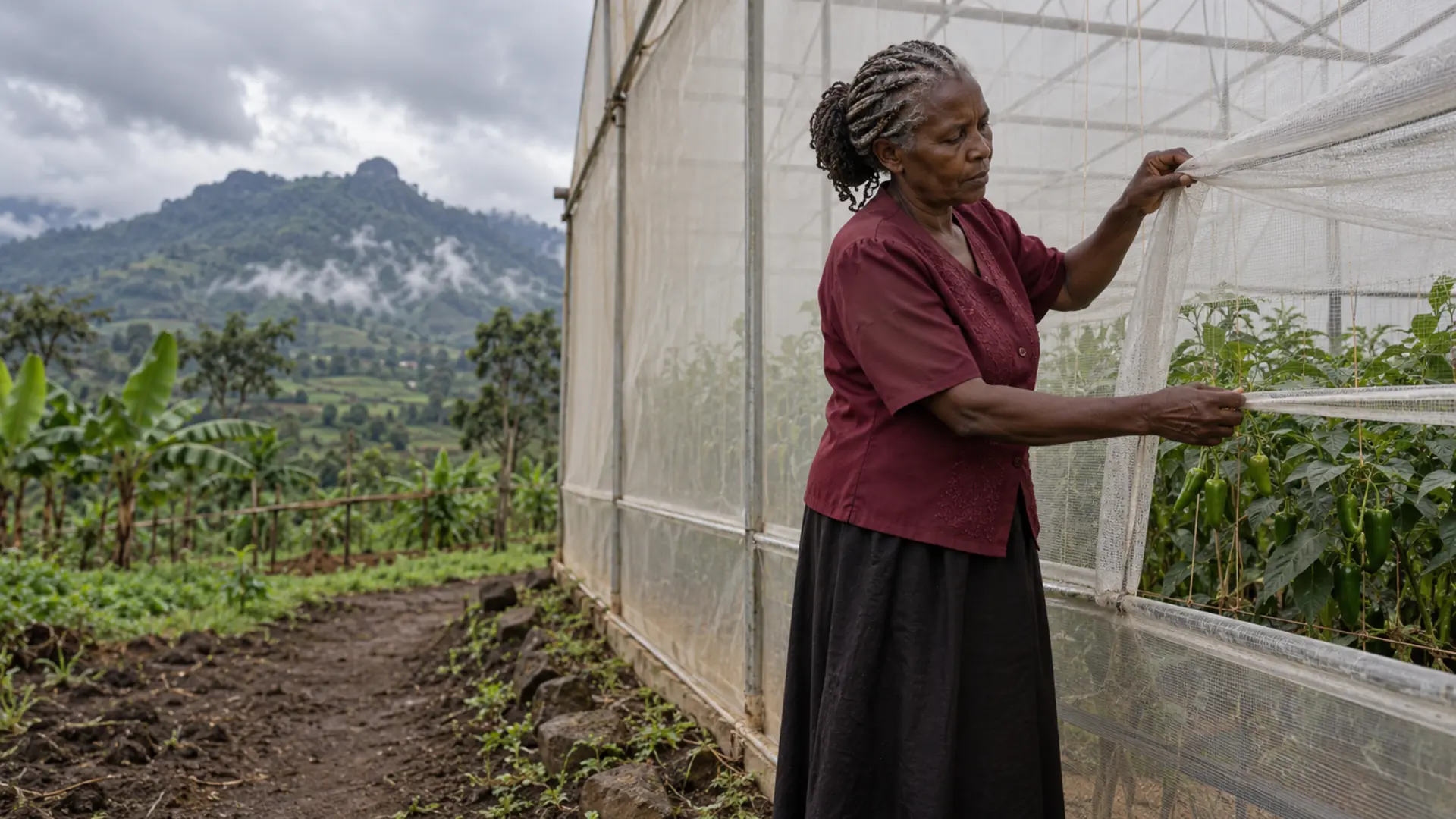
A costly sequence is easy to repeat. A grower is advised to screen against thrips and whitefly. The finest mesh available is fitted, because finer sounds safer. Within a few weeks the house may become too hot, the crop becomes stressed, and somebody removes part of the net to let the place breathe. Once the screen is open, whitefly can enter, leaving the grower with both a hot house and failed exclusion.
The mistake is not the net. It is treating exclusion and ventilation as two separate decisions when they are one decision with two sides. Every micron you take out of the aperture, you have to pay for in vent area, and if you do not pay you will lose the screen.
This guide sets out what the published sources actually say about which aperture stops which pest, what each costs in airflow, how to compensate, and the entry discipline without which the best mesh in the world is decoration. It names no pesticide and no product.
What this guide helps you decide
Which pest you are actually trying to exclude, since that determines everything else. What aperture the literature associates with that pest, and how much the sources disagree. How much extra vent area you must provide to carry the same airflow through that screen. Whether a finer mesh is worth it in your climate at all. And what has to change in how people and plants enter the house for the screen to keep working.
The short answer
Exclusion and ventilation trade against each other, and the trade gets steeply worse as the target pest gets smaller. One extension source reports airflow reductions of 45 per cent for a thrips-grade screen, 32 and 25 per cent for the two whitefly grades, 25 per cent for aphids, 30 per cent for citrus leafminer and 15 per cent for serpentine leafminer. The same source notes that because thrips are so much smaller, excluding them requires three to four times the area of material.
That is the whole article in two sentences. If you want to exclude thrips, you need roughly three to four times the screened vent area, or you will have a hot house.
And there is a caution that is more important than any number: the East African evidence shows that nets which perform well against larger pests do not reliably exclude the small ones. A multi-country trial in Benin and Kenya found netting proved effective in protecting vegetable nurseries against larger lepidopteran and dipteran pests, but that netting did not effectively protect the vegetables against small insects such as aphids and whiteflies, although a visual barrier could delay outbreaks.
Which pest, and how small is it
Screening works on body dimensions, so the specification starts with the insect.
Extension guidance from the University of Connecticut, published in 2016, gives thorax widths and the corresponding screen opening for each pest: western flower thrips, thorax 0.0085 inches, opening 0.0059 by 0.0059 inches; silverleaf whitefly, thorax 0.0094 inches, opening 0.0107 by 0.0304 inches; greenhouse whitefly, thorax 0.0113 inches, opening 0.0158 by 0.0178 inches; melon aphid, thorax 0.0140 inches, opening 0.0158 by 0.0178 inches; citrus leafminer, thorax 0.0171 inches, opening 0.0105 by 0.0322 inches; serpentine leafminer, thorax 0.0239 inches, opening 0.0237 by 0.0237 inches.
A greenhouse manufacturers’ association guide gives the same thorax dimensions in micrometres: western flower thrips 215, silverleaf whitefly 239, greenhouse whitefly 288, melon aphid 355, green peach aphid 434, citrus leafminer 435, serpentine leafminer 608.
Insect Netting: Keeping Whitefly Out Without Cooking the Crop
Mesh aperture comparison chart pairing target pests with the published screen opening sizes and the airflow reduction reported for each
The sources disagree, and you should know why
This is where most netting advice goes wrong, by picking one number and presenting it as settled.
The University of California’s ornamental guidance states that for thrips exclusion the material must be of sufficiently small pore size, at 145 micrometres, about one two-hundredth of an inch. A university engineering source gives a different table again: leafminers 0.025 inches at mesh 40, whiteflies 0.018 inches at mesh 52, aphids 0.013 inches at mesh 78, thrips 0.0075 inches at mesh 132.
These are not errors. Different sources use different weave conventions, some giving a square opening and some a rectangular one with two dimensions, and they draw on measurements of different insect populations. The practical consequence is that you should treat published apertures as a range, not a specification, and you should not assume that two nets described as thrips-proof will behave the same.
There is direct evidence for that last point. A North Carolina trial comparing screening materials found that two high-resistance fabrics excluded thrips at around 90 per cent, but that for whitefly one of them gave essentially no exclusion while another very effectively excluded whiteflies, despite the poorer performer having smaller holes. Aperture is not the only variable; weave and thread geometry matter too.
What the screen costs you in airflow
The airflow penalty is real, large, and reported very differently depending on the framing.
The University of Connecticut figures given above, 15 to 45 per cent depending on the grade of screen, describe the reduction attributable to a specific pest-grade mesh. A university engineering source is blunter about the effect on a naturally ventilated house: it reports up to an 85 per cent reduction if naturally ventilated when screens are added to inlet openings.
Those two are not reconcilable as stated and this article does not attempt to average them. What both establish is that the penalty is a first-order design problem rather than a detail.
The mechanism is straightforward. A screen impedes air movement, so the air exchange rate falls, and both heat and moisture accumulate. An engineering paper on improving airflow through insect-proof screens states it directly: the exclusion of very small insects requires installation of fine mesh screens which impede ventilation and thus increase temperature and humidity. Wageningen’s Africa-focused greenhouse toolbox says the same in design language: mesh size determines the permeability for insects and for air, and in one North African case study it records that openings can be covered with insect nets against one particular pest, but that nets against other insects decrease the ventilation rate too much.
Paying for it: three ways to get the airflow back
Increase the screened area. This is the primary answer and the one the extension figure quantifies: three to four times the area of material for a thrips-grade screen. The engineering method behind it is simple to state, if harder to execute: the required screen area equals the total ventilation capacity divided by the approach velocity through the screen. A finer screen forces a lower approach velocity, so the area must grow.
Fold the screen rather than stretching it flat. The same engineering study found that a screen with a typical 60 degree fold allowed a higher airflow, by about 37 per cent, in comparison with a flat screen under similar pressure drops. This is a genuinely useful and under-used technique: a concertina of mesh across a vent presents far more screen area than the vent opening itself.
Choose the thread, not just the hole. The same study reports that manufacturing screens with threads that have an aerodynamic shape may under some conditions improve ventilation by 30 to 50 per cent. Whether such material is available to you is another question, but it is worth asking a supplier about thread profile rather than only about mesh count.
Insect Netting: Keeping Whitefly Out Without Cooking the Crop
Diagram of a screened vent showing how the required screen area grows as the aperture becomes finer, and the two published ways of recovering airflow
Wageningen’s toolbox gives rough vent-capacity benchmarks for hot climates that are worth knowing as a sanity check: around 30 per cent ventilation capacity for single-span tunnels in a hot desert climate, and around 40 per cent in subtropical designs once insect nets are installed.
What East African trials measured
This is where the argument stops being theoretical. Note carefully that none of the following was conducted in Uganda; they are Kenyan and Tanzanian trials and must be read as neighbouring evidence rather than local data.
A Tanzanian cabbage trial compared two insect-proof nets, one white at 17.2 per cent shade and one silver at 50.1 per cent shade. Temperatures under the nets ran above the open field by 10.4 degrees Celsius in the first season and 6.5 degrees in the second under the white net, and 6.3 and 5.9 degrees under the silver. Both nets significantly reduced insect pest populations. But the yield results split: the white nets increased marketable yield by 45.4 per cent in the first season and 16.4 per cent in the second, while the silver nets reduced yield by 18.6 and 15.0 per cent respectively.
Read that carefully, because it is the most instructive result in this article. The net that kept the structure coolest produced the worst crop, because its shading cost more than its cooling gained. Netting decisions cannot be made on temperature alone.
A Tanzanian tomato trial found the total number of insect pests per plant over the season generally lower under nets than in the open, with the small mesh better than the large, and marketable yields across two seasons of 2.7 and 10.8 tonnes per hectare in the open, 7.9 and 38.4 under large mesh, and 16.8 and 50.1 under small mesh.
A Kenyan tomato trial at Njoro compared a fine mesh at 0.4 millimetre pore diameter, a large mesh at 0.9 millimetre and a floating row cover, and reported reductions in leafminers, bollworms, onion thrips, mites, whiteflies and aphids, with yield loss falling from 22.8 per cent unprotected to 2.3 per cent with permanent cover. Its statement about modified microclimate is qualitative only; no temperature figures are attached to it, and none should be inferred.
The Ugandan pest pressure this is all for
Two Ugandan studies establish that the target pests are real here.
A study of thrips on tomato and pepper across Uganda recorded six species on tomato, Frankliniella occidentalis, Thrips tabaci, F. schultzei, Scirtothrips dorsalis, Ceratothrips ericae and Megalurothrips sjostedti, with pepper hosting the same set except F. schultzei. It found higher thrips populations in the first season, higher counts in intercropped than monocropped arrangements, and the heaviest loads at flowering, reaching 100 per cent of plants in the case of pepper.
A 2023 study of Bemisia tabaci distribution across Uganda’s agro-ecological regions found one whitefly species group widely distributed, predominating on cassava and found on 17 other host plants across all nine zones sampled, with regional dominance from 34.8 per cent in south-western farmlands to 50 per cent in north-eastern drylands, and warned that its occurrence on cultivated and non-cultivated plants could increase the acquisition and transmission of viruses between them.
That second finding has a direct implication for siting. If there is cassava next to your screenhouse, you are living beside a whitefly reservoir, and the discipline below matters more, not less.
The exclusion discipline, without which none of this works
Screening fails at the gap, not at the weave. This is the part of the job that costs nothing and is skipped most often.
Entry. Extension guidance from Florida describes the standard: a double door system that allows workers to enter an air lock room and close the outside door behind them before entering the greenhouse production area, and notes that the air lock room can also be used to maintain a footbath, hand washing area and other sanitation for workers.
What you carry in. The same source names the two commonest failure routes bluntly. Whiteflies will enter through unscreened roof vents even twenty feet above ground. And pests arrive on infested plants brought from other areas, which it describes as a common discovery. If you buy transplants, they are the most likely way your pest gets in, and holding new material apart and inspecting it before it enters is worth more than any upgrade to the mesh.
Sealing. A manufacturers’ association bulletin states the requirement plainly: air inlets, vents and fans must be screened, doors need to be air locked, and all leaks or gaps in the house need to be sealed. Walk the ground line. That is where the gaps are.
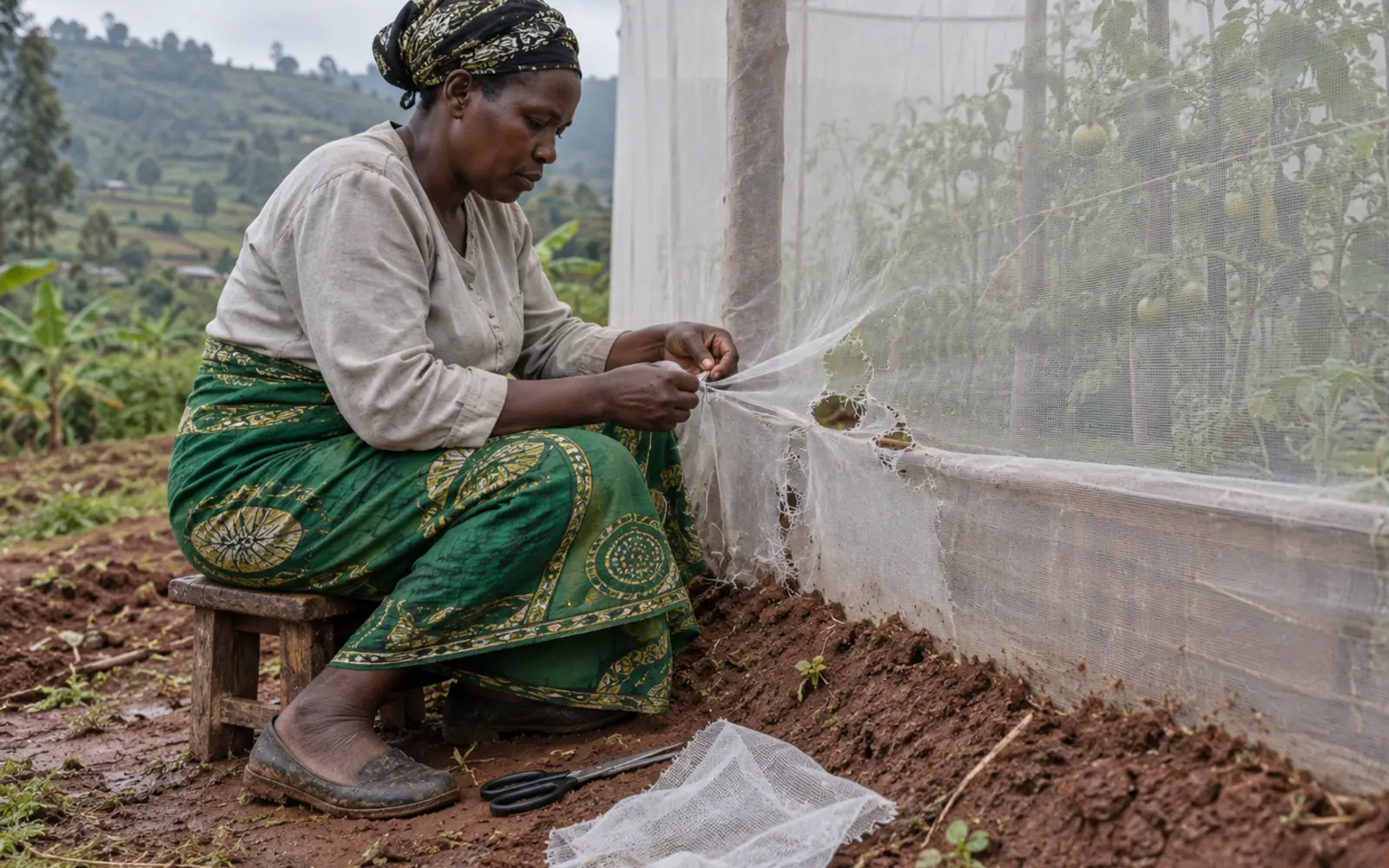
Inspection and repair. A fixed day each week, walking the perimeter, looking at the ground seal and the joints where the mesh meets the structure. Repair tears the day you find them.
One thing never to do. The same bulletin warns: never use high-pressure cleaners or brushes on screening, as they will alter the hole size and make the screening useless. A screen cleaned aggressively is a screen destroyed. When pressure drop across the screen rises above about 0.4 inches of water, the extension guidance says it probably needs cleaning, but clean it gently.
Insect Netting: Keeping Whitefly Out Without Cooking the Crop
Exclusion discipline checklist covering entry protocol, transplant hygiene, net inspection and repair, and sealing points
A selection method rather than a recommendation
There is no universal mesh, and this article will not pretend otherwise. Work through the following in order.
First, name the pest that is actually costing you money, from your own scouting records rather than from a general worry. If it is a virus-transmitting whitefly, the exclusion case is strong. If it is a caterpillar, a much coarser and cheaper mesh will do and you keep your airflow.
Second, look up the aperture range associated with that pest, in more than one source, and note the disagreement.
Third, work out what airflow you will lose and whether your structure can be given the extra vent area to compensate. If it cannot, you have a choice to make, and choosing the finer mesh anyway is choosing a hot house.
Fourth, decide about shading separately from mesh size. The Tanzanian cabbage result shows that these are different variables with opposite effects on yield.
Fifth, budget the entry discipline as part of the cost of the net. Without it, the net does not deliver what you are paying for.
Why a hotter house is worse than it sounds
It is tempting to treat a few extra degrees as an inconvenience. In a Ugandan structure it is usually more than that, and it is worth naming the mechanisms so the trade-off is judged properly.
A screened house loses air exchange, and air exchange is doing three jobs at once. It removes heat, so the interior temperature rises. It removes moisture transpired by the crop, so humidity rises. And it replenishes carbon dioxide inside the canopy, so a house that exchanges air slowly can run short of the raw material of photosynthesis on a bright still day even while the light is abundant.
The humidity consequence is the one growers underestimate. Higher humidity means longer leaf wetness, and longer leaf wetness is exactly what fungal disease needs. It is entirely possible to fit a fine screen that successfully excludes an insect vector and then lose the same crop to a fungal problem the screen created. The Tanzanian cabbage result described above is a warning of the same kind in a different direction: the intervention that most reduced heat also most reduced yield.
None of this argues against screening. It argues for treating the mesh, the vent area and the crop’s disease profile as one decision rather than three, and for being sceptical of any advice that discusses aperture without mentioning airflow.
Reading a supplier’s specification
You will be shown a specification sheet. Here is how to read it without being led.
Mesh count is not aperture. A count of threads per inch tells you nothing on its own, because thread thickness varies. Two nets with the same count can have visibly different holes. Ask for the hole dimension in micrometres or millimetres, and ask whether it is a square opening or a rectangular one with two different dimensions, because the rectangular ones are the ones where the pest gets through the long axis.
Porosity is not airflow. Open area as a percentage is a useful comparison between similar nets and a poor predictor of installed performance, because pressure drop depends on thread shape as well as hole size. The association guide is candid on this point: there remains no formula for determining how a screened greenhouse will behave.
A pest-proof claim is a claim, not a measurement. If a net is described as thrips-proof, ask what aperture that corresponds to and against which species it was tested. The North Carolina trial result above shows why: exclusion performance did not follow hole size in a simple way even between commercially sold materials.
Shading is a separate number and must be asked for separately. A net that is coloured, coated or heavier will shade more. That is a yield variable in its own right, as the cabbage trial demonstrated, and it does not appear on a mesh-size line.
Take the numbers you are given, put them next to the published ranges in this article, and treat any large discrepancy as a question for the supplier rather than a reason to disbelieve either.
Cost categories
No prices. The lines a complete netting decision must cost are: the mesh itself, priced per square metre of material rather than per metre of vent, because the compensating area is the real quantity; the additional structure needed to carry a larger or folded screened area; fixings and battens, since a net fixed badly tears at the fixing; the vestibule or air lock and its doors; repair materials, kept on site; the labour of weekly inspection; and, if you are moving to a finer mesh, the cost of whatever you must do about heat, which may mean more vent area, a taller structure, or shading you had not planned.
Common mistakes
Choosing the finest mesh available on the reasoning that finer is safer. Sizing the screen to the vent opening rather than to the airflow. Fitting the net flat when a folded run would have carried more air through the same opening. Assuming two nets described the same way perform the same. Buying transplants and walking them straight in. Leaving the ground line unsealed. Cleaning the mesh with a pressure washer. Judging the net by temperature alone rather than by yield. And removing a panel of net to cool the house, which converts a ventilation problem into a pest problem without solving either.
Warning signs and escalation points
Act if: the house is consistently hotter than an unscreened comparison and the crop is showing it; you find the target pest inside within weeks of a new net, which points to an entry route rather than a mesh failure; the mesh has visible tears, sagging or gaps at the ground; or somebody has already removed a panel.
Get engineering advice before you specify, rather than after, if your structure has fixed vent openings that cannot be enlarged. In that case the mesh choice is constrained by the structure, and choosing as though it were not will cost you the crop.
Where it works and where it does not
Screening works well where the pest is large enough that a coarse mesh will stop it, where the structure has generous vent area or can be given more, and where entry discipline is maintained.
It works less well, and sometimes not at all, where the target is thrips or whitefly, the structure is small and low with limited vent area, and the site is hot. In that situation the honest answer may be that fine-mesh exclusion is not available to you at an acceptable cost, and that your pest management has to rest on other measures.
A low-risk first step
Before buying anything, do two things.
Measure the total vent opening area of the structure and express it as a percentage of the floor area. Then take your target pest’s aperture and the associated airflow reduction, and ask whether you can multiply your screened area enough to cover it. For thrips, that means asking whether you can provide three to four times the screened area.
If the answer is no, you have learnt something important for free, and you should be thinking about a coarser mesh, a folded screen, a bigger structure, or a different pest management approach, rather than about which supplier to call.
What to do next
Read integrated pest management scouting and thresholds first, because the pest you actually have determines the mesh you actually need, and greenhouse heat and humidity in Uganda for the climate side of the same trade-off. Whole farm biosecurity covers the entry discipline in a wider setting, and verifying seed and planting material quality matters because bought-in transplants are a significant route by which pests can enter a screened house. Our guide to greenhouse ventilation sizing and our forthcoming guide to shade net houses - scheduled in this programme address the two structural questions this article depends on.
About the author
The Falcon Foundation Ltd Editorial Team produces evidence-based agricultural guidance for Ugandan farmers, drawing on published research and institutional sources and translating them into practical decision support. Where evidence is unavailable or contested, we say so rather than filling the gap.
