
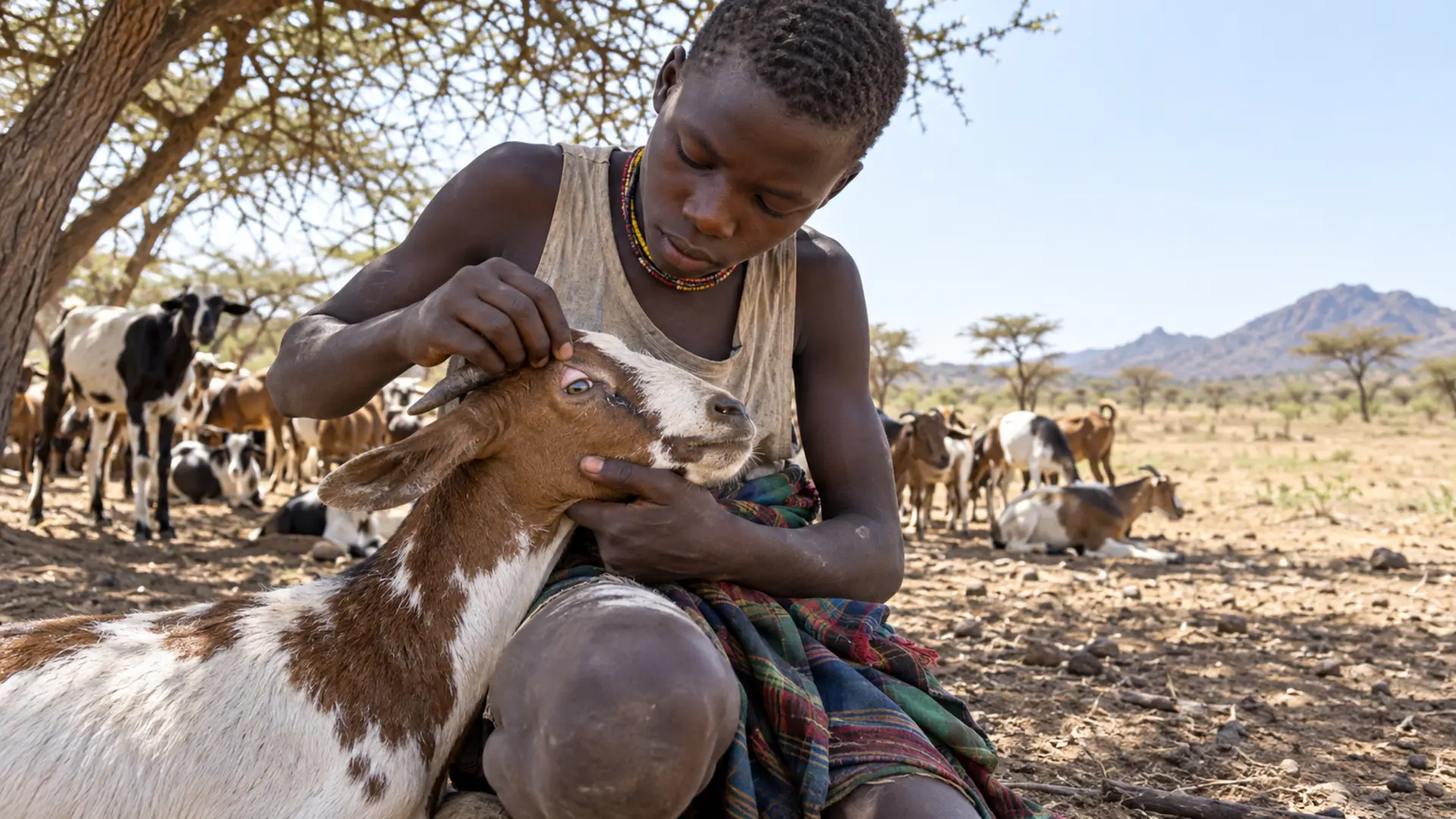
Most Ugandan goat and sheep keepers deworm the same way: everything in the flock, every few months, whether or not any individual animal needs it.
It feels like diligence. It is, in fact, the single most efficient way to destroy the usefulness of the drugs you depend on, and the Ugandan evidence says the damage is already substantial.
A study of goats on Ugandan farms found resistance to at least one anthelmintic group on 61 per cent of the 33 farms surveyed. Work at a national research institute in Serere measured reductions in worm egg counts after treatment of only 28.5 per cent in one goat type and 11 per cent in another, and the authors stated that this may indicate occurrence of anthelmintic resistance in the goat farming sector in Uganda. A study in the south-western highlands concluded directly that it confirmed the presence of anthelmintic resistance in goats there, reporting effectiveness in one district as low as around half and attributing it to widespread overuse.
This is not a warning about something that might happen. It is a description of where Ugandan small ruminant farming already is.
The good news is that the method for doing better has been validated here, in Ugandan goats, and it needs no equipment.
What this guide gives you and what it deliberately does not
It gives you a way to decide which animals to treat rather than treating all of them, a whole-animal check to use alongside it, and the grazing changes that reduce the challenge in the first place.
It names no drug, no drug class, no dose and no treatment interval. Those are veterinary decisions, they differ by animal and by farm, and in a country with documented resistance they are exactly the decisions that should not be taken from an article. What this guide does is put you in a position to have a much better conversation with a veterinary professional.
Sheep-specific management is covered separately in running a Ugandan sheep flock. Housing and kidding are covered in their own articles.
The method: what it is and where it came from
The eyelid scoring system was developed in South Africa. The paper that introduced it explains both the name and the logic: the name was coined to describe the system evolved for treating only those animals unable to cope with current worm challenge on pasture, by using clinical anaemia as the determinant, and the name is an acronym derived from the name of the originator of the idea.
The principle is simple. One particular worm feeds on blood. An animal carrying enough of them becomes anaemic. Anaemia shows in the colour of the membrane inside the lower eyelid. So the colour of that membrane is a proxy for the burden of that worm, readable in seconds, by anyone, with no equipment at all.
The scoring
The membrane is graded on a five-point scale from deep red to almost white.
Worms in Goats and Sheep: FAMACHA, Selective Treatment and Slowing Resistance
A five-band scoring card showing the eyelid membrane colour categories from red through to white, with the anaemia status of each and the action associated with each band.
Published descriptions put score 1 as red with no evidence of anaemia and score 5 as pale or white with severe anaemia, with scores 2, 3 and 4 running through red-pink, pink and pink-white between them.
The action rule, as published: scores 1 and 2 require no treatment, scores 4 and 5 warrant treatment, and score 3 is judged on body condition and context. One extension source states it as treating animals scoring 3, 4 or 5 and not treating those scoring 1 or 2, which places the middle band on the treat side; another places it on judgement. That difference between sources is real, and score 3 is genuinely the judgement call. Use the whole-animal check below to decide it, and take the decision with veterinary input rather than alone.
How to do it. Steady the animal’s head. Roll the lower lid down with a thumb to expose the membrane. Look at the colour, in daylight, not in the shade of a shed. Read it immediately, because the colour changes as you hold it.
A note on charts and certification. In some countries the printed colour chart is distributed only through certified instructors, and training programmes with examinations exist. That is an institutional distribution control in those countries, not a scientific requirement, and we found no equivalent certifying body in Uganda. The originating research is clear that the technique itself is learnable: it reports that participants were trained using informal information sessions and practical demonstrations, that clinical evaluation of anaemia was found reliable for practical use with sufficient training, and that the overwhelming majority of trainees, some poorly literate, were able to implement the system successfully.
Two practical consequences. Learn it from someone who can show you on live animals, because colour judgement is taught by eye and not by text. And do not trust the colour reproduction of any chart printed on an ordinary printer, including any illustration in this guide, as a calibrated reference.
The blind spot, and why it matters more in Uganda than elsewhere
This is the most important section in the guide, and getting it wrong would be dangerous.
Eyelid scoring detects anaemia. Anaemia is caused by blood-feeding worms. Therefore the method detects one worm and is blind to the others.
The originating paper states the limitation plainly: the system was designed for the control of one disease only, thus principally useful for warmer climates, and must be used with caution with other blood-feeding worm species. Extension guidance elsewhere puts it more bluntly still, stating that the scoring system is only useful for that one infection.
Now set that beside Ugandan data. A study of commercial goat farms in central Uganda found egg shedding in 43 per cent of goats, and identified on culture three worm groups: the blood-feeding genus at 56 per cent, and two others at 33 and 11 per cent.
Worms in Goats and Sheep: FAMACHA, Selective Treatment and Slowing Resistance
A panel showing that eyelid scoring detects only blood-feeding worms, set against Ugandan survey data on which worm genera were actually found in goats.
Read the arithmetic. In that Ugandan survey, 44 per cent of the worms identified were of types that eyelid colour cannot detect at all.
That is the case for never using eyelid scoring on its own. An animal with a good eyelid score can still be carrying a substantial burden of worms that do not cause anaemia, and a keeper who scores only the eye will conclude that animal is fine.
The whole-animal check
The response to the blind spot is a structured five-point inspection of the same animal, developed by one of the same researchers who developed the eyelid system.
Worms in Goats and Sheep: FAMACHA, Selective Treatment and Slowing Resistance
An annotated outline of a goat with five numbered inspection points marked at the eye, jaw, back, tail area and nose, each with what is being assessed at that point.
The five points, as published:
The eye. Eyelid membrane colour, as above. Detects blood loss.
The jaw. Swelling under the jaw, which published descriptions identify as an accumulation of fluid indicating blood-feeding worm or liver fluke burden. This is a serious sign and an animal showing it needs professional attention.
The back. Body condition, scored on a five-point scale from emaciated to over-fat. Published guidance states that animals with poor body condition, at the lower end of that scale, usually require attention.
The tail and hindquarters. Faecal soiling, scored for the degree of dag, which reflects scouring and therefore points at the worms the eye cannot see.
The nose. Nasal discharge, which points at a different parasite altogether.
Used together, these five give you a picture of the animal rather than a reading of one membrane. The fourth point in particular is the practical answer to the blind spot: scouring without anaemia is exactly the signature of the worms eyelid colour misses.
Does the method actually work in Uganda?
Yes, and this is the finding that should make every Ugandan keeper take it seriously.
The Ugandan study that documented resistance across 61 per cent of surveyed farms also evaluated the eyelid method in the same Ugandan goat population. It reported a significant correlation between pre-treatment packed cell volume, which is the laboratory measure of anaemia, and the eyelid scores, at a correlation coefficient of minus 0.89.
A correlation of that strength means the eyelid score was tracking the laboratory measure closely, in Ugandan goats, under Ugandan conditions.
One qualification, because accuracy varies by study and species. A validation conducted in eastern Ethiopia reported sensitivity and specificity of roughly 71 and 62 per cent in goats and 67 and 97 per cent in sheep, with a highly significant association between eye colour and packed cell volume in both.
So: a strong screening tool, validated here, not a diagnostic guarantee. Do not quote a single accuracy figure as universal, because the published figures differ.
Selective treatment and refugia
Having identified which animals need attention, the next question is why you should deliberately leave the others alone.
The answer is a concept called refugia, and it is the whole basis of slowing resistance.
Worms in Goats and Sheep: FAMACHA, Selective Treatment and Slowing Resistance
A diagram contrasting whole-flock treatment with selective treatment, showing how untreated animals and pasture larvae preserve a population of susceptible worms and dilute resistant survivors.
A veterinary faculty definition puts it clearly: refugia describes the population of parasites that are not exposed to a treatment, including the free-living larval stages on pasture as well as the parasites inside any animals that are not treated, which together form the farm’s reservoir of susceptible parasites.
The originating eyelid paper explains the practical use: a practical approach to reducing selection pressure for resistance is to treat only a proportion of the flock or herd, leaving many untreated animals in which unselected, non-resistant worms survive and propagate, thus ensuring a preponderance of susceptible worms in refugia.
The mechanism, in plain terms. Every time you treat an animal, the worms that survive are the ones the drug could not kill. If you treat every animal, the only worms breeding are survivors, and next season’s population is their children. If you leave some animals untreated, those animals carry ordinary susceptible worms which breed alongside the survivors and dilute them.
A technical manual states the selection principle directly: the more frequently treatment is given, the faster resistance develops, because treatment gives the resistant worms a reproductive advantage over the susceptible worms for a period after dosing.
Australian guidance recommends deliberately leaving a stated minimum proportion undrenched when a treatment is given so that untreated worms dilute the eggs from resistant worms. This guide does not reproduce a proportion, because the right proportion depends on the flock, the season and the resistance status of the farm, and because setting it is a veterinary decision. Ask for it specifically.
The grazing work, which does more than any product
Every keeper wants the answer to be something you administer. For worms in a warm climate the larger part of the answer is where and how the animals graze.
Grazing height. Infective larvae are concentrated close to the ground. Extension guidance puts larval density as high within a short vertical distance from the ground on the leaf blades, and notes that the larvae float on moisture from dew or rain, which is how they are picked up. The practical instruction is not to graze animals down onto very short swards.
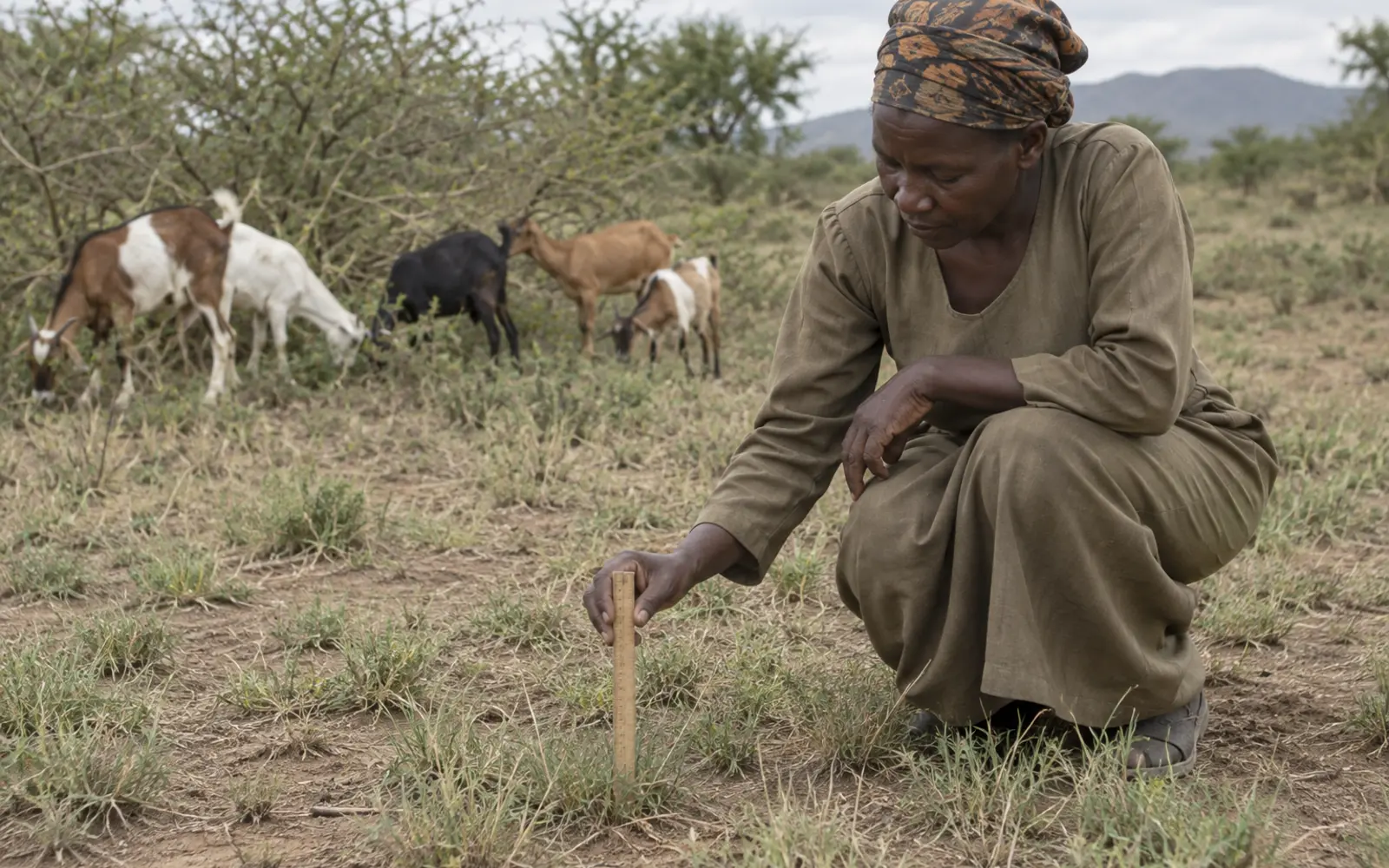
This is a measurement, not an impression. A ruler and a habit of checking is the whole method.
Rotation and rest. Extension guidance on the tropics specifically gives a short grazing period followed by a rest period of several weeks as effective for parasite control in tropical climates. That tropical figure is far shorter than the rest periods recommended in temperate guidance, and it is the relevant one for Uganda: larvae develop and die faster in warm wet conditions than in cold ones. Do not copy temperate rest periods.
Keep young animals on the cleanest ground. Ugandan data supports this directly. A study in Apac District, northern Uganda, found young animals had significantly higher odds of infection than adults. Published management guidance says to graze young and low-immunity animals in paddocks not previously grazed by contaminated adult animals.
Watch tethering. The same Apac study found tethered animals had significantly higher odds of infection than free-grazing ones, and recommended adopting better grazing management options such as rotational grazing to reduce larval contamination. The mechanism is obvious once stated: a tethered animal grazes a small circle repeatedly, including its own dung zone.
Stocking rate. More animals per unit area means more eggs deposited, means more larvae per mouthful.
Consider grazing with cattle. Published guidance describes alternating small ruminants and cattle on the same ground, with cattle following, because the two groups are largely refractory to each other’s worms. The integrated approach is discussed in integrated crop and livestock farming.
Grazing management competes for the same land as feed planning, which is why the fodder calendar and the parasite plan should be built together rather than separately. The feed side is covered in year-round fodder planning for goats and cattle.
How often to score
The originating study increased frequency as the risk season developed: evaluating animals every three weeks at the start of the high-risk season, rising to fortnightly and subsequently to weekly examinations at its height. Another extension source recommends examining all animals in the herd every two to three weeks with increased frequency for vulnerable animals.
Translated for Uganda: scoring frequency should rise in the warm wet periods when pasture larval populations build, and the specific calendar months differ by region. Build the schedule against your own rainfall record rather than against a northern-hemisphere season.
Identifying animals, which everything else depends on
Selective treatment requires that you can tell one animal from another, and a surprising number of flocks cannot.
Without identification, a score is a fact about a moment rather than about an animal. You cannot tell whether the pale-eyed goat last month is the pale-eyed goat this month, which means you cannot identify the individuals that repeatedly score badly. That matters, because those animals are doing two things: they are suffering, and they are shedding disproportionately onto the pasture everything else grazes.
Identification does not require purchased tags. Any durable, readable, individual mark works, provided it is recorded in the same book as the scores. What matters is that the mark survives the season and that two animals never carry the same one.
Once identification exists, a further use appears. Animals that repeatedly score well under the same challenge as the rest of the flock are carrying something worth keeping, and animals that repeatedly need treatment are carrying the opposite. Over several seasons that record becomes a breeding and culling decision made on evidence rather than on appearance, and it is the only intervention in this whole subject that gets cheaper and more effective over time rather than less.
Common mistakes
Treating the whole flock on a fixed routine. This is the practice that produced the resistance the Ugandan studies found.
Using eyelid colour alone. Ugandan data shows a large share of worms it cannot detect.
Reading the eyelid in poor light or after holding the lid open too long.
Trusting a home-printed colour chart as calibrated.
Quoting one accuracy figure as universal. Published sensitivity and specificity differ between studies and between species.
Copying temperate pasture rest periods into a tropical climate.
Tethering young animals on the same ground repeatedly.
Grazing animals down onto very short swards and then blaming the drug.
Increasing the dose when a product stops working. That is a resistance signal and it is a veterinary matter.
Treating a bottle-jaw animal at home rather than getting help.
When to call a veterinarian
Contact a veterinary professional, and do not attempt to manage it yourself, when:
- Any animal shows swelling under the jaw, marked pallor, weakness or collapse. These indicate severe blood loss.
- An animal in apparently reasonable condition dies suddenly, or several do.
- A product that previously worked no longer appears to. This needs investigation, including faecal egg count testing before and after treatment, not a heavier dose.
- You want a treatment programme designed for your flock. This is exactly the conversation the scoring record prepares you for, and it is far more productive if you arrive with several weeks of scores rather than an impression.
- Scouring is widespread, particularly without anaemia, since that pattern points at the worms eyelid colour does not detect.
- Young stock are failing to thrive despite adequate feed.
Ask specifically about faecal egg counting, about whether treating only affected animals is appropriate on your farm, and about what proportion to leave untreated. Those three questions are the practical content of this whole subject.
What comes onto the farm is the other half of the problem, and it is covered in whole-farm biosecurity. A bought-in animal can import resistant worms that your farm has never had.
A practical action plan
This week: learn the scoring on live animals from someone who can show you, not from a printed chart alone.
This week: score every animal and write the scores down with the date and the animal’s identity. A flock without individual identification cannot be selectively treated, so if you do not have a way of telling animals apart, that is the first job.
This week: do the whole-animal check on every animal you scored, not just the eye.
This month: measure your sward height where the flock actually grazes, and write it down.
This month: identify the cleanest ground you have and reserve it for the young stock.
This month: look at your tethering practice. If animals are tethered repeatedly on the same small areas, that is a change you can make at no cost.
Before the next wet period: agree a treatment approach with a veterinary professional, taking your scoring records with you. Ask the three questions above.
Every scoring round: record what you found and what you did. After one season this record tells you which animals repeatedly score badly, and that is a breeding and culling decision as much as a health one. The record framework is in farm record keeping and gross margin analysis.
Conclusion
Uganda has already spent a good deal of the effectiveness of its small ruminant dewormers, and the published evidence from four separate Ugandan studies says so.
What remains is worth protecting, and the method for protecting it is not expensive. It is a thumb, daylight, a record book and the discipline to leave alone the animals that do not need treating even though treating everything feels more responsible.
Two cautions carry the whole guide. Eyelid colour sees one worm and misses others, and in the one Ugandan survey that identified genera, nearly half of what was found was invisible to it. And the grazing changes, sward height, rest, clean ground for the young, are doing more of the work than any product, at no cost, in a way no worm can become resistant to.
Author: Falcon Foundation Ltd Editorial Team
The Falcon Foundation Ltd Editorial Team produces evidence-based agricultural guidance for Ugandan farmers, drawing on published research and institutional sources and translating them into practical decision support. Where evidence is unavailable or contested, we say so rather than filling the gap.
