
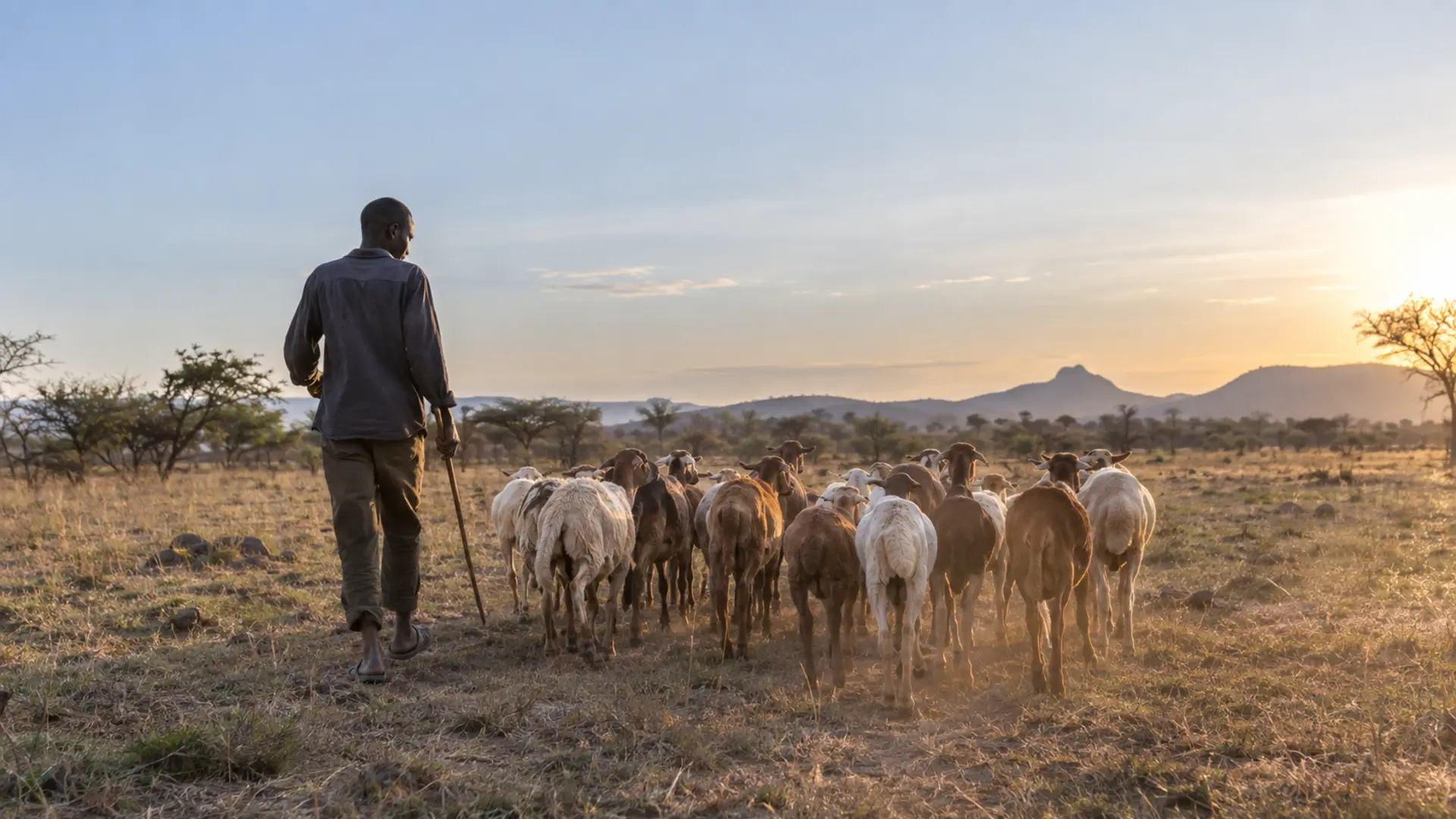
In most Ugandan markets, on most farms and in most conversations, sheep and goats are one category. They are counted together, grazed together, housed together and sold at the same auctions to the same buyers. The shorthand is convenient and mostly harmless right up to the point where a keeper takes a management practice that works for goats and applies it to sheep.
Then it stops being harmless. The sheep graze in the part of the sward where the worm larvae sit, and the worm plan built for goats does not address that. The sheep strip a paddock the goats would have left standing. The sheep refuse the browse the goats thrive on. The sheep panic in a handling race designed for goats. The sheep come out of a shelter that was fine for goats with pneumonia.
None of this is because sheep are harder animals. It is because sheep are different animals, and the differences are systematic enough to plan around.
This guide sets out what actually changes when the animal is a sheep: how it feeds, where it picks up parasites, how it behaves in a group, what shelter and handling it needs, and how to time sales. It ends with a blank flock-structure worksheet you fill in from your own land and your own records.
What this guide does not do
It does not tell you that sheep are more profitable than goats, or less. We looked hard for evidence that would support such a statement for Ugandan or East African conditions and did not find any.
What we found instead is worth knowing. The nearest applicable studies are both West African and they contradict each other: a Nigerian comparison from Plateau State favours goats on its profitability indicators, while a Ghanaian analysis of rural small ruminant production favours sheep, reporting a revenue-cost ratio of 2.33 for sheep against 1.36 for goats. Neither is East African, neither is Ugandan, and two studies pointing opposite ways across West Africa cannot settle a Ugandan question. The one East African enterprise figure we could trace concerns mohair and wool systems, which Uganda’s hair sheep do not have.
We are reporting that gap rather than filling it. If somebody tells you sheep return more than goats in Uganda, ask which study, for which system, in which district.
It also does not cover goat management in any depth, parasite drug protocols, wool production, or ration formulation. Detailed goat work belongs to the goat guides, including kidding season preparation. The year-round feed question for both species is dealt with in year-round fodder planning for goats and cattle.
The one difference that produces all the others
A goat is predominantly a browser. A sheep is predominantly a grazer.
That is the root difference, and almost everything else in this guide follows from it. It is a matter of proportion rather than an absolute rule - sheep will browse when grass is short and goats will graze when browse is scarce - but the proportions are strongly and consistently different, and they are different by anatomy and behaviour, not by habit.
A goat feeds upward. It works shrubs, hedges, regrowth, leaf litter on standing stems and anything it can reach by standing on its hind legs. It is selective, takes a mouthful and moves, and rarely strips one plant completely before going to the next.
A sheep feeds downward. It works the grass sward, bites close to the ground with a narrow muzzle that lets it select individual plants and even individual leaves within a sward, and will graze a patch down hard before moving off it.
Hold those two feeding patterns in mind and the rest of the list writes itself.
Sheep Are Not Goats: Running a Ugandan Sheep Flock on Its Own Terms
A four-column comparison matrix setting sheep against goats across grazing behaviour, preferred feed height, parasite exposure, flocking behaviour, fencing response, housing need and handling method.
Consequence one: the same land does not feed them the same way
A paddock that supports goats may not support sheep, and land that is useless for sheep can be good goat country.
Bush, thicket, hedgerow and steep scrub are goat resources. A sheep on that land is standing in a larder it cannot reach. Conversely, open grass sward - especially short, dense, improved or naturally short grassland - is sheep country, and goats on it will underperform relative to what they would do on browse.
This is why sheep and goats are complementary on mixed land, and it is also why running them as one undifferentiated herd on one type of land guarantees that one species is being under-fed. If you have both, the useful question is not how many small ruminants the land carries but how much grazing and how much browse the land carries, and then matching the species split to that.
For a farm building its feed base, the implication is direct: investing in browse species - fodder shrubs, hedges, tree legumes - buys goat carrying capacity. Investing in improved grass and managed pasture buys sheep carrying capacity. The two investments are not interchangeable. The soil and water work that underpins either is set out in agroforestry for soil and water conservation and crop rotation and cover crops.
Consequence two: grazing height governs larval intake, and that is the sheep keeper’s lever
This is the section where it would be easy to write something tidy and wrong, so it is worth being careful.
Gastrointestinal nematodes complete their cycle on pasture. Eggs pass out in dung, hatch, and the larvae develop through stages until they become infective. Infective larvae then move a short distance in the moisture film on grass leaves and wait to be eaten. They concentrate in the lowest part of the sward, close to the soil surface. The veterinary reference states it plainly: infective third-stage larvae can migrate vertically only short distances and are found close to the ground. An extension source puts numbers on it, describing larval density as high within two to three inches vertically from the ground on the leaf blades, and notes that the larvae float on the moisture from dew or rain, which is how they are picked up.
So an animal grazing the top of a sward eats relatively few of them, and an animal grazing hard at the base of the sward eats a great many. Sheep graze at the base of the sward. That is a real mechanism, it is well supported, and it is the reason sward height is the single most useful measurement in sheep grazing.
What does not follow, and what we are not going to claim. It is tempting to conclude from that mechanism that sheep therefore carry heavier worm burdens than goats on the same ground. We went looking for evidence of that and found the opposite. The parasitology guidance we could verify states that goats run in mixed grazing systems with sheep tend to carry heavier worm burdens and suffer more adverse effects, and it attributes that to immunity rather than to exposure: sheep develop a stronger age-related immunity, while goats, having evolved as browsers that largely avoided ingesting infective larvae, developed an immune response that is often incomplete even in adults.
The honest position is therefore two-sided. Sheep are the species whose feeding behaviour puts them in the larval zone, so grazing management is the lever that matters most for them. Goats are the species the outcome literature reports as ending up more heavily parasitised when the two are run together. Those two statements are not in conflict, and neither of them supports a simple ranking of which species is harder to keep worm-free. This guide makes no such ranking.
What is not in doubt is that in a warm, humid climate with year-round grass growth - which describes much of Uganda - the challenge is continuous rather than seasonal, because there is no cold season to interrupt larval development on the pasture.
Sheep Are Not Goats: Running a Ugandan Sheep Flock on Its Own Terms
A cross-section diagram of a grass sward showing the zone near the soil surface where infective larvae concentrate, the grazing height at which sheep feed, and the management levers that raise the grazing plane.
The levers that actually work are grazing-management levers, not drug levers:
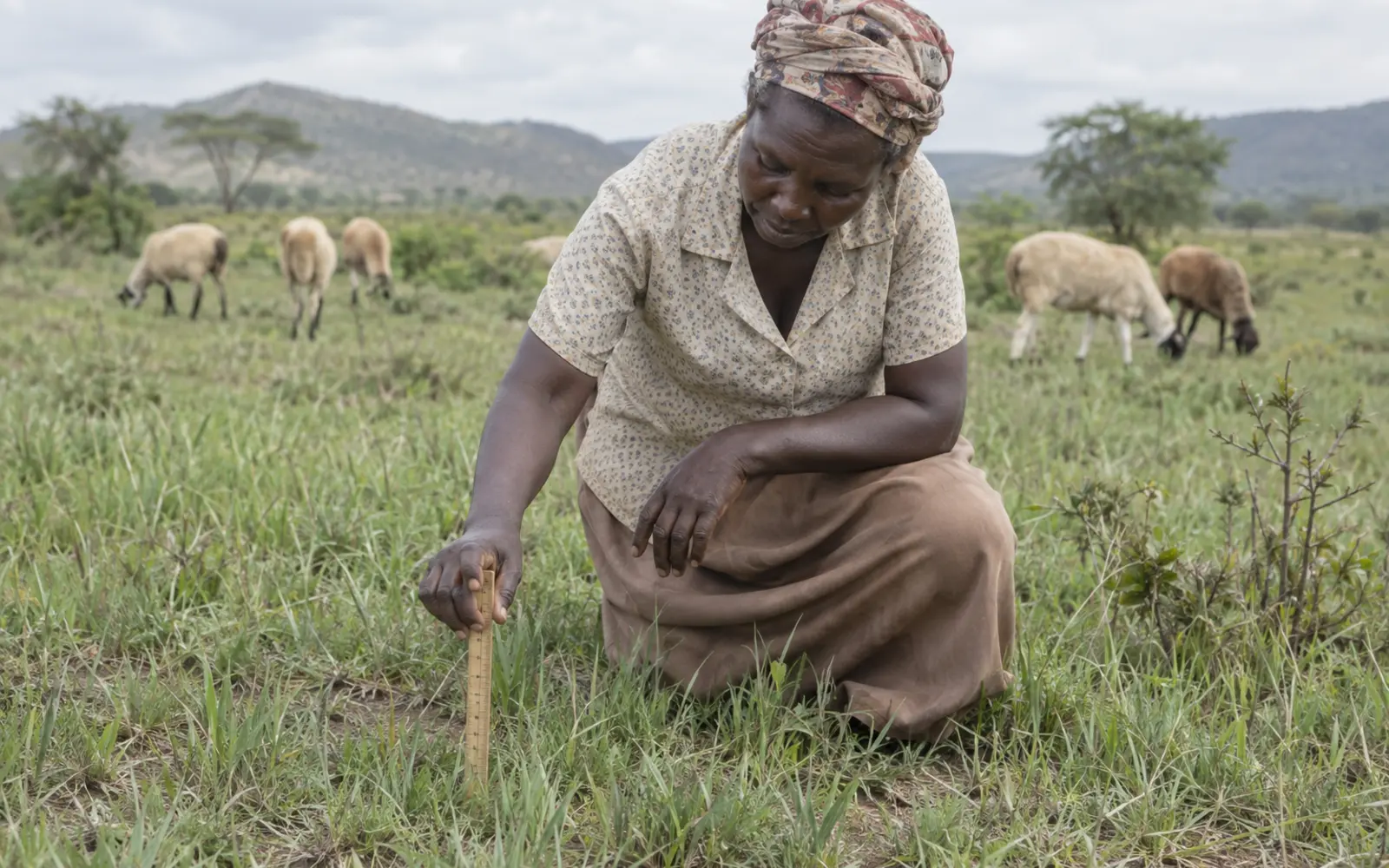
Sward height. Keeping animals off very short grass is the single most effective control available to a smallholder, because it lifts the grazing plane out of the larval zone. This is why the supporting photograph in this article shows a ruler. Sward height is a measurement, and it is the measurement that matters most in sheep grazing.
Rotation and rest. Moving the flock and resting the paddock breaks the cycle by giving larvae time to die before the next grazing. How long that rest needs to be depends on temperature, moisture and species, and in warm humid conditions larval survival differs from the temperate figures most published guidance is built on. Rest periods should be set from local observation rather than copied from a northern-hemisphere table.
Not grazing lambs on the ground that carried last season’s lambs. Young animals are the most susceptible class and the most likely to contaminate. Keeping the youngest class on the cleanest ground available is a free intervention.
Stocking rate. More animals per hectare means more eggs per hectare means more larvae per mouthful. Overstocking is a parasite decision as much as a feed decision.
Watching where dung concentrates. Night paddocks, feeding points and water points concentrate dung, and dung is where the eggs are. We could not find a published source naming night-boma and feeding-point contamination as a specific control lever, so treat this one as a reasonable inference from the larval-distribution evidence above rather than as a sourced recommendation. It costs nothing to act on: do not let the flock graze the ground immediately around a permanent night boma as though it were ordinary pasture.
This guide does not give drenching protocols, product names, dose rates or treatment intervals. Anthelmintic use in sheep is a veterinary decision, and there are two documented reasons to take that seriously rather than treating it as a formality.
The first is that frequent treatment drives resistance. The technical manual for sustainable worm control states the mechanism directly: the more frequently treatment is given, the faster resistance develops, because treatment gives the resistant worms a reproductive advantage over the susceptible ones for two to three weeks after dosing. Blanket treatment of a whole flock at fixed intervals is precisely the practice that accelerates it.
The second is that resistance is already documented in this region. A 2025 review of anthelmintic resistance in African livestock names Uganda among the countries with published resistance findings, citing a Ugandan study that measured albendazole efficacy at only 11 to 28.5 per cent against gastrointestinal nematodes in naturally infected goats. Treat that as evidence that the problem exists here, not as a national rate: it is a single study, it is now over a decade old, and it concerns goats rather than sheep. Ask a veterinary professional to design a programme for your flock based on what is actually happening in your animals, and ask specifically about faecal egg counting and about whether treating only affected animals is appropriate in your case.
The signs that send you to a veterinarian rather than to a shop are set out in the escalation section below.
Consequence three: sheep flock, goats disperse
Put twenty sheep on open land and they hold together as a group, move as a group and respond to a threat by bunching. The animal-welfare codes are unambiguous about it: sheep have very strong flocking and following instincts, they move toward other sheep willingly, and a stationary sheep is motivated to move by the sight of other sheep moving away.
The usual shorthand is that goats do the opposite and disperse. We could not find a source that states the contrast in those terms - the goat literature we could open describes goats living in fission-fusion social groups without comparing them to sheep - so take the dispersal half as keeper observation rather than as documented fact. The sheep half is what this section rests on, and it is well evidenced.
This has practical consequences in both directions.
In favour of sheep: they are easier to move, easier to count, easier to keep out of a neighbour’s crop and easier to bring in at the end of the day. A flock that moves as a unit can be handled by one person. Goats scattered across a hillside cannot.
Against sheep: because they move as a unit, they graze as a unit, which means they hammer a patch rather than spreading grazing pressure. Without management, a sheep flock will overgraze the part of a paddock it likes and leave the rest standing. This makes paddock subdivision and rotation more valuable for sheep than for goats, not less.
Flocking also means a sheep on its own is a stressed sheep. This is not a soft point: the Canadian code of practice states that social isolation of sheep is extremely stressful and must be avoided, and that sheep must have visual contact with other sheep. An isolated sheep will try hard to rejoin the group, including through a fence it would otherwise respect. Where an animal must be separated, separate it with a companion.
Consequence four: fencing and boundaries behave differently
Goats test fences. They lean on them, climb them, put their heads through them and work at weaknesses persistently. Sheep, with some exceptions, respect a barrier that a goat would treat as a puzzle.
This means a fence adequate for sheep is often inadequate for goats, and a keeper moving from goats to sheep can usually spend less on boundaries. It also means the temptation to run sheep on light boundaries is stronger, and the failure mode is different: sheep do not usually break out individually, they break out as a flock, all at once, usually through a gap they were driven toward.
Do not assume the fence that held goats will hold sheep in every situation. A panicked flock generates force a browsing goat does not.
Consequence five: shelter requirements differ
Both species need shelter from rain, and both need dry ground to lie on. The difference is in what happens when the requirement is not met.
Goats are notably intolerant of getting wet and will generally take themselves to shelter. Sheep, with a fleece or a dense hair coat, will stand out in rain longer, and will lie on wet ground longer, which makes them dependent on the keeper providing dry lying space rather than on their own avoidance behaviour.
Wet lying ground, poor ventilation and crowding are the conditions in which respiratory disease develops in housed small ruminants. The extension guidance names overcrowded housing with poor ventilation as a risk factor, and describes poor sanitation as a problem in two ways: urine and faeces release gases that harm the respiratory tract, and wet bedding chills the animals. Note that it attributes this to animals of all ages rather than singling out lambs, and we have not claimed otherwise here. The shelter requirements that matter are a dry floor, a roof that actually keeps rain off the lying area, and ventilation that removes moisture without creating a draught at animal height.
Floor design is worth a specific note. For goats, published Ugandan guidance recommends gravel floors as the best option, with some keepers preferring wood. Sheep have the same basic requirement - a floor that drains, stays dry and can be cleaned - and the same failure mode, which is a floor that holds moisture and turns the lying area into a permanently damp pad.
Whatever the floor, the operating requirement is the same: the lying area must be dry when the animals lie down on it, and the way you check that is to put your hand on it.
Consequence six: handling is a different job
A goat being handled tends to resist individually and to keep its feet. A sheep being handled tends to move with the group and, when caught, to go down.
That makes group handling of sheep easier and individual handling different. A race or funnel designed for sheep works with the flocking instinct: the animals follow each other, and a single handler at the head of a well-designed race can move a whole flock. The same layout applied to goats produces a jam.
Two practical rules carry over from everything known about small ruminant handling. Move them at their own pace rather than pushing, because a pushed flock bunches and a bunched flock stops. And handle them by the body rather than by the wool, hair, ears or legs, because those attachments are not load-bearing and injuring them is easy.
Any handling system should also be designed on the assumption that at some point the flock will be handled by somebody who is not you, in a hurry. The layout carries that risk, not the instructions.
Flock structure: what you are actually planning
A sheep flock is not a number of sheep. It is a set of animal classes, each with its own feed requirement, its own space requirement and its own role, and planning means deciding the proportion of each.
Breeding ewes. The productive core. Everything else is either supporting them, replacing them or being sold.
Replacement ewe lambs. Retained female young that will become breeding ewes. The number retained each year determines how fast the flock grows and how old the breeding ewes get. Retaining none means the flock ages and shrinks; retaining too many means the flock eats more than it sells.
Rams. Kept for breeding. Numbers are small and management is specific: a ram running permanently with the flock produces lambs at random times of year, which makes feed planning, lambing supervision and market timing impossible. Controlling when the ram is with the ewes is the single most powerful planning lever a sheep keeper has, and it costs nothing but a separate enclosure.
Male lambs held for sale. The output class. How long they are held determines both the sale weight and the feed cost, and the two move in opposite directions.
Lambs at foot. The current lamb crop, still on their dams.
The planning question is not how many sheep the land holds but whether the land holds each class through its worst month, which in most of Uganda is the late dry season. A flock structure that works in the rains and starves in the dry season is a flock structure that does not work.
Sheep Are Not Goats: Running a Ugandan Sheep Flock on Its Own Terms
A blank flock-structure planning worksheet with rows for each animal class and empty columns for current number, target number, feed days required and notes, plus a land and shelter capacity panel.
Breeds and what is actually present in Uganda
Sheep breed lists circulate widely in East African material and many of them describe animals that are not present in Uganda. Here is what the record actually says.
Uganda’s sheep are hair sheep. The national survey of Uganda’s indigenous animal genetic resources, prepared for FAO by the Ministry’s Department of Animal Production, describes them as hairy and fat-tailed and states directly that they do not have wool under the coarse hairy coat. Any guidance built around wool, shearing or fleece management is not about your animals.
Three types are recorded, by region. The same survey places a Masai-type sheep in Eastern and Northern Uganda including Karamoja; an East African blackhead type in Western Uganda, particularly the former Ankole district; and an East African long-tailed type found widely all over Uganda, small and of many different colours.
Red Maasai is recorded in Uganda. An ILRI breed record citing the FAO domestic animal diversity database gives a Ugandan Red Maasai population estimated at 235,400 in 2002. That figure is more than two decades old and should be treated as a historical record rather than a current count.
Two names that appear in regional lists are not Ugandan records. Djallonke is documented across West and Central Africa, south of latitude 14 degrees north, in a list of countries that does not include Uganda or any East African country. Blackhead Persian is documented in Tanzania and Mozambique, and we found no document placing it in Uganda. Note the trap here: the East African blackhead type recorded in western Uganda is not the same thing as Blackhead Persian, and the similar names are exactly how a careless breed list gets assembled.
One further correction, because the error is common: Mubende is a Ugandan goat type. It is not a sheep. If you see it in a sheep breed list, the rest of that list deserves the same suspicion.
For a keeper choosing animals, the practical approach is unchanged by any of this. Buy locally adapted animals from a flock you can inspect, in your own agro-ecological zone, rather than buying a name.
What matters is that the animals have survived and produced where you intend to keep them.
Market timing
Sheep sales in Uganda are strongly seasonal, driven by festival demand, school-fee cycles and the dry-season liquidity squeeze that pushes many keepers to sell at once.
The planning consequence is that the worst time to sell is the time when everyone else is selling because they must. Controlling the breeding season - which means controlling when the ram is with the ewes - moves the lamb crop to a point where the sale animals reach target condition outside the peak supply window.
This requires a feed base that carries the animals through to that point, which is why breeding control and dry-season feed planning are the same decision looked at from two ends. Conserved feed makes it possible to hold animals past the distress-selling window, and the practical options at small scale are covered in drum, bag and tube silage for small herds.
The price mechanism itself - who sets the farm-gate price and on what basis - is covered in how Ugandan farm-gate prices are formed. Reading that before the next sale is worth more than any weight-gain intervention.
Common mistakes
Managing sheep as goats on browse-dominated land. Underfeeds the sheep continuously while the keeper concludes the animals are poor doers.
Treating worms as a season rather than a system. In a warm humid climate with year-round grass growth, the challenge is continuous and grazing management is the control.
Grazing sheep permanently around the night boma. Concentrates dung, concentrates larvae, and the youngest animals get the heaviest dose.
Leaving the ram with the ewes all year. Removes every planning lever at once: feed, supervision, lamb uniformity and market timing.
Isolating a single sheep. Causes real distress and provokes escape behaviour.
Assuming a wet floor is acceptable because the roof is sound. Lambs pay for that assumption.
Buying a breed name rather than adapted animals. Especially when the name may not describe any population present in Uganda.
Selling in the same week as every other keeper in the district. A calendar decision, not a market accident.
Copying temperate parasite rest periods. Larval survival differs under Ugandan temperature and moisture conditions.
Treating the whole flock at fixed intervals as routine. This accelerates anthelmintic resistance and is a decision for a veterinarian, not a habit.
When to call a veterinarian
Call a veterinary professional, and do not attempt to treat, when:
- Animals show pale gums or pale membranes around the eye, weakness, bottle-jaw swelling under the jaw, or sudden deaths in animals that appeared to be in reasonable condition. These are signs of heavy parasite burden and they require professional assessment, not a guess at a product.
- Several animals show coughing, nasal discharge, laboured breathing or reluctance to move, particularly in housed or crowded animals or in lambs.
- Lameness affects more than an occasional individual, or an individual does not recover.
- A ewe is straining without progress at lambing, or a lamb presentation is abnormal. This guide gives no obstetric procedure and no keeper should attempt one from written instructions.
- Abortions occur, or more than an isolated stillbirth. Some causes of abortion in small ruminants are transmissible to people, so handle material with care and get a diagnosis.
- Animals do not respond to a treatment that has previously worked. This is the signal that resistance may be developing and it needs investigation rather than a heavier dose.
- Any condition where you are considering a product without knowing what it is registered for, what the dose is and what the withdrawal period is.
Farm-level disease entry control - the question of what comes onto the farm and how - is covered in whole-farm biosecurity.
A practical action plan
Step one: classify your land. Walk it and decide what proportion is grazing sward and what proportion is browse. That ratio, not a stocking table, tells you the sensible species split.
Some scale, for context. Uganda’s 2021 national livestock census recorded 4.4 million sheep, up 27.8 per cent from 3.4 million in 2008, alongside 17.4 million goats, up 39.4 per cent from 12.4 million. Sheep are a real national enterprise, and they are outnumbered by goats roughly four to one, which is part of why sheep-specific guidance is thin.
Step two: count your flock by class. Not a total. Breeding ewes, replacement ewe lambs, rams, male lambs held for sale, lambs at foot. Use the worksheet.
Step three: find your worst month. Identify the point in the year when feed is shortest, and check whether your current flock, by class, can be carried through it. If it cannot, the flock is too large for the feed base regardless of what the land looks like in the rains.
Step four: take control of the ram. Build or identify a separate enclosure and decide, deliberately, when the ram joins the ewes. This is the highest-return single change available to most Ugandan sheep keepers.
Step five: measure sward height where the flock grazes. Start writing it down. Once you can see the relationship between how short you graze a paddock and how the animals look six weeks later, the parasite conversation changes from a product conversation into a grazing conversation.
Step six: identify the cleanest ground on the farm and reserve it for lambs.
Step seven: put your hand on the shelter floor at the end of a wet night. If it is wet, fix that before anything else.
Step eight: set a target sale window outside the district’s peak supply period, and work backwards to the breeding date that produces it.
Conclusion
The value in separating sheep from goats is not taxonomic. It is that every practical difference between them - the feed they can reach, the parasites they pick up, the way they move, the shelter they need, the way they are handled - traces back to one fact about how they eat, and that makes the differences predictable rather than a list to memorise.
A grazer needs grass, gets worms from the base of the sward, moves as a group, and depends on you for a dry floor. Build the system around those four things and a Ugandan sheep flock is a manageable enterprise.
Build it around what worked for the goats, and it is not.
Author: Falcon Foundation Ltd Editorial Team
The Falcon Foundation Ltd Editorial Team produces evidence-based agricultural guidance for Ugandan farmers, drawing on published research and institutional sources and translating them into practical decision support. Where evidence is unavailable or contested, we say so rather than filling the gap.
