
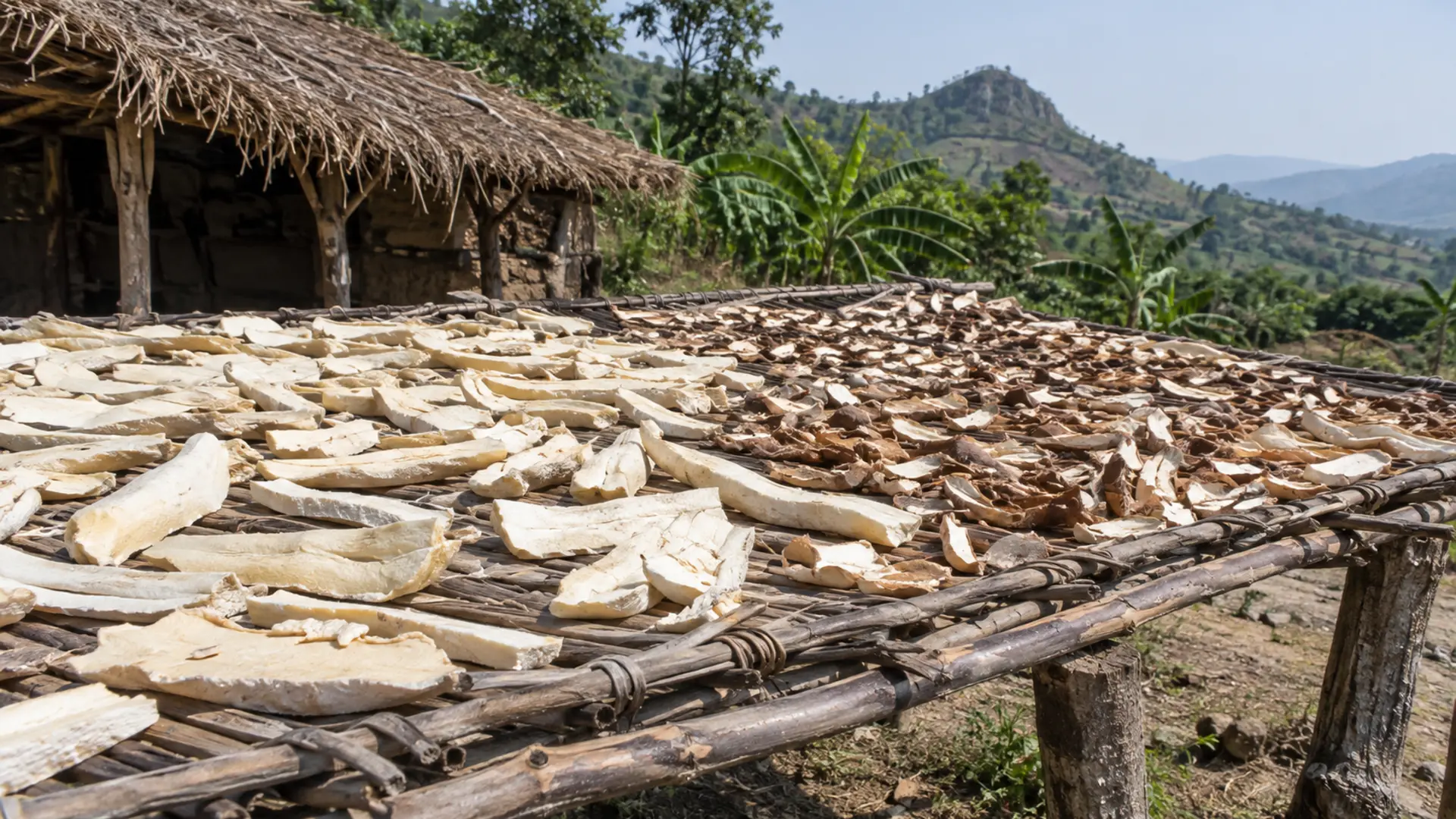
Almost every cheap or free feed material available on a Ugandan farm carries something that can harm an animal.
Cassava peel carries cyanide. Cotton seed cake carries gossypol. Napier grass carries oxalates, and after a drought breaks it can carry dangerous nitrate. Leucaena carries mimosine. Calliandra and sorghum carry tannins.
None of that makes these materials unusable. Most of them are excellent feeds. What it means is that the question “is this safe to feed” has no answer, because it is the wrong question.
The right questions are three: what processing has it had, how much of the diet will it be, and does the animal have a rumen.
What this guide covers and what it excludes
It covers six anti-nutritional factors, the Ugandan materials that carry each, the processing that reduces them and by how much, why species differ so sharply, the documented clinical signs, and the point at which a veterinarian must be called.
It excludes universal feeding rates, because the documented safe proportions differ by animal, by physiological state and by processing. It excludes veterinary treatment protocols and doses entirely. It excludes mycotoxins produced during storage, which are a different problem with a different cause and are covered in feed storage and feed testing.
This is a reference and safety article. The practical feed articles in this programme point back to it, which is why it is organised as a table first and an explanation second.
And the single most important sentence in it: every poisoning picture described here is a reason to call a veterinarian, and this article contains no treatment for any of them.
The Ugandan context
Uganda has, as far as we could establish, no published livestock poisoning case report for any of the six factors in this guide. We searched specifically and found none. A review of Ugandan small ruminant feed resources was opened and checked directly and contains no anti-nutritional factor content at all.
What Uganda does have is two documented human cyanide poisoning outbreaks from cassava, and they are worth knowing because they establish that the hazard is real here rather than theoretical.
In Kasese District in September 2017, an investigation found cassava flour containing “cyanogenic glycoside that was equivalent to an average of 88 ppm of cyanide (range = 85-90)”, with 98 probable cases and two deaths. In Terego District in February 2023, an investigation found “HCN 460.32mg/Kg, exceeding the maximum limit of 10mg/Kg”, with 19 cases and one fatality.
Both are human food incidents, not livestock ones, and this guide labels them as such. What they demonstrate is that inadequately processed bitter cassava in Uganda has reached concentrations that killed people. An animal fed the same material is not in a safer position than the person who ate it.
Why the rumen changes everything
Before any individual factor, there is one anatomical fact that decides most of the practical answers in this article, and it is the difference between an animal that ferments its feed and one that does not.
Risk framework
Explain why the same material can be safe for one animal and dangerous for another, since this single mechanism resolves most of the practical questions in the article.
A ruminant does not digest feed directly. It ferments it first, in a large chamber full of micro-organisms, and only afterwards digests the products. Those micro-organisms break down compounds the animal itself could not handle.
That is why the same material can be a good feed for a cow and a poison for a chicken.
Three of the six factors in this guide are documented as being handled by rumen microbes.
Mimosine. The international feed database records that “mimosine is broken down in the rumen to DHP (3,4 and 2,3 dihydroxy-piridine), a goitrogen that is detoxified by rumen bacteria.”
Condensed tannins. For sorghum, the database records that in ruminants “effects are less negative since condensed tannins are complexed and precipitated by the rumen microflora”, and notes documented beneficial effects including “bloat prevention and increasing… by-pass protein.”
Oxalates. A veterinary extension resource records that “Ruminants rumen microbes break down the oxalate, thereby releasing calcium for absorption”, with the important qualification that “Mature ruminants can usually consume large quantities of oxalates without harm if the young potentially toxic plant is ingested gradually.”
Note that qualification. Gradually. The rumen population adapts, and it needs time to do so.
And one factor where the rumen does not save the animal. Mimosine is broken down in the rumen, but the product is a goitrogen, and the database still records that mimosine “causes Leucaena to be toxic to cattle if fed in large amounts (more than 30% of the diet) over long periods.”
So the rumen is not a blanket permission. It changes the picture for three of six factors, it changes it partially for a fourth, and it does not make any material unlimited.
The reference table
This table is the deliverable of the article. The sections that follow explain each row, but the table is what belongs on the wall of the feed store.
Comparison matrix
Provide the single reference table this whole article exists to deliver, so that a farmer can find a material they are about to feed and read across to the factor, the processing and the species risk.
The table is the deliverable. The sections that follow explain each row.
Cyanogenic glycosides
This is the factor with the most Ugandan relevance and the widest range of processing outcomes, so it is worth setting out the numbers method by method.
Process diagram
Show which cassava processing methods reduce cyanide and by how much, because cassava is the most widely fed free material in Uganda and the reduction figures differ by an order of magnitude between methods.
What it is. Cassava and some other plants contain compounds which, when the plant tissue is damaged, release hydrogen cyanide. Cyanide blocks the body’s ability to use oxygen at cell level.
Where it sits. The international feed database records that cassava roots contain “0.02-0.03% HCN (DM basis)” rising to “up to 0.22% DM” in bitter varieties, against “less than 0.01% HCN” in sweet varieties. Fresh leaves reach “0.2% HCN (DM basis)” in bitter types and “about 0.1% HCN (DM basis)” in sweet ones.
And it gives a safety figure: “Roots containing less than 0.01% (100 mg/kg) of HCN in the DM are safe for use in animal diets.”
The peel is where the problem concentrates. International agency guidance records peel at “650 ppm in bitter varieties, 200 ppm in sweet varieties” against pulp at “310 ppm and 38 ppm respectively.” Which means that peeling alone “reduces cyanogenic glucoside content by at least 50%.”
What processing achieves. The documented figures differ enormously by method.
Soaking “removes about 20% of the free cyanide in fresh root chips after 4 hours.”
Boiling removes “About 90% of free cyanide… within 15 minutes of boiling”, with a “55% reduction in bound cyanide after 25 minutes.”
Sun drying: “more than 86% of HCN present in cassava was lost during sundrying.”
Fermentation: “approximately 98%.”
Ensiling with poultry litter over eight weeks: “about 98% of the free cyanide.”
Three practical conclusions.
Peel before you feed. It is the cheapest single intervention and it halves the problem.
Dry properly, not partially. The 86 per cent figure is for sun drying, and a half-dried heap is not sun-dried cassava.
Fresh bitter cassava root, peel or leaves fed unprocessed is the dangerous case. Everything else in this section is about getting away from that.
Clinical signs, and an honest gap. The international agency guidance we opened describes chronic effects across several species including poultry and small ruminants: “reduced growth rates, thyroid dysfunction (goitrogenic effects), zinc deficiency parakeratosis, hind limb paralysis, and muscular weakness.”
What it does not contain is a cattle-specific acute clinical description, and we could not find one in any source we could open. This guide therefore gives no acute sign list for cattle cyanide poisoning. What it gives you instead is the circumstance: an animal that becomes acutely distressed shortly after being fed unprocessed bitter cassava material is a veterinary emergency, whatever the specific sign.
The separate subject of managing cassava disease in the field, which affects which material you have to feed in the first place, is in cassava mosaic and brown streak disease management.
Mimosine
What it is. An amino acid found in Leucaena, which the database records at “up to 12% DM in young shoots.”
Species picture. The database describes mimosine as detrimental to non-ruminants, naming horses, donkeys and poultry among them. In ruminants it is converted in the rumen to a goitrogenic compound which rumen bacteria can themselves detoxify.
The documented ceilings, and they differ sharply by animal. For cattle, toxic “if fed in large amounts (more than 30% of the diet) over long periods.” For sheep, supplementation at “25-50% of dried leucaena leaves.” For goats, “between 50 and 75% of leucaena foliage can be included in a grass-based diet.”
Documented signs. “alopecia, excessive salivation and enlarged thyroid glands.” Hair loss, drooling, visible throat swelling.
Documented effects short of visible poisoning. “low feed intake” and reduced “live-weight gain and reproductive performance.”
Mitigation. Three approaches are named in the source: transfer of specific rumen bacteria from adapted animals, supplementation with certain mineral salts, and reduction of mimosine by soaking in water and drying. This guide names them and gives no procedure, rate or dose for any of them. A farmer intending to feed Leucaena as a major dietary component should establish that with a veterinary or animal nutrition adviser before planting it, not after. Establishment and management of the species itself is covered in fodder trees and shrubs for Ugandan farms.
Condensed tannins
What they are. Plant compounds that bind protein. At low levels this is useful, because it protects dietary protein from being broken down too fast in the rumen. At high levels it depresses intake and digestibility.
Where they are. In Calliandra, the database reports a range “from less than 1% to 20-30%”, with values “up to 38% for calliandra cultivated in Colombia.” In sorghum grain, high-tannin types are reported at “13.9 g/kg DM (tannic acid eq.), 55.7 g/kg DM (condensed tannins)” against low-tannin types at “0.5 g/kg DM” on both measures.
Ruminants. Effects “are less negative since condensed tannins are complexed and precipitated by the rumen microflora”, with documented benefits including bloat prevention and increased by-pass protein. At high tannin content the database still records “decreased rumen DM and protein degradability” and “decreased protein digestibility.”
Poultry. The picture is worse. Tannins “reduce growth rate, egg production and protein utilization, and… damage the mucosal lining.” Broilers can take “up to 70% low-tannin sorghum”, but high-tannin sorghum is usable only when “reconstituted after high-moisture storage for 10 days.”
A caution about predicting from a number. The database records that “A poor relationship was found between tannin content and in situ DM and protein degradability.” In other words, a laboratory tannin figure is a poor predictor of how the material will actually perform. Introduce gradually and watch intake rather than relying on a number.
A Ugandan data point. An agroforestry species factsheet for Uganda records Calliandra as “Still on trial in Uganda, and so far common only near Kabale”, and notes that “A high tannin content reduces its palatability as fodder but the foliage contains about 22% protein.”
Reduced palatability is the practical first sign. Animals refusing a high-tannin material are telling you something before any figure does.
Gossypol
What it is. A compound in cotton seed which is toxic to animals with simple stomachs and much better tolerated by ruminants.
Concentration depends entirely on processing method. The database records screw press cake at “200-500 mg/kg” free gossypol, pre-press solvent at “200-700 mg/kg”, and direct solvent extraction at “up to ten times higher… (1000-5000 mg/kg)”, with current commercial product “routinely with 1000-2000 mg/kg.”
That is a difference of an order of magnitude between processing routes for the same raw material. A farmer buying cotton seed cake in Uganda usually does not know which route produced it, and this is the single most important uncertainty in the section.
Ruminants. “cottonseed meal can be safely included up to 15% in cattle diets” for mature animals.
But reproduction is the exception. The same source records that it “may affect their reproductive performance”, with documented findings in bulls of “Lower normal sperm percentage after 5 weeks (49% vs. 83%)” and in buffaloes of “Lower conception rate (50 vs. 83%).”
Those are large effects and they appeared within weeks. A farm feeding cotton seed cake to breeding males or to females around service should treat this as a specific, documented risk rather than a general caution.
Poultry and other simple-stomached animals. Broilers at “up to 10-15% of the diet”, layers at “10% in layer diets” with iron supplementation required above 5 per cent, at documented iron to gossypol ratios of “2:1 (broilers) and 4:1 (layers).” Other monogastric species are also named in the source as susceptible.
The practical rule. Cotton seed cake is a good ruminant protein at moderate inclusion. Around breeding it deserves separate thought. For poultry the tolerances are far lower and involve a supplementation requirement, which is a formulation question rather than a farm mixing question.
Oxalates
What they are. Compounds that bind calcium. A veterinary extension resource describes the mechanism: “Soluble oxalate has a high affinity for calcium. When… absorbed into the systemic circulation it binds calcium ions to form insoluble calcium oxalate”, leading to “Calcium oxalate crystal formation and accumulation in renal tubules precipitating acute nephrosis and uraemia.”
In plain terms: it takes calcium out of circulation and it damages the kidneys.
Where they are. Napier grass is the material that matters most in Uganda. The feed database reports oxalate content “2.5-3.1% DM historically reported without observed animal health problems”, and a cultivar comparison in which “total oxalate ranged from 1.95 to 3.23% DM and was higher in leaves than in stems.”
Species. Ruminants are protected by rumen microbes breaking oxalate down, provided introduction is gradual. Horses lack this and develop a chronic calcium disorder described in the source as “Big Head”.
Plant age matters. “actively growing leaves contain the greatest concentrations of oxalate” while “mature dry plants contain low levels.”
That is directly actionable. Young lush Napier regrowth is the higher-oxalate material. Mature stands are lower.
An important note on the same forage. The feed database entry records that historically, the documented fatalities associated with this forage were attributed to nitrate rather than oxalate. That takes us to the last factor.
Nitrates
What happens. Plants take up nitrogen as nitrate. Normally they convert it into protein. When growth stops, the conversion stops and the nitrate accumulates.
A university extension publication describes the conditions: accumulation “occurs due to luxury uptake of nitrogen… and the plant’s inability to metabolize” it, and is worsened when growth “has slowed or stopped, which can be caused by… drought.” It adds that “Plants that have been fertilized with nitrogen typically have higher nitrate levels.”
The dangerous moment is specific and predictable. A drought stops growth while the roots keep taking up nitrogen. Rain arrives. The farmer cuts the flush of new growth and feeds it. That is the classic nitrate poisoning circumstance, and it is a moment every Ugandan livestock keeper will meet.
Documented thresholds, expressed on a dry matter basis as potassium nitrate: safe from zero to 7,220 parts per million; caution for pregnant animals from 7,220 to 10,830; restrict to half the ration from 10,830 to 14,440; avoid for pregnant animals above 14,440; and a danger zone above 28,880 parts per million.
Note that pregnant animals have their own thresholds, lower than the general ones.
Mechanism and speed. “Nitrite is 10 times as toxic to cattle as nitrate”, and it converts the blood pigment into “methemoglobin [which] cannot transport oxygen.” Death can follow “within 2-10 hours.”
Documented signs, and this is the one to memorise. “bluish/chocolate brown mucous membranes” and “dark ‘chocolate-colored’ blood.”
Brown gums and brown blood. Nothing else in this guide gives you a sign that specific and that fast.
On conservation. Ensiling “reduces nitrate levels; however, this does not guarantee… ‘safe’ levels… Testing is still recommended.”
So ensiling helps and does not settle the matter. Hay making does not reduce nitrate at all, because nitrate is not volatile.
The wider question of how much nitrogen goes onto a forage stand in the first place connects to fertiliser types and quality verification.
The two that kill quickly
Four of the six factors in this guide cost money over months. Two can kill within hours, and they announce themselves differently.
Diagnostic panel
Give the farmer the documented clinical signs for the two factors that kill quickly, so that a poisoning is recognised in time to call for help rather than after the animal has died.
Four of the six factors in this guide cause chronic problems: poor growth, poor conception, depressed intake, thyroid enlargement. They cost money over months.
Two can kill in hours. Nitrate and cyanide.
Both are associated with a specific, recognisable circumstance rather than a gradual decline.
Nitrate: forage cut after a drought broke, or heavily fertilised grass, fed to hungry animals. Signs within hours. Brown mucous membranes, brown blood.
Cyanide: unprocessed bitter cassava root, peel or fresh leaves. Acute distress after feeding.
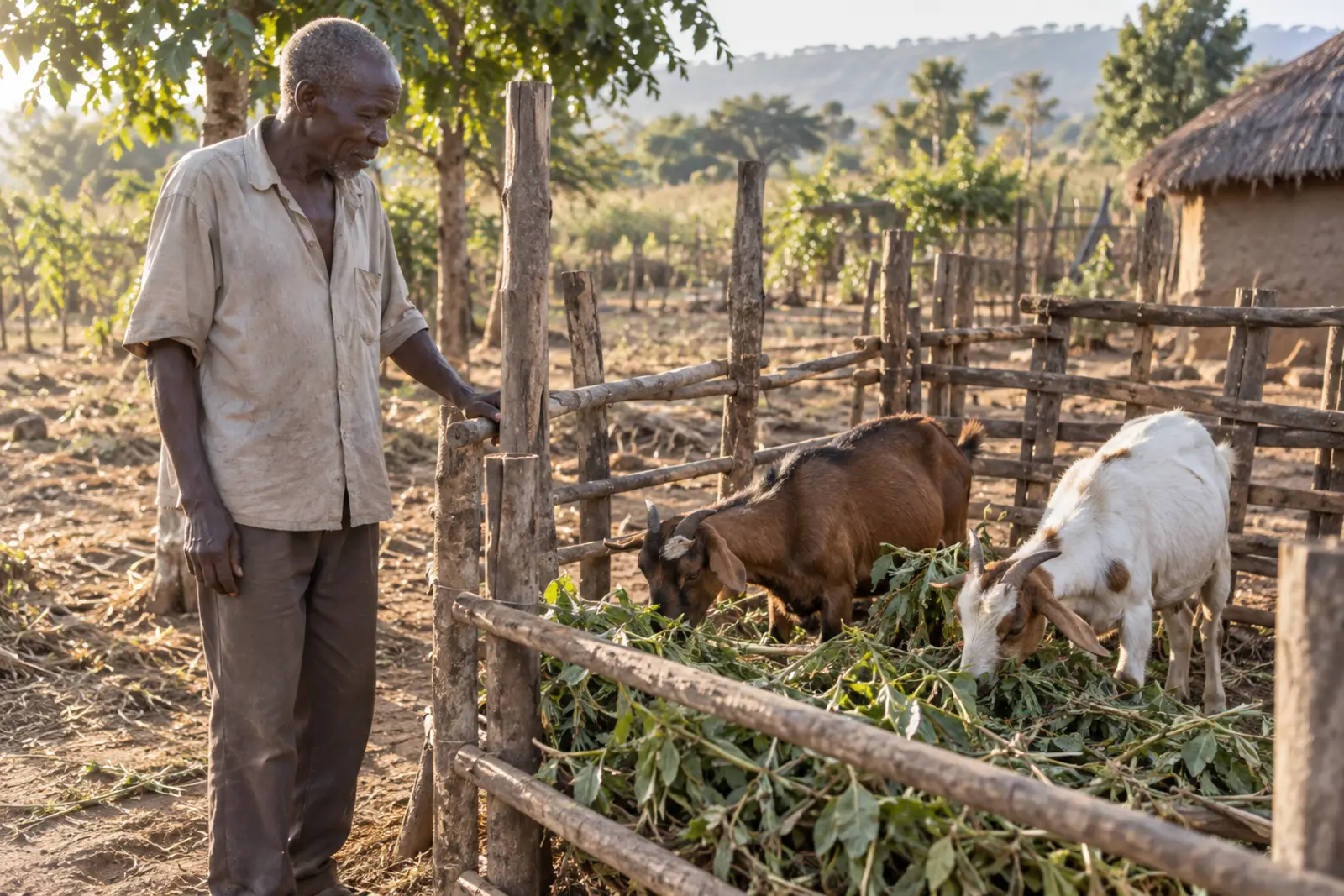
In both cases the instruction is identical and it is the only instruction this article gives. Remove the feed from every animal that has it. Call a veterinarian immediately. Do not treat, do not drench, do not wait to see whether the others are affected.
Before you feed anything new
This checklist applies to any material, including ones this article does not cover, which is what makes it worth keeping.
Checklist
Convert the whole article into a sheet a farmer completes before introducing any new on-farm material, because the decision point is always the same regardless of which factor is involved.
The checklist applies to any material, which is its value. You will meet materials this guide does not cover, and the eight questions still work.
Three of them carry most of the weight.
Which plant part, and which variety type? Cassava peel is not cassava root. Bitter cassava is not sweet cassava. Young Napier regrowth is not mature Napier. The factor concentrates in specific parts and specific material.
Does the animal have a rumen, and is it adapted? The rumen protection documented in this guide is conditional on gradual introduction. A sudden change gives you the material without the adaptation.
Is it pregnant or young? The nitrate thresholds set separate limits for pregnant animals. The gossypol findings concern reproduction directly. Physiological state is not a detail.
And the fourth that people skip: what proportion of the day’s feed will this be? Every documented ceiling in this article is a proportion of the diet, not a quantity. A material that is 10 per cent of the ration is a different proposition from the same material at 50 per cent.
The starting point for knowing what proportion anything is, is an inventory of what you actually have, which is covered in the farm feed resource inventory.
Common mistakes and why they fail
Feeding fresh cassava peel straight from the kitchen. The peel is where cyanide concentrates and unprocessed is the dangerous form.
Half-drying cassava. The 86 per cent reduction figure is for sun drying. Partially dried material has had partial reduction.
Cutting and feeding the flush after a drought breaks. The classic nitrate circumstance.
Assuming hay is safer than fresh grass for nitrate. Drying does not remove nitrate.
Assuming silage is safe for nitrate. Ensiling reduces it and the source explicitly says testing is still recommended.
Introducing a new forage suddenly. The rumen protection documented for oxalates and tannins is conditional on gradual introduction.
Feeding cotton seed cake to breeding animals without thought. The documented reproductive effects appeared within five weeks.
Applying a goat figure to cattle. The documented mimosine tolerances differ by a factor of two or more between species.
Relying on a laboratory tannin figure. The source records a poor relationship between tannin content and actual degradability.
Treating a suspected poisoning yourself. Every factor here has a veterinary escalation and this guide gives no treatment.
Cautions and escalation points
Call a veterinarian immediately for: brown or bluish mucous membranes; dark chocolate coloured blood; any animal acutely distressed after a feed change; sudden death in an animal that was feeding normally; multiple animals affected at once.
Call a veterinary or animal nutrition adviser before you start for: feeding Leucaena as a major component; feeding cotton seed cake to breeding stock; feeding any material at more than a modest proportion of the diet; any ration for poultry involving these materials, because the tolerances are lower and involve supplementation questions this article does not cover.
Have forage tested for nitrate after a drought breaks, before feeding the new growth, if testing is available to you. This is the one laboratory test in this guide with a documented life-saving rationale.
Do not mix problems. This article covers compounds that are in the plant. Mould growth and the toxins it produces during storage are a separate hazard with a separate cause, covered in feed storage and feed testing and, for grain intended for people, in maize post-harvest and aflatoxin.
Practical action plan
Today. Walk your feed store and your feeding area. List every material you are currently feeding and every material you intend to feed. Find each one in the reference table.
This week. For each material carrying a factor, establish what processing it has actually had. Not what it should have had. Peeled or not. Dried fully or partly. Fermented or not.
Before the next drought breaks. Decide now what you will do with the first flush of growth after rain returns. That decision made calmly in advance is worth more than any threshold table, because the circumstance arrives when animals are hungry and judgement is worst.
Whenever you introduce anything new. Complete the checklist. Introduce gradually, over days rather than in one feed. Watch at day one, day three and day seven, and write down what you saw.
Across the year. Keep the record. Which material, which animals, what proportion, what happened. Uganda has no published livestock poisoning case record for these factors, which means your own farm record is the only evidence specific to your system. The framework for keeping it is in year-round fodder planning for goats and cattle and the cost side is in diagnosing what your feed is actually costing you.
Conclusion
There is no list of safe feeds and dangerous feeds. There is a list of materials, each carrying a factor, each reduced by a specific processing step, each tolerated differently by animals with and without a rumen.
Peel the cassava and dry it properly. Introduce new forage gradually. Treat the flush after a drought as a hazard until it is tested. Think separately about breeding animals and pregnant animals. And know the two pictures that mean hours rather than months.
Everything else in this subject is detail. Those five things are most of the risk.
Author
This guide was produced by the Falcon Foundation Ltd Editorial Team. We research agricultural questions against published institutional guidance, international feed databases, veterinary technical sources and peer-reviewed evidence, and we translate them into decisions a Ugandan farmer can act on. Where no evidence exists for a claim we would otherwise have made, we say so rather than filling the gap. This article gives no veterinary treatment, no drug, no dose and no procedure for any mitigation method, and every poisoning picture it describes is referred to a qualified veterinary professional.