
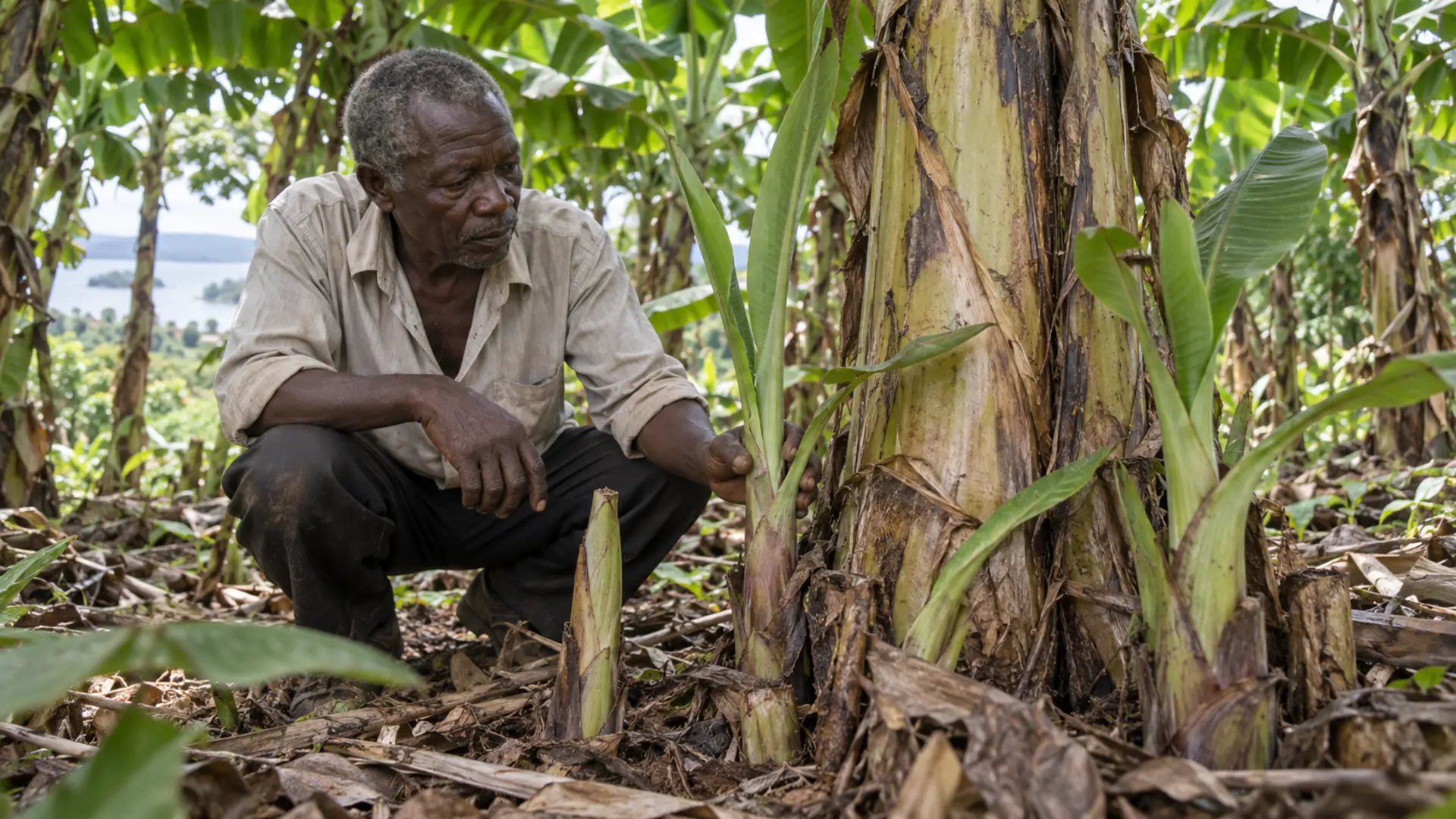
A banana plant is not really a plant. It is a mat: an underground corm sending up a succession of shoots, of which one is currently bearing, one is coming behind it, and several others are competing for the same water, light and nutrients without contributing anything.
Managing that succession is most of what banana husbandry is. Get it right and the mat produces a decent bunch on a predictable cycle for years. Get it wrong and you have a crowded stool producing small bunches on plants too thin to hold them up.
This guide covers the succession, how to select a follower, how to remove the rest properly, and the mulching question. On two of those points the published sources disagree with each other, and rather than pick a side we have reported the disagreement, because a grower who knows a figure is contested is better equipped than one who has been given false certainty.
It does not cover banana bacterial wilt, which has its own article at banana bacterial wilt management, and it names no pesticide.
The succession
The national banana production manual describes the structure directly, advising that farmers desucker the banana mat to plants at various growth ages, described as mother, daughter and granddaughter, in order to get big bunches.
That is the model: a bearing plant, a follower well advanced behind it, and a younger one behind that, so that as each bunch is harvested the next plant is already most of the way to flowering. The genebank regeneration guidance describes the same relationship more simply: among the followers or daughter plants, a sucker or ratoon is selected to succeed the mother plant.
The purpose of desuckering is stated plainly in the national manual: to reduce competition for water, light and nutrients.
How many to keep, and the dispute nobody mentions
Here is the first genuine disagreement, and it is worth knowing about because you will hear both numbers from people who are equally confident.
Three plants per mat. The national production manual advises desuckering to three plants at the mother, daughter and granddaughter stages.
One or two suckers. The same manual, in its section on timing, states that one or two suckers must be maintained.
Those two statements sit in the same document and we could not reconcile them from the text. We are reporting that rather than quietly choosing one.
A single successor. The genebank regeneration guidance says to desucker plants regularly to maintain a single successor sucker at a time.
No number at all. Research guidance from the regional agricultural research and insect physiology institutes on cultural control of the banana weevil declines to give a figure, saying only that reduction of competition for growth factors through desuckering should be encouraged to leave few plants in a mat, leading to sturdy plants.
These sources are not careless. They are written for different purposes. A genebank keeping a variety alive wants one clean successor. A weevil management programme wants sturdy plants. A production manual wants continuity of harvest. Those aims point at slightly different numbers.
What to do with that. Treat three as the working maximum for a production plot, understand that fewer means sturdier, and notice the phrase the weevil researchers chose: leading to sturdy plants. Stem sturdiness is not a cosmetic matter. It is what stops a plant snapping under a bunch, and it is directly connected to the mulching question below.
If your plot is on a slope, in a windy site, or already has a toppling problem, take the lower end of the range.
Choosing the follower
Not all suckers are candidates, and the one that looks most promising is usually the one to remove.
Banana Mat Management: Desuckering, Mulching and Deciding How Many Plants to Keep
A three-panel identification card showing a peeper, a sword sucker and a water sucker side by side with their leaf shapes, rhizome connection and whether each should be kept.
The three types, as described in the published banana reference:
Peepers. Just emerging, showing only leaf sheaths without a midrib or lamina. Too young to judge; leave them to develop or remove them depending on how many you already have.
Sword suckers. Their leaves have a midrib and a very narrow lamina. Narrow, pointed, sword-shaped. These are the ones to keep. The genebank guidance names the recommended stage as the sword sucker, describing it as a sucker 50 to 150 centimetres in height with lanceolate leaves, followed by the peeper.
Water suckers. These usually have a small rhizome and broad leaves, and, critically, their connection to the rhizome is often structurally weak. The reference states directly that water suckers are not suitable for selection as a ratoon to continue the life of the mat into the next generation.
The trap. A water sucker looks better. It is greener, its leaves are broader, and it appears more vigorous. It is not. The broad leaves indicate that it is drawing on the mother rather than developing its own strong corm connection, and a plant grown from it will be poorly anchored.
The rule is simple to remember and easy to apply: narrow leaves keep, broad leaves go.
For planting material rather than followers, the national manual gives its own specification, preferring sword suckers and describing suckers of 1.8 to 2.1 metres high and about 45 centimetres in girth for planting, noting the advantage that these are less infected with nematodes and weevils than larger planting material.
Removing a sucker so that it stays removed
This is the technique section, and it is the one most growers are doing incompletely.
Cutting a sucker off at ground level does not remove it. The growing point sits below the cut, and the sucker regrows. That is why plots that are “desuckered regularly” are crowded again within weeks and why the job feels endless.
The national manual gives the correct method: the sucker pseudostem is cut off near its corm, and the sharp point of the knife or panga is twisted in the growing point, thus killing it.
Banana Mat Management: Desuckering, Mulching and Deciding How Many Plants to Keep
A cutaway diagram of a sucker being removed showing the cut position near the corm, the growing point below it, and the twisting action used to destroy the growing point.
Two actions, not one. Cut near the corm, below the soil surface, not at ground level. Then put the point of the blade into the exposed growing point and twist to destroy it.
A sucker removed this way does not come back. A sucker cut at ground level comes back and you do the job again.
Timing. The national manual gives guidance that suckers up to about six months old are removed, from flowering through to harvest time, maintaining the stated number.
Frequency. Set it from your own plot rather than from any printed interval. In a high-rainfall area with good fertility, suckers appear fast and the round comes more often. The practical discipline is that desuckering is a scheduled round, not something done when the plot looks untidy, because by the time it looks untidy the competition has already cost you bunch size.
Banana Mat Management: Desuckering, Mulching and Deciding How Many Plants to Keep
A blank mat management calendar worksheet with rows for desuckering rounds, follower selection, mulch placement, manure application and plot inspection, and empty month columns for the grower to complete.
Mulching: the honest trade-off
This is the part of the guide that required the most care, because the evidence genuinely points in two directions and most writing on banana picks one.
What mulch does for you
The national production manual lists the benefits: it protects the soil against heavy rain and strong sunshine, prevents erosion in plantations on steep slopes, provides organic matter, stimulates root development, improves soil drainage, decreases soil temperature, and increases soil porosity and biological life.
The measured effects are substantial. A United Kingdom-funded crop protection project working in East Africa reported that higher bunch weights were obtained as a result of mulch addition in all cultivars, with an average increase of 10.7 kilograms or 83 per cent. Research on plant nutrition reported Ugandan field trials in which fertiliser and mulch together produced average yield increases ranging from 4.8 tonnes per hectare per year in the south-west to 8.0 in the central region and 10.0 in the south.
Those are not marginal numbers.
What mulch costs you
Against those benefits sits a body of evidence that mulching raises pest pressure, and Ugandan researchers have measured it rather than asserted it. This is where most writing on banana picks a side, and where the actual findings are more interesting than either side allows.
Banana Mat Management: Desuckering, Mulching and Deciding How Many Plants to Keep
A two-column evidence panel setting the documented benefits of mulching banana against the documented pest and toppling costs, with each finding labelled by the study and site it came from.
The national manual states it bluntly: mulching is known to increase pest attack and toppling. Mulching therefore should be done off the mat.
The Ugandan research is more specific and more interesting. A study of mulch effects on banana weevil populations and damage in Uganda found that weevil populations were higher in mulched than unmulched systems. But the damage finding was site-dependent: damage was greater in mulched systems at one Ugandan site but not at a second. And despite the higher weevil numbers, mulching still gave yield benefits in the range of 18 to 27 per cent.
The same crop protection project that recorded the bunch weight gains also recorded that mulched plots generally had higher counts of a plant-parasitic nematode than unmulched plots.
So mulch raises pest numbers, may or may not raise actual damage depending on the site, and improves yield anyway.
The finding that reconciles them
One more piece of Ugandan evidence changes the picture. In demonstration trials combining fertiliser and mulch, average weevil corm damage and nematode-induced root necrosis were both low and similar for both plot types.
Read that carefully. Where nutrition was also managed, damage stayed low regardless of mulch.
That suggests the real relationship is not mulch causing damage, but mulch raising pest numbers in a system where plant vigour determines whether those numbers translate into damage. A well-fed, sturdy plant tolerates a pest population that overwhelms a starved one.
What to actually do
Mulch. The yield evidence is strong and consistent.
Mulch off the mat. This is the national manual’s own instruction and it is the practical resolution of the trade-off: you get the soil, moisture and erosion benefits in the inter-mat space while keeping the moist sheltered habitat away from the corm where the weevil breeds and where surface rooting encourages toppling.
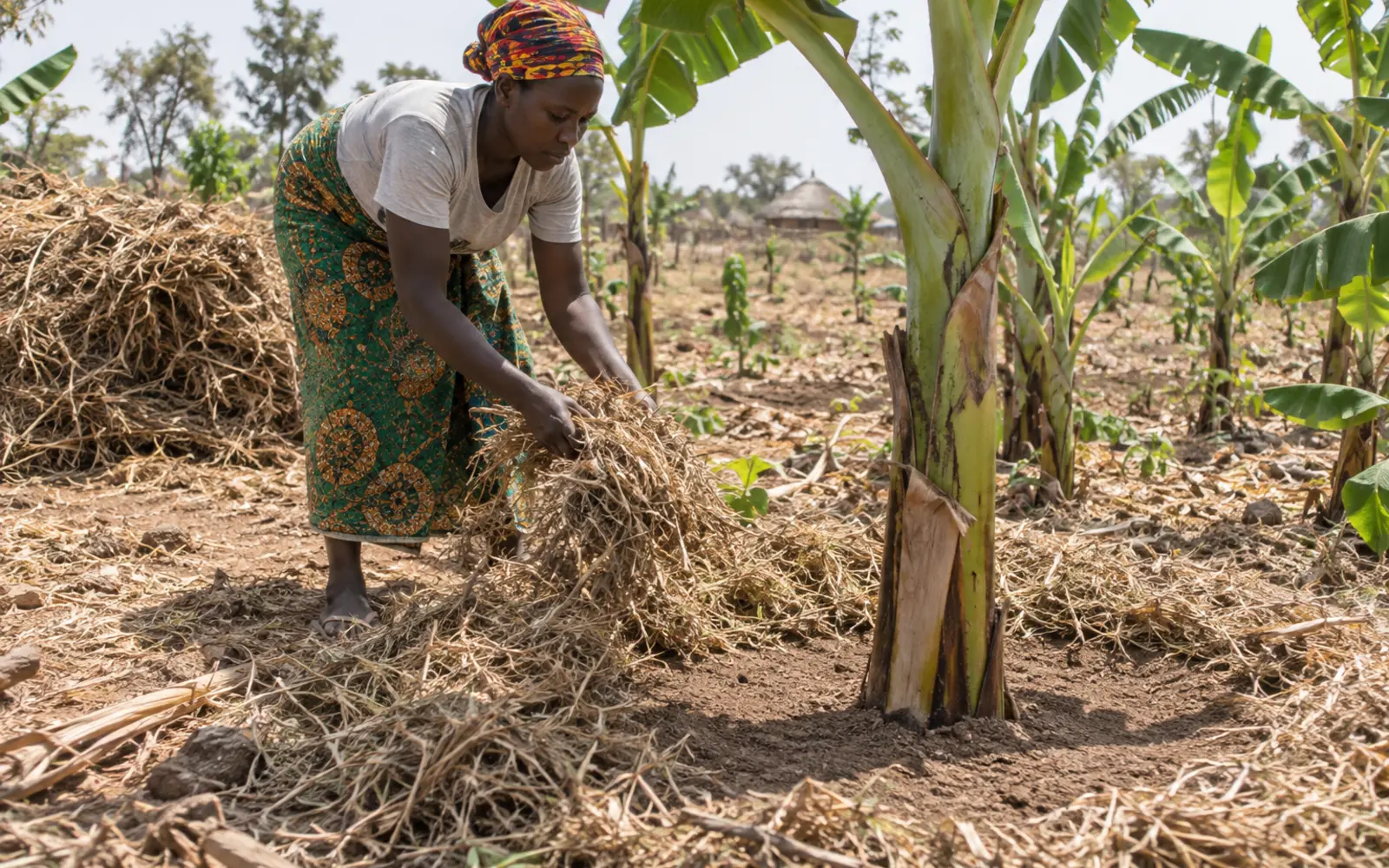
Keep a clear ring of bare soil around each mat. It also lets you see the base of the plant, which is where you look for problems.
Feed the plot. The reconciling evidence says nutrition is what determines whether pest pressure becomes pest damage. Manure, compost or fertiliser according to a soil test, using soil testing and fertility and composting and organic matter.
Apply mulch when the crop has established, as the manual advises, rather than to a newly planted field.
Watch for toppling, especially on slopes. The erosion benefit of mulch on steep ground is real and is covered in soil erosion control on Ugandan slopes, but toppling risk rises with surface rooting and with tall thin plants, which brings the argument back to keeping fewer, sturdier plants per mat.
Why bunch size falls, in order of likelihood
When a grower says bunches are getting smaller, the causes worth checking sit in a reasonably predictable order, and only one of them requires buying anything.
Too many plants on the mat. Competition for water, light and nutrients is the reason the national manual gives for desuckering at all. This is the first thing to count and the cheapest to correct.
Suckers that were cut but not killed. A mat that was desuckered a month ago and is crowded again was not actually desuckered; the growing points were left intact.
A water sucker carried as the follower. A plant grown from a weakly connected sucker produces a smaller bunch and is more likely to topple carrying it.
Declining fertility on a plot that is harvested continuously. Bananas export a great deal of potassium in the bunch, and a plot that has been cropped for years without return will show it in bunch size before it shows it anywhere else.
Pest or disease pressure that the plant can no longer tolerate. Note the order: this comes after nutrition, because the Ugandan mulch evidence suggests that pest numbers translate into damage most readily in plots that are not well fed.
Working down that list in order costs nothing until the fourth item, and most growers find their answer before they get there.
Clean planting material
Most weevil and nematode problems arrive on the farm rather than appearing on it.
The research on cultural control of banana weevil states that the most important mode of spreading of banana weevil to new fields is through infested planting material, and that paring and hot water treatment have been found to be effective and simple for eliminating weevils from planting material.
The national manual describes paring: removing all the roots and parts with damage, that is the tunnels formed by larvae or the necrosis due to nematodes, and states that brown and black spots due to infestation should be removed until only white tissue remains. It notes that clean suckers may be obtained from non-infested fields, by paring the corm to remove eggs and larvae, or by use of tissue cultured plants.
Until only white tissue remains is the standard, and it is more aggressive than most growers pare. A corm that still shows brown tunnelling has not been pared enough.
The wider principle of controlling what enters the farm is in whole-farm biosecurity, and the scouting logic that turns observation into a decision is in integrated pest management scouting and thresholds.
Common mistakes
Cutting suckers at ground level. They regrow, because the growing point is below the cut.
Keeping the biggest, greenest, broadest-leaved sucker. That is the water sucker and it is the one to remove.
Desuckering when the plot looks untidy rather than on a round.
Carrying six or seven plants on a mat and wondering why bunches are small and stems are thin.
Mulching right up against the mat, which the national manual specifically advises against.
Abandoning mulch entirely because of weevils, when the Ugandan evidence shows yield benefits even where weevil numbers rose.
Mulching a plot that is never fed, which is the condition in which pest numbers most likely become pest damage.
Planting unpared suckers, or paring only until the corm looks tidy rather than until only white tissue remains.
Taking planting material from a plot with a disease problem.
Treating declining bunch size as a soil problem without ever counting the plants on the mat.
Doing the round efficiently
Desuckering a plot of any size is tiring work, and the way it is organised determines whether it gets finished.
Work one row at a time and finish each mat completely before moving on. The common alternative, walking the plot removing the most obvious suckers, leaves every mat half done and means the next round starts from nowhere.
Carry one tool and keep it sharp. A blunt panga makes the cut-near-the-corm step harder and makes the twist that destroys the growing point almost impossible, which is precisely why that step gets skipped.
Do the follower selection in the same pass, not as a separate visit. You are already at the base of the mat looking at the suckers; deciding which one stays costs seconds at that moment and requires a whole second walk if deferred.
Take the removed material out of the plot rather than leaving it between the rows, particularly where weevil pressure is a concern, since cut pseudostem material lying in the plot is exactly the sheltered damp habitat the adult weevil uses.
And mark where you stopped. A plot desuckered over three sessions with no record of the boundary will have a strip that gets done twice and a strip that gets missed.
When to involve a professional
Contact a district agricultural officer, an extension officer or a plant health laboratory rather than acting alone when:
- Plants wilt, yellow from the older leaves inward, or show internal discolouration when a pseudostem is cut. The national manual identifies a wilt disease as a major destructive disease of bananas in Uganda, with losses it puts as high as 100 per cent, and identifies a separate wilt affecting highland areas. Distinguishing between wilts is a diagnostic job.
- Toppling becomes frequent rather than occasional.
- A pest or symptom appears that you do not recognise.
- You are bringing planting material onto the farm from outside and want it checked.
- You want a fertility recommendation, which should follow a soil analysis rather than a general figure.
A practical action plan
This week: count the plants on ten mats. Not an impression. A count. If most mats are carrying more than three plants, you have found your bunch size problem.
This week: learn the leaf shapes. Walk the plot and identify sword and water suckers until you can do it without thinking. This is the skill the whole guide rests on.
This month: run a proper desuckering round. Cut near the corm and destroy the growing point on every sucker you remove. Expect the round to take longer than usual the first time, and expect the next one to be much lighter.
This month: select and mark your followers. One sword sucker per mat as the successor, plus whatever younger material your chosen system carries.
This month: fix your mulch placement. If mulch is heaped against the mats, pull it back and leave a clear ring of bare soil at each base.
This season: feed the plot, on the basis of a soil test if you can get one. The Ugandan evidence says this is what determines whether pest numbers become pest damage.
Every month: walk the plot deliberately, looking at the base of plants rather than at the canopy, with a bag for anything removed.
Keep the routine sheet. Which round was done, when, and what you found. Two seasons of that record is what turns this from a set of instructions into your own management system, and the framework is in farm record keeping and gross margin analysis.
Conclusion
Banana mat management is not complicated, but it is specific, and two of its details are almost universally done wrong.
Suckers are removed by destroying the growing point, not by cutting at ground level, which is why most growers feel they are desuckering constantly and getting nowhere. And the sucker that looks best, broad-leaved and vigorous, is the one to remove, because its connection to the corm is weak.
On mulch, the honest position is not the simple one. Ugandan research found more weevils under mulch, found more damage at one site and not at another, found more nematodes, and found higher yields anyway, with damage staying low at both when the plots were also fed. That is why the national manual’s instruction to mulch off the mat is the right practical answer: it keeps almost all of the benefit and moves the habitat away from the corm.
Count your plants, learn the leaf shapes, destroy the growing points, and keep the mulch off the mat. Everything else in banana follows more easily once those four are in place.
Author: Falcon Foundation Ltd Editorial Team
The Falcon Foundation Ltd Editorial Team produces evidence-based agricultural guidance for Ugandan farmers, drawing on published research and institutional sources and translating them into practical decision support. Where evidence is unavailable or contested, we say so rather than filling the gap.
