
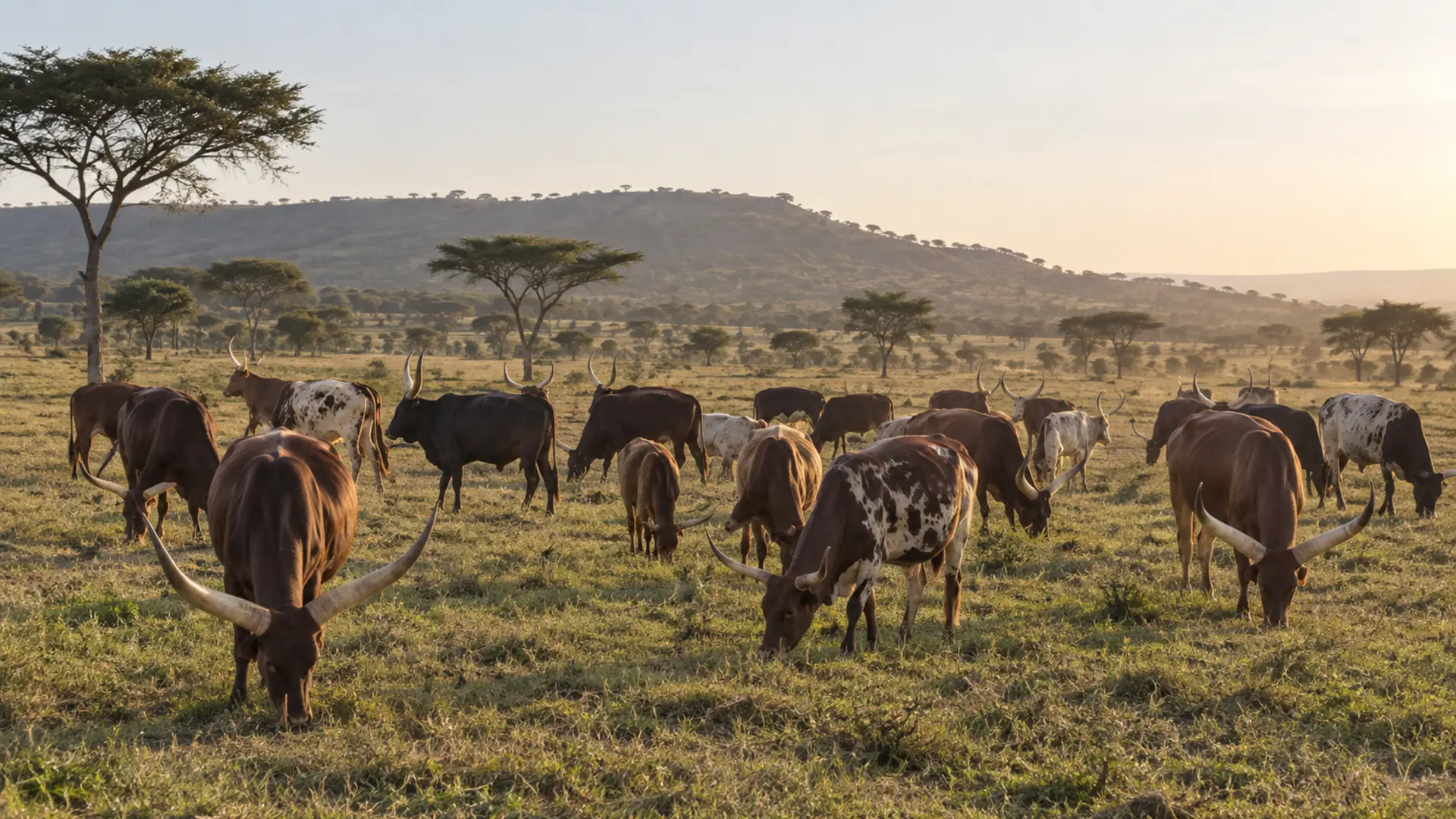
A cattle keeper in the corridor notices the ticks are still there two days after spraying. So they spray again sooner. Then they mix in something else. Then they double the strength.
Every one of those responses makes the next season worse.
This is not a general warning imported from somewhere else. A Ugandan study using laboratory testing found synthetic pyrethroid resistance in 90 per cent of the tick populations it screened. A separate Ugandan study found that in the high-resistance district, every single farmer interviewed reported acaricide failure, and those same farms were spraying twice a week at double the recommended concentration.
Those two findings sit next to each other for a reason.
What this guide covers and what it excludes
It covers how to tell a technique failure from a resistance problem, what the Ugandan resistance evidence actually shows, an application audit you complete at the crush, the warning signs that resistance is developing, and the non-chemical measures with an honest account of the evidence for each.
It excludes, deliberately and completely, the name, trade name or concentration of any acaricide. It also excludes veterinary treatment of tick-borne disease, vaccination decisions, and dairy or beef husbandry. Chemical classes are named, because rotation between classes is the core of the subject and cannot be discussed without them. Products are not.
Every treatment decision in this article escalates to a veterinary professional. This guide helps you diagnose why control is failing. It does not tell you what to put in the drum.
The Ugandan context
The national livestock census recorded a cattle population of 14.5 million in 2021. The heaviest concentrations it records include Kotido at around 718,000, Amudat at around 677,000 and Kiruhura at around 402,000.
On what ticks cost, two figures exist and they do not sit comfortably together.
A study of the area around Lake Mburo National Park in the south west put the total annual economic cost of ticks and tick-borne diseases there at “Ug. Shs 437,754,600 (USD 308,144)”, with a per-animal annual cost of “Ug. Shs 6,700 ± 580” in pastoral herds and “Ug. Shs 7,600 ± 970” on ranches, at an exchange rate the study states as 1,420 shillings to the dollar.
A separate journal article cites a national figure of more than 1.1 billion United States dollars annually in direct and indirect losses. That figure appears in the article as a citation of another source, which we were not able to open and verify.
We report both and we label them differently. The Lake Mburo figures come from a field economics study of a defined area. The national figure is a secondary citation whose origin we could not check. A farmer should take the per-animal figure as the more trustworthy of the two, and should treat any national billion-dollar figure they are quoted as something to ask for the source of.
The operating principle, in plain language
Resistance is not something a tick decides to do. It is what happens to a population when you kill every individual except the few that happen to survive, and then let those few breed.
Three things follow, and every practical recommendation in this guide comes from one of them.
Anything that lets a tick survive a treatment selects for resistance. That includes resistance genes, and it equally includes a tick that was never wetted because nobody lifted the tail. A tick that survives because of bad coverage breeds just as successfully as one that survives because of a resistance gene, and its offspring inherit the habit of living in a place your spray does not reach.
Under-dosing is worse than not treating at all. A full dose kills susceptible and partially resistant ticks alike. A half dose kills only the fully susceptible ones, which is precisely the selection you do not want.
Shortening the interval increases the number of selection events. Every treatment is a round of selection. Spraying twice a week rather than weekly doubles the pressure on the population without doubling the kill.
That is why the sequence a frustrated farmer reaches for, spray more often, mix products, raise the strength, is the exact sequence that produces a resistant population fastest.
What the Ugandan evidence shows
This is the part of the subject where Uganda has unusually good published evidence, and it is worth setting out with the figures attached rather than summarised.
Risk framework
Present the Ugandan resistance evidence with its own figures, so that a reader understands both that the problem is real and where it has and has not been documented.
A study published in Parasites and Vectors in 2016, titled “Emergence of multi-acaricide resistant Rhipicephalus ticks and its implication on chemical tick control in Uganda”, screened tick populations using the larval packet test, a laboratory method.
The scope: “31 tick populations from 30 farms” across “17 districts”. The species: “Rhipicephalus (Rhipicephalus) appendiculatus and Rhipicephalus (Boophilus) decoloratus”.
The findings, quoted exactly.
Synthetic pyrethroids. “Resistance against SP was detected in 90.0 % (27/30) of the tick populations tested.” And within those, “60.0 % (18/30) and 63.0 % (19/30) of the above ticks were super resistant (0 % mortality).”
Read that second figure carefully. Super resistant is defined in the study as zero per cent mortality. Not reduced kill. No kill at all.
Organophosphates. “13.3 % (4/30) of the one host tick R. decoloratus were resistant to DD.”
Amidines. “12.9 % (4/31) of the tick populations tested had amitraz resistant Rhipicephalus ticks.”
Multiple classes. “55.2 % (16/29) of the resistant Rhipicephalus ticks” showed resistance to more than one class.
The National Drug Authority has published on the same problem, describing ticks that have “developed super resistance to almost all the available 21 acaricides” on most farms in the western and central regions, across “amidines, pyrethroids, Organosphates and their combinations”.
A companion regulator article records that “Super resistant ticks that are not responsive to all the molecules of acaricides on market have been identified on 68% of the farms that reported the problem in Western and Central Uganda in July 2016”.
And the finding that matters most for an individual farmer. The regulator states that “No complaints have been registered from Northern and Eastern Uganda as yet, where tick samples collected showed susceptibility to all molecules.”
Resistance in Uganda is not universal. It is regionally concentrated and farm-specific. That means two things: your farm may not have it, and the farm next door may.
What the same evidence says about farm practice
This is the part that connects the laboratory result to the drum at the crush.
A study published in Veterinary Medicine International in 2020 compared farms in a high-resistance district and a low-resistance district. In the high-resistance district, farms with crossbred cattle “were reported to be extensively using acaricides, shortening the application interval to twice a week and increasing concentration of acaricides by atleast two folds over manufacturer’s recommended concentration.”
The outcome: “100%” of farmers in the high-resistance district reported acaricide failure, against “none of the farmers from” the low-resistance district.
The regulator names the same practices directly as causes: “Mixing of different acaricides together, changing them very often, using very low to very high concentration” together with “wrong applicators, and prolonged use of one type of acaricide.”
We are not going to claim these studies prove that bad practice caused the resistance. They are observational and the direction of causation cannot be settled from them. What they establish is that the two travel together, and that the practices the regulator identifies are exactly the practices the mechanism above predicts would drive resistance.
That is enough to act on.
Is it resistance, or is it you
Ticks alive after a treatment have four possible explanations and only one of them is resistance. The other three are cheaper to fix and far more common.
Decision tree
Separate the three explanations for ticks surviving a spray, because the correct response to each is different and the commonest Ugandan mistake is to treat every failure as if it were resistance.
Work down the decision tree before concluding anything, because three of its four endpoints are not resistance.
Coverage failure is the commonest and the easiest to fix. A tick in an unwetted ear is not a resistant tick.
Concentration failure runs in both directions. Under-dosing selects for resistance. Over-dosing wastes money, risks the animal and, on the Ugandan evidence above, travels with failure rather than preventing it.
A sudden, herd-wide failure with no history of gradual decline is more likely to be a handling or storage fault than a resistance event, because resistance builds in a population over seasons rather than appearing in a week.
Suspected resistance looks like gradual decline over several seasons, with intervals that have been shortened repeatedly and still do not hold.
And the honest limit of the tree: it narrows the possibilities. It does not confirm resistance. Only a laboratory can do that, and the next section explains what that costs.
Where the ticks actually are
You cannot audit coverage without knowing where to look, and the documented attachment sites differ sharply between the two tick species that matter in Uganda.
Diagnostic panel
Give the farmer the tick attachment sites documented for the species that matter in Uganda, because a coverage audit is meaningless without knowing where to look.
A coverage audit is meaningless unless you know where to look, and the documented attachment sites differ by tick type.
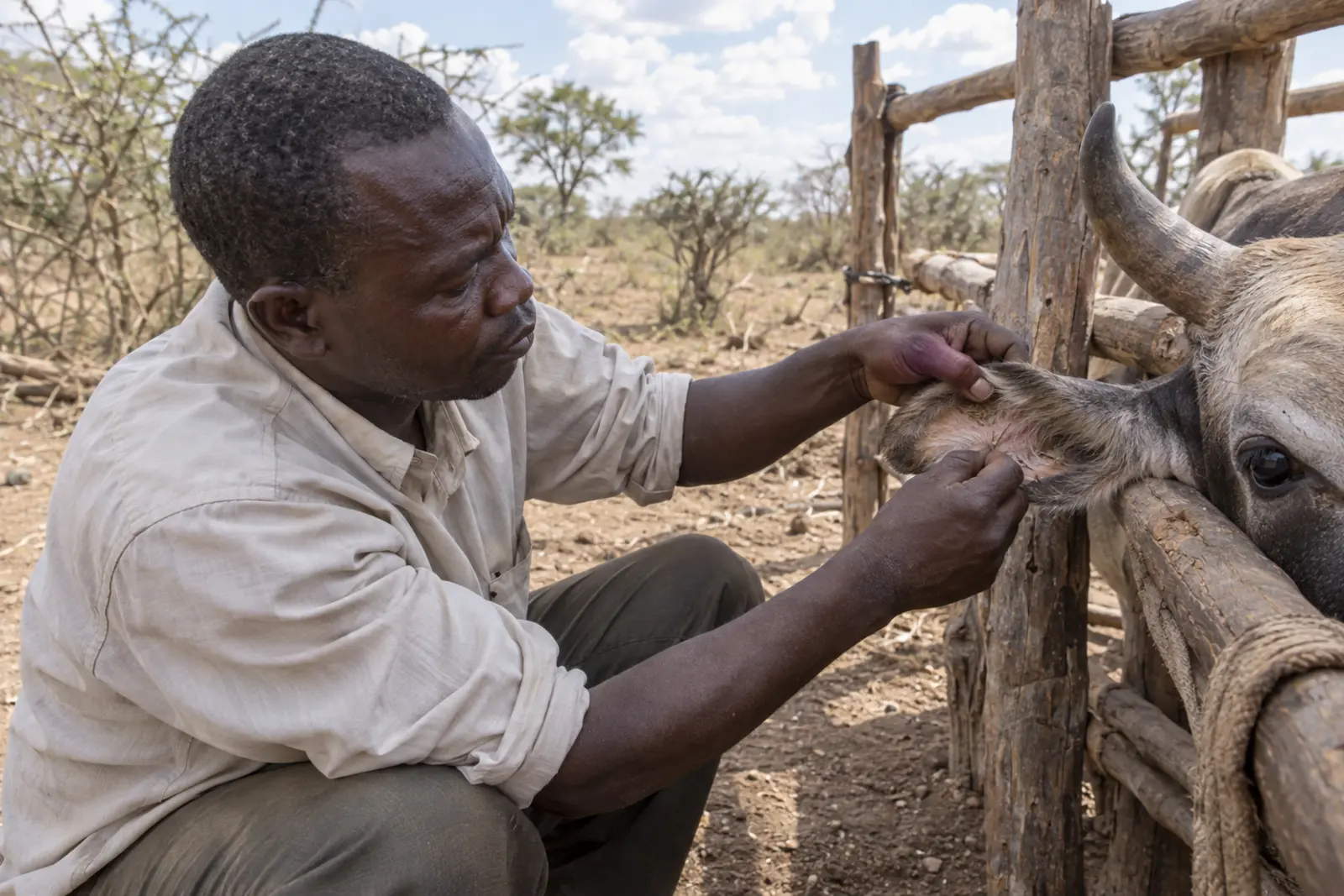
For the three-host ear tick, an international compendium records that “The adult tick prefers to feed on the pinnae of the ears, followed by the head, whereas nymphs are most commonly present on the ears, head, legs and feet.” This is the species documented as the vector of the parasite causing East Coast fever.
For newly attached larvae of the one-host blue tick, the documented sites are “the softer skin inside the thigh, flanks, and forelegs” with ticks also occurring “on the abdomen and brisket”. That description comes from a closely related one-host species rather than from the Ugandan species itself, and we label it as such rather than presenting it as species-specific.
Heartwater is transmitted by a different genus entirely, with the tropical bont tick named as a principal vector.
The practical consequence is short. If your spray routine does not individually handle each ear, lift the tail, reach the inner thighs and the udder or scrotum, and reach the feet, then you are leaving ticks alive in the documented attachment sites of both major species on your cattle.
The application technique audit
This is the sheet that finds the faults a farmer cannot see from memory. It is completed at the crush, during an actual treatment, by somebody watching rather than spraying.
Checklist
Convert the application technique audit into a sheet the farmer completes at the crush during an actual treatment, because technique faults are invisible in recollection and obvious in observation.
Complete the checklist while somebody is actually spraying. Not afterwards, and not from memory.
Four principles sit behind it.
Measure, do not estimate. A marked container, read against the label rate, every time. The Ugandan intervention study’s training emphasised “proper acaricide dilution and application” for exactly this reason.
Wet to the skin, not to the hair. The same study emphasised “proper spraying to wet the animal with acaricide and reach all tick attachment sites.” Hair that looks wet from two metres away is not the same as skin that is wet.
Handle the ears. They are the documented preferred site of the adult ear tick and they cannot be reached by a spray aimed at a standing animal from the side.
Record the interval in days, not in weeks. An interval that has quietly shortened from fourteen days to seven to four over two seasons is the single clearest warning sign available to a farmer, and nobody notices it without a written record. The general discipline is in farm record keeping and gross margin analysis.
An honest gap. We searched for a documented figure for the volume of spray needed per adult bovine for full coverage, and for a documented comparison of spray race against hand spraying. We could not verify either from a source we were able to open. This guide therefore gives no litres-per-animal figure and makes no claim about which application method is superior. Your veterinary officer can advise on both for your equipment.
Confirming resistance, and what that costs
A farmer cannot confirm resistance at the crush. The confirmation is a laboratory procedure.
The international agency’s guidance names the available laboratory bioassays: “the larval packet test (LPT), larval immersion test (LIT), and adult immersion test (AIT)”, alongside in vivo testing, which “involves treating infested cattle with acaricides and monitoring tick mortality.”
A 2025 study describes what the standard method costs in practice: “The LPT is labour-intensive, requires laboratory facilities with reference susceptible tick strains, and takes at least six weeks to obtain results.” The same study records that its work was applied “to the laboratory conditions at Makerere University in Kampala”, which establishes that Ugandan laboratory capacity for this exists.
Six weeks is a long time in a tick season. It is also the price of an answer rather than a guess, and the decision tree above exists precisely so that a farmer eliminates the cheap explanations before paying that price.
One further finding from the 2025 work worth knowing. It records a third species, Rhipicephalus microplus, as “invasive in Serere.” A new species arriving in a district changes the control picture, and it is a reason to have ticks identified rather than assumed.
Rotation, honestly
The regulator and the Ugandan intervention study both recommend rotation between acaricide classes. The intervention study calls for “evidence-based acaricide rotation” guided by laboratory testing, and for “regulatory oversight and restricted release of acaricide molecules at a time to create reserve molecule(s).”
Two honest qualifications belong with that recommendation.
Rotation between classes, not between products. Two products in the same chemical class are the same thing for resistance purposes. A farmer who switches monthly between three products that are all synthetic pyrethroids has rotated nothing. This is the single most common misunderstanding in the subject, and it is why this guide names classes at all.
We could not verify the efficacy evidence. We searched for a source weighing the published evidence on whether rotation actually delays resistance, and could not open one. Rotation is reported here as prevailing regulatory and expert guidance in Uganda, which it clearly is. It is not reported as a proven intervention, because we could not verify a document establishing that.
And rotation is not a decision to make alone. Which class, in what order, at what interval, for your ticks, is a veterinary question informed by testing. The decision to change class is where this article stops and your veterinary officer begins.
What works that is not a chemical
Every non-chemical measure below has a sound biological rationale. What differs, and differs enormously, is how much of each is actually documented.
Comparison matrix
Set out the non-chemical measures with the documented strength of evidence for each, so that a farmer investing labour in one of them knows what is actually established.
The international agency’s guidance names the available non-chemical approaches: anti-tick vaccines, natural predators and manual removal; breeding cattle with greater resilience; and pasture rotation and spelling.
Here is what we could and could not establish about each.
Pasture spelling. The biological case is strong. One-host ticks in this subgroup can “complete their life cycle in as little as 3-4 weeks”, and a tick “may spend up to 80% of its life as a questing larva” waiting on pasture. Unfed larvae are documented as surviving “as long as 3 to 4 months without feeding” in warm conditions and longer in cooler ones. So resting a paddock long enough for the larvae on it to die is a real mechanism.
The problem is the number. We searched for a documented spelling duration and could not verify one from a source we could open, and the larval survival figures above come from a related species in a different climate. This guide therefore does not give you a number of weeks. What it gives you is the reasoning, and the instruction to ask a veterinary officer what spelling period applies to your species and your season.
Hand removal. Named in the international guidance. It is labour, it is slow, and on a large herd it is not a control strategy. On a small herd, during an outbreak, on the documented predilection sites, it is a real reduction and it costs nothing but time. Ticks removed by hand should be destroyed, not dropped.
Breed tolerance, and a Ugandan finding that contradicts the common belief. A study in Soroti district compared 295 Nkedi Zebu and 165 Ankole cattle across 86 herds. Both breeds showed “high, moderate and low mean counts” of the three principal tick species, with no significant difference in tick burden between them. What the Zebu showed was a “higher degree of disease resistance”, which is an immune response to the pathogens the ticks carry, not fewer ticks.
That distinction matters. An indigenous breed may survive infection better. On this Ugandan evidence, it does not carry fewer ticks. A farmer told that switching breeds will reduce their tick problem should be shown this study. Breed selection for other reasons is a separate subject, covered in dairy cattle breed and cross selection.
Grazing timing and bush management. Both follow from the questing behaviour described above and both are sensible. Neither has a documented Ugandan figure we could verify, and this guide presents them as reasoning rather than as evidence.
The wider integration of grazing with cropping, which is where paddock rotation becomes practical on a mixed farm, is in integrated crop and livestock farming.
Common mistakes and why they fail
Shortening the interval. Doubles the selection events without doubling the kill. Documented on Ugandan farms alongside universal reported failure.
Raising the concentration. Documented on the same farms. It does not overcome resistance, it costs money, and it risks the animal.
Mixing products in the drum. Named by the regulator as a contributing practice. It also destroys any ability to know what worked.
Rotating between products of the same class. Feels like rotation. Is not rotation.
Buying whatever is on the shelf this month. The regulator names “changing them very often” as a contributing practice. Random switching is not a strategy.
Treating only the visible ticks. The engorged females you can see are the end of the cycle, not the beginning. The larvae are on the pasture.
Concluding resistance from one failed spray. Three of the four endpoints of the decision tree are not resistance, and they are all cheaper to fix.
Bringing in animals without quarantine. A purchased animal can import a resistant tick population onto a farm that did not have one. This is the single highest-risk event and it is dealt with in whole farm biosecurity.
Cautions and escalation points
Every product decision is veterinary. What to use, at what strength, at what interval, and when to change class. This guide names no product and no rate and will not.
Sick animals are veterinary, urgently. Tick-borne diseases kill. An animal that is dull, off feed, breathing hard, or with visibly enlarged lymph nodes needs a veterinary officer now, not a spray. This guide contains no treatment for tick-borne disease of any kind.
Human safety. Acaricides are hazardous to the person applying them. The general framework for handling agricultural chemicals safely, including protective equipment and mixing discipline, is in safe pesticide use, selection, mixing and application.
Escalate to a veterinary officer for: any change of chemical class; any suspected resistance; any sick animal; any decision about spelling periods; any newly arrived tick species.
Escalate to the national drug regulator if you suspect a product is substandard or falsified, since that is a separate problem from resistance and has a different remedy.
Be careful whose advice you take. The quality of tick advice circulating in Ugandan cattle areas varies enormously, and the framework for judging an agricultural information source is in reliable sources of farming advice.
Practical action plan
This week. Complete the technique audit checklist during an actual treatment. Write down the current interval in days and the previous one. Handle the ears, lift the tail, and check the documented predilection sites on five animals by hand.
This month. Fix whatever the audit found, and change nothing else. Do not switch product while you are correcting technique, because you will not know which change did what.
Next treatment. Measure the dilution with a marked container against the label rate. Make the wash up fresh. Record the date, the interval and the class used.
Over the season. Keep the interval record. A stable interval with acceptable control means the problem was technique. An interval that keeps shortening despite corrected technique is your case for laboratory testing.
If the record points to resistance. Take it to your veterinary officer, ask about tick identification and laboratory testing, and understand that the answer takes weeks rather than days.
Alongside all of it. Quarantine every incoming animal. Rest paddocks where your system allows it. Remove ticks by hand from the documented sites on the worst-affected animals. None of this replaces chemical control, and all of it reduces how hard your chemical control has to work.
Conclusion
The Ugandan evidence on this subject is unusually good, and it says two things at once.
Resistance is real, it is documented across three chemical classes, and on most farms in two regions it is severe. And in the regions where it was documented, it travelled alongside doubled concentrations and halved intervals.
A farmer who responds to failing control by spraying harder is applying the one strategy that the mechanism predicts and the Ugandan data records as accompanying total failure. A farmer who instead audits coverage, measures the dilution, records the interval and quarantines incoming animals is doing the unglamorous things that keep the chemicals working.
The chemicals are a finite resource. How long yours last is largely determined at the crush.
Author
This guide was produced by the Falcon Foundation Ltd Editorial Team. We research agricultural questions against published government instruments, institutional guidance and peer-reviewed evidence, and we translate them into decisions a Ugandan farmer can act on. Where a figure or a claim could not be verified from a document we were able to open and read, we say so in the article rather than filling the gap. This article names no acaricide product, trade name, concentration or dose, and every treatment decision it discusses is referred to a qualified veterinary professional.
