
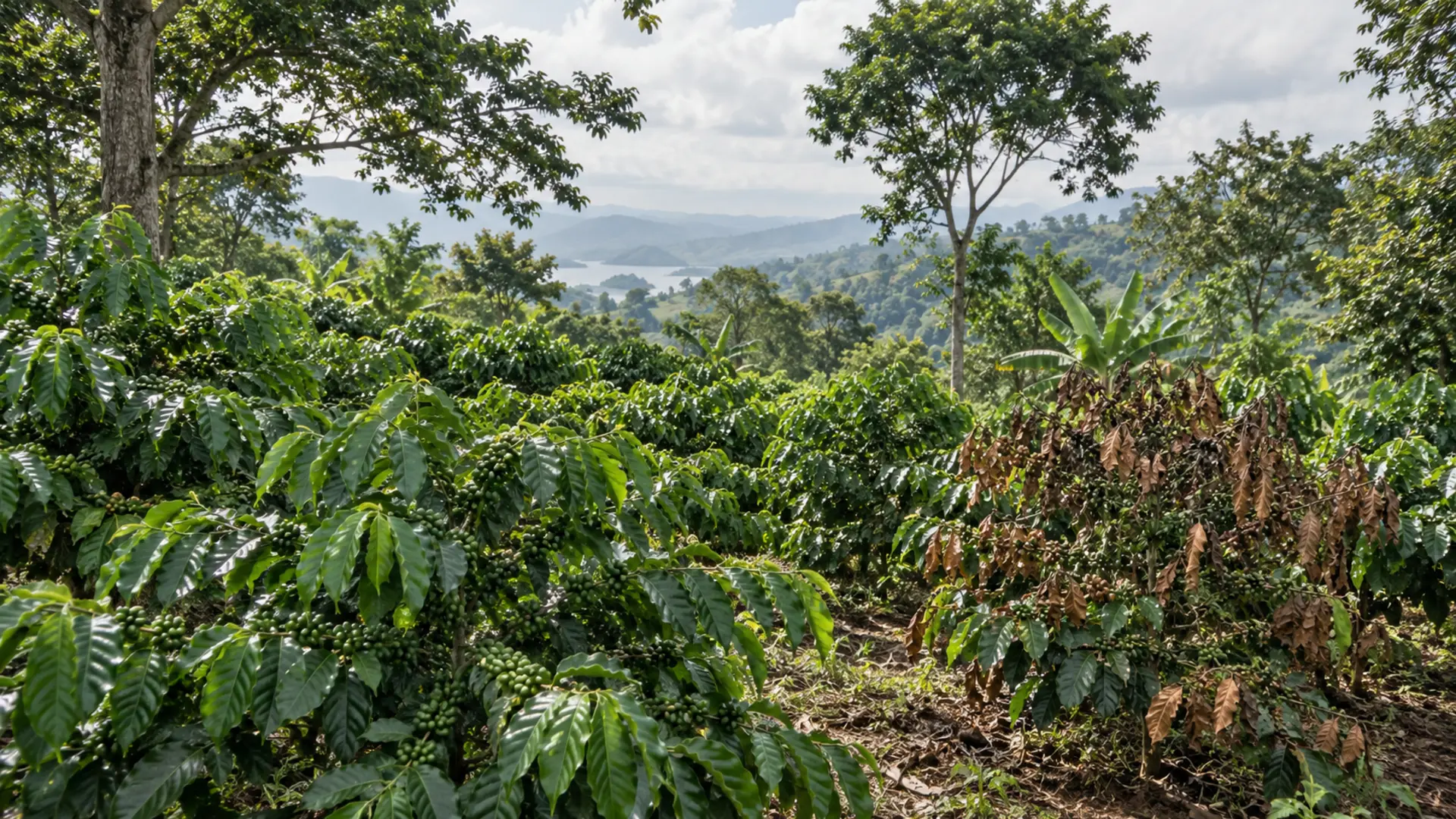
A coffee farmer walking a garden and finding wilting has to answer one question quickly: is this a tree to uproot, a twig to cut, or something to leave alone?
Getting that wrong is expensive in both directions. Uprooting healthy trees destroys productive capacity. Leaving an infected one standing spreads a disease that, in Uganda’s own epidemic, is recorded as having destroyed nearly half the national robusta crop.
This guide gives you a triage decision, the tool hygiene evidence, a mapping method, and an honest account of the four points on which credible sources disagree.
It covers the two problems that most often produce wilting in Ugandan robusta. It does not cover harvesting and quality, which is in coffee harvesting, drying and quality control, and it names no pesticide, because for the insect problem the evidence says chemical control does not reach the target anyway.
What happened in Uganda, and why it still matters
Coffee wilt disease, also called tracheomycosis, caused by the fungus Fusarium xylarioides, reached Uganda in the 1990s.
A plant pathology factsheet records the course of it. “By the early 1990s, it had spread into eastern regions of neighbouring Uganda and was endemic by the latter half of the decade.” The scale: “Nearly half of Uganda’s Robusta crop was destroyed, with losses of over US$100 million; around half of Uganda’s smallholder farms were badly affected.” And the survey finding: “Uganda was particularly badly affected, with CWD present in 90% of the farms surveyed and 45% of coffee bushes infected per farm.”
At farm level, the same source records one case in which “By 1999, the yield from the coffee farm had reduced from 1000 kg to 400 kg, a 60% decline in income.”
Which coffee is at risk. This matters for triage. The factsheet states that “Two distinct host-specific strains exist, one restricted to Arabica in Ethiopia and the other infecting Robusta in Uganda,” and that “The Robusta strain causes a more serious disease than the Arabica strain.” A Ugandan study from Makerere University and the coffee research institute states the position for this country directly: tracheomycosis “is currently attacking only robusta coffee.”
So an arabica grower in a Ugandan highland district is in a different position from a robusta grower, and a wilting arabica tree is not, on the Ugandan evidence, this disease.
Where incidence stands more recently. A multi-region Ugandan survey published in 2024 found that “Overall, 3.9% of the sampled coffee trees were infected by Coffee Wilt Disease (CWD), with the highest incidence (8.2%) recorded in Southwestern Uganda.”
That is a very different figure from the epidemic-era 45 per cent, and the improvement is real. It is also not zero, and the disease has not gone.
The triage decision
With the background established, this is the working part of the guide. Take it into the garden rather than reading it at a table, because every question on it is answered by looking at something.
Coffee Wilt and Black Twig Borer in Uganda: Triage, Tool Hygiene and Mapping Your Garden
A decision flowchart routing an affected coffee tree to one of three outcomes: remove and destroy, prune and monitor, or leave and record, based on observable signs.
The flowchart routes a wilting tree or branch to one of three outcomes. The order of the questions is what makes it work.
Question one: the whole tree, or individual twigs? This is the single most informative observation, and it is available from three metres away. A whole tree in decline points one way. Individual twigs wilting on an otherwise healthy tree points the other.
Question two, for individual twigs: is there an entry hole, and does the wilting stop at a point? Black twig borer damage is localised. The insect enters, tunnels, and the material beyond the point of entry dies while the rest of the branch lives.
Question three, for a whole tree: what is under the bark? This is the check that separates coffee wilt from other whole-tree problems, and it is the one most farmers never do. Remove bark carefully at the collar of the affected stem and look at the wood beneath.
Here the sources describe what you will see differently, and you should know that before you look. The plant pathology factsheet states that the disease “produces a characteristic blue-black staining underneath the bark.” The Ugandan study states that “When the bark is removed from the collar of the affected stem, a brown to violet streak is observed in the wood,” while the same study’s field observations also recorded blue-black coloration.
Blue-black, or brown to violet. Both descriptions come from credible sources. What they agree on is that there is a distinct discolouration in the wood that is not normally there. Treat that as the finding, and treat the specific colour as variable.
Question four: is there a physical explanation? Waterlogging, drought stress and mechanical damage at the base all kill coffee trees and none of them requires uprooting the neighbours. The above-ground picture of coffee wilt, as described in the factsheet, is that “Leaves dry up, plants are defoliated and branches die back” with “Cracks develop and trunks swell,” and that “Plants are killed and die between three and fifteen months after the first appearance of symptoms.”
An honest limitation. We searched for a single source that distinguishes coffee wilt from every other Ugandan coffee problem in one diagnostic comparison, and found none. This triage narrows the possibilities. It does not confirm a diagnosis, and a garden with an unexplained pattern of losses warrants a qualified inspection rather than a decision made from an article.
Removal, and the radius question
Where the triage says remove, the documented method is specific.
The CFC and CABI regional coffee wilt programme report describes it: “the infected coffee bushes are uprooted by digging out as much of the root system as possible and then burning them on the spot.” The plant pathology factsheet states that “Uprooting and burning is the most effective eradication strategy for CWD.”
Two details in that sentence carry the weight.
As much of the root system as possible. Cutting a tree off at ground level leaves the root system in the soil, which is not removal.
On the spot. The factsheet notes that “The physical moving of infected plants by people hastens the spread,” and the Ugandan study lists among the dispersal routes “transportation of infected plants as fire wood.” Carrying an infected tree home for firewood is a documented spread mechanism. Burn it where it stood.
The radius question. This is where a farmer has to make a judgement the sources cannot make for them. The factsheet describes “getting farmers to remove and burn infected trees and healthy nearby plants within a 10m radius.” The programme report says the same and is candid about the difficulty: “trees up to 10 m away should be uprooted” but this “could be too much for many farmers to accept,” while “if infection is at an early stage… it would be advisable to eradicate all trees in a 10 m radius.”
A ten metre radius is a substantial area of a smallholder garden. The source itself records that many farmers will not do it. What it does not do, and what we will not do either, is pretend the smaller intervention is equivalent. A farmer removing only the visibly affected tree is making a defensible economic choice and accepting a higher risk, and should know that is the trade being made.
The other dispersal routes to close. The Ugandan study lists dispersal by “coffee husk mulches,” “infected unhulled dry cherries (Kiboko)” and “infected transplants.” Each of those is a routine farm operation that can move the pathogen. The factsheet adds a fourth: “Removing weeds with a machete can inadvertently wound stems and provide an entry point for the fungus.”
The same Ugandan study also reported that “F. xylarioides was present in roots of Musa sp. (the beer type banana)” in some districts, which is a documented reservoir finding worth knowing on a farm where coffee and banana grow together.
Tool hygiene, and the finding that changes the standard advice
A farmer who removes an infected tree correctly and then prunes the next one with the same blade has moved the problem rather than solved it. What follows sets the published coffee advice against the only rigorously tested Ugandan work we could find.
Coffee Wilt and Black Twig Borer in Uganda: Triage, Tool Hygiene and Mapping Your Garden
A panel of the documented tool sanitation methods with what each source states, what was actually tested, and the one finding that changes standard practice.
Tools are a documented spread route, and the guidance on treating them turns out to be less settled than it looks.
What the coffee sources say. The programme report instructs that “Any knife used to examine the bark should immediately be sterilized,” that “Frequent disinfection of cutting blades should reduce the chance of transmission,” and that “implements should be flamed over fire before cutting each stem or after cutting a few stems.” The Ugandan research study describes surface sterilising tools with alcohol before moving to the next tree, though that was a laboratory sampling protocol rather than a farm recommendation.
Notice what is missing from all of those: a duration. Flame the implement, for how long?
What has actually been tested. No study testing disinfectant type and contact time against the coffee wilt pathogen was found in any source we could open. The best-evidenced Ugandan tool sanitation work we located concerns a different pathogen entirely: the bacterium causing banana Xanthomonas wilt.
That study found three things worth a Ugandan coffee farmer’s attention.
First, that “no Xanthomonas vasicola pv. musacearum… was recovered from tools washed with cold water and different laundry soaps or detergents” comparably to a standard bleach solution. Cold water and ordinary soap performed comparably to the bleach treatment.
Second, on flaming, that it takes “up to a minute to clear all bacteria” and that “the currently recommended 20-40 second heating could thus be inadequate.”
Third, that boiling water required “at least 40 seconds.”
How to use this honestly. That study concerns a bacterial disease of banana, not a fungal disease of coffee. We are not transferring its conclusions. What it establishes is narrower and still useful: that tool sanitation methods differ substantially in effectiveness by duration, that the durations commonly recommended may be too short, and that soap and water is a tested method rather than a poor substitute for something better.
The practical position for a coffee farmer is therefore this. Treat the tool between trees, every time, using a method you can actually sustain. Do not assume a brief pass through a flame is sufficient, because in the one Ugandan study that measured it, for a different pathogen, it was not. And if you are also managing banana on the same farm, the full approach is in banana bacterial wilt management.
Black twig borer
The second cause of wilting is an insect, and almost nothing about it resembles the disease. Setting the two side by side is the fastest way to see why the responses differ.
Coffee Wilt and Black Twig Borer in Uganda: Triage, Tool Hygiene and Mapping Your Garden
A comparison table setting coffee wilt disease against black twig borer across what is affected, the pattern of symptoms, what is visible on the plant, the speed of decline and the response required.
The second problem is an insect, and it behaves nothing like the disease.
What it is. Xylosandrus compactus is an ambrosia beetle. A peer-reviewed account from Hawaii explains the relationship that defines it: ambrosia beetles are “species that feed exclusively on fungi,” and “The fungus is the sole food source for the beetles.” The insect does not eat the coffee. It bores in, cultivates a fungus, and lives on that.
The mechanism: “Female beetles bore entry holes and excavate tunnels inside branches, which are inoculated with fungus.”
What you see. The Hawaiian source describes that “first leaves of infested branches on coffee plants turn light green within hours of attack. Wilted leaves and bark beyond the affected area turn brown or black after few days.” Ugandan extension material describes it slightly differently: “One week after the initial entry of a female BCTB, the leaves on the infested plant turn dull green, curl inward, and wilt.”
The insect itself. Ugandan extension material gives the dimensions: “The adult females of BCTB are 1.4-1.8 mm long and 0.7-0.8 mm wide, shiny black in color.” Life cycle: “The entire life cycle, from egg to mature adult, takes 28.5 days at 27 degrees Celsius with 50% and 60% relative humidity,” and “Each female hatches between 10 and 30 eggs.”
Under a month from egg to adult, and up to thirty eggs per female. That reproductive rate is why twig removal has to be prompt to be worth doing at all.
A note on precision. The claim frequently made is that the female bores into the node specifically. We could not verify that anatomical detail in any source we opened. The sources describe boring into branches and twigs and forming tunnels. This guide says branches and twigs.
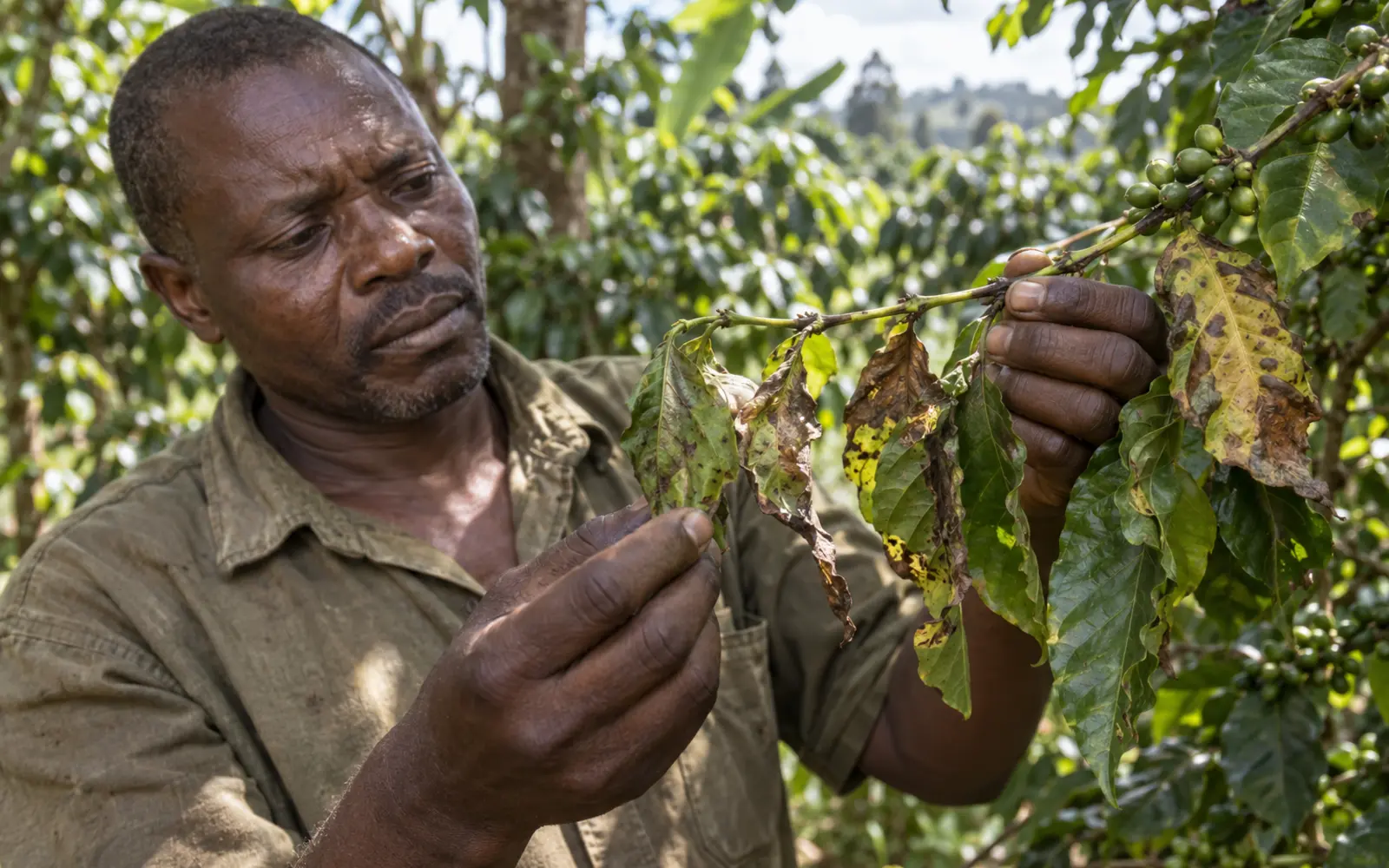
Host range. A Ugandan review reports that the insect infests “more than 224 other plant species in about 62 families worldwide.” That figure is the reason alternate host management appears in every management discussion of this pest, and it is also why eliminating it from a landscape is not a realistic goal.
Ugandan incidence. Two sets of Ugandan survey figures exist and they do not line up. A review citing earlier survey work reports that prevalence, incidence and damage “were 58.1, 34.0 and 3.8% respectively in the central region,” with district level figures in the south west of “Bundibugyo (62.5%), Mityana (50%), Rubirizi (40%) and Kasese (30%).” A separate multi-region survey published in 2024 reports that “On average, 9.4% of the primary branches were infested” with “highest damage levels… recorded in Eastern (17.2%) and Western (12.4%) regions.”
Those are different measurements from different survey years using different methods. They are not comparable and this guide does not combine them. What both establish is that the insect is widespread in Ugandan coffee.
Economic loss. The review reports loss “estimated at 9% of the coffee export volume valued at US$40.1 million annually.” That is a cited secondary figure and we label it as one.
Managing the borer, and the disagreement about it
This is the fourth and most practically consequential disagreement in this article.
Coffee Wilt and Black Twig Borer in Uganda: Triage, Tool Hygiene and Mapping Your Garden
A panel setting out four points on which credible sources disagree, with both positions stated, the source type for each and no resolution offered.
The pruning position. The peer-reviewed Hawaiian account states that “The infested branches should be pruned and destroyed; pruning can be done a few centimeters before the symptomatic area,” and that “Use of chippers or shredders to destroy the pruned branches results in ~90% mortality of the beetles in the stem.” A Ugandan review cites earlier work stating that “Pruning and burning of beetle-infested plant material is essential and effective.”
The counter-position. An agroforestry research organisation working in Uganda with international crop research partners states directly that “Pruning and burning infested twigs is an option, but requires large investments in labour and time that are unaffordable for most smallholder farmers.” Its own finding points elsewhere: “coffee systems with older and taller shade trees have less infestation than younger systems with smaller trees.” It also notes that chemical control is ineffective because “the borer remains unreachable deep within twigs.”
Both positions come from credible institutions and both are about Uganda.
How to use this. The disagreement is not really about whether pruning works. It is about whether a smallholder can afford the labour to do it thoroughly enough to matter. That is a farm-specific question, and a farmer is better placed to answer it than either source.
What follows from taking both seriously is a two-part approach.
Prune selectively rather than comprehensively. Remove the twigs you find while doing work you were doing anyway, and destroy them properly. Do not plan a garden-wide twig removal campaign unless you have the labour, because the evidence says most farms do not.
Manage the structure of the garden. The shade finding is the one that costs labour once rather than continuously. Ugandan extension material points the same way: “Avoid bushiness by planting at 3x3 m spacing and performing adequate desuckering and pruning.” Open canopy structure, adequate spacing and mature shade are documented as associated with lower infestation, and they are managed at establishment and at annual pruning rather than twig by twig.
Watch the alternate hosts. Ugandan extension material names musizi and musambya trees among hosts to avoid near coffee. The Ugandan review reports that removal of alternate hosts was the most effective measure in its own study of robusta.
And know what biological control exists. The Ugandan review cites work identifying “Two ants namely Plagiolepsis sp. and Pheidole megacephala… as potential predators of BCTB.” That is a documented observation of potential, not an established control method, and this guide presents it as such. The general framework for weighing biological control claims is in biological control and biopesticides: evidence and limits.
The whole approach here, scouting regularly and acting on what a threshold of observation tells you rather than on a calendar, is the logic set out in integrated pest management scouting and thresholds.
Replanting, and the interval nobody agrees on
Where a tree has been removed, the next question is when the site can be replanted.
The programme report states it plainly, and states the disagreement within itself: “a fallow period of at least 6 months (Hakiza, personal communication) to 2 years (Wrigley, 1988) before replanting.”
Six months, from a personal communication. Two years, from a 1988 publication. That is a four-fold difference in how long a productive position stands empty, attributed within a single source to two different authorities.
We are not going to average them. What we will say is that a farmer choosing the longer interval is choosing the more cautious course, and one choosing the shorter is accepting more risk in exchange for earlier production. Both are defensible and the choice should be conscious.
What to replant with. The national coffee research institute reports that it “developed and released seven CWD-resistant Robusta coffee varieties” and that “three more Robusta coffee varieties were developed, bringing the total number to ten.” An international variety database confirms one of these, KR-2, as “Resistant to coffee wilt disease (CWD),” “Selected at NaCORI-Uganda after passing a rigorous screening for coffee wilt disease (CWD) resistance,” with a stated yield of “2600 kg/ha.”
A limitation. We could not find a release year for these varieties in any source we opened. And resistant is not immune. A resistant variety changes the risk on a site with a history; it does not remove the reason for the tool hygiene and removal discipline described above.
The general discipline for verifying what you are actually buying when you order planting material applies here with full force, and is in verifying seed and planting material quality.
Mapping the garden
A coffee garden of several hundred near-identical trees defeats memory within a season. The sheet below is deliberately blank, including its legend.
Coffee Wilt and Black Twig Borer in Uganda: Triage, Tool Hygiene and Mapping Your Garden
A blank garden mapping sheet with a plain grid for plotting tree positions, a legend of four blank symbol definitions and a recording table for dates and actions.
Everything above depends on knowing where things are happening, and a coffee garden is too large and too uniform to hold in memory.
The mapping sheet is deliberately blank, including the legend. Define your own marks, because a farmer who invents their own symbols uses them and a farmer handed a key does not.
Three reasons the map earns its keep.
Pattern distinguishes causes. Scattered single trees across a garden and a spreading cluster in one corner suggest different things. Neither is visible from a single walk; both are visible on a map built over three inspections.
Removed trees stay on the record. A site where an infected tree was uprooted is a site with a replanting interval attached to it. Without a map, that position is forgotten within a season and replanted by accident.
The tool column is the discipline. Recording that the tool was treated, every time, on the same sheet as the observation, is what turns an intention into a practice.
A final note on where this fits. A coffee garden is one part of a farm, and the movement of tools, material and people between its parts is the thing that spreads problems. The whole-farm version of that thinking is in whole farm biosecurity.
The short version
Whole tree or individual twigs. That observation drives everything.
For a whole tree, check under the bark at the collar. A distinct discolouration in the wood is the finding, whatever colour the source called it.
Uproot with as much root as possible and burn on the spot. Do not carry it home. Decide consciously about the ten metre radius, knowing what you are trading.
For a twig, cut a few centimetres beyond the symptoms and destroy it.
Treat the tool between trees, every time, and do not assume a quick pass through a flame is enough.
Manage the garden structure rather than chasing every twig, because the labour evidence says most farms cannot sustain the chasing.
Map it, because the pattern is the diagnosis and no one remembers a garden accurately.
Author: Falcon Foundation Ltd Editorial Team
The Falcon Foundation Ltd Editorial Team produces evidence-based agricultural guidance for Ugandan farmers, drawing on published research and institutional sources and translating them into practical decision support. Where evidence is unavailable or contested, we say so rather than filling the gap.