
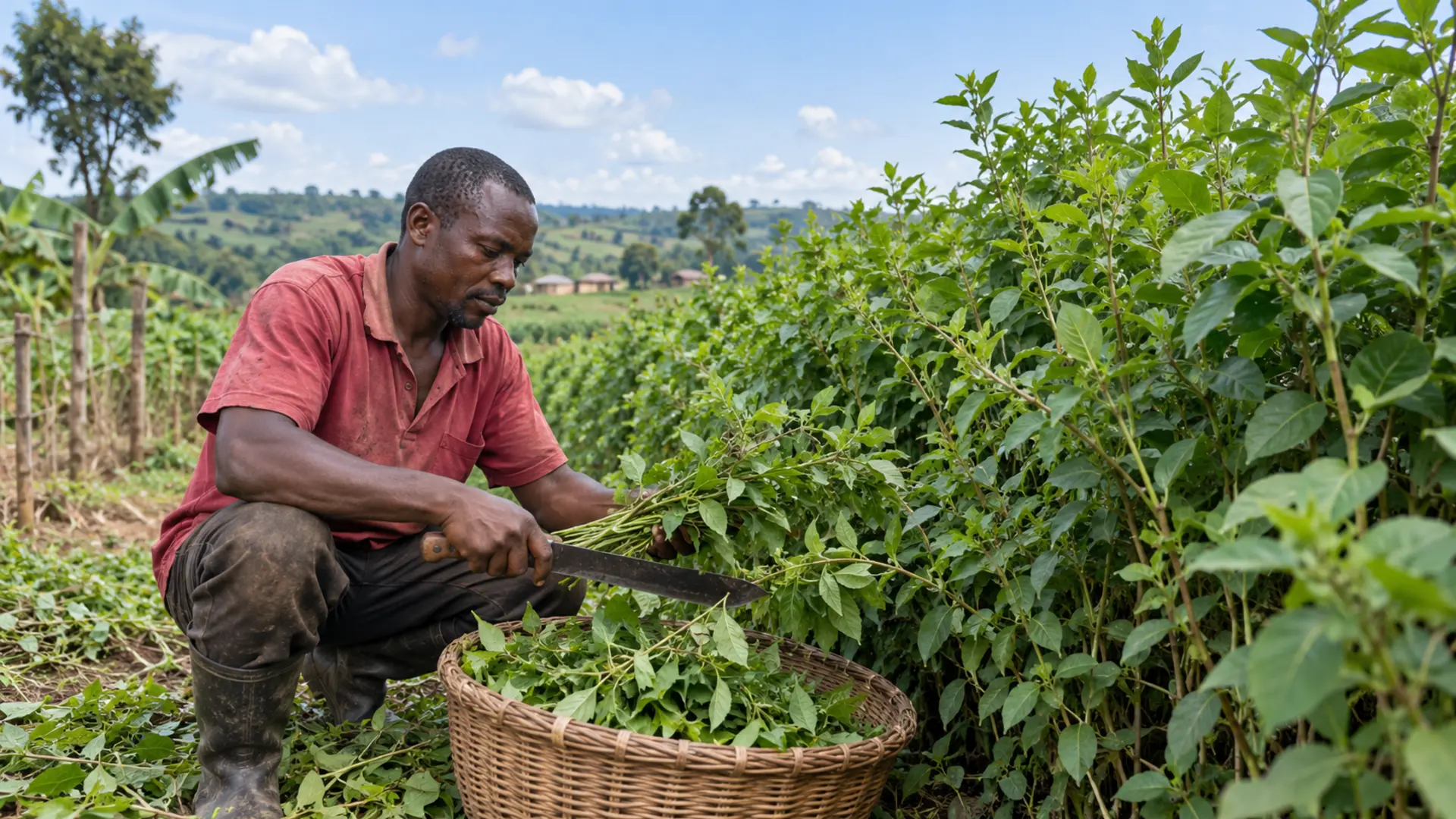
Protein is the expensive part of a Ugandan livestock ration. It is also the part that a farm can grow standing in the ground, cut with a knife, and carry to the animal without buying anything.
That is the case for fodder trees, and it is a strong one. What follows is the practical detail behind it: which species, how to establish each, how long before the first cut, how often to cut after that, and, most importantly, what each one cannot safely be fed at.
One species in this guide carries a documented toxicity ceiling that differs by animal type. Two published sources disagree about the tannin content of another by roughly a factor of three. And no controlled Ugandan feeding trial exists for any of the four.
None of that is a reason to avoid fodder trees. It is a reason to plant them with the limits in front of you.
This article deals with woody species only. Fodder grasses are a separate subject and are covered in fodder grasses and their nutrient demands. The wider planning of feed supply across a year sits in year-round fodder planning for goats and cattle, and the question of what you already have on the farm before planting anything new is dealt with in the farm feed resource inventory.
The species table
Four species carry almost all of the documented evidence that a Ugandan farmer can act on. Before the detail, here they are against each other on the things that decide which one belongs on a particular farm.
Fodder Trees and Shrubs for Ugandan Farms: Species, Establishment and the Feeding Limits That Matter
A four-species comparison table covering establishment method, time to first harvest, cutting height and interval, animals suited, documented protein figure and documented feeding limitation.
Four species carry most of the documented evidence relevant to a Ugandan farm. The table above sets them against each other. What follows fills in the detail, species by species, with the source figures stated as the sources state them.
Read the final column first. On a farm with cattle, sheep and goats sharing one feed store, the species with the tightest ceiling determines what can safely be grown.
Calliandra
Calliandra calothyrsus is the species most often promoted to East African smallholders, and it has the most useful establishment detail behind it.
Spacing. The World Agroforestry species database states that for fodder production “spacing can be dense: 0.5 x 0.5 m to 0.75 x 0.75 m.” That is much closer than most farmers plant it, and the density is the point: this is a cut-and-carry crop, not a tree.
Seed treatment. The same source describes preparing setts and instructs to “soak in cold water for 24 hours.” This is a step people skip and then wonder why germination was poor.
Cutting height. The database states that “Highest yields obtained from coppicing when cut at 1 m.” One metre is the documented figure. Cutting lower gives less regrowth; cutting higher wastes material into stem.
Protein. Here the two sources are close. World Agroforestry states “Protein content is 22% (dry matter).” Feedipedia gives crude protein at “about 20% of DM, up to 28%.”
Tannins, where the sources part company. World Agroforestry reports “condensed tannins (up to 11%).” Feedipedia reports a far wider picture, describing tannin content ranging from “less than 1%” to “20-30%,” with values “up to 38%” reported in Colombia.
We are not going to reconcile those. They are two credible international databases reporting different bodies of analysis, and the honest reading is that condensed tannin content in Calliandra varies enormously with provenance, age and processing. What that means practically is that a farmer cannot assume the material they plant matches the figure in any published table.
Condensed tannins are not simply a problem. At moderate levels they protect dietary protein from breakdown in the rumen. At high levels they depress intake and digestibility. Because the published range spans both situations, the sensible approach is to introduce Calliandra gradually and watch intake, rather than to assume a particular tannin level and feed accordingly.
Leucaena, and the ceiling that comes with it
Leucaena leucocephala is the highest-yielding species in this guide and the one that requires the most care.
Fodder Trees and Shrubs for Ugandan Farms: Species, Establishment and the Feeding Limits That Matter
A safety panel setting out the documented mimosine content of leucaena, the documented maximum dietary proportion for cattle, the different documented tolerances for sheep and goats, the symptoms and the documented mitigation approaches.
Establishment. The Tropical Forages database states that “Seed must be scarified,” and names rhizobium inoculant strains used for it. Unscarified Leucaena seed germinates badly and unevenly.
Layout and yield. The same source distinguishes two systems. For hedgerows, “rows 4-9 m apart at seeding rates of 1.5-3.0 kg/ha.” For high-density fodder production, plants “0.5-1.0 m apart in rows 1-3 m apart,” with reported yields exceeding “15 t/ha/year.”
Cutting. The database gives cutting at “6-12 week intervals.”
Protein. Feedipedia reports crude protein at “23.3% DM.”
Now the part that governs everything else.
Leucaena contains mimosine. Feedipedia states that the species “contains large amounts of mimosine (up to 12% DM in young shoots).” The same source describes mimosine as detrimental to non-ruminants, naming horses, donkeys and poultry among them.
In ruminants, the position is different but not simple. Mimosine is broken down in the rumen to a compound described as a goitrogen, a substance that interferes with thyroid function. Feedipedia states that mimosine “causes Leucaena to be toxic to cattle if fed in large amounts (more than 30% of the diet)” over long periods, with the reported effects being “low feed intake” and reduced “live-weight gain and reproductive performance.”
The documented clinical signs are stated as “alopecia, excessive salivation and enlarged thyroid glands.” In plainer terms: hair loss, drooling, and visible swelling at the throat.
The tolerances differ by species, and this is where a mixed-livestock Ugandan farm has to pay attention. For sheep, the source describes supplementation at “25-50% of dried leucaena leaves,” with larger amounts acceptable during feed scarcity. For goats, it states that “Between 50 and 75% of leucaena foliage can be included in a grass-based diet.”
So the same tree that is limited to under a third of a cattle diet is documented as tolerable at half to three-quarters of a goat diet. A farmer who reads only the goat figure and applies it to cattle is heading for a problem, and that is precisely why this guide gives the three figures together rather than a single average.
Three mitigation approaches appear in the source. One is the transfer of rumen bacteria, specifically Synergistes jonesii, from adapted cattle, sheep or goats to unadapted ones. One is supplementation with zinc sulphate or iron salts. One is reducing mimosine content by soaking in water and drying.
This guide states that those approaches exist and does not give any procedure, rate or dose for any of them, because none of them is something a farmer should attempt from an article. If you intend to feed Leucaena as a major component of a cattle diet, that is a conversation to have with a qualified veterinary or animal nutrition adviser before you plant, not after.
The general question of toxic and problem plants on Ugandan farms is covered separately in poisonous and problem plants for Ugandan livestock. This section deals only with the ceiling that applies to a species you would plant deliberately.
Gliricidia
Gliricidia sepium is the easiest of the four to establish, because it grows readily from large cuttings.
Protein. Feedipedia reports crude protein at “about 225 g/kg DM in fresh leaves,” which is roughly 22.5 per cent.
Time to first harvest. This is the figure that matters most for planning, and the source distinguishes two cases: first harvest “6-8 months after establishment from cuttings and 12-16 months after planting seedlings.”
Read that difference carefully. Establishing from cuttings halves the wait. On a farm that needs standing protein by the next dry season, that is the whole decision.
Cutting height. Feedipedia gives a cutting height of between “0.5 and 2 m.” The World Agroforestry database gives “Pruning at 0.3-1.5 m.” Those two ranges overlap but are not identical, and we report both rather than picking one.
Acceptance. The source notes something practical that farmers encounter and then assume is a fault in their animals: “Animals unfamiliar” with the species “may initially refuse the fresh foliage.” Refusal on first offering is documented behaviour, not evidence the material is bad. Introduce it alongside familiar feed.
Goat inclusion. The source gives a documented figure for goats of “30-40% of forage DM.”
Variability. Feedipedia notes that “coumarin can vary strongly between genotypes.” That is another reason the material you actually plant may not behave like a published average.
What we could not find. We searched for a documented hedgerow spacing figure for Gliricidia and did not find one in any source we could open. This guide therefore gives no Gliricidia spacing figure. That is a gap, it is reported as a gap, and a farmer should take spacing advice for this species from a local forage specialist rather than from a number in an article that has not been verified.
Fodder Trees and Shrubs for Ugandan Farms: Species, Establishment and the Feeding Limits That Matter
Three schematic planting layouts for a fodder bank, a boundary hedge row and a contour hedgerow, each with the documented spacing figures and the source-stated seeding rate where available.
Mulberry, and the one Ugandan data point
Mulberry is the species least often promoted as a fodder tree in Uganda and the one with the only Ugandan measurement we could find.
Protein. Feedipedia reports crude protein at “19.1% DM,” within a range of 11.5 to 26.4 per cent.
Tannins. Reported at “7 g/kg DM,” which is low, and this is the practical contrast with Calliandra. Mulberry is a low-tannin, highly digestible material.
The Ugandan measurement. Feedipedia records work by Kabi and colleagues published in 2008 finding that the rumen degradable protein of white mulberry in steers was high, at 10 to 20 per cent of dry matter, and that optimal nutrient degradability was obtained at cutting intervals of one to two months.
That cutting interval figure is the most directly transferable number in this entire guide for a Ugandan farmer, because it was measured on Ugandan animals. One to two months between cuts.
Spacing. Feedipedia reports around 30,000 plants per hectare under low pruning and 7,000 to 12,000 plants per hectare for medium pruning.
Harvest. The source describes harvesting “after 60-70 days of regrowth at 50 cm above soil.”
Feeding levels. Two trials are reported. Dairy work in Cuba fed mulberry at 0.1 or 0.2 per cent of body weight and reported milk increases of 8.6 per cent and 32.3 per cent respectively. Goat work in Costa Rica found the best result at 1.5 per cent of body weight.
A safety note that is a negative finding. Mulberry contains phytoestrogens, plant compounds that can affect reproduction. The source states that these “do not delay puberty onset in lambs” at dietary levels “up to 60%.” That is a reassuring documented finding at a stated level, and it is reported here as such rather than extended to other animals or higher levels.
What the milk evidence actually shows
Fodder trees are usually sold to farmers on a milk response. It is worth looking at what has actually been measured.
Fodder Trees and Shrubs for Ugandan Farms: Species, Establishment and the Feeding Limits That Matter
A panel setting three pieces of milk response evidence against each other, labelled by study type and country, showing which is a controlled result and which is farmer testimony.
The Kenyan study. Work published in Veterinary Medicine International in 2020 examined 235 cows on 80 farms in Meru County, Kenya. The reported finding was that feeding two kilogrammes of Calliandra or Sesbania, at wet weight, “appeared to have the optimum effect” and was “associated with 50% higher milk production.”
That is the strongest East African evidence in this article. Note its nature: an on-farm observational study, reporting an association across many farms, not a controlled trial with randomised allocation. Farms that feed fodder trees may differ in other ways from farms that do not.
The Tanzanian report. A project report on Calliandra recorded farmer testimony of “4 to 5 litres per cow per day.” We include it and we label it exactly for what it is: testimony recorded in a project report. It is not a trial result and it should not be quoted as one.
The Cuban trials. The mulberry figures above, 8.6 per cent and 32.3 per cent milk increases at two feeding levels, come from controlled work conducted outside Africa.
What is missing. No controlled Ugandan fodder tree feeding trial was identified for any of these species. The Ugandan measurement we did find, Kabi and colleagues in 2008, is a degradability study rather than a production trial.
The practical conclusion follows directly. A Ugandan farmer planting fodder trees should expect a real but uncertain response rather than a specific percentage. The only way to know what it does on your animals is to record milk yield before the change and after it, which is a discipline dealt with in farm record keeping and gross margin analysis.
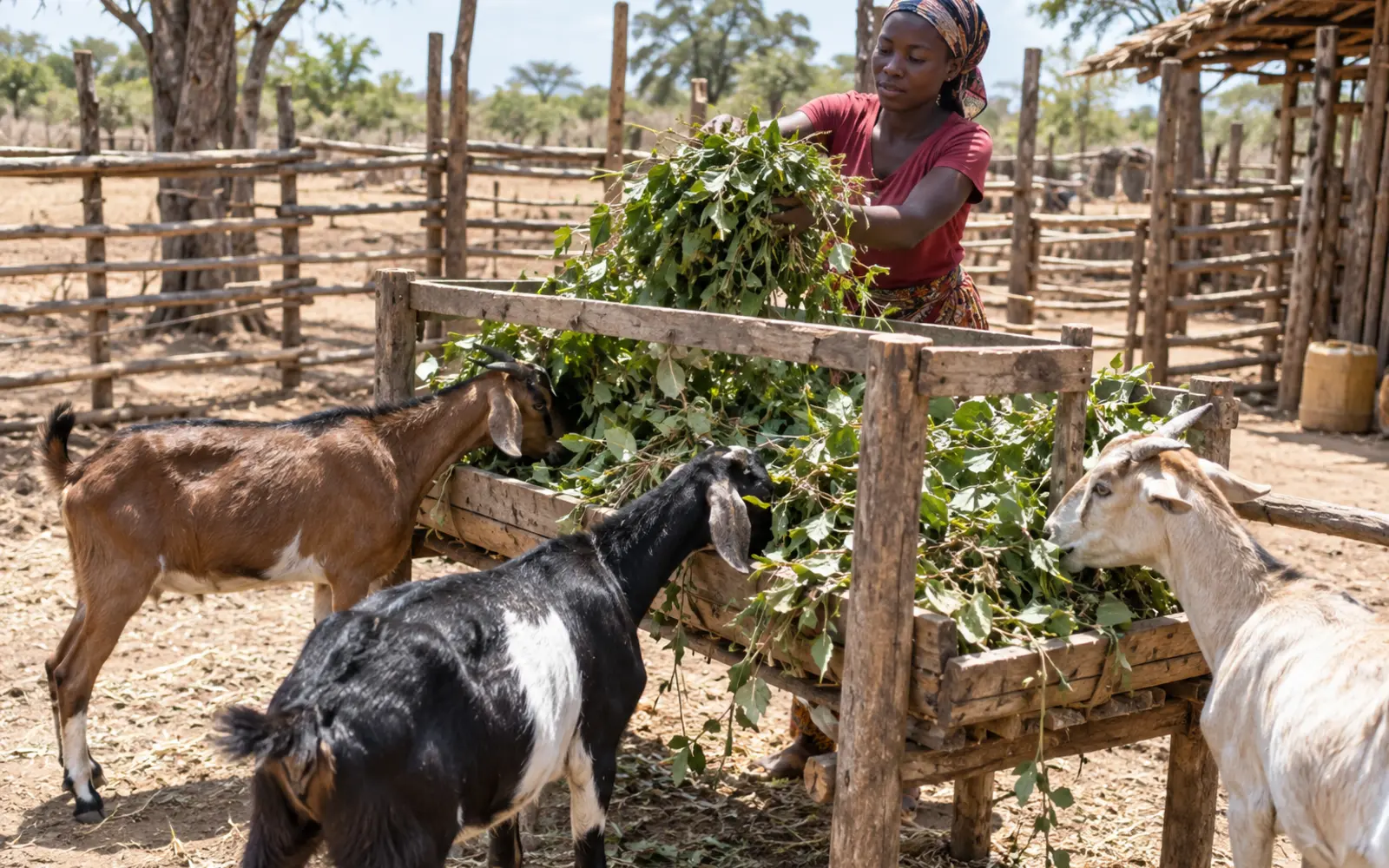
Layout: how the planting is actually arranged
Three arrangements cover almost every Ugandan situation, and the choice between them is about purpose rather than species.
The dense block. A compact area planted at close spacing, existing only to produce cut material. This is the arrangement the close Calliandra spacing figures describe, and the one the high-density Leucaena figures describe. It is a feed store that happens to be alive.
The boundary hedge. A single dense line along an existing boundary. The advantage is that it uses land already given up to a boundary. The disadvantage is that a single line produces far less than the same number of plants in a block, and that boundary plants are the ones most likely to be browsed by somebody else’s animals.
The contour hedgerow. Lines following the contour across a slope, with crops in the alleys between. The Leucaena hedgerow spacing of four to nine metres between rows is the documented figure for this arrangement. It serves two purposes, and the soil conservation purpose is dealt with in agroforestry for soil and water conservation.
Two cautions on layout.
Spacing figures are species-specific. The close Calliandra spacing is documented for Calliandra. Applying it to Leucaena or Gliricidia is not supported by anything in this article.
Protect the establishment. Every species here is palatable, and a young plant that is browsed before it has a root system does not recover. Fencing or siting away from stock during the first year is part of the establishment cost, not an optional extra.
Getting through the first year
The failure mode for fodder trees on Ugandan farms is not that they die. It is that they are cut too early, cut too hard, and never recover their vigour.
Fodder Trees and Shrubs for Ugandan Farms: Species, Establishment and the Feeding Limits That Matter
A blank first-year establishment planner with rows for each month and columns for the task, the species, the area planted, what was observed and what it cost in labour days.
Three rules get a planting through year one.
Do the seed treatment. Leucaena seed is documented as requiring scarification. Calliandra setts are documented as requiring soaking in cold water for 24 hours. These are not refinements. A farmer who skips them and gets patchy establishment usually concludes the species does not work here.
Wait for the documented first harvest. Gliricidia from cuttings is documented at six to eight months; from seedlings, twelve to sixteen. Cutting at four months because the plant looks big enough is how a fodder bank becomes a collection of dead stumps.
Cut at the documented height. One metre for Calliandra, on the evidence of the coppicing yield finding. Within the stated range for Gliricidia. Fifty centimetres above the soil for mulberry. Height is not a detail; it is what determines whether there is enough remaining structure to drive regrowth.
Where to obtain planting material
A 2022 study of the Ugandan forage seed market identifies NARO Holdings, the National Forestry Authority and ROBRAN Holdings among the suppliers handling Calliandra, Leucaena leucocephala, Leucaena trichandra and Gliricidia.
Two honest qualifications on that.
It is a market study, not an endorsement, and this guide names those organisations because the study names them, not because we have assessed the quality of any material they supply. Supplier availability changes.
And the general discipline for verifying planting material before you buy applies here as much as to any crop seed. That is covered in verifying seed and planting material quality.
Managing the cutting after year one
Once a bank is established, the variable a farmer actually controls is the interval between cuts. Everything else, the species and the layout, is fixed at planting.
The documented intervals differ, and they are worth holding side by side. The Tropical Forages reference gives Leucaena at “6-12 week intervals.” The Ugandan mulberry work found optimal nutrient degradability at “cutting intervals of 1 to 2 months,” and separate mulberry guidance describes harvesting after 60 to 70 days of regrowth. Calliandra is described in terms of coppicing height rather than interval.
Two of those figures, six to twelve weeks and one to two months, sit close enough together to give a usable working rule: on most Ugandan farms, a cut roughly every two months is within the documented range for the species that have one. That is a working rule drawn from the published intervals, not a trial result, and it is offered as such.
Three things go wrong in practice.
Cutting on demand rather than on interval. A protein bank gets raided whenever feed runs short elsewhere, which means it is cut hardest exactly when it is growing slowest. The bank has to be on a calendar of its own, and the calendar has to be respected in a dry month.
Cutting the whole bank at once. A block cut entirely on one day produces a flush and then nothing. Dividing the bank into sections and cutting them in rotation converts the same area into a continuous supply, which is the entire purpose of building it.
Letting the plants get away. A bank left uncut for a season becomes woody, and the proportion of the cut material that is actually leaf falls sharply. Stem is not protein. If a bank has been neglected, cutting it back to the documented height is a better use of a day than cutting the tops off.
What a protein bank does not solve
It is worth being clear about the limits of the whole idea, because fodder trees are often presented as a complete answer to feed cost.
They are a protein source, not an energy source. A ration short of energy is not fixed by adding leaf material with a crude protein content of twenty per cent. The distinction matters because the symptom a farmer notices, animals losing condition, can come from either.
They do not replace bulk. Cut browse is a supplement to a basal feed, and the documented inclusion figures in this guide are proportions of a diet that has something else in it. The basal supply is a grass and crop residue question.
They take a year before they give anything. Every species here has a first harvest measured in months, and the shortest is six months from a cutting. A farm facing a feed shortage this dry season is not solved by planting trees now. The bank is next year’s answer.
They do not remove the need to know your own numbers. What a protein bank costs and what it returns is a farm-specific calculation, and the approach to making it is set out in diagnosing what your feed is actually costing you.
The decision, in short
Fodder trees are the cheapest standing protein most Ugandan farms can build, and the evidence that they raise milk production is real if imprecise.
Choose the species by the animals you keep, not by what is promoted locally. A farm with cattle at the centre of it has to respect the documented Leucaena ceiling in a way a goat farm does not.
Establish properly, wait for the documented first harvest, and cut at the documented height. Those three things determine whether you have a protein bank in year three or a row of stumps.
And record what happens to your own animals, because the Ugandan production evidence that would tell you what to expect does not exist. Until it does, your own before-and-after record is the best evidence available to you, and it is better than any figure this guide could have given you.
Author: Falcon Foundation Ltd Editorial Team
The Falcon Foundation Ltd Editorial Team produces evidence-based agricultural guidance for Ugandan farmers, drawing on published research and institutional sources and translating them into practical decision support. Where evidence is unavailable or contested, we say so rather than filling the gap.
